You are here

![Do triangles always exist? with Example - [Class 7 Ganita Prakash] - Do triangles always exist?](https://cdn.teachoo.com/0a675579-275a-482d-84ad-1d4249430d5e/slide85.jpg)
Do triangles always exist?
Last updated at November 7, 2025 by Teachoo
Transcript
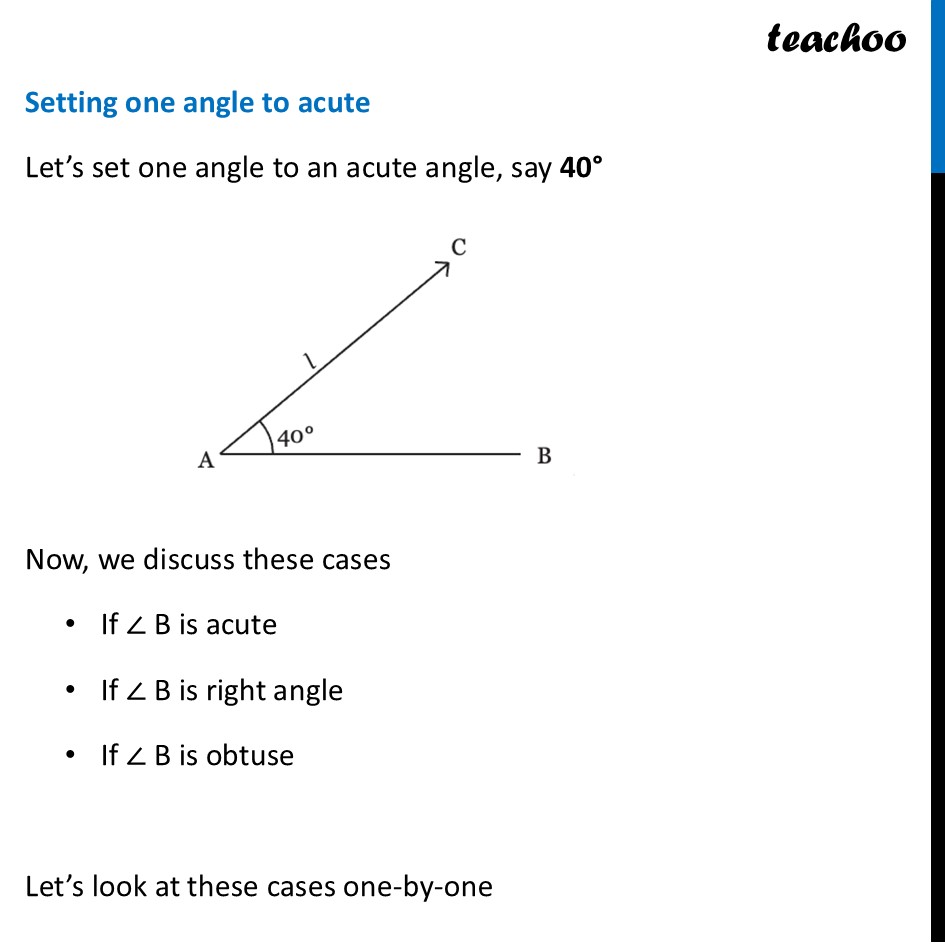
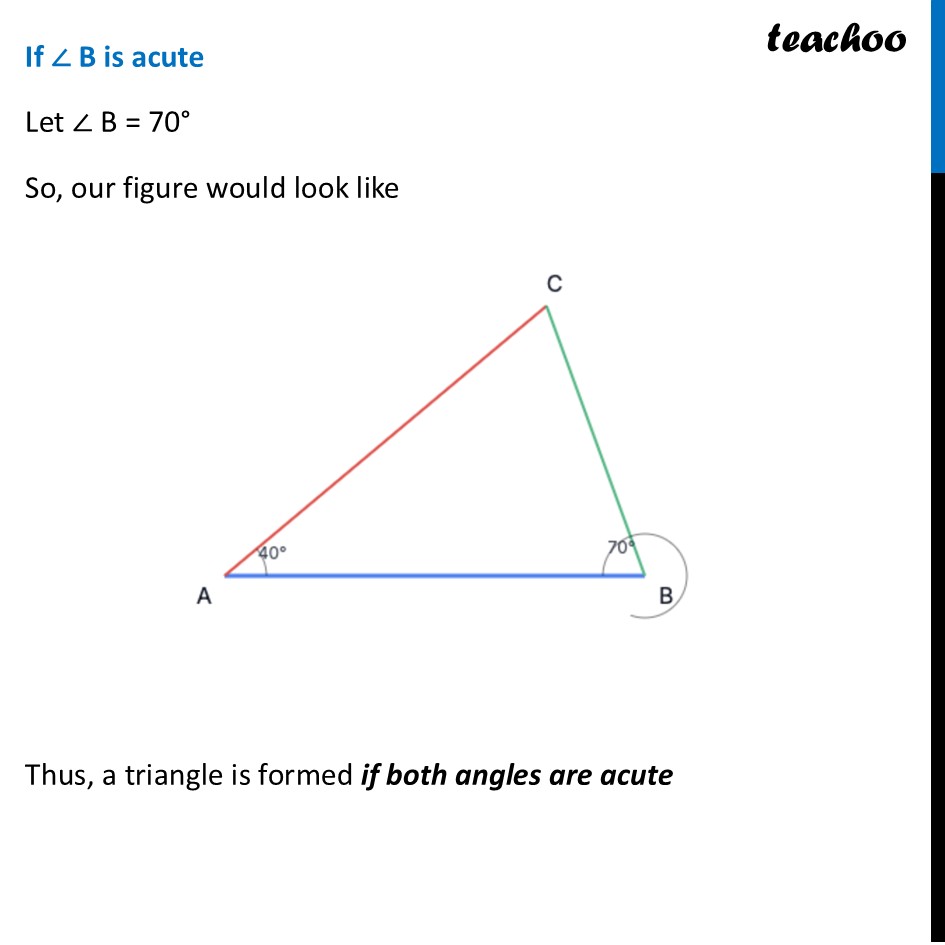
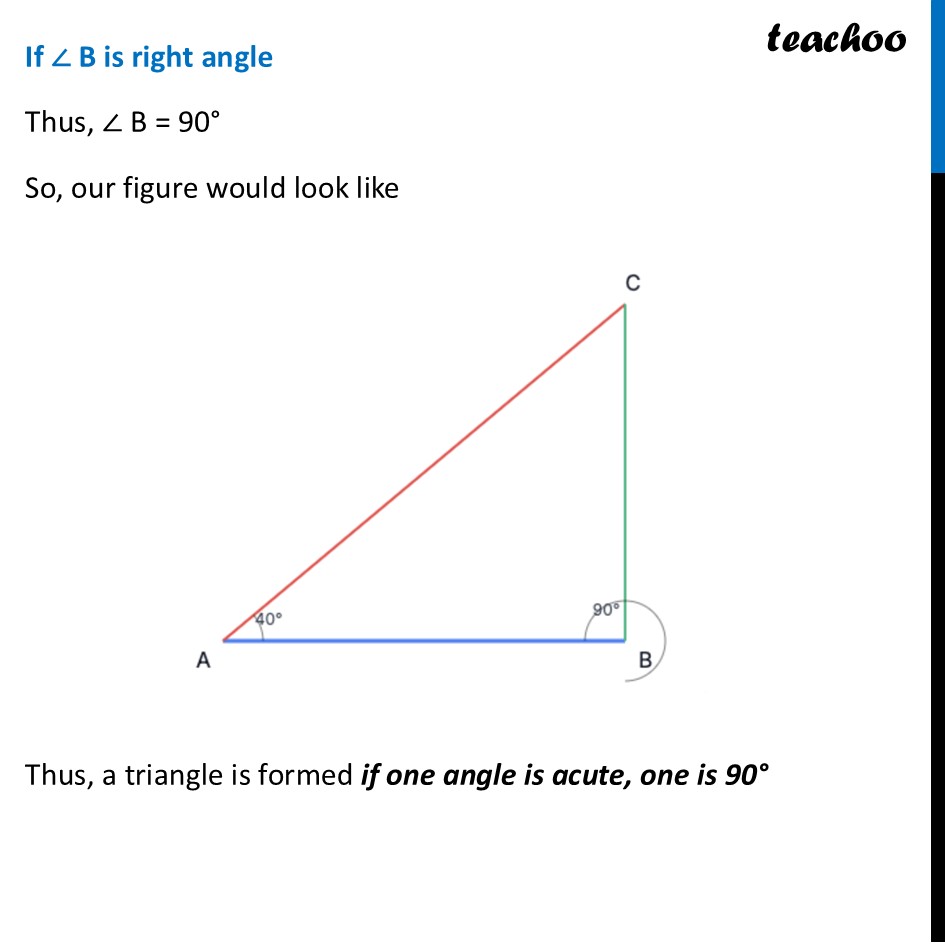
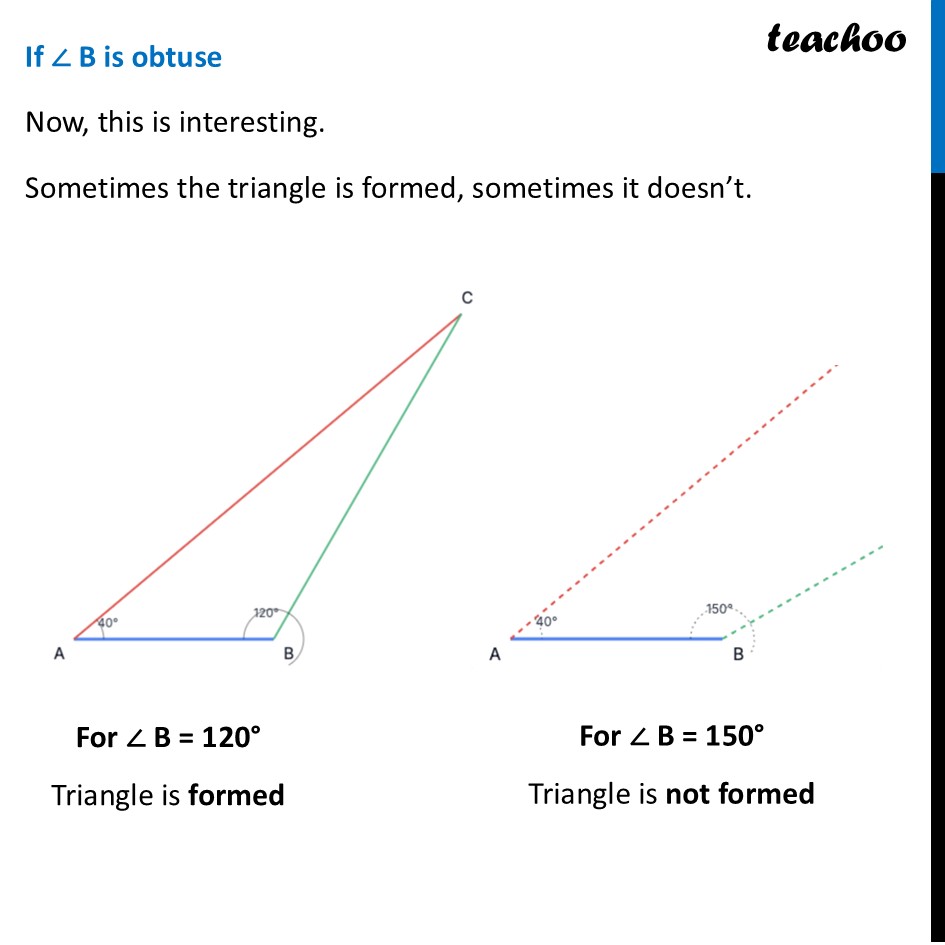
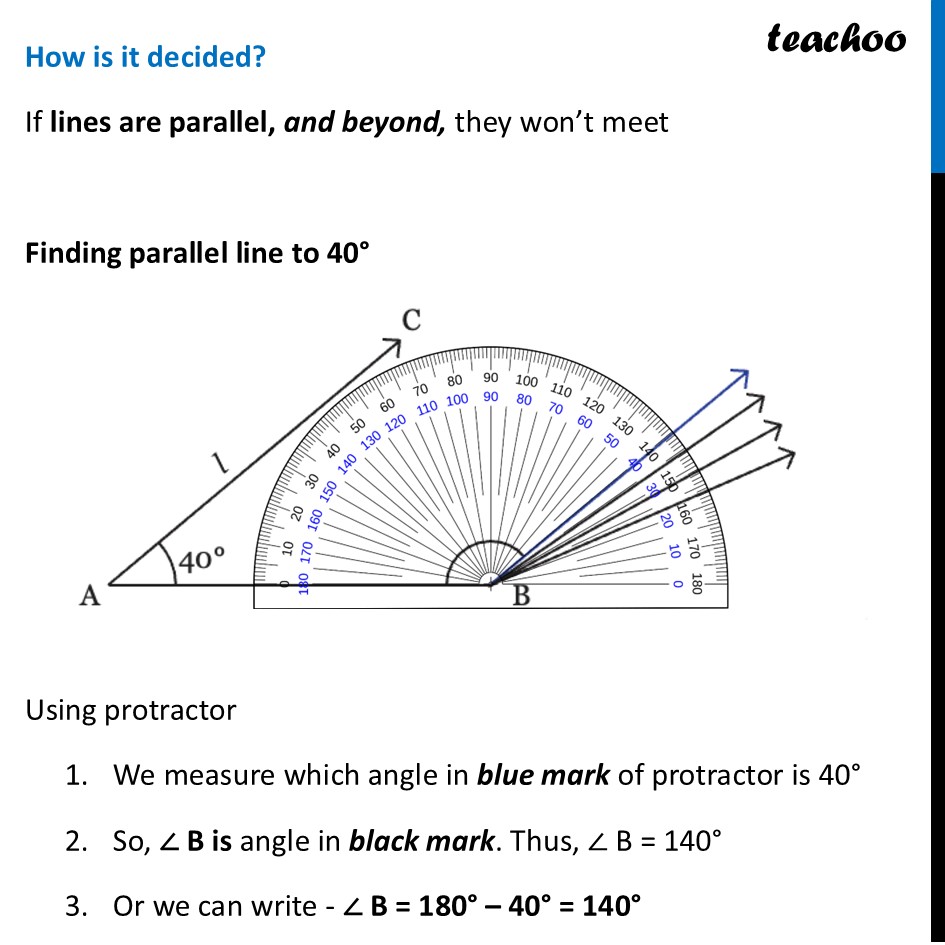
Do triangles always exist?We cannot always form a triangle from two given angles and an included side. The triangle is only formed if the two lines extending from the base angles intersect to create the third vertex. If the two angles are too large, the lines will be parallel or point away from each other, and will never meet. Example: In all these 3 cases, the lines never meet So, triangle is not possible Setting one angle to acute Let’s set one angle to an acute angle, say 40° Now, we discuss these cases If ∠ B is acute If ∠ B is right angle If ∠ B is obtuse Let’s look at these cases one-by-one If ∠ B is acute Let ∠ B = 70° So, our figure would look like Thus, a triangle is formed if both angles are acute If ∠ B is right angle Thus, ∠ B = 90° So, our figure would look like Thus, a triangle is formed if one angle is acute, one is 90° If ∠ B is obtuse Now, this is interesting. Sometimes the triangle is formed, sometimes it doesn’t. For ∠ B = 120° Triangle is formed For ∠ B = 150° Triangle is not formed How is it decided? If lines are parallel, and beyond, they won’t meet Finding parallel line to 40° Using protractor We measure which angle in blue mark of protractor is 40° So, ∠ B is angle in black mark. Thus, ∠ B = 140° Or we can write - ∠ B = 180° – 40° = 140° So, for angles 140° and more - triangle is not formed Thus, we can say that The smallest value for ∠ B where the lines will not meet is 140° The General Rule This example with 40° and 140° (which add up to 180°) reveals the general rule for all triangles: A triangle can be formed if the sum of the two given angles is less than 180° A triangle cannot be formed if the sum of the two given angles is 180° or more We also note that the length of the base (AB) has no effect on whether the triangle can be formed or not