You are here


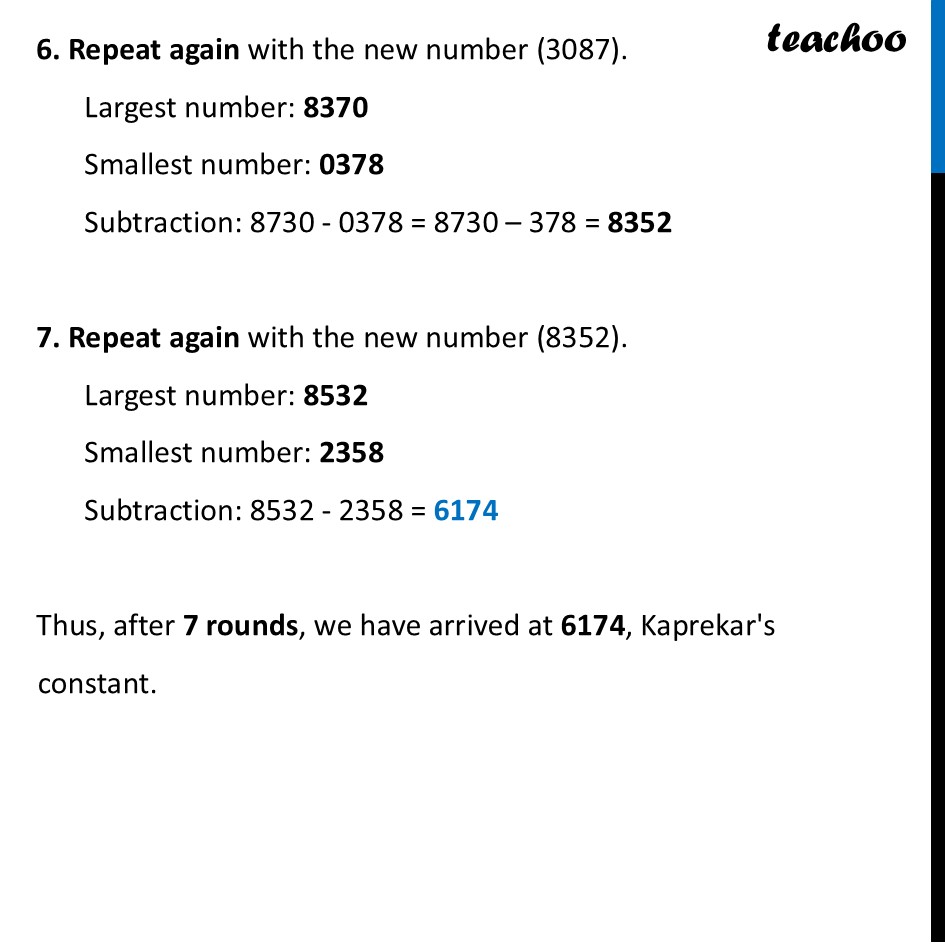
Figure it out - Page 64, 65
Figure it out - Page 64, 65
Last updated at August 14, 2026 by Teachoo
Transcript
Question 4 How many rounds does the number 5683 take to reach the Kaprekar constant? Arrange the digits to create the largest and smallest possible numbers. Largest number (A): 8653 Smallest number (B): 3568 Subtract the smaller number from the larger one. 8653 – 3568 = 5085 2. Repeat the process with the new number (5085). Largest number: 8550 Smallest number: 0558 Subtraction: 8550 – 0558 = 8550 – 558 = 7992 3. Repeat again with the new number (7992). Largest number: 9972 Smallest number: 2799 Subtraction: 9972 - 2799 = 7173 4. Repeat again with the new number (7173). Largest number: 7731 Smallest number: 1377 Subtraction: 7731 - 1377 = 6354 5. Repeat again with the new number (6354). Largest number: 6543 Smallest number: 3456 Subtraction: 6543 - 3456 = 3087 6. Repeat again with the new number (3087). Largest number: 8370 Smallest number: 0378 Subtraction: 8730 - 0378 = 8730 – 378 = 8352 7. Repeat again with the new number (8352). Largest number: 8532 Smallest number: 2358 Subtraction: 8532 - 2358 = 6174 Thus, after 7 rounds, we have arrived at 6174, Kaprekar's constant.