You are here
Last updated at November 5, 2026 by Teachoo
Transcript
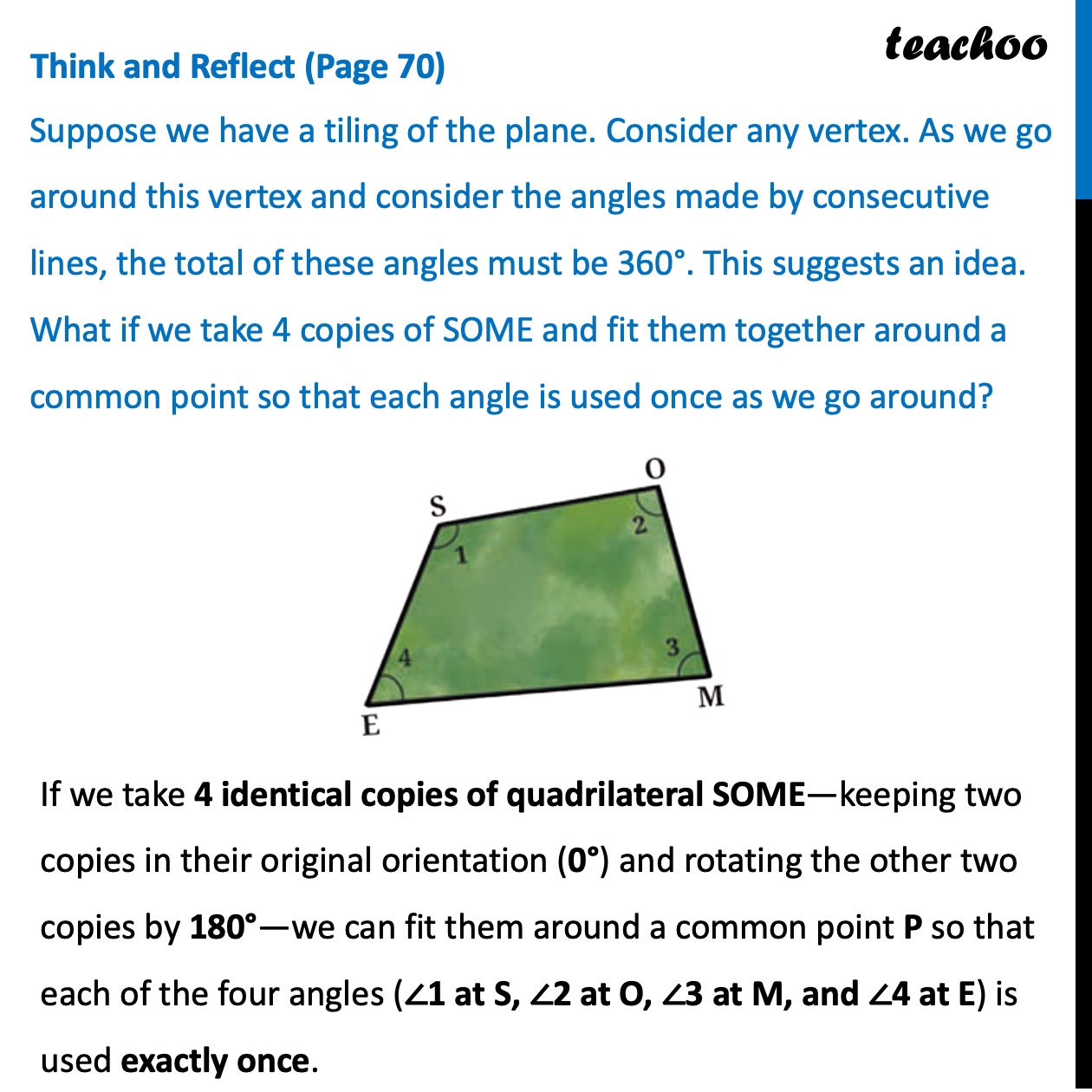
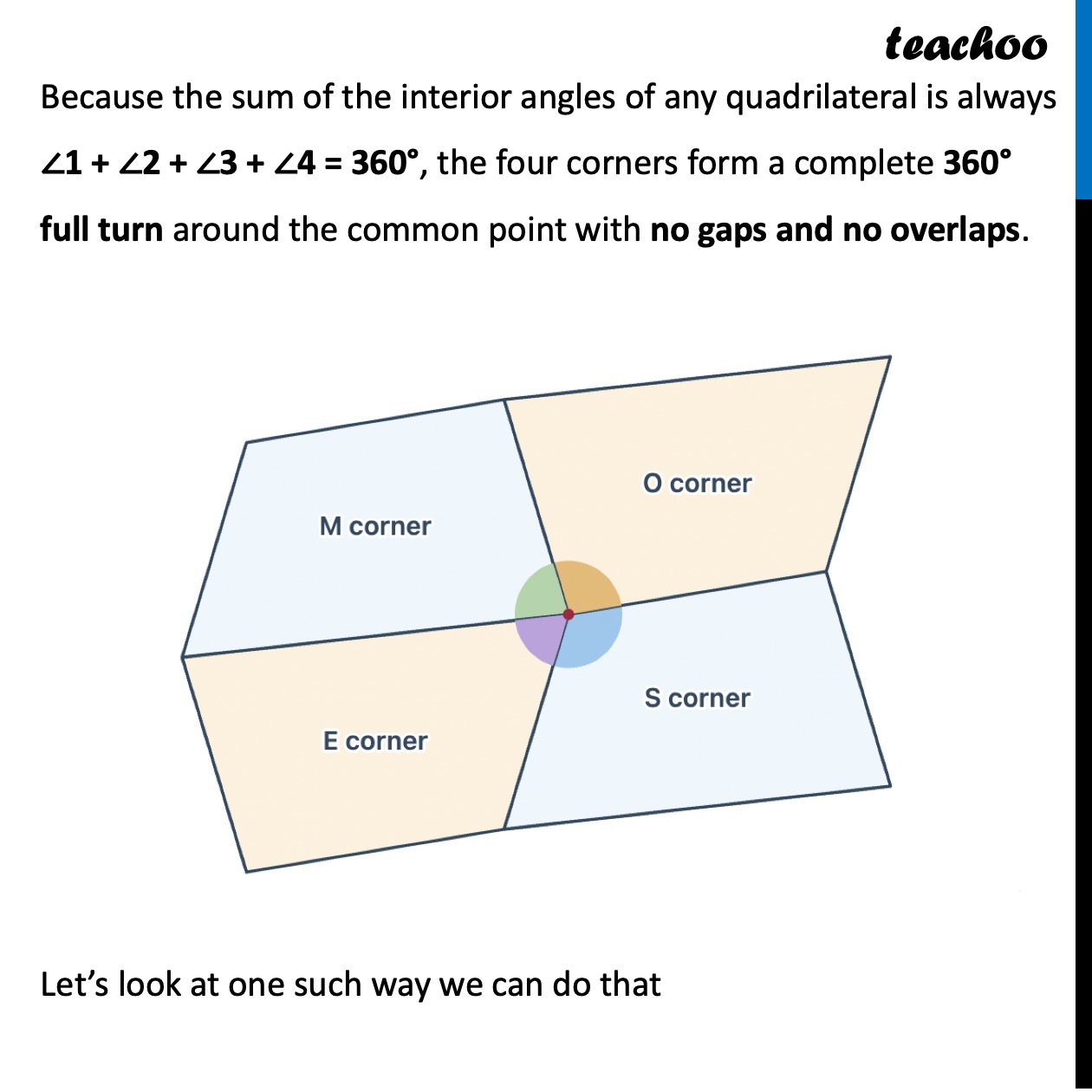
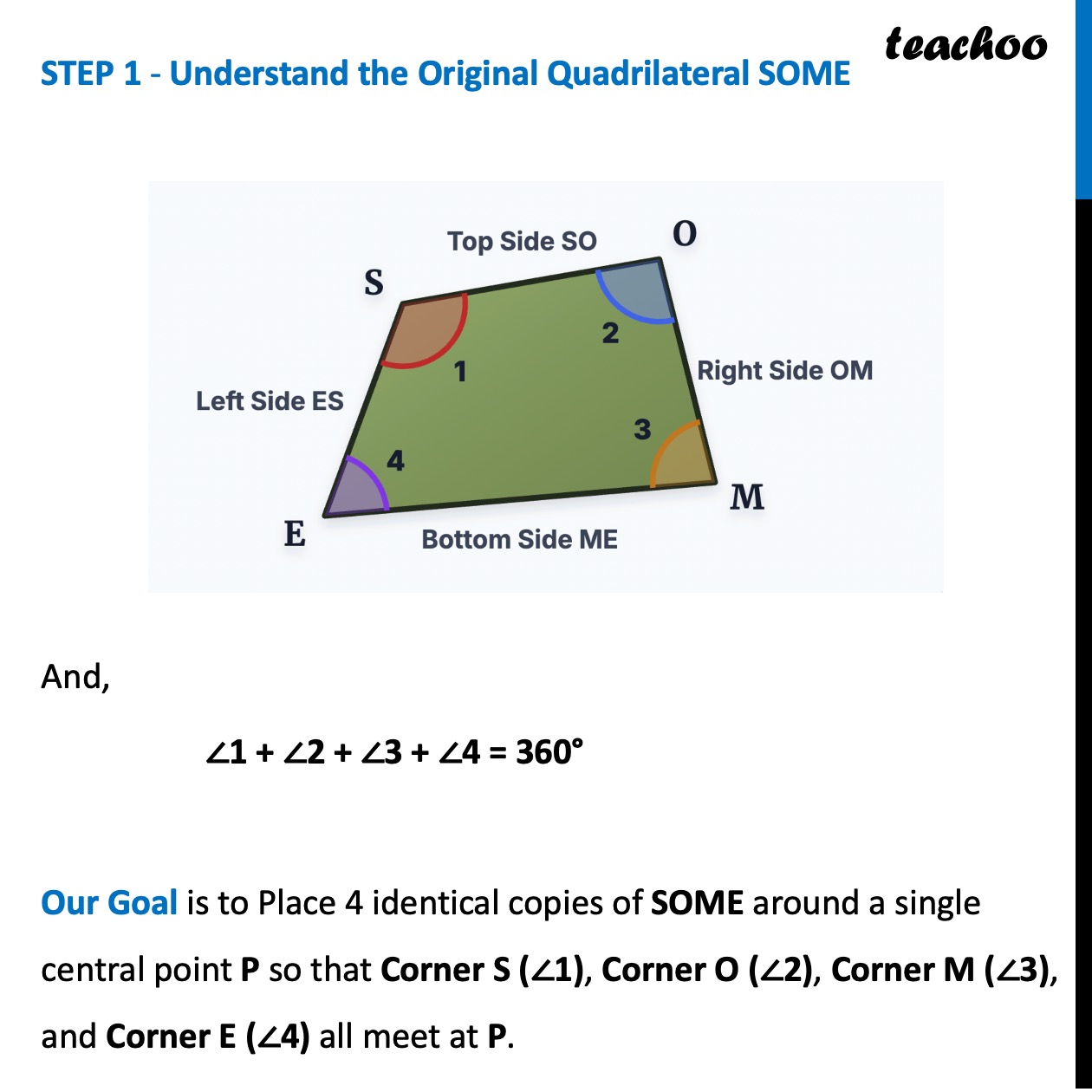
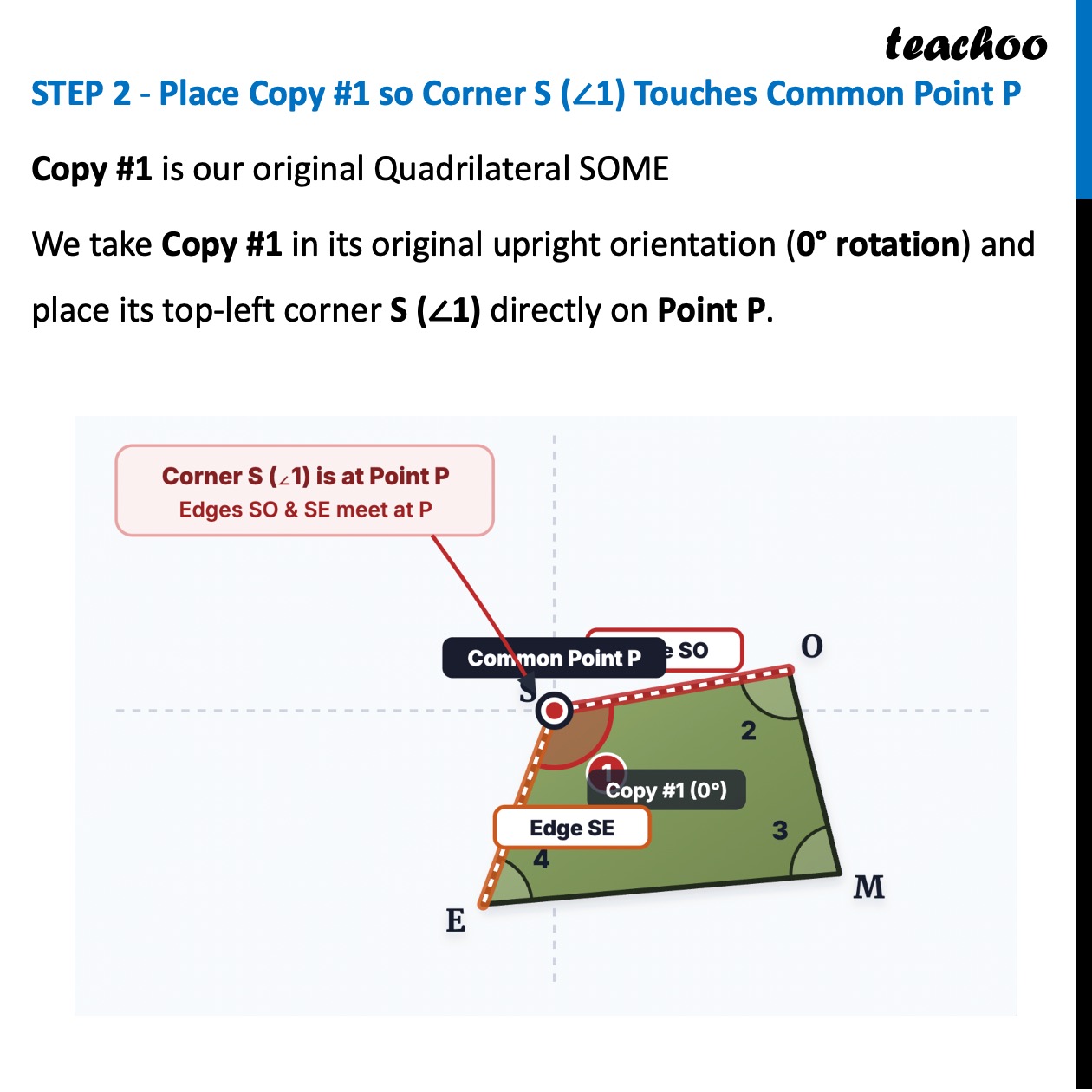
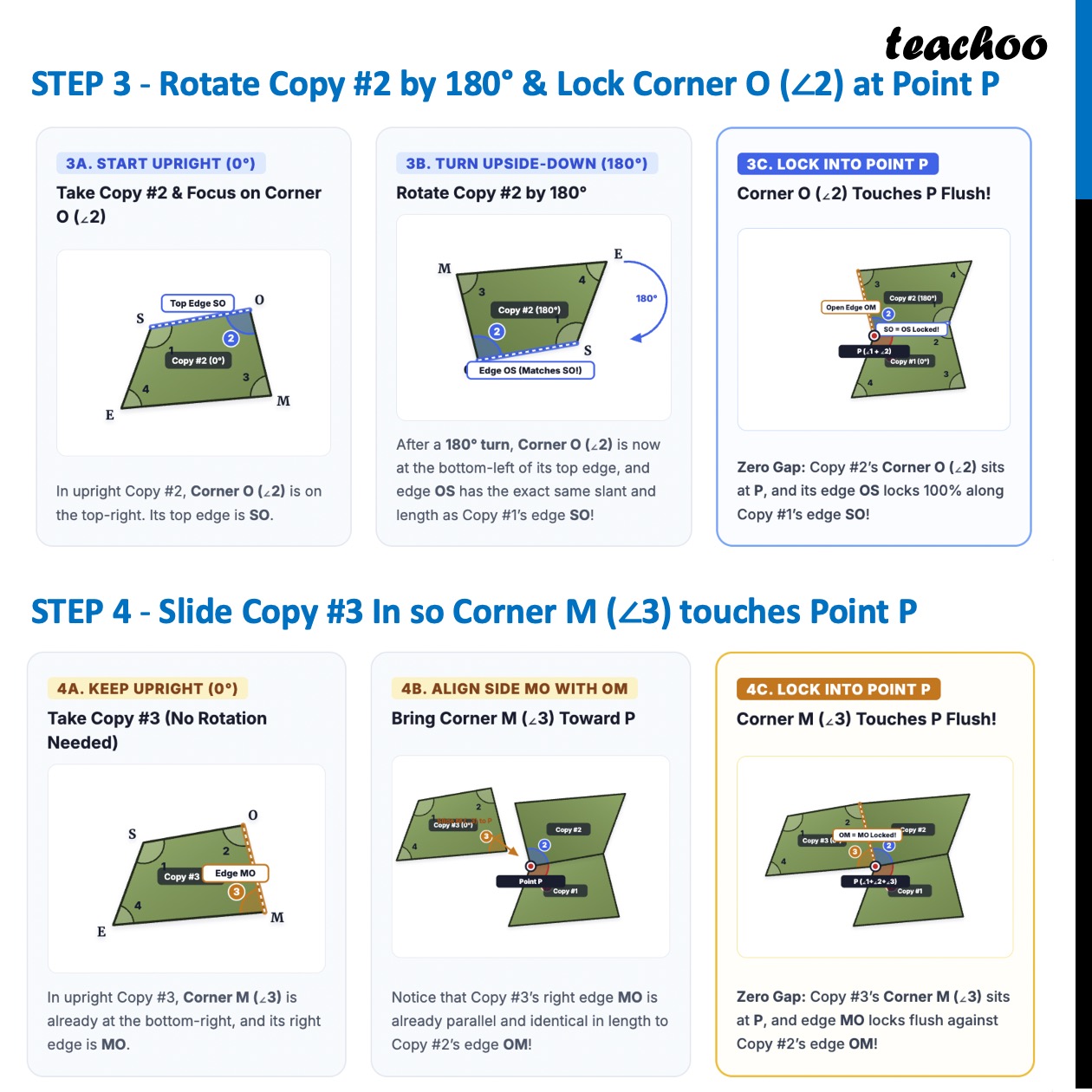
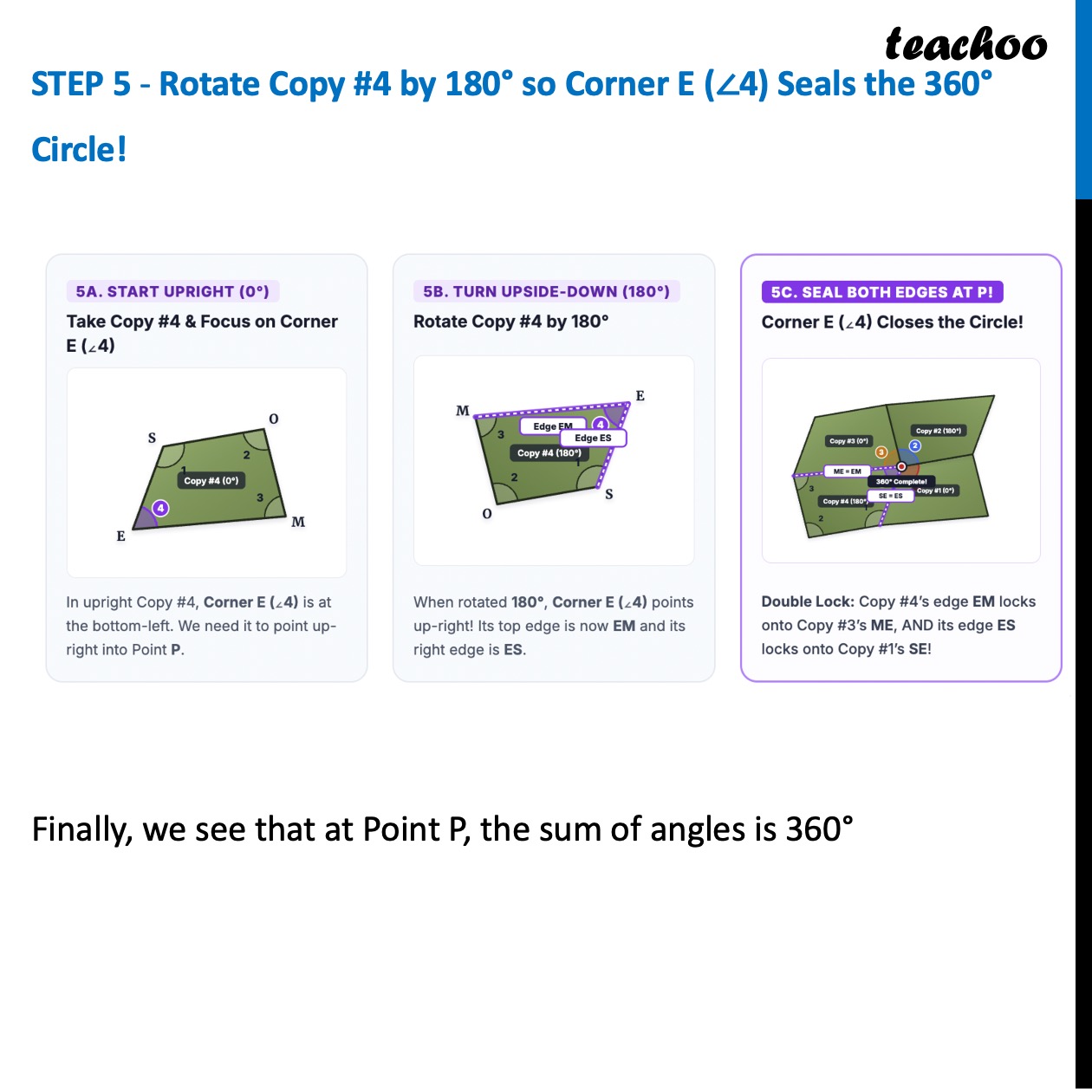
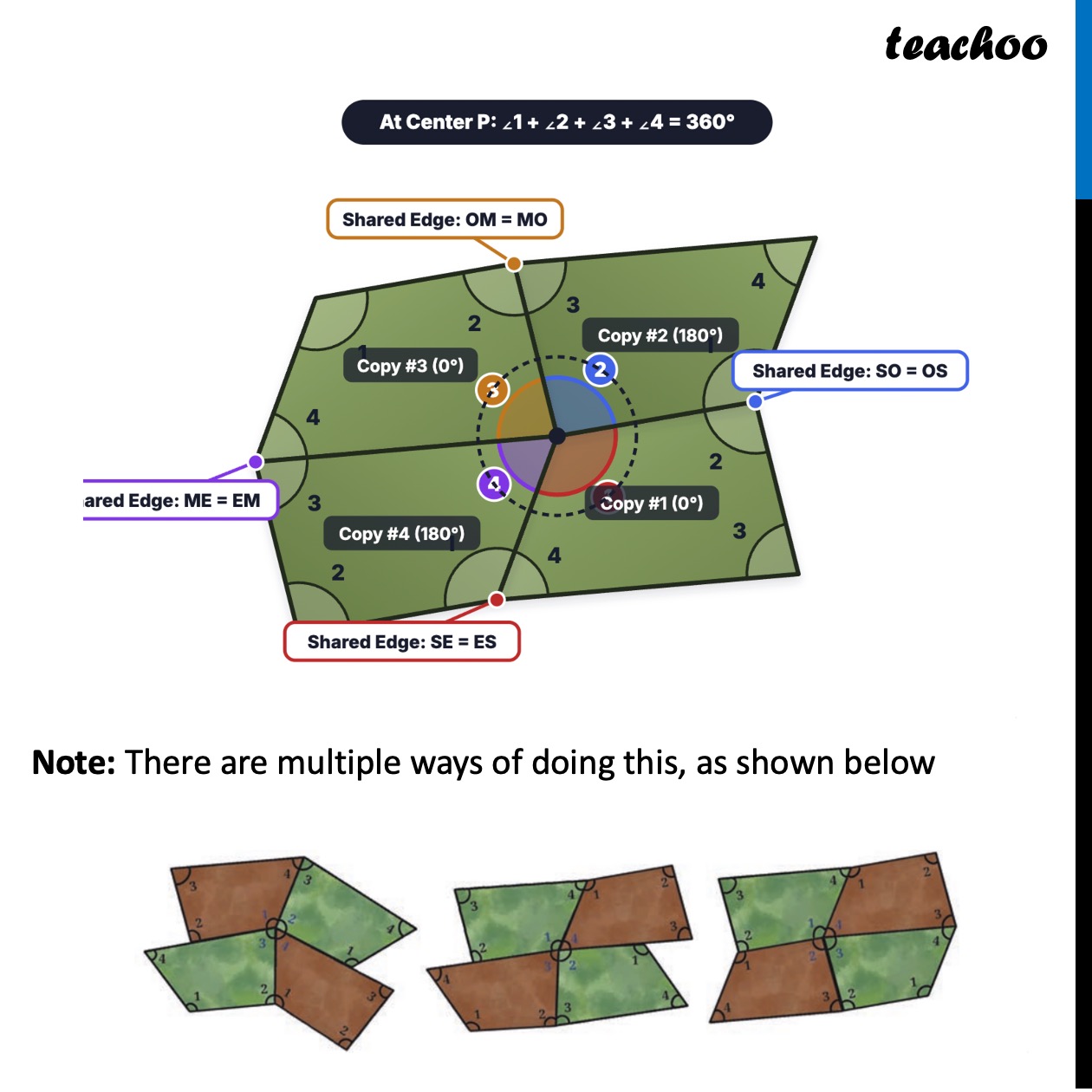
Think and Reflect (Page 70) Suppose we have a tiling of the plane. Consider any vertex. As we go around this vertex and consider the angles made by consecutive lines, the total of these angles must be 360°. This suggests an idea. What if we take 4 copies of SOME and fit them together around a common point so that each angle is used once as we go around? If we take 4 identical copies of quadrilateral SOME—keeping two copies in their original orientation (0°) and rotating the other two copies by 180°—we can fit them around a common point P so that each of the four angles (∠1 at S, ∠2 at O, ∠3 at M, and ∠4 at E) is used exactly once. Because the sum of the interior angles of any quadrilateral is always ∠1 + ∠2 + ∠3 + ∠4 = 360°, the four corners form a complete 360° full turn around the common point with no gaps and no overlaps. Furthermore, because alternating copies are rotated by 180°, every pair of touching edges consists of the exact same side of the quadrilateral placed in opposite directions (SO with OS, OM with MO, ME with EM, and ES with SE), allowing this pattern to repeat infinitely to tile the entire plane. Fig, 12.26 Because the sum of the interior angles of any quadrilateral is always ∠1 + ∠2 + ∠3 + ∠4 = 360°, the four corners form a complete 360° full turn around the common point with no gaps and no overlaps. Let’s look at one such way we can do that Step 1 - Understand the Original Quadrilateral SOME And, ∠1 + ∠2 + ∠3 + ∠4 = 360° Our Goal is to Place 4 identical copies of SOME around a single central point P so that Corner S (∠1), Corner O (∠2), Corner M (∠3), and Corner E (∠4) all meet at P. Top Side SO O Right Side OM Left Side ES M E Bottom Side ME Step 2 - Place Copy #1 so Corner S (∠1) Touches Common Point P Copy #1 is our original Quadrilateral SOME We take Copy #1 in its original upright orientation (0° rotation) and place its top-left corner S (∠1) directly on Point P. Corner S (.1) is at Point P Edges SO & SE meet at P Step 3 - Rotate Copy #2 by 180° & Lock Corner O (∠2) at Point P Step 4 - Slide Copy #3 In so Corner M (∠3) touches Point P 3A. START UPRIGHT (0°) Take Copy #2 & Focus on Corner O (22) In upright Copy #2, Corner O (22) is on the top-right. Its top edge is SO. 3B. TURN UPSIDE-DOWN (180°) Rotate Copy #2 by 180° 180° After a 180° turn, Corner O (22) is now at the bottom-left of its top edge, and edge OS has the exact same slant and length as Copy #1's edge SO! 3C. LOCK INTO POINT P Corner O (22) Touches P Flush! Copy #2 (180°) . Open Edge OM ® , “ jm, SO = 05S Locked! (©) P(.1+ 22) Copy #1 (0°) Zero Gap: Copy #2's Corner O (.2) sits at P, and its edge OS locks 100% along Copy #1's edge SO! 4A. KEEP UPRIGHT (0°) 4B. ALIGN SIDE MO WITH OM 4C. LOCK INTO POINT P Take Copy #3 (No Rotation Bring Corner M (23) Toward P Corner M (3) Touches P Flush! Needed) Copy #3 (0°) Copy #2 Point P P (.14.2+.3) > Copy #1 In upright Copy #3, Corner M (.3) is Notice that Copy #3's right edge MO is Zero Gap: Copy #3's Corner M (.3) sits already at the bottom-right, and its right already parallel and identical in length to at P, and edge MO locks flush against edge is MO. Copy #2's edge OM! Copy #2's edge OM! Step 5 - Rotate Copy #4 by 180° so Corner E (∠4) Seals the 360° Circle! Finally, we see that at Point P, the sum of angles is 360° 5A. START UPRIGHT (0°) Take Copy #4 & Focus on Corner E (24) Copy #4 (0°) In upright Copy #4, Corner E (24) is at the bottom-left. We need it to point up- right into Point P. 5B. TURN UPSIDE-DOWN (180°) Rotate Copy #4 by 180° When rotated 180°, Corner E (24) points up-right! Its top edge is now EM and its right edge is ES. 5C. SEAL BOTH EDGES AT P! Corner E (24) Closes the Circle! Copy #2 (180°) Copy #3 (0°) @ ® 360° Complete! [se-es | emia Copy #4 (180°; ~ Double Lock: Copy #4's edge EM locks onto Copy #3’s ME, AND its edge ES locks onto Copy #1's SE! Note: There are multiple ways of doing this, as shown below At Center P: .1+ 2.2 + .3 + .4=360° Copy #2 (180°) a © _- Copy #1 (0°) Copy #3 (0°) Shared Edge: SO = OS ared Edge: ME = EM Copy #4 (180°) Shared Edge: SE = ES