
 You are here
Last updated at October 23, 2026 by Teachoo
Transcript
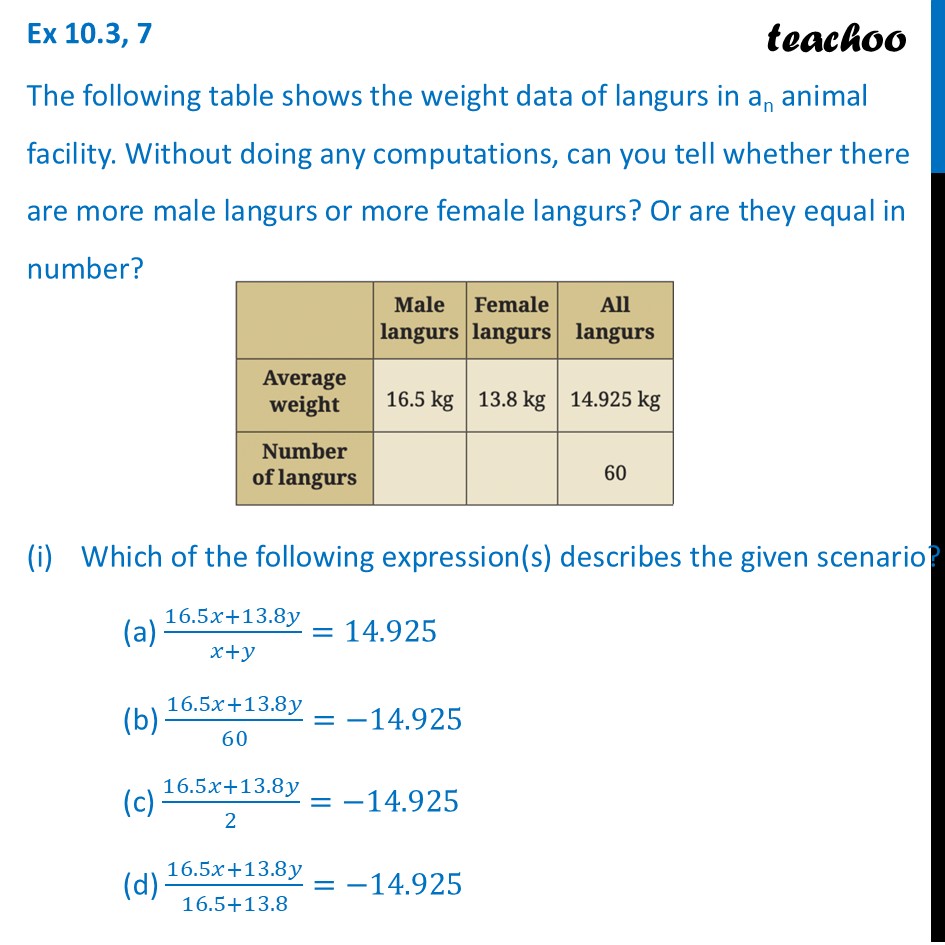
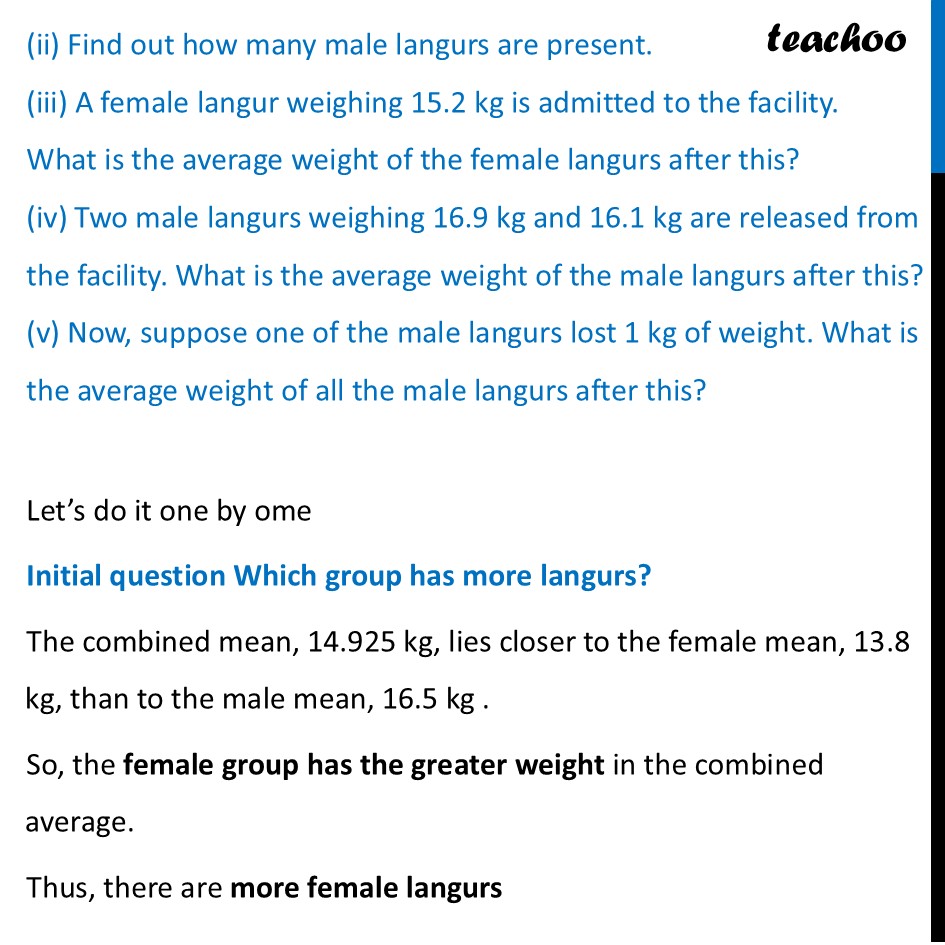
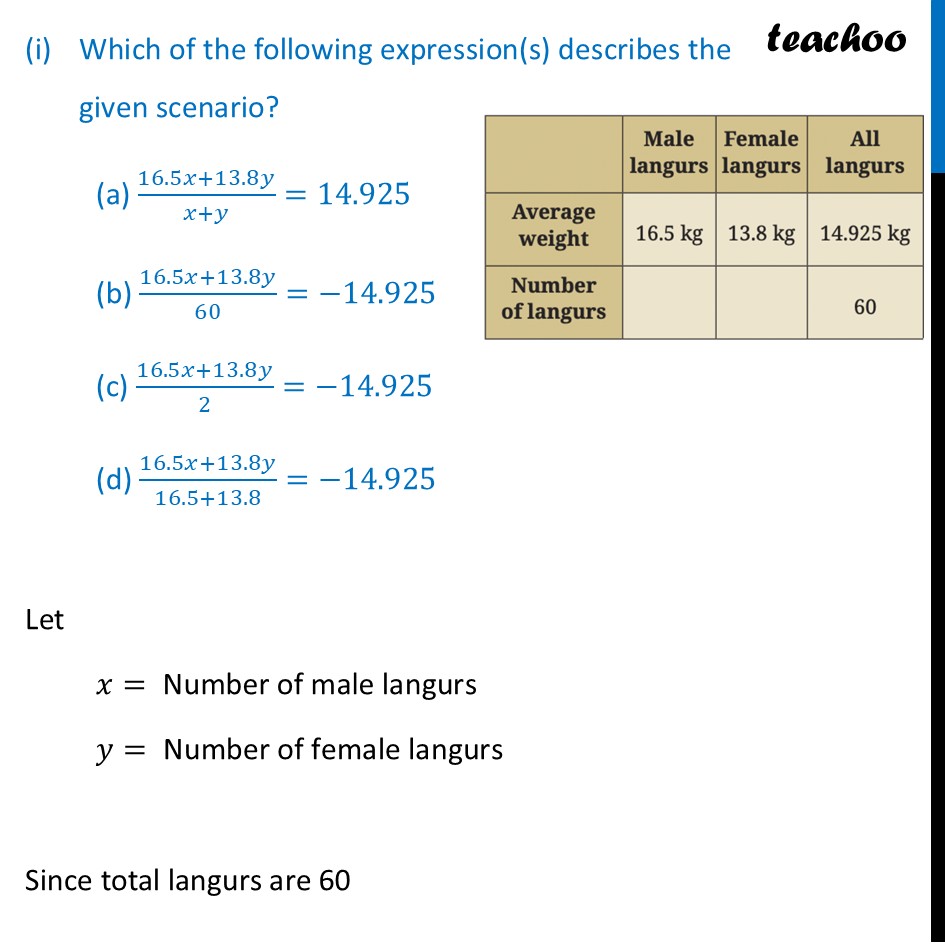
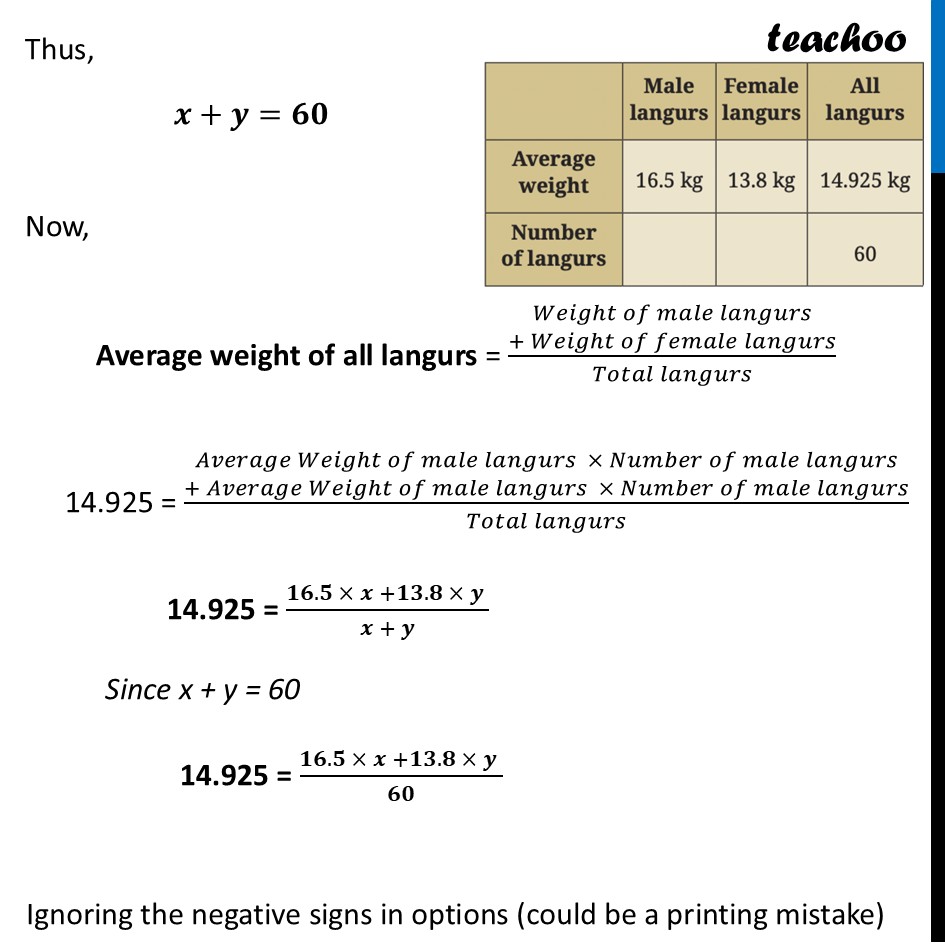
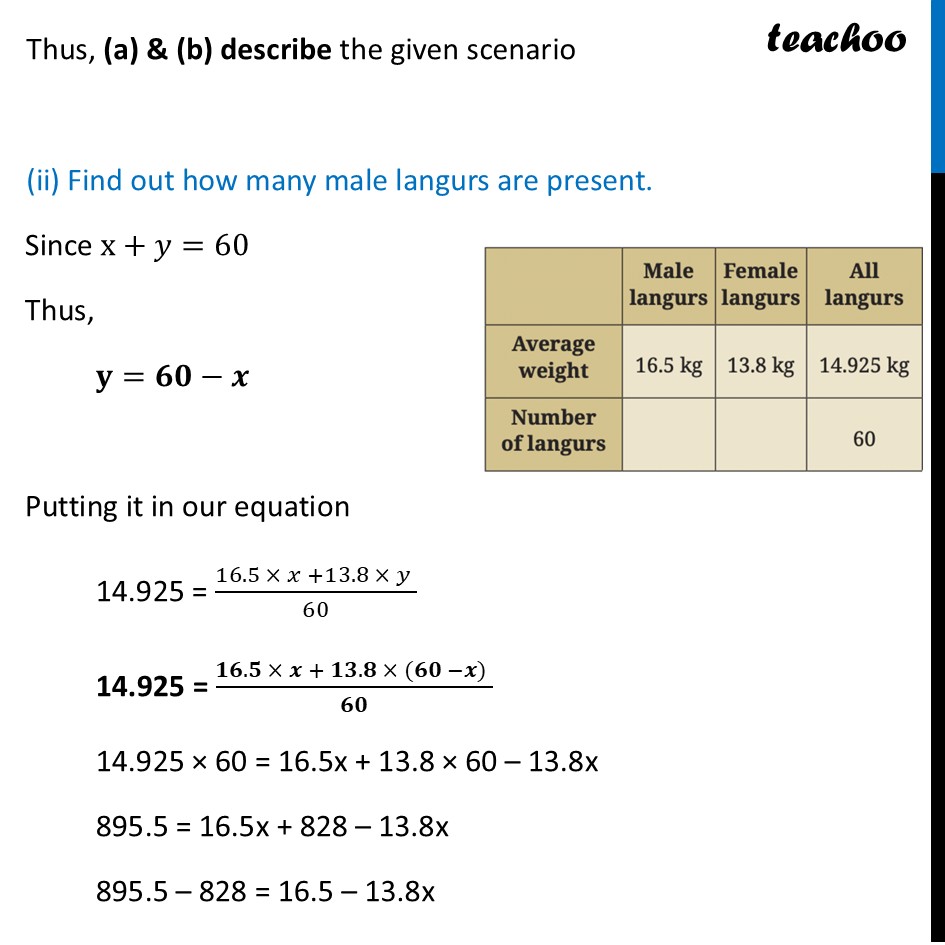
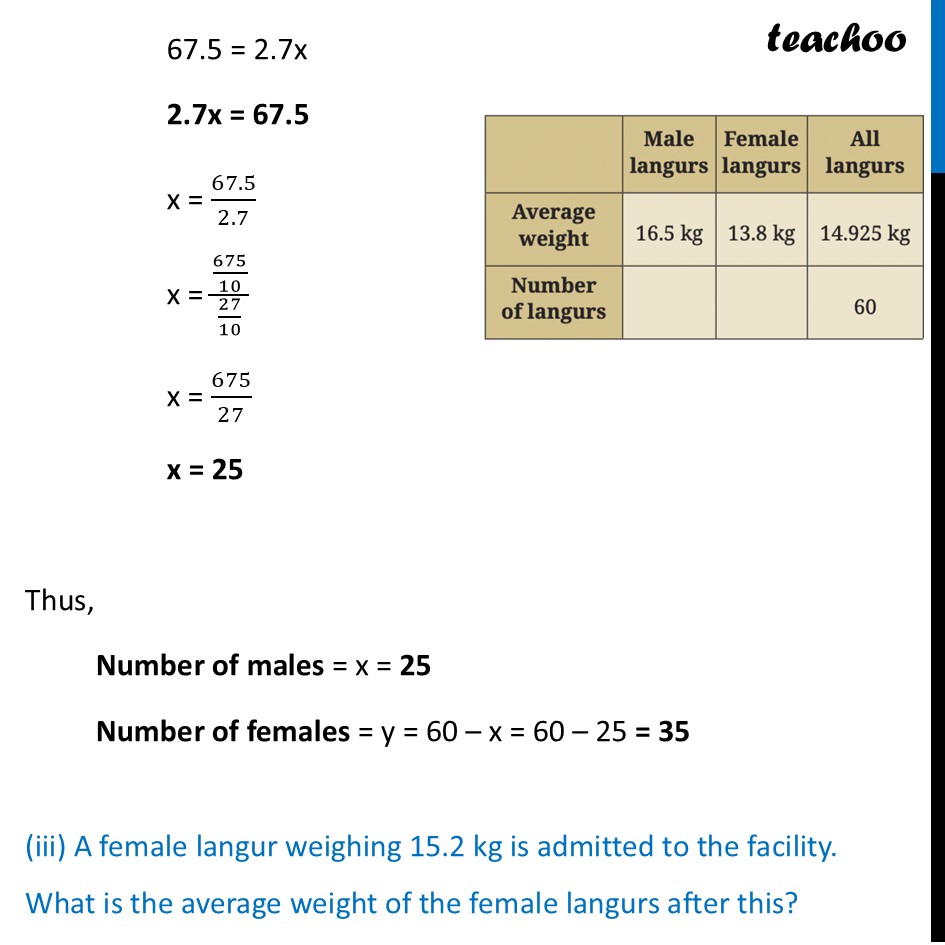
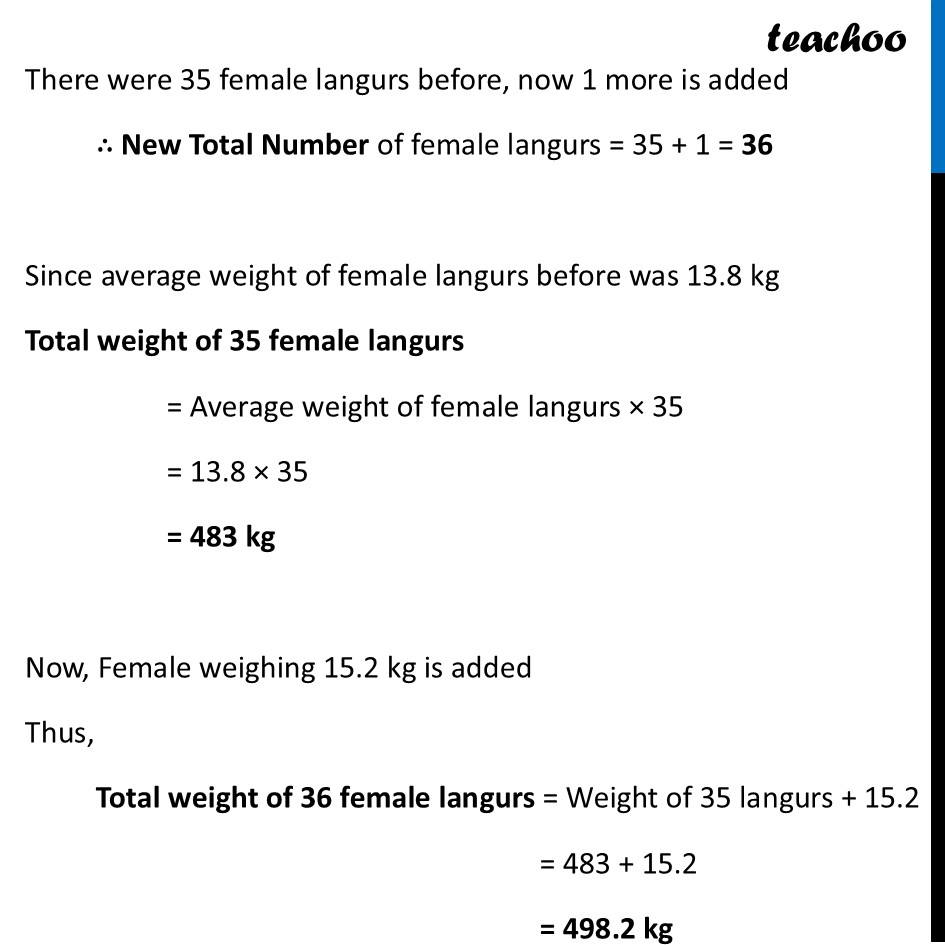
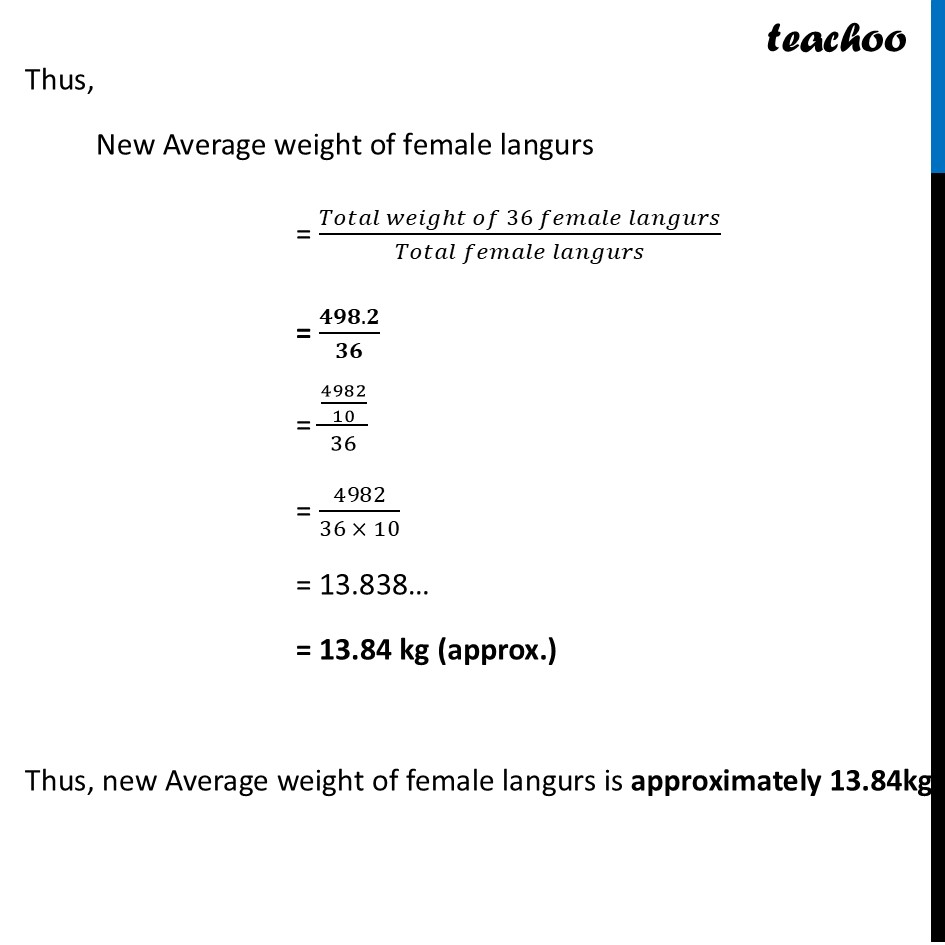
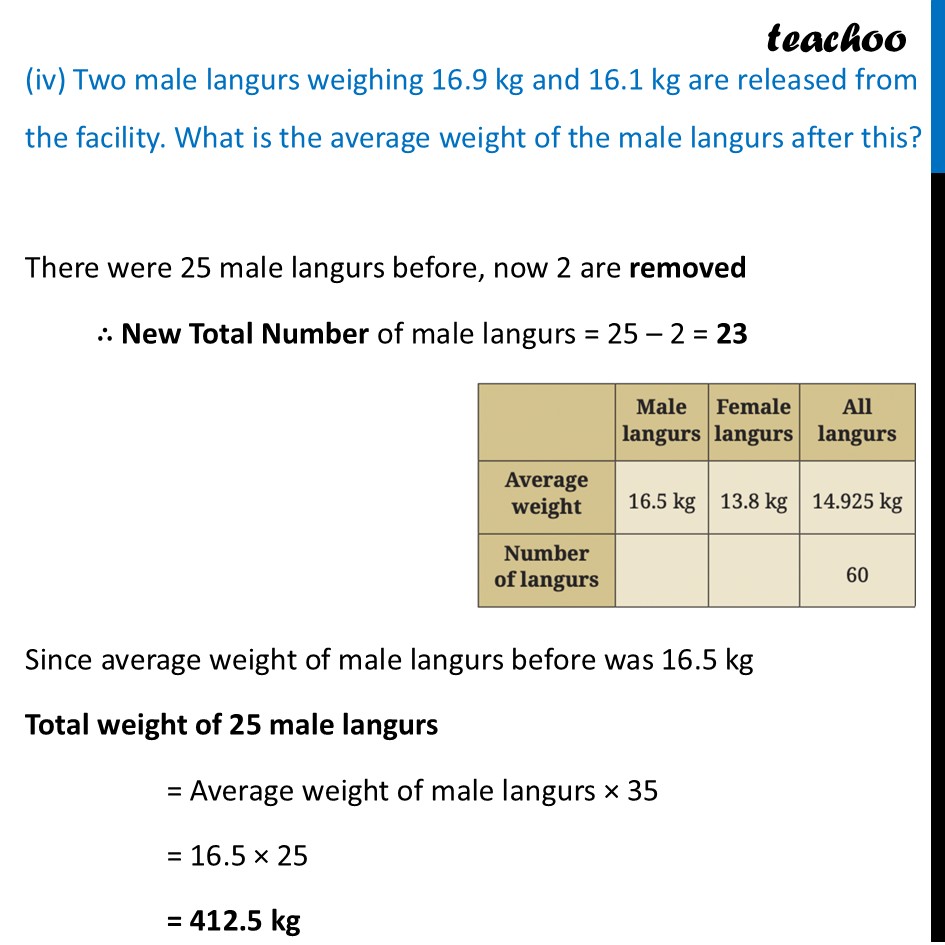
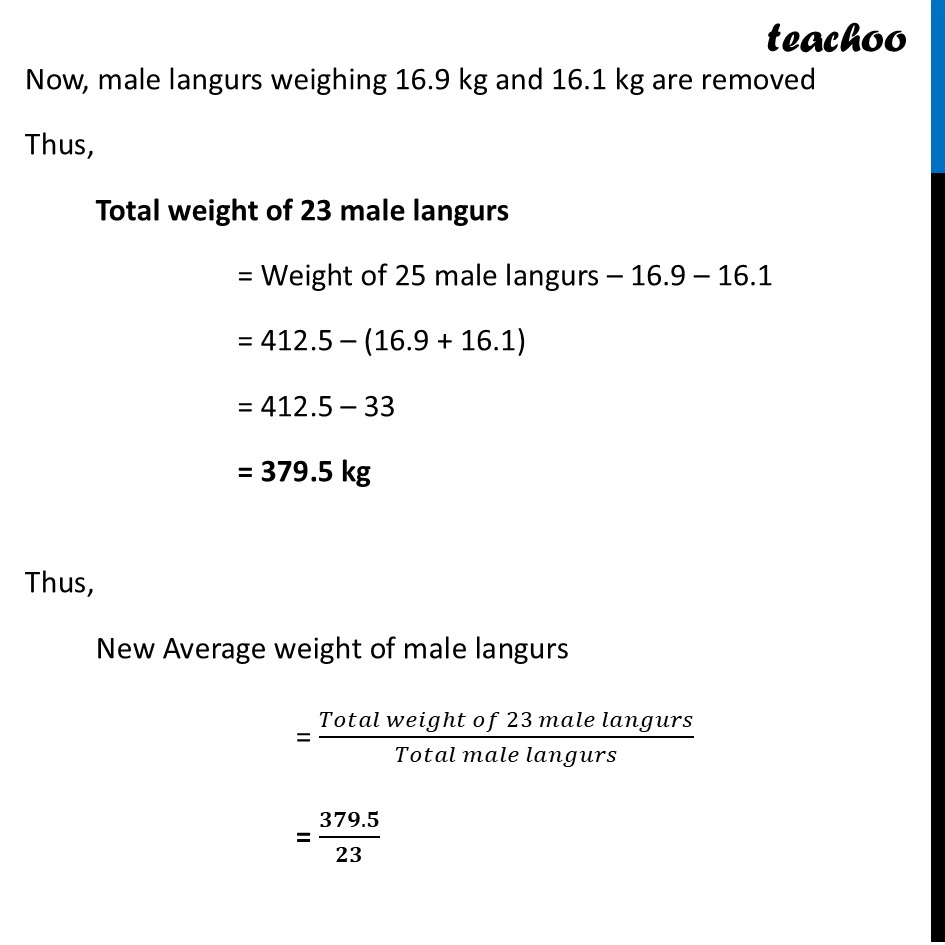
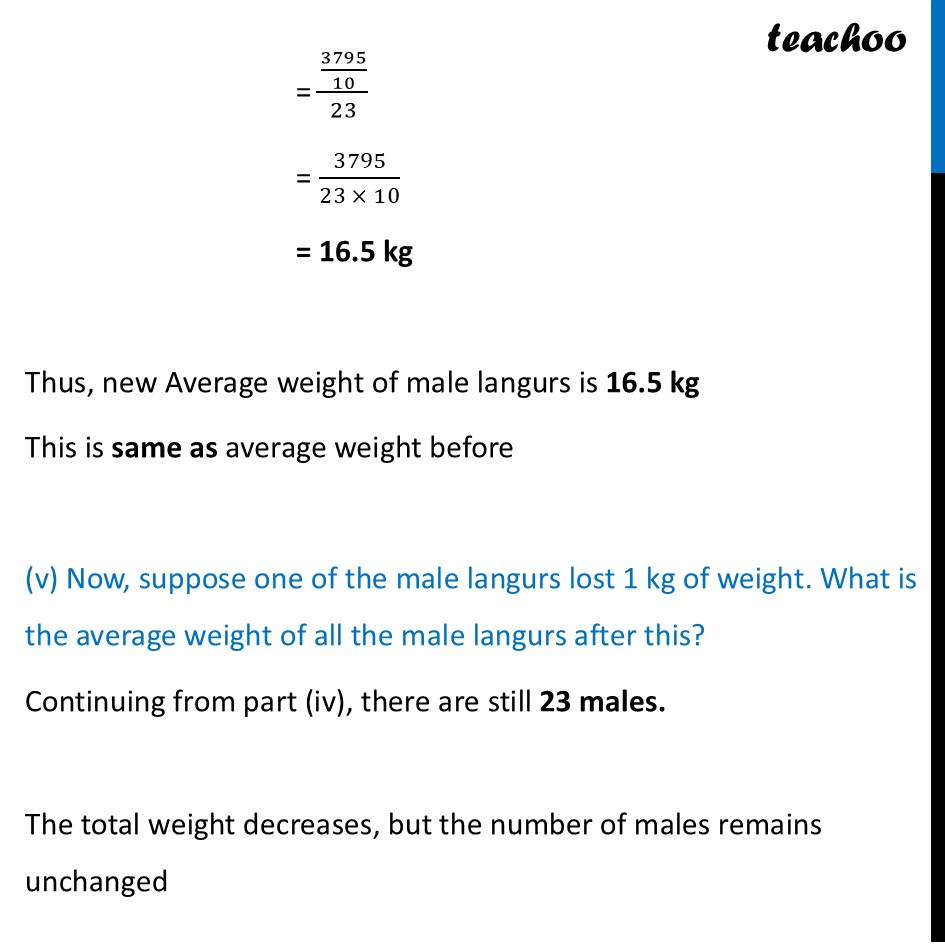
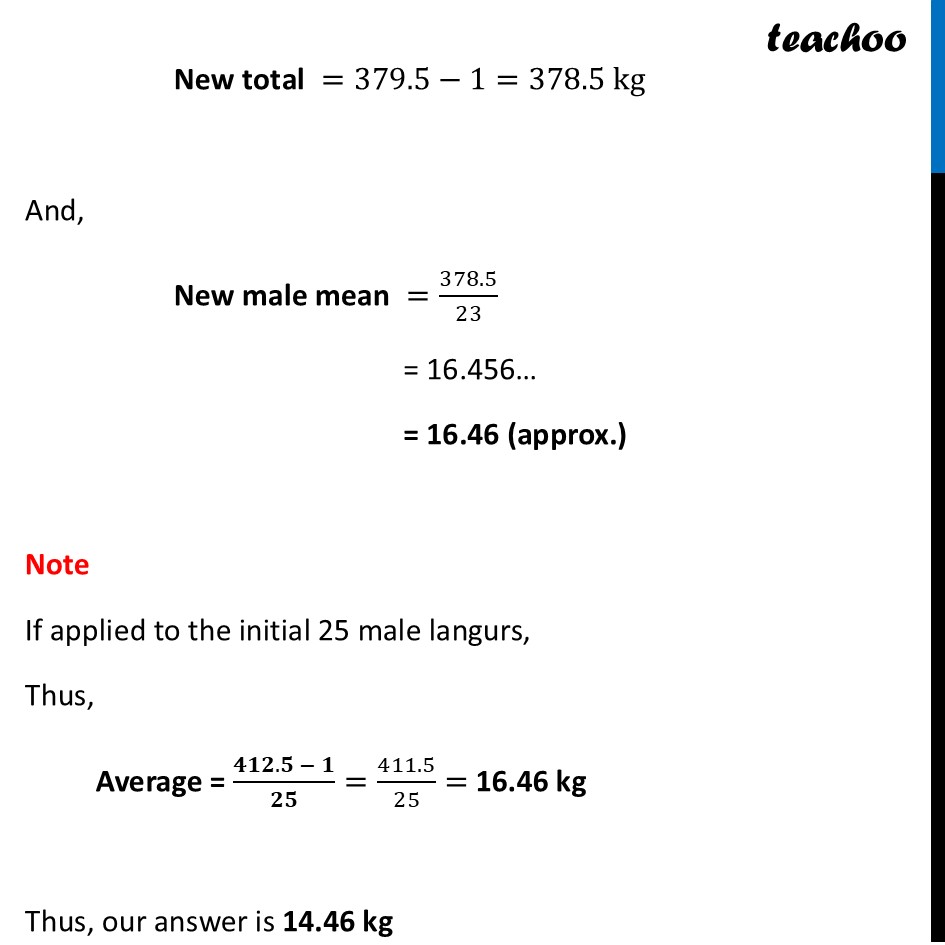
Ex 10.3, 7 The following table shows the weight data of langurs in a_(n) animal facility. Without doing any computations, can you tell whether there are more male langurs or more female langurs? Or are they equal in number? Which of the following expression(s) describes the given scenario? (a) (16.5𝑥+13.8𝑦)/(𝑥+𝑦)=14.925 (b) (16.5𝑥+13.8𝑦)/(60)=−14.925 (c) (16.5𝑥+13.8𝑦)/(2)=−14.925 (d) (16.5𝑥+13.8𝑦)/(16.5+13.8)=−14.925 Male | Female All langurs |langurs| langurs Average weight 16.5 kg 13.8 kg 14.925 kg Number of langurs 60 (ii) Find out how many male langurs are present. (iii) A female langur weighing 15.2 kg is admitted to the facility. What is the average weight of the female langurs after this? (iv) Two male langurs weighing 16.9 kg and 16.1 kg are released from the facility. What is the average weight of the male langurs after this? (v) Now, suppose one of the male langurs lost 1 kg of weight. What is the average weight of all the male langurs after this? Let’s do it one by ome Initial question Which group has more langurs? The combined mean, 14.925 kg, lies closer to the female mean, 13.8 kg, than to the male mean, 16.5 kg . So, the female group has the greater weight in the combined average. Thus, there are more female langurs Which of the following expression(s) describes the given scenario? (a) (16.5𝑥+13.8𝑦)/(𝑥+𝑦)=14.925 (b) (16.5𝑥+13.8𝑦)/(60)=−14.925 (c) (16.5𝑥+13.8𝑦)/(2)=−14.925 (d) (16.5𝑥+13.8𝑦)/(16.5+13.8)=−14.925 Let 𝑥= Number of male langurs 𝑦= Number of female langurs Since total langurs are 60 Thus, 𝒙+𝒚=𝟔𝟎 Now, Average weight of all langurs = ([𝑊𝑒𝑖𝑔ℎ𝑡 𝑜𝑓 𝑚𝑎𝑙𝑒 𝑙𝑎𝑛𝑔𝑢𝑟𝑠 ; + 𝑊𝑒𝑖𝑔ℎ𝑡 𝑜𝑓 𝑓𝑒𝑚𝑎𝑙𝑒 𝑙𝑎𝑛𝑔𝑢𝑟𝑠])/(𝑇𝑜𝑡𝑎𝑙 𝑙𝑎𝑛𝑔𝑢𝑟𝑠) = ([𝐴𝑣𝑒𝑟𝑎𝑔𝑒 𝑊𝑒𝑖𝑔ℎ𝑡 𝑜𝑓 𝑚𝑎𝑙𝑒 𝑙𝑎𝑛𝑔𝑢𝑟𝑠 × 𝑁𝑢𝑚𝑏𝑒𝑟 𝑜𝑓 𝑚𝑎𝑙𝑒 𝑙𝑎𝑛𝑔𝑢𝑟𝑠; + 𝑊𝑒𝑖𝑔ℎ𝑡 𝑜𝑓 𝑓𝑒𝑚𝑎𝑙𝑒 𝑙𝑎𝑛𝑔𝑢𝑟𝑠])/(𝑇𝑜𝑡𝑎𝑙 𝑙𝑎𝑛𝑔𝑢𝑟𝑠) The total body weight is 16.5𝑥+13.8𝑦 Therefore (16.5𝑥+13.8𝑦)/(𝑥+𝑦)=14.925 Male | Female All langurs |langurs| langurs Average weight 16.5 kg 13.8 kg 14.925 kg Number of langurs 60 Thus, 𝒙+𝒚=𝟔𝟎 Now, Average weight of all langurs = ([𝑊𝑒𝑖𝑔ℎ𝑡 𝑜𝑓 𝑚𝑎𝑙𝑒 𝑙𝑎𝑛𝑔𝑢𝑟𝑠; + 𝑊𝑒𝑖𝑔ℎ𝑡 𝑜𝑓 𝑓𝑒𝑚𝑎𝑙𝑒 𝑙𝑎𝑛𝑔𝑢𝑟𝑠])/(𝑇𝑜𝑡𝑎𝑙 𝑙𝑎𝑛𝑔𝑢𝑟𝑠) 14.925 = ([𝐴𝑣𝑒𝑟𝑎𝑔𝑒 𝑊𝑒𝑖𝑔ℎ𝑡 𝑜𝑓 𝑚𝑎𝑙𝑒 𝑙𝑎𝑛𝑔𝑢𝑟𝑠 × 𝑁𝑢𝑚𝑏𝑒𝑟 𝑜𝑓 𝑚𝑎𝑙𝑒 𝑙𝑎𝑛𝑔𝑢𝑟𝑠; + 𝐴𝑣𝑒𝑟𝑎𝑔𝑒 𝑊𝑒𝑖𝑔ℎ𝑡 𝑜𝑓 𝑚𝑎𝑙𝑒 𝑙𝑎𝑛𝑔𝑢𝑟𝑠 × 𝑁𝑢𝑚𝑏𝑒𝑟 𝑜𝑓 𝑚𝑎𝑙𝑒 𝑙𝑎𝑛𝑔𝑢𝑟𝑠])/(𝑇𝑜𝑡𝑎𝑙 𝑙𝑎𝑛𝑔𝑢𝑟𝑠) 14.925 = (𝟏𝟔.𝟓 × 𝒙 +𝟏𝟑.𝟖 × 𝒚 )/(𝒙 + 𝒚) Since x + y = 60 14.925 = (𝟏𝟔.𝟓 × 𝒙 +𝟏𝟑.𝟖 × 𝒚 )/(𝟔𝟎) Ignoring the negative signs in options (could be a printing mistake) Thus, (a) & (b) describe the given scenario Male | Female All langurs |langurs| langurs Average weight 16.5 kg 13.8 kg 14.925 kg Number of langurs 60 Thus, (a) & (b) describe the given scenario (ii) Find out how many male langurs are present. Since x+𝑦=60 Thus, 𝐲=𝟔𝟎−𝒙 Putting it in our equation 14.925 = (16.5 × 𝑥 +13.8 × 𝑦 )/(60) 14.925 = (𝟏𝟔.𝟓 × 𝒙 + 𝟏𝟑.𝟖 × (𝟔𝟎 −𝒙) )/(𝟔𝟎) 14.925 × 60 = 16.5x + 13.8 × 60 – 13.8x 895.5 = 16.5x + 828 – 13.8x 895.5 – 828 = 16.5 – 13.8x 67.5 = 2.7x 2.7x = 67.5 x = (67.5)/(2.7) x = ((675)/(10))/((27)/(10)) x = (675)/(27) x = 25 Thus, Number of males = x = 25 Number of females = y = 60 – x = 60 – 25 = 35 Male | Female All langurs |langurs| langurs Average weight 16.5 kg 13.8 kg 14.925 kg Number of langurs 60 67.5 = 2.7x 2.7x = 67.5 x = (67.5)/(2.7) x = ((675)/(10))/((27)/(10)) x = (675)/(27) x = 25 Thus, Number of males = x = 25 Number of females = y = 60 – x = 60 – 25 = 35 (iii) A female langur weighing 15.2 kg is admitted to the facility. What is the average weight of the female langurs after this? Male | Female All langurs |langurs| langurs Average weight 16.5 kg 13.8 kg 14.925 kg Number of langurs 60 There were 35 female langurs before, now 1 more is added ∴ New Total Number of female langurs = 35 + 1 = 36 Since average weight of female langurs before was 13.8 kg Total weight of 35 female langurs = Average weight of female langurs × 35 = 13.8 × 35 = 483 kg Now, Female weighing 15.2 kg is added Thus, Total weight of 36 female langurs = Weight of 35 langurs + 15.2 = 483 + 15.2 = 498.2 kg And, Thus, New Average weight of female langurs = (𝑇𝑜𝑡𝑎𝑙 𝑤𝑒𝑖𝑔ℎ𝑡 𝑜𝑓 36 𝑓𝑒𝑚𝑎𝑙𝑒 𝑙𝑎𝑛𝑔𝑢𝑟𝑠)/(𝑇𝑜𝑡𝑎𝑙 𝑓𝑒𝑚𝑎𝑙𝑒 𝑙𝑎𝑛𝑔𝑢𝑟𝑠) = (𝟒𝟗𝟖.𝟐)/(𝟑𝟔) = ((4982)/(10))/(36) = (4982)/(36 × 10) = 13.838… = 13.84 kg (approx.) Thus, new Average weight of female langurs is approximately 13.84kg (iv) Two male langurs weighing 16.9 kg and 16.1 kg are released from the facility. What is the average weight of the male langurs after this? There were 25 male langurs before, now 2 are removed ∴ New Total Number of male langurs = 25 – 2 = 23 Since average weight of male langurs before was 16.5 kg Total weight of 25 male langurs = Average weight of male langurs × 35 = 16.5 × 25 = 412.5 kg Now, male langurs weighing 16.9 kg and 16.1 kg are removed Thus, Total weight of 23 male langurs = Weight of 25 male langurs – 16.9 – 16.1 = 412.5 – (16.9 + 16.1) = 412.5 – 33 = 379.5 kg Thus, New Average weight of male langurs = (𝑇𝑜𝑡𝑎𝑙 𝑤𝑒𝑖𝑔ℎ𝑡 𝑜𝑓 23 𝑚𝑎𝑙𝑒 𝑙𝑎𝑛𝑔𝑢𝑟𝑠)/(𝑇𝑜𝑡𝑎𝑙 𝑚𝑎𝑙𝑒 𝑙𝑎𝑛𝑔𝑢𝑟𝑠) = (𝟑𝟕𝟗.𝟓)/(𝟐𝟑) = ((3795)/(10))/(23) = (3795)/(23 × 10) = 16.5 kg Thus, new Average weight of male langurs is 16.5 kg Male | Female All langurs |langurs| langurs Average weight 16.5 kg 13.8 kg 14.925 kg Number of langurs 60 Now, male langurs weighing 16.9 kg and 16.1 kg are removed Thus, Total weight of 23 male langurs = Weight of 25 male langurs – 16.9 – 16.1 = 412.5 – (16.9 + 16.1) = 412.5 – 33 = 379.5 kg Thus, New Average weight of male langurs = (𝑇𝑜𝑡𝑎𝑙 𝑤𝑒𝑖𝑔ℎ𝑡 𝑜𝑓 23 𝑚𝑎𝑙𝑒 𝑙𝑎𝑛𝑔𝑢𝑟𝑠)/(𝑇𝑜𝑡𝑎𝑙 𝑚𝑎𝑙𝑒 𝑙𝑎𝑛𝑔𝑢𝑟𝑠) = (𝟑𝟕𝟗.𝟓)/(𝟐𝟑) = ((3795)/(10))/(23) = (3795)/(23 × 10) = 16.5 kg Thus, new Average weight of male langurs is 16.5 kg = ((3795)/(10))/(23) = (3795)/(23 × 10) = 16.5 kg Thus, new Average weight of male langurs is 16.5 kg This is same as average weight before (v) Now, suppose one of the male langurs lost 1 kg of weight. What is the average weight of all the male langurs after this? Continuing from part (iv), there are still 23 males. The total weight decreases, but the number of males remains unchanged New total =379.5−1=378.5 kg And, New male mean =(378.5)/(23) = 16.456… = 16.46 (approx.) Note If applied to the initial 25 male langurs, Thus, Average = (412.5−1)/(25)=(411.5)/(25)= 16.46 kg as well). New total =379.5−1=378.5 kg And, New male mean =(378.5)/(23) = 16.456… = 16.46 (approx.) Note If applied to the initial 25 male langurs, Thus, Average = (𝟒𝟏𝟐.𝟓 − 𝟏)/(𝟐𝟓)=(411.5)/(25)= 16.46 kg Thus, our answer is 14.46 kg
