
 You are here
pages 131 to 133
What were guilds (shrenis), and what functions did they perform?
![Guilds - State and Society up to 1000 CE - [Teachoo] - Concepts](https://cdn.teachoo.com/9b0025bd-bc1d-458c-a397-5e7634b31a8c/a-craft-guild-at-work.jpg)
A craft guild at work
- Guilds (shrenis) were collective organisations of traders, artisans and merchants — associations of people engaged in the same profession, craft or occupation.
- They became especially important in the expansion of trade and commerce after the rise of territorial states such as the mahajanapadas.
| Function | What guilds did |
|---|---|
| Quality control | Regulated the quality of goods. |
| Prices | Often fixed prices to protect artisans and consumers. |
| Professional discipline | Guild courts supervised members and enforced standards. |
| Finance | Functioned as banks, financiers and trustees. |
How did guilds function as financial institutions?

Don't Miss Out — Guilds as Financial Institutions
- The Nashik cave inscription (2nd century CE), connected with the Shaka king Nahapana and his son-in-law Ushavadata , records monetary donations deposited with professional guilds ( shrenis ).
- The guilds were required to pay a fixed rate of interest on these endowments.
- The interest was used to maintain Buddhist monasteries and caves .
The Nashik cave inscription
This evidence shows that guilds were not only craft or trade associations; they could also function as
banking and credit institutions
, investing funds and generating a regular income.
What evidence from texts and inscriptions tells us about guilds?
Text/inscription
What it tells us about guilds
Jataka
literature
Refers to
eighteen types of guilds
, showing they were well-established and influential institutions in the economic life of early India
Nashik cave inscription
(2nd century CE, Nahapana and Ushavadata)
Guilds accepted deposits, paid fixed interest, and this interest maintained Buddhist monasteries and caves
Sanchi Great Stupa inscription
Records the guild of
ivory workers from Vidisha
, who carved the
stone sculptures on the gateways and railings
of the stupa, showing craft guilds' role in art and religious patronage
References to guilds of silk weavers
Indicate the
organised nature of the textile industry
in this period
DON'T MISS OUT — Sanchi
An inscription on the southern gateway of the Great Stupa at Sanchi refers to the welfare and patronage activities of the guild of ivory workers from Vidisha . These artisans carved stone sculptures on the gateways and railings, showing the role of craft guilds in artistic production and religious patronage.
How did guilds, coins, industries and trade expand together?
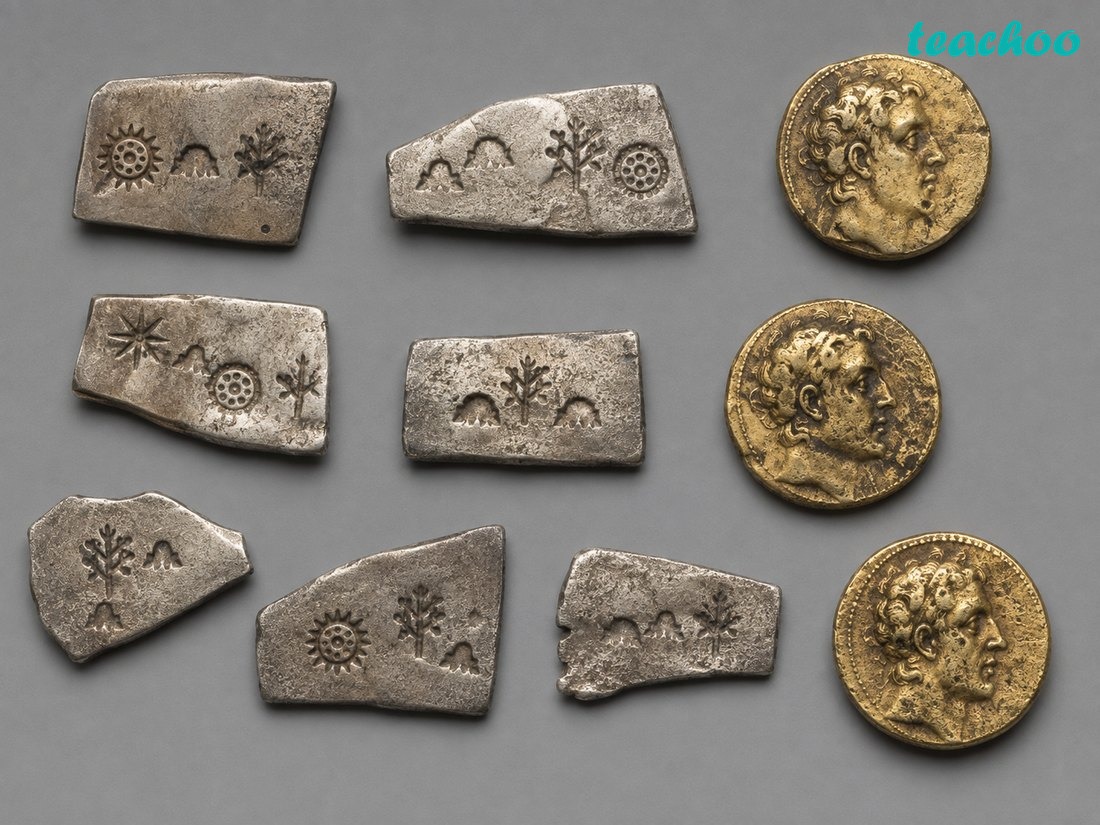
Early Indian coins
- Guilds played a significant role in the expansion of trade and commerce , especially after the rise of territorial states in the form of the mahajanapadas ( 6th century BCE ).
What changed together from around the 6th century BCE?
Mahājanapadas
Larger territorial states
Guilds
Organised professional associations became important
Coins
Silver punch-marked coins circulated
These are parallel developments in an expanding trade-and-money economy, not a step-by-step chain.
- Metallic coins , beginning with silver punch-marked coins , also came into circulation during this same period .
- So as trade and commerce expanded, guilds grew alongside it, and this happened at the same time money itself began circulating in the form of coins, rather than one developing before the other.
- The economic prosperity achieved during the pre-Gupta period laid a strong foundation for cultural and economic developments of later periods .
- Industries continued to expand , supported by the availability of raw materials and the skill and enterprise of artisans and craftspersons .
- Literary and archaeological sources refer to a wide variety of textiles: silk, cotton, wool, linen .
- Diverse weaving techniques were in use, and centres such as Mathura, Kashi, and Kamarupa emerged as important hubs of textile production.
- Merchants of various categories figure prominently in literary and epigraphical sources, highlighting the growing importance of trade .
- Two very different pieces of evidence, the Nashik cave inscription and the Sanchi gateway inscription , both show guilds involved in religious activity , one through financial support , the other through actual craftsmanship .
What Have We Learned
- Guilds (shrenis): associations of traders, artisans, merchants in the same profession, craft, or occupation.
- Guild functions: quality control, price fixing, guild courts for discipline, and acting as banks, financiers, and trustees.
- Nashik cave inscription (2nd century CE, Nahapana and Ushavadata): guilds paid fixed interest on deposits, used to maintain Buddhist monasteries and caves.
- Jataka literature: eighteen types of guilds recorded.
- Sanchi Great Stupa inscription: guild of ivory workers from Vidisha carved the gateway and railing sculptures.
- Guilds grew significant especially after the rise of the mahajanapadas (6th century BCE), alongside the start of silver punch-marked coin circulation.
- Pre-Gupta textiles: silk, cotton, wool, linen; hubs at Mathura, Kashi, Kamarupa; guilds of silk weavers existed.
Section Summary - Guilds
What they were
Shrenis - associations of traders and artisans
Regulation
Fixed quality and prices; guild courts enforced standards
Finance
Acted as banks, financiers and trustees
↓
Guilds organised craft and trade, and financed public and religious works
