You are here
Visualising a GP
Last updated at August 14, 2026 by Teachoo
Transcript
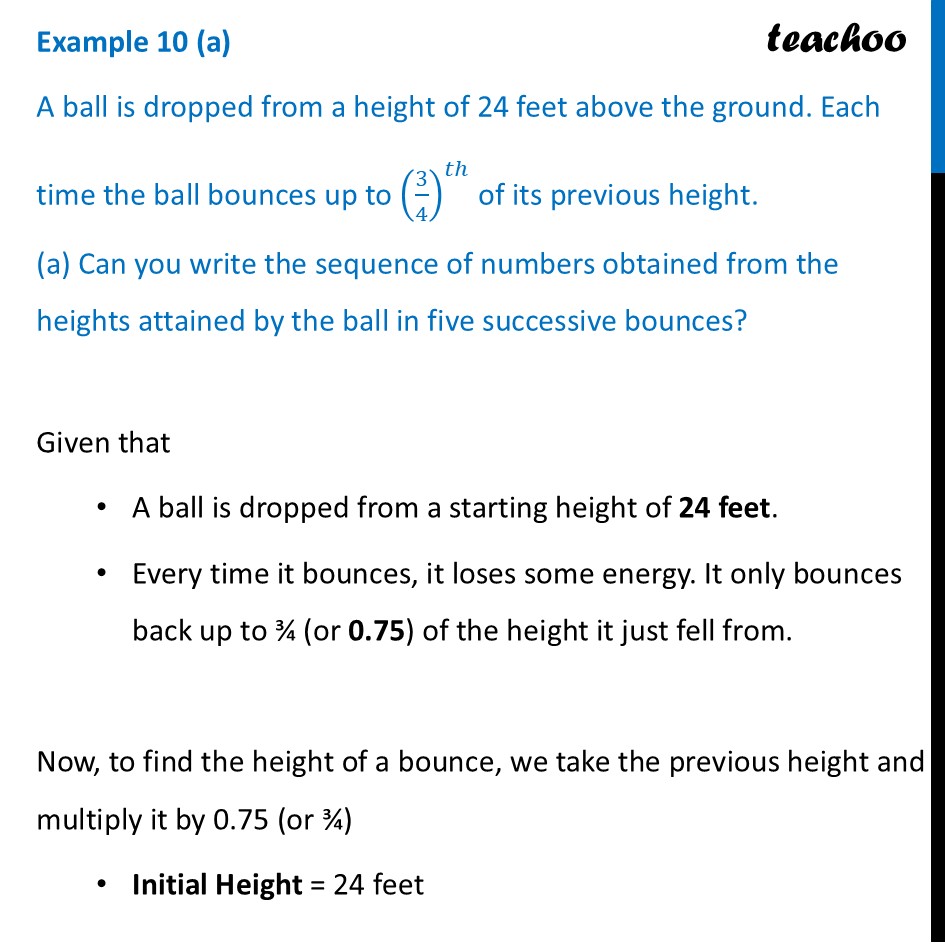
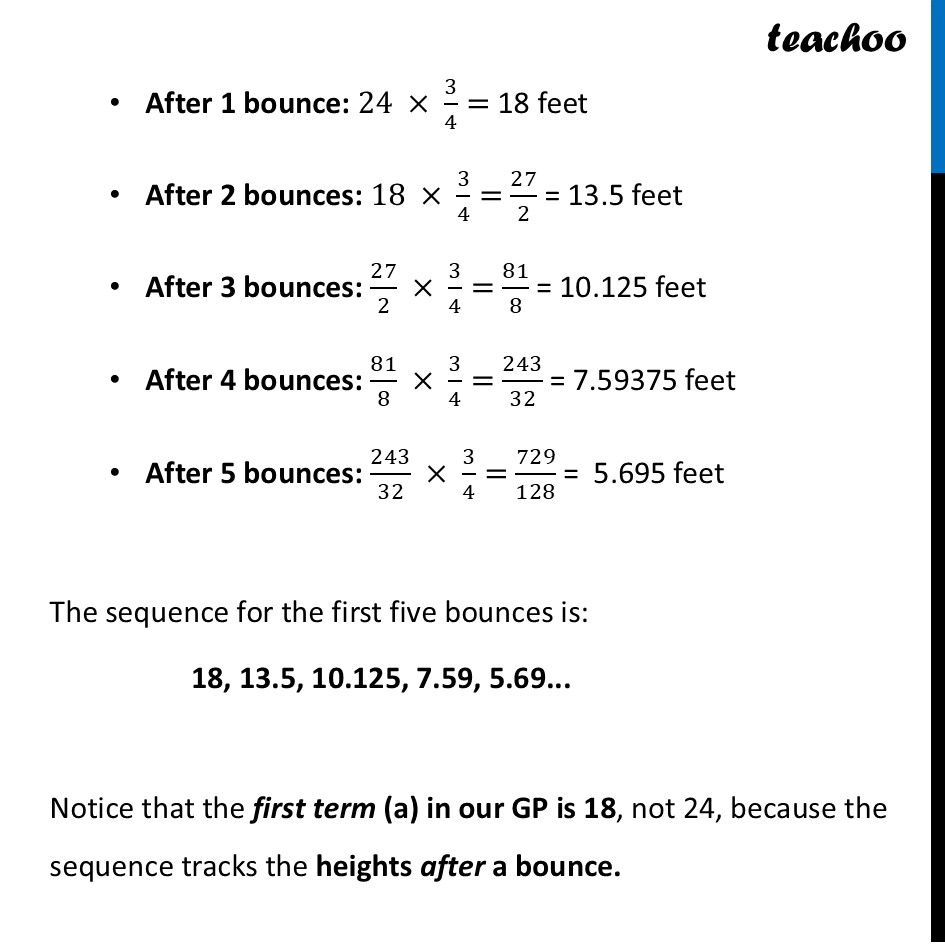
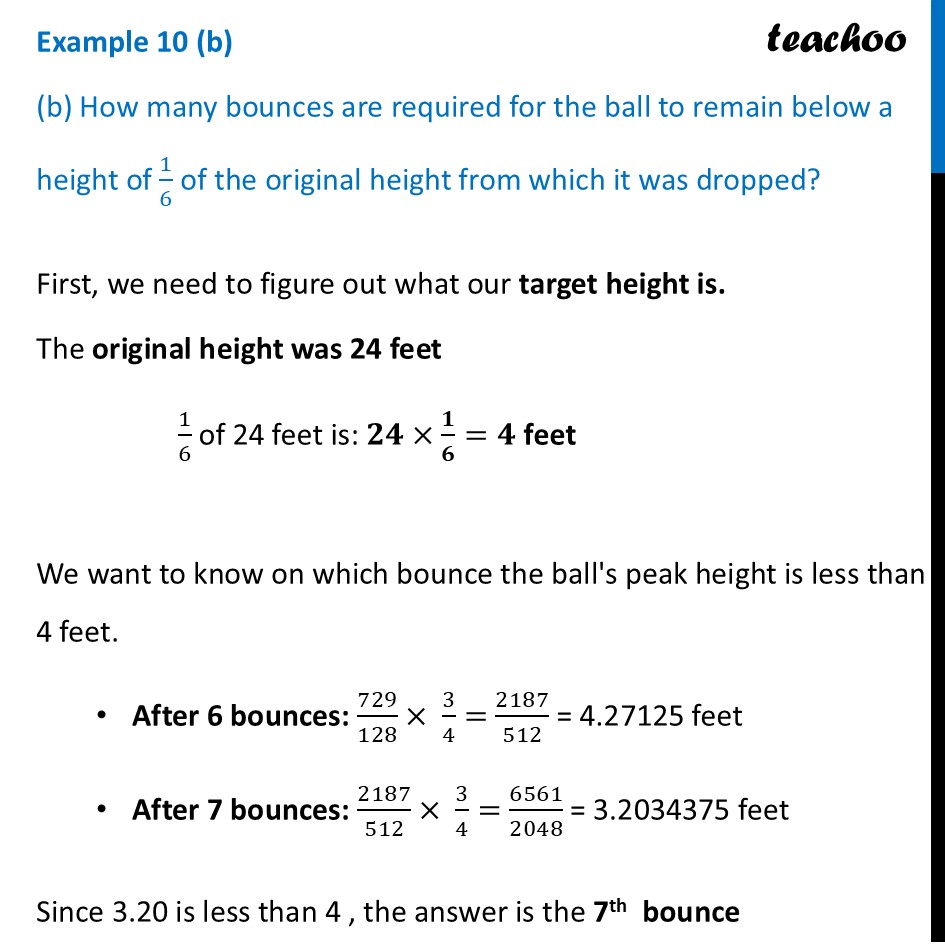
Example 10 (a) A ball is dropped from a height of 24 feet above the ground. Each time the ball bounces up to (3/4)^𝑡ℎ of its previous height. (a) Can you write the sequence of numbers obtained from the heights attained by the ball in five successive bounces? Given that A ball is dropped from a starting height of 24 feet. Every time it bounces, it loses some energy. It only bounces back up to ¾ (or 0.75) of the height it just fell from. Now, to find the height of a bounce, we take the previous height and multiply it by 0.75 (or ¾) Initial Height = 24 feet After 1 bounce: 24 × 3/4= 18 feet After 2 bounces: 18 × 3/4= 27/2 = 13.5 feet After 3 bounces: 27/2 × 3/4= 81/8 = 10.125 feet After 4 bounces: 81/8 × 3/4= 243/32 = 7.59375 feet After 5 bounces: 243/32 × 3/4= 729/128 = 5.695 feet The sequence for the first five bounces is: 18, 13.5, 10.125, 7.59, 5.69... Notice that the first term (a) in our GP is 18, not 24, because the sequence tracks the heights after a bounce. Example 10 (b) (b) How many bounces are required for the ball to remain below a height of 1/6 of the original height from which it was dropped? First, we need to figure out what our target height is. The original height was 24 feet 1/6 of 24 feet is: 𝟐𝟒×𝟏/𝟔=𝟒 feet We want to know on which bounce the ball's peak height is less than 4 feet. After 6 bounces: 729/128× 3/4= 2187/512 = 4.27125 feet After 7 bounces: 2187/512× 3/4= 6561/2048 = 3.2034375 feet Since 3.20 is less than 4 , the answer is the 7th bounce