You are here
Fractals as a GP Sequence
Fractals as a GP Sequence
Last updated at August 14, 2026 by Teachoo
Transcript
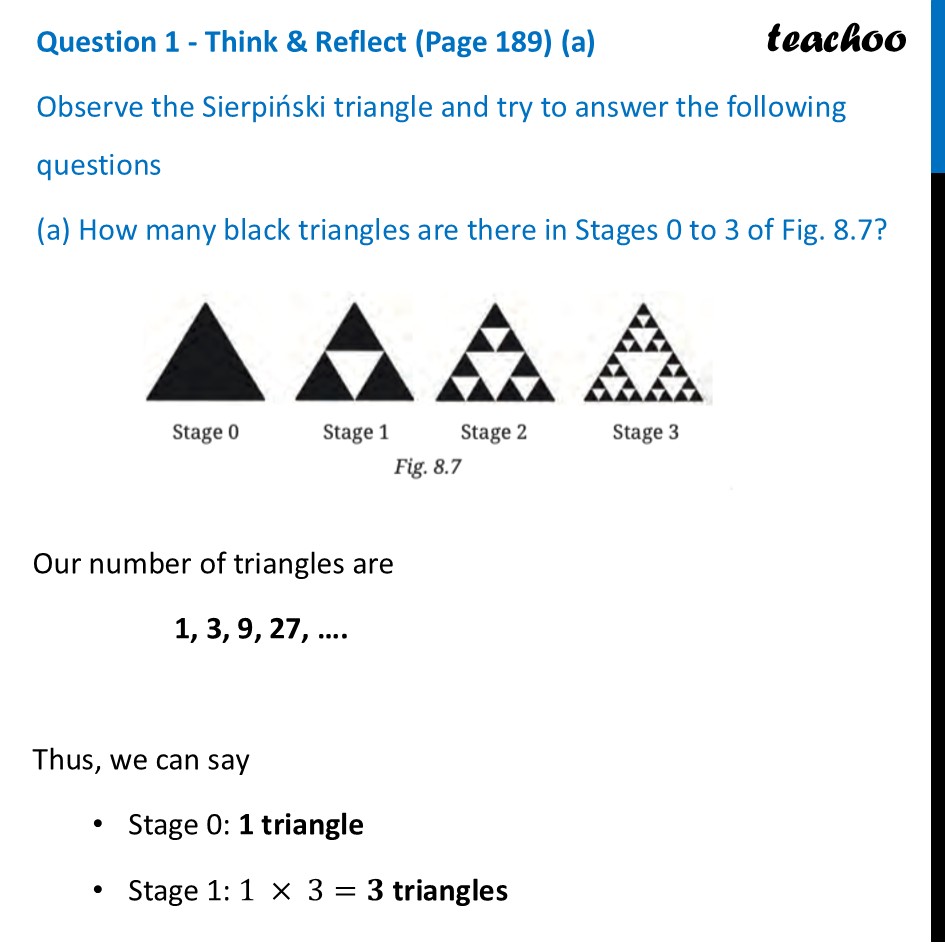
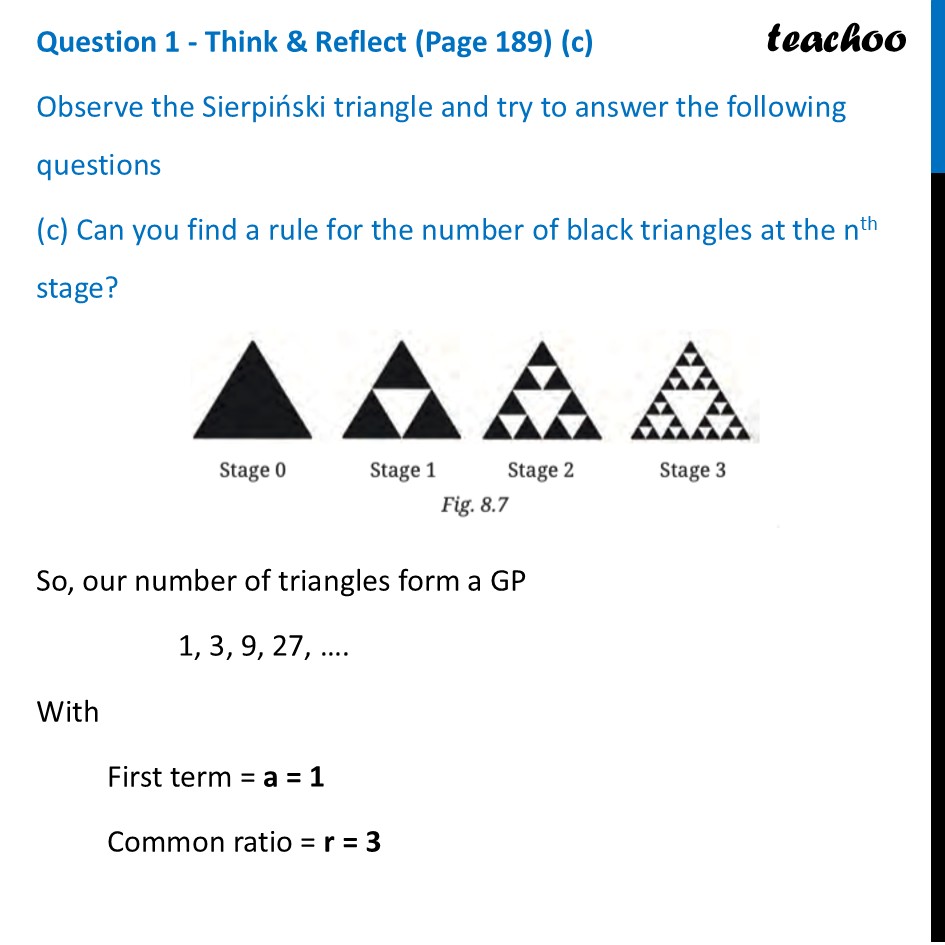
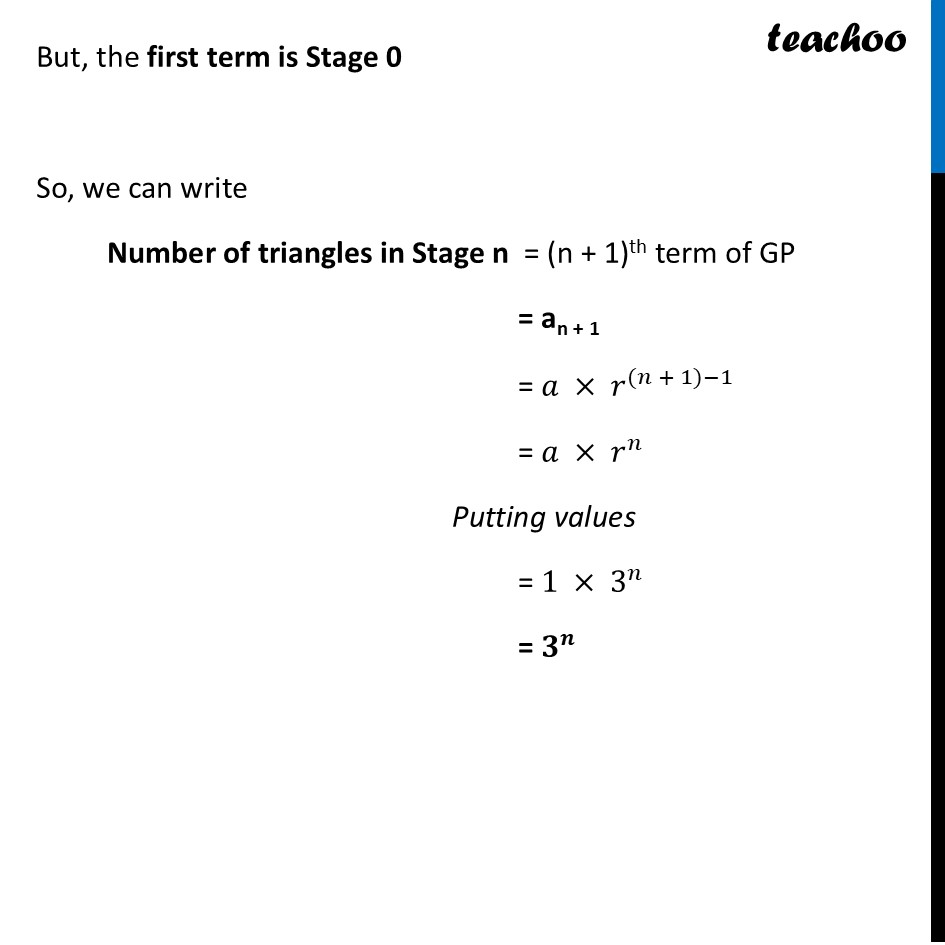
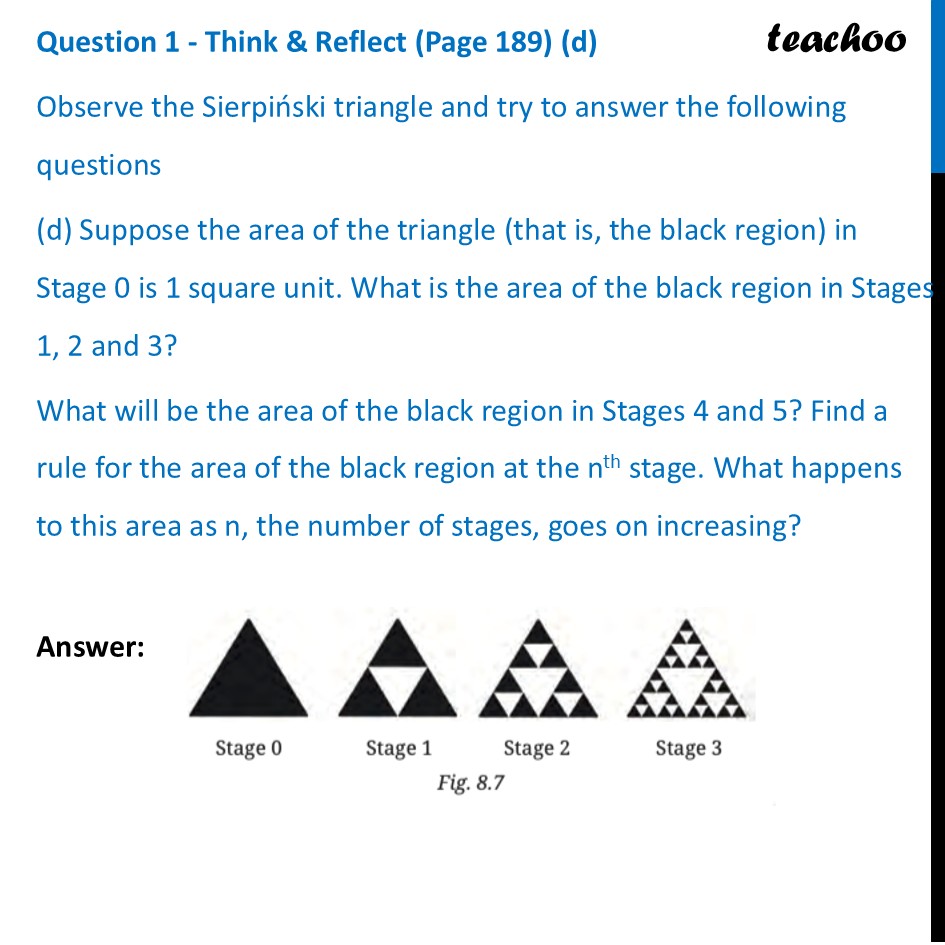
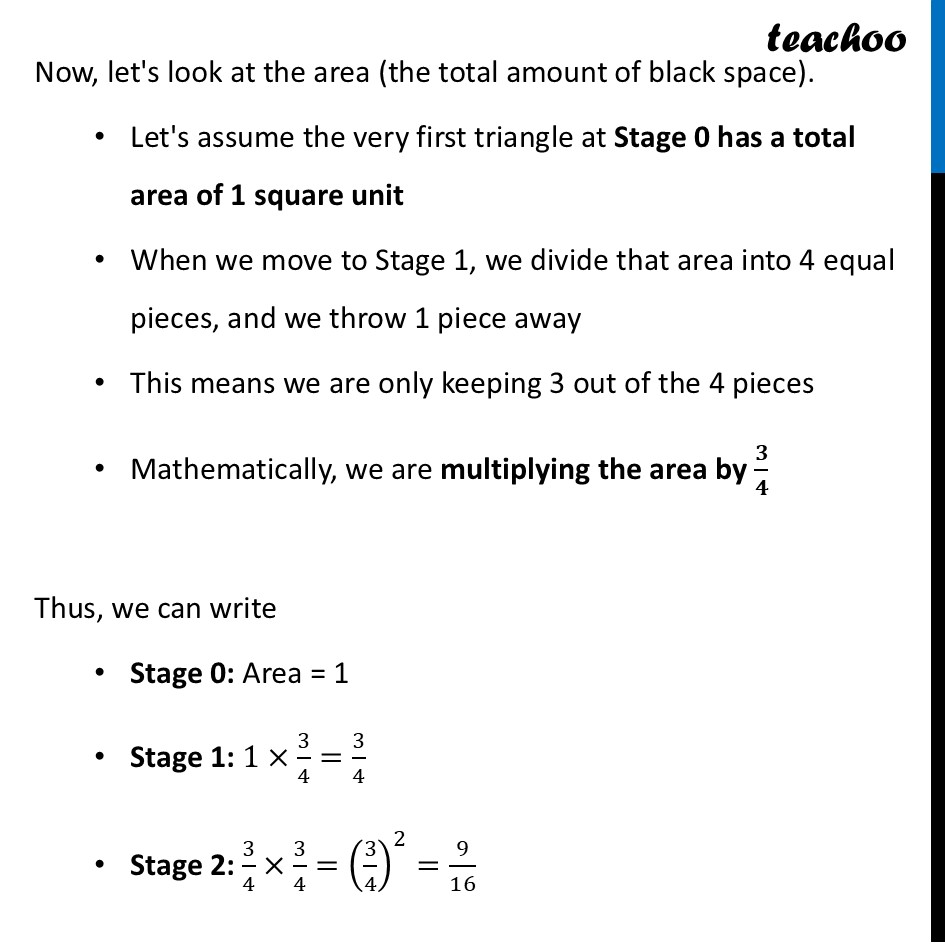
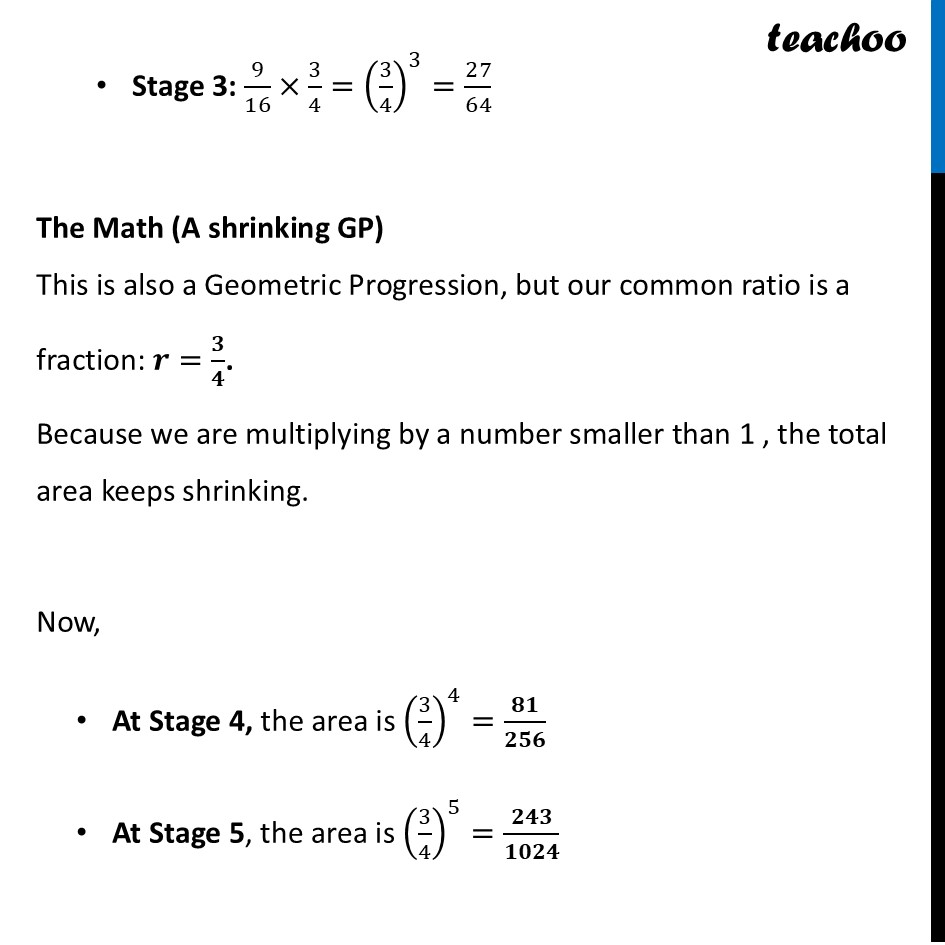
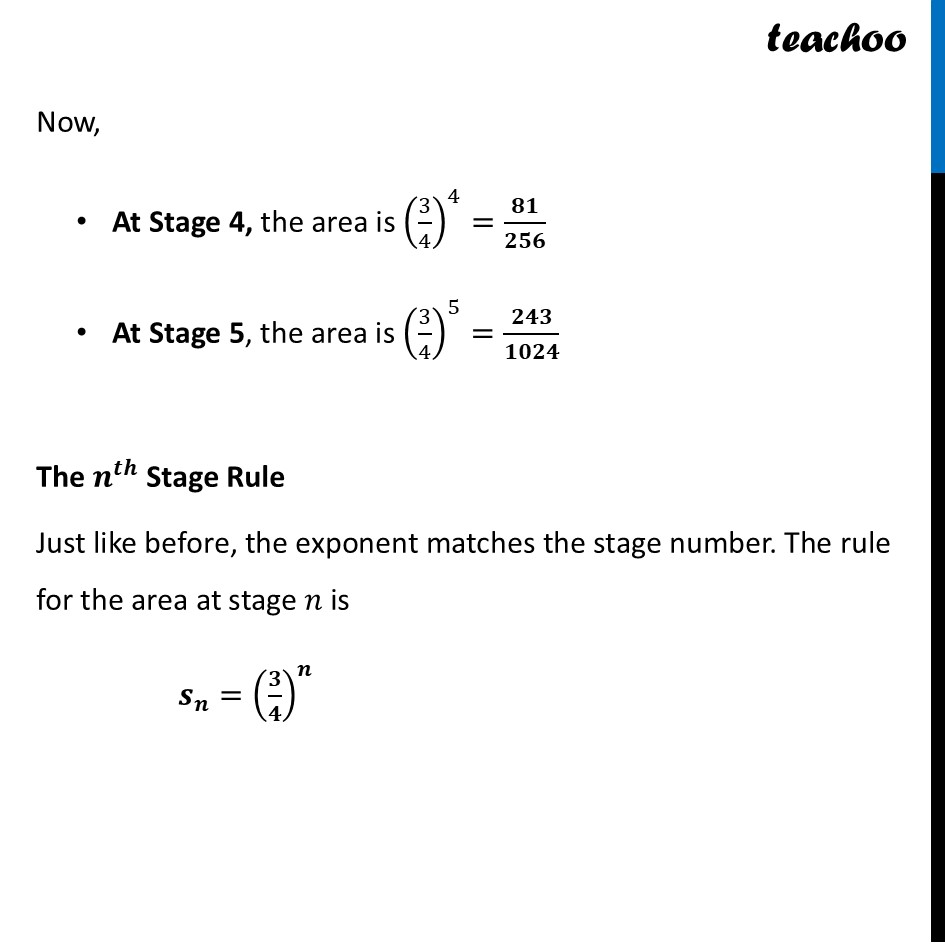
Question 1 - Think & Reflect (Page 189) (a) Observe the Sierpiński triangle and try to answer the following questions (a) How many black triangles are there in Stages 0 to 3 of Fig. 8.7? Our number of triangles are 1, 3, 9, 27, …. Thus, we can say Stage 0: 1 triangle Stage 1: 1 × 3=𝟑 triangles Stage 2: 3 × 3=𝟗 triangles Stage 3: 9 × 3=𝟐𝟕 triangles Question 1 - Think & Reflect (Page 189) (b) Observe the Sierpiński triangle and try to answer the following questions (b) Can you predict the number of black triangles at Stages 4 and 5? Now, Number of triangles in Stage 4 = 3 × Number of triangles in Stage 3 = 3 × 27 = 81 Now, Number of triangles in Stage 5 = 3 × Number of triangles in Stage 4 = 3 × 81 = 243 Question 1 - Think & Reflect (Page 189) (c) Observe the Sierpiński triangle and try to answer the following questions (c) Can you find a rule for the number of black triangles at the nth stage? So, our number of triangles form a GP 1, 3, 9, 27, …. With First term = a = 1 Common ratio = r = 3 But, the first term is Stage 0 So, we can write Number of triangles in Stage n = (n + 1)th term of GP = an + 1 = 𝑎 × 𝑟^((𝑛 + 1)−1) = 𝑎 × 𝑟^𝑛 Putting values = 1 × 3^𝑛 = 𝟑^𝒏 But, the first term is Stage 0 So, we can write Number of triangles in Stage n = (n + 1)th term of GP = an + 1 = 𝑎 × 𝑟^((𝑛 + 1)−1) = 𝑎 × 𝑟^𝑛 Putting values = 1 × 3^𝑛 = 𝟑^𝒏 Question 1 - Think & Reflect (Page 189) (d) Observe the Sierpiński triangle and try to answer the following questions (d) Suppose the area of the triangle (that is, the black region) in Stage 0 is 1 square unit. What is the area of the black region in Stages 1, 2 and 3? What will be the area of the black region in Stages 4 and 5? Find a rule for the area of the black region at the nth stage. What happens to this area as n, the number of stages, goes on increasing? Now, let's look at the area (the total amount of black space). Let's assume the very first triangle at Stage 0 has a total area of 1 square unit When we move to Stage 1, we divide that area into 4 equal pieces, and we throw 1 piece away This means we are only keeping 3 out of the 4 pieces Mathematically, we are multiplying the area by 𝟑/𝟒 Thus, we can write Stage 0: Area = 1 Stage 1: 1×3/4=3/4 Stage 2: 3/4×3/4=(3/4)^2=9/16 Stage 3: 9/16×3/4=(3/4)^3=27/64 The Math (A shrinking GP) This is also a Geometric Progression, but our common ratio is a fraction: 𝒓=𝟑/𝟒. Because we are multiplying by a number smaller than 1 , the total area keeps shrinking. Now, At Stage 4, the area is (3/4)^4=𝟖𝟏/𝟐𝟓𝟔 At Stage 5, the area is (3/4)^5=𝟐𝟒𝟑/𝟏𝟎𝟐𝟒 Now, At Stage 4, the area is (3/4)^4=𝟖𝟏/𝟐𝟓𝟔 At Stage 5, the area is (3/4)^5=𝟐𝟒𝟑/𝟏𝟎𝟐𝟒 The 𝒏^𝒕𝒉 Stage Rule Just like before, the exponent matches the stage number. The rule for the area at stage 𝑛 is 𝒔_𝒏=(𝟑/𝟒)^𝒏