
 You are here
![Mean when a Number is Added to each term [Class 8 Ganita Prakash II] - Tinkering with Mean](https://cdn.teachoo.com/1b4a7300-7bc1-4218-9481-e1c571f4d67c/slide32.jpg)
Last updated at March 5, 2026 by Teachoo
Transcript
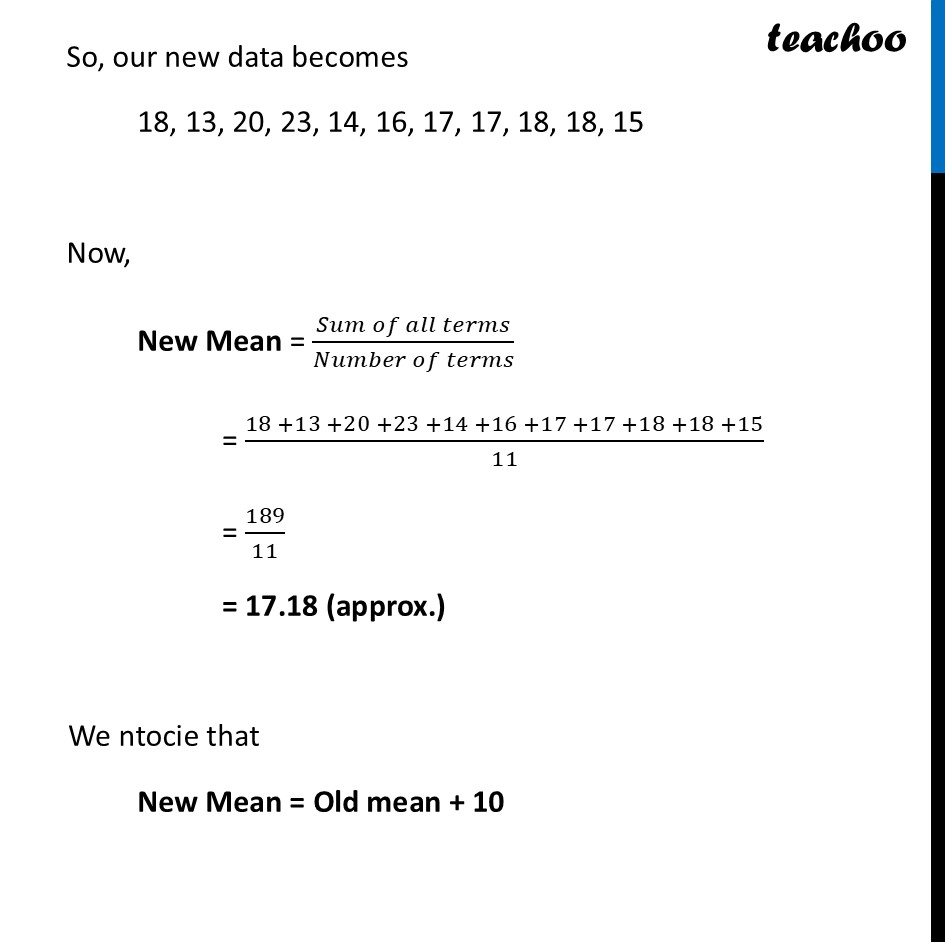
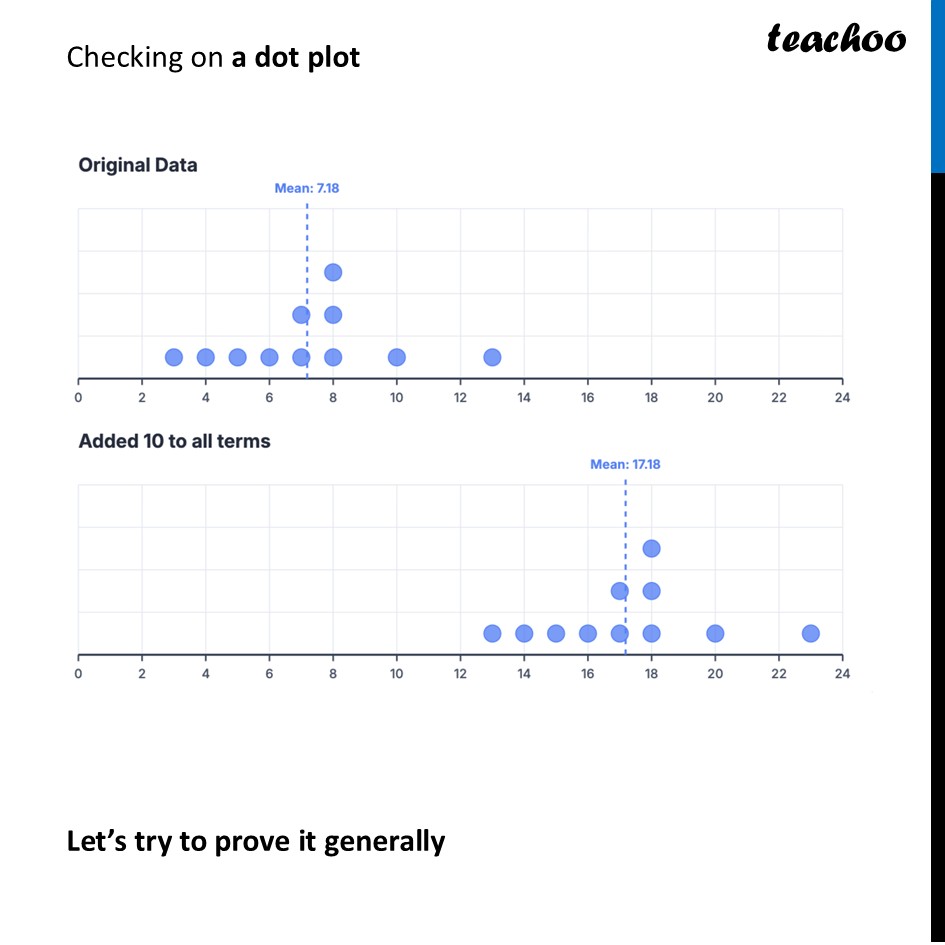
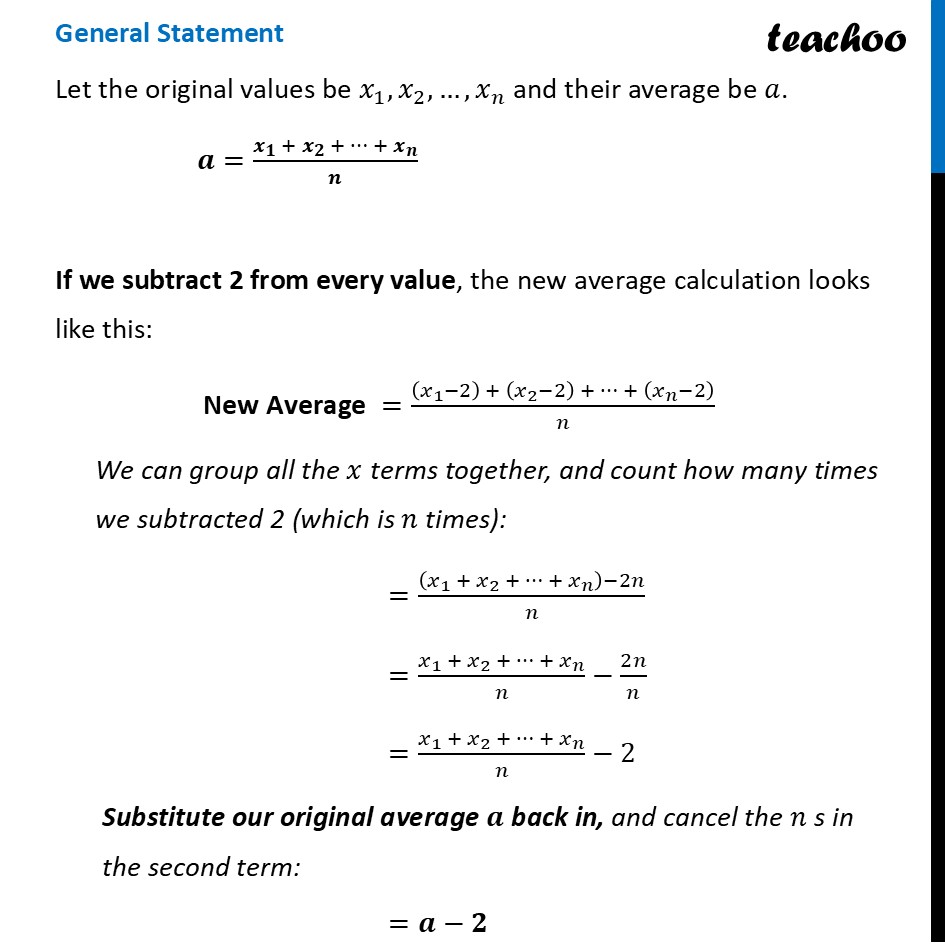
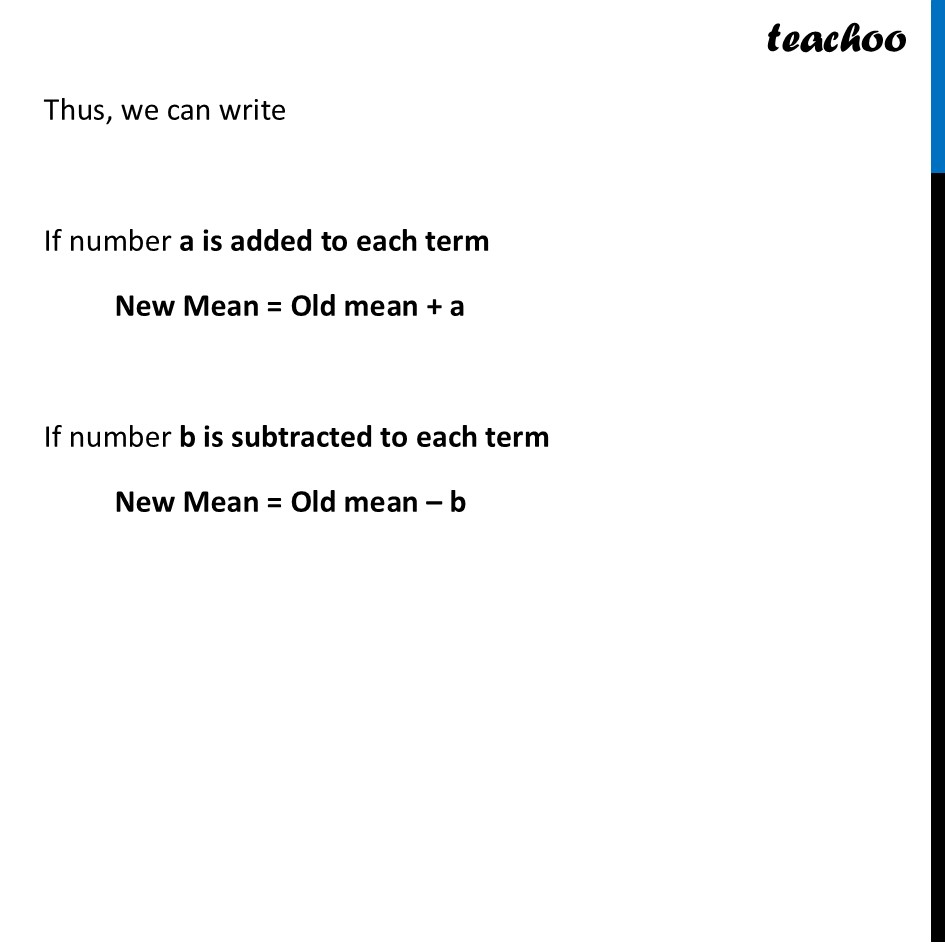
Mean when a Number is Added to each termLet’s Consider the data: 8, 3, 10, 13, 4, 6, 7, 7, 8, 8, 5. Finding its mean Now, Mean = (𝑆𝑢𝑚 𝑜𝑓 𝑎𝑙𝑙 𝑡𝑒𝑟𝑚𝑠)/(𝑁𝑢𝑚𝑏𝑒𝑟 𝑜𝑓 𝑡𝑒𝑟𝑚𝑠) = (8 + 3 + 10 + 13 + 4 + 6 + 7 + 7 + 8 + 8 + 5)/11 = 79/11 = 7.18 (approx.) Now, let’s add each term with 10 So, our new data becomes 18, 13, 20, 23, 14, 16, 17, 17, 18, 18, 15 Now, New Mean = (𝑆𝑢𝑚 𝑜𝑓 𝑎𝑙𝑙 𝑡𝑒𝑟𝑚𝑠)/(𝑁𝑢𝑚𝑏𝑒𝑟 𝑜𝑓 𝑡𝑒𝑟𝑚𝑠) = (18 +13 +20 +23 +14 +16 +17 +17 +18 +18 +15)/11 = 189/11 = 17.18 (approx.) We ntocie that New Mean = Old mean + 10 Checking on a dot plot Let’s try to prove it generally General Statement Let the original values be 𝑥_1,𝑥_2,…,𝑥_𝑛 and their average be 𝑎. 𝒂=(𝒙_𝟏 + 𝒙_𝟐 + ⋯ + 𝒙_𝒏)/𝒏 If we subtract 2 from every value, the new average calculation looks like this: " New Average "=((𝑥_1−2) + (𝑥_2−2) + ⋯ + (𝑥_𝑛−2))/𝑛 We can group all the 𝑥 terms together, and count how many times we subtracted 2 (which is 𝑛 times): =((𝑥_1 + 𝑥_2 + ⋯ + 𝑥_𝑛 )−2𝑛)/𝑛 =(𝑥_1 + 𝑥_2 + ⋯ + 𝑥_𝑛)/𝑛−2𝑛/𝑛 =(𝑥_1 + 𝑥_2 + ⋯ + 𝑥_𝑛)/𝑛−2 Substitute our original average 𝒂 back in, and cancel the 𝑛 s in the second term: =𝒂−𝟐 Thus, we can write If number a is added to each term New Mean = Old mean + a If number b is subtracted to each term New Mean = Old mean – b
