
 You are here
Last updated at March 5, 2026 by Teachoo
Transcript
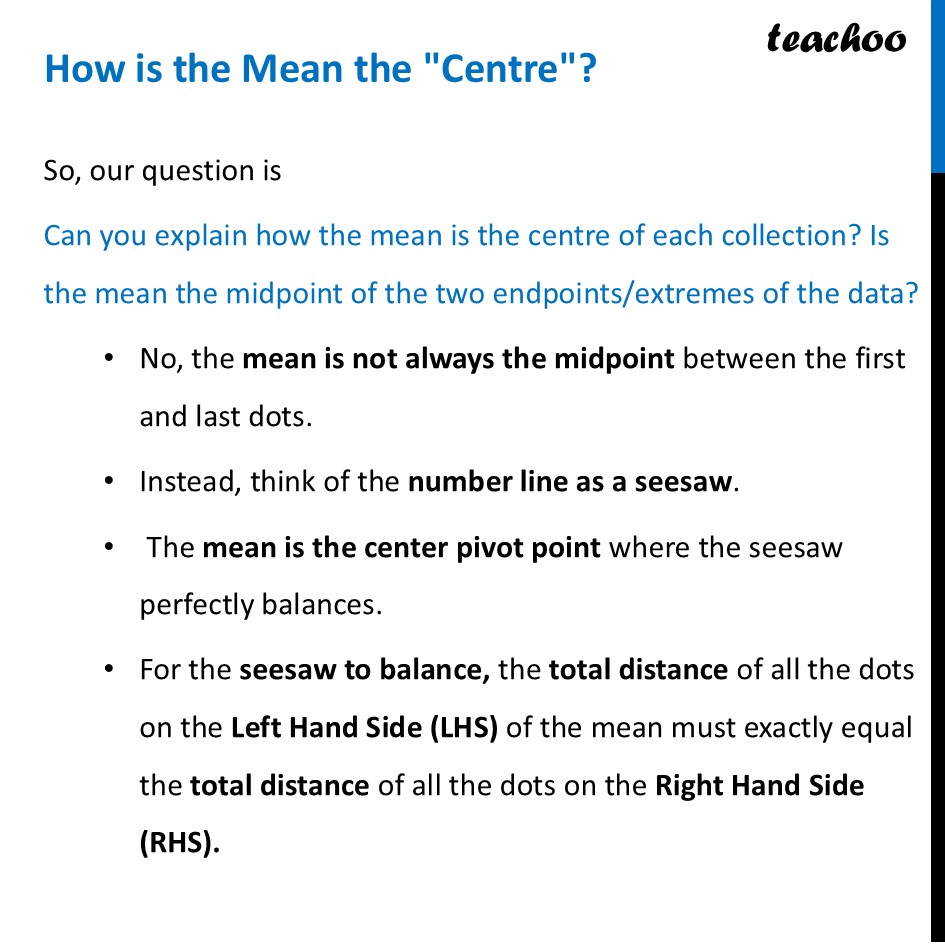
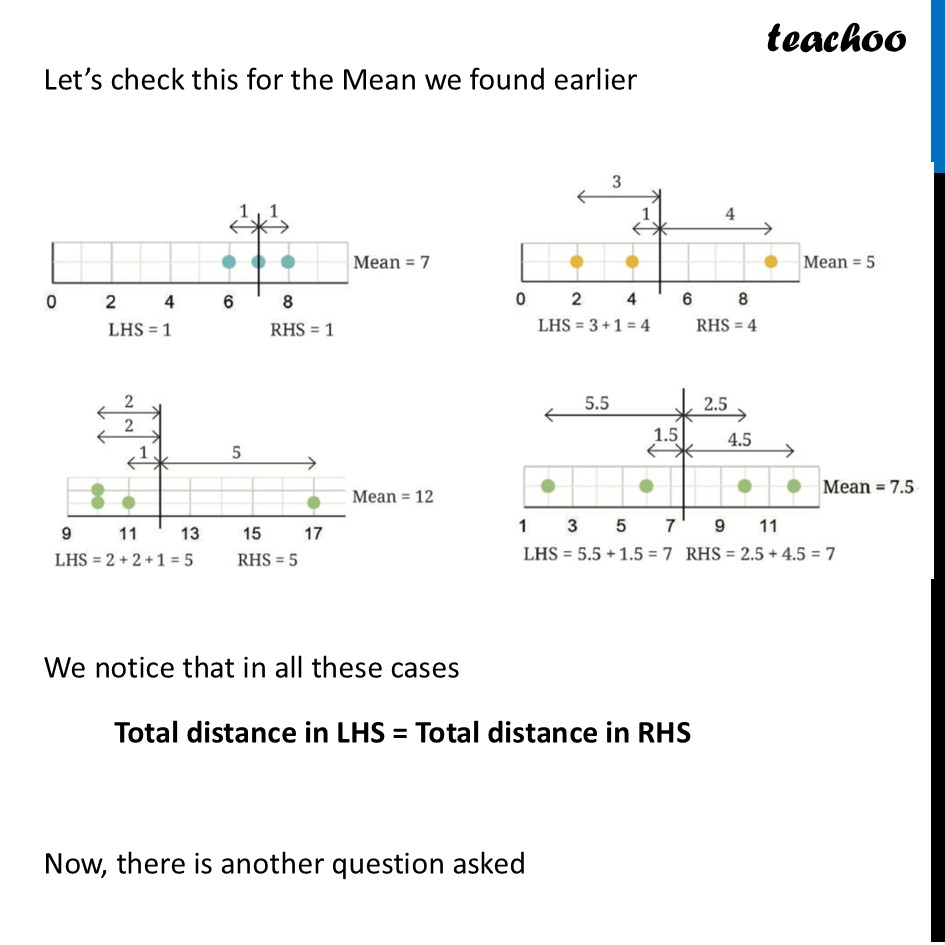
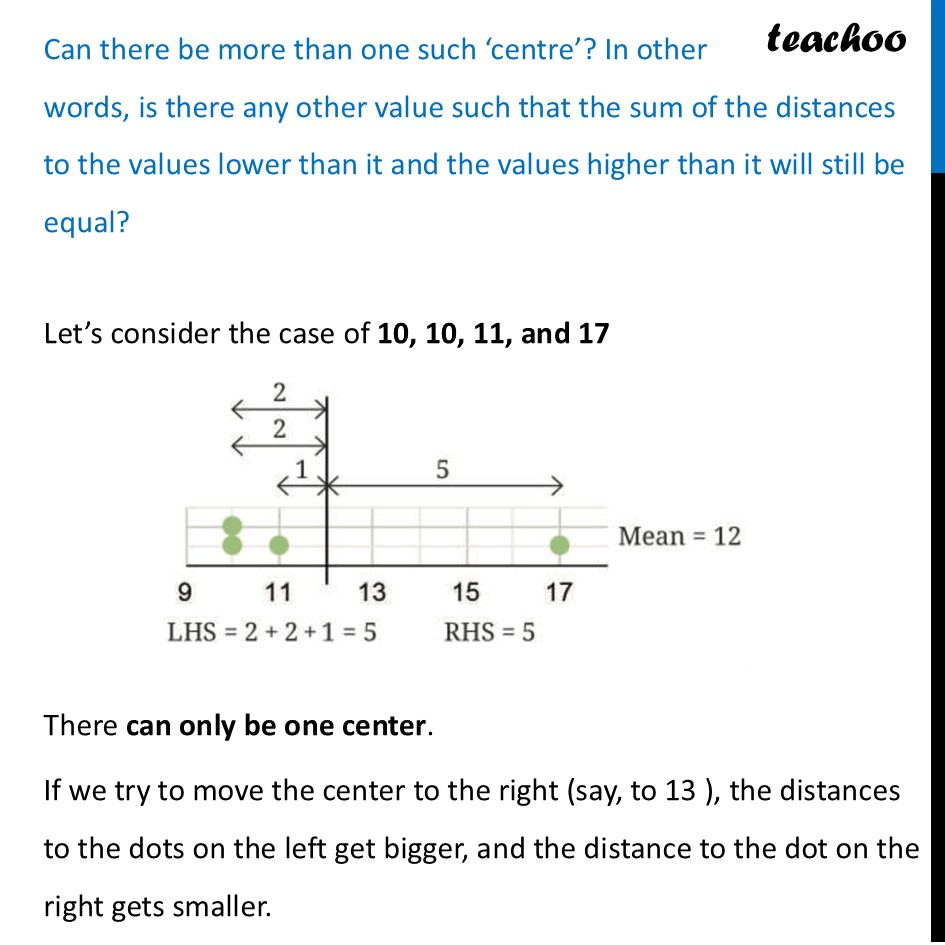
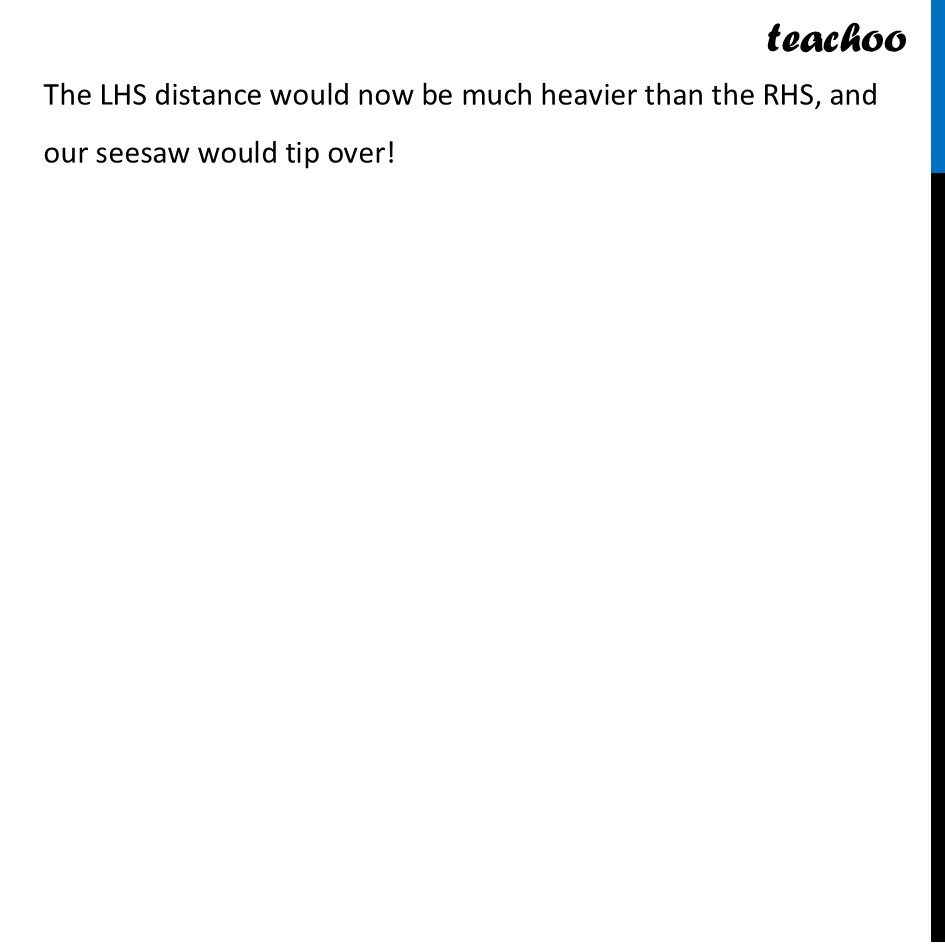
How is the Mean the "Centre"?So, our question is Can you explain how the mean is the centre of each collection? Is the mean the midpoint of the two endpoints/extremes of the data? No, the mean is not always the midpoint between the first and last dots. Instead, think of the number line as a seesaw. The mean is the center pivot point where the seesaw perfectly balances. For the seesaw to balance, the total distance of all the dots on the Left Hand Side (LHS) of the mean must exactly equal the total distance of all the dots on the Right Hand Side (RHS). Let’s check this Question: Verify that this holds for all the collections of data shown earlier. Let's verify this using Plot 3 from our first set (the dots at 2,4 , and 9 where the mean is 5 ): LHS Distances (from 5): The dot at 𝟒 is 𝟏 step away. The dot at 2 is 𝟑 steps away. Total LHS distance =1+3=4. RHS Distances (from 5): The dot at 9 is 𝟒 steps away. Total RHS distance =𝟒. LHS (4) = RHS (4). It perfectly balances! Questions: Can there be more than one such 'centre'? In the case of the collection 10, 10, 11, and 17 whose mean is 12, suppose there is a different centre larger than 12. There can only be one center. If we try to move the center to the right (say, to 13 ), the distances to the dots on the left get bigger, and the distance to the dot on the right gets smaller. The LHS distance would now be much heavier than the RHS, and our seesaw would tip over! Let’s check this for the Mean we found earlier We notice that in all these cases Total distance in LHS = Total distance in RHS Now, there is another question asked Can there be more than one such ‘centre’? In other words, is there any other value such that the sum of the distances to the values lower than it and the values higher than it will still be equal? Let’s consider the case of 10, 10, 11, and 17 There can only be one center. If we try to move the center to the right (say, to 13 ), the distances to the dots on the left get bigger, and the distance to the dot on the right gets smaller. The LHS distance would now be much heavier than the RHS, and our seesaw would tip over!
