
 You are here
![Unchanging Mean - With Questions [Tales By Dots And Lines] - Teachoo - Tinkering with Mean](https://cdn.teachoo.com/d5d6f4f4-95c7-46db-a1fe-ad16ae7928ba/slide28.jpg)
Last updated at March 5, 2026 by Teachoo
Transcript
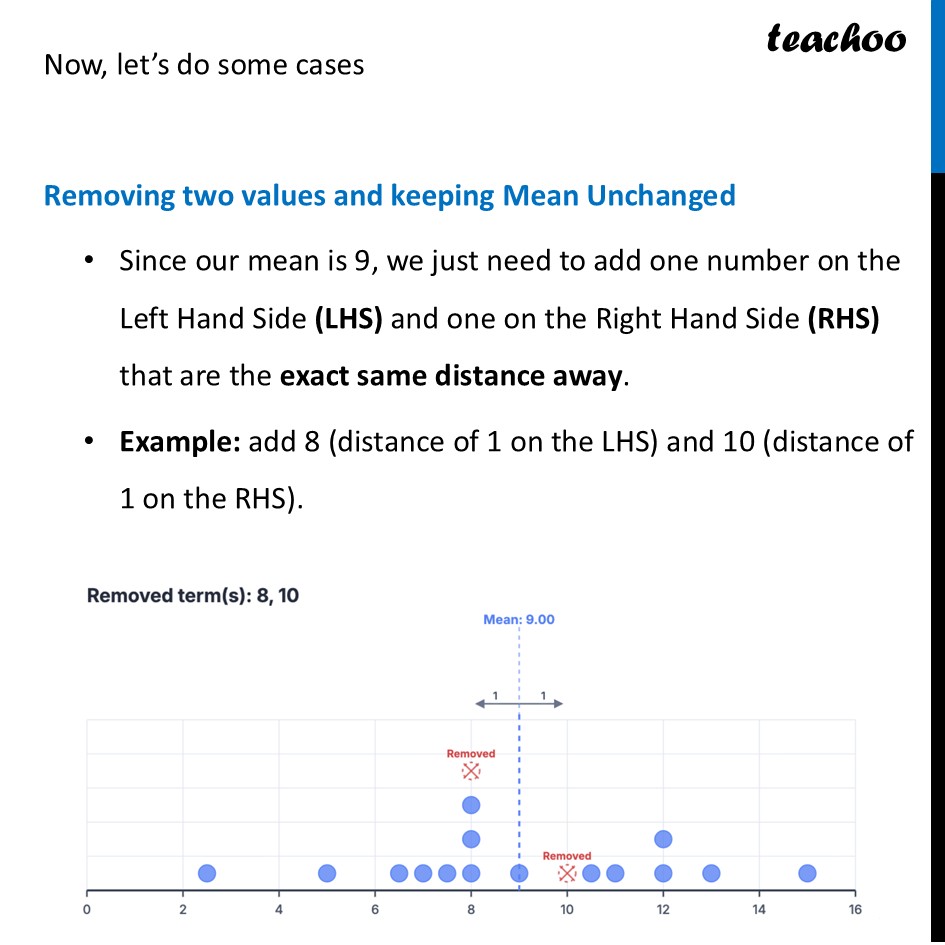
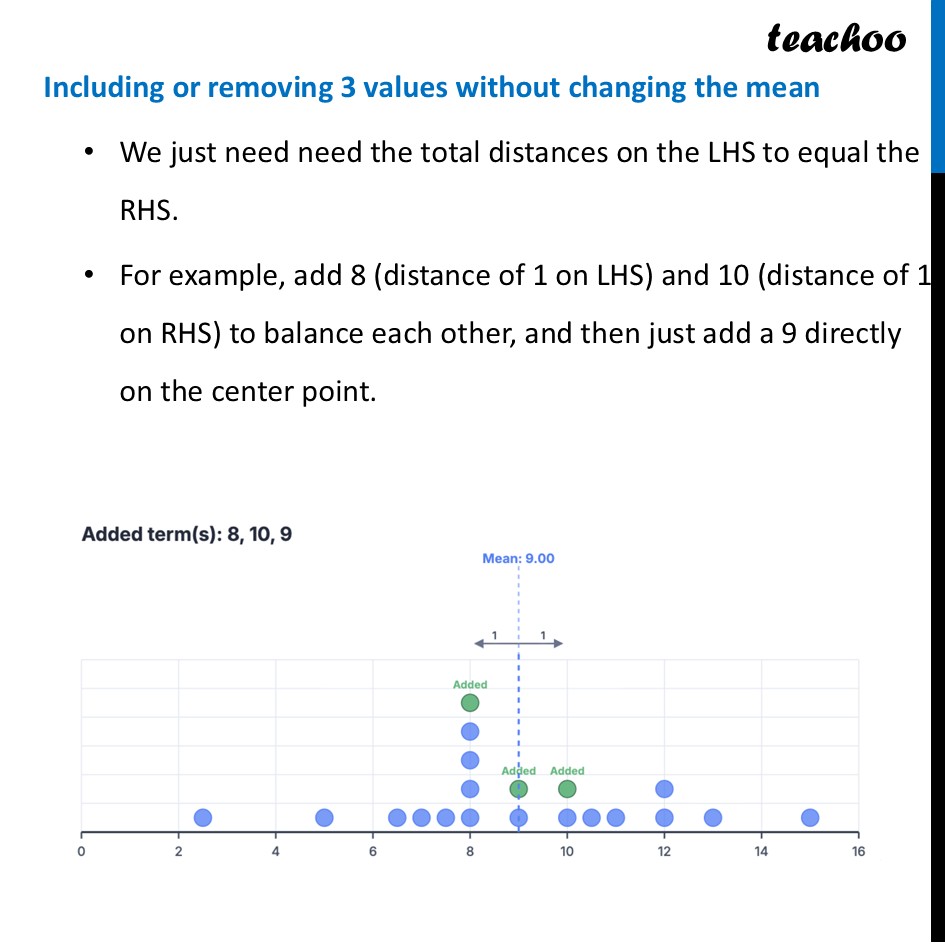
Unchanging MeanTo keep the mean exactly the same, any new values you add (or remove) must perfectly balance each other out on the left and right sides of the mean. Let’s try this data: 2.5, 5, 6.5, 7, 7.5, 8, 8, 8, 8, 9, 10, 10.5, 11, 12, 12, 13, 15 Plotting a dot plot Now, let’s do some cases Removing two values and keeping Mean Unchanged Since our mean is 9, we just need to add one number on the Left Hand Side (LHS) and one on the Right Hand Side (RHS) that are the exact same distance away. Example: add 8 (distance of 1 on the LHS) and 10 (distance of 1 on the RHS). Including or removing 3 values without changing the mean We just need need the total distances on the LHS to equal the RHS. For example, add 8 (distance of 1 on LHS) and 10 (distance of 1 on RHS) to balance each other, and then just add a 9 directly on the center point. Now, let’s do a question Try to include 2 values greater than the mean and 1 value less than the mean, so that the mean stays the same. Let's build this balance: RHS (Greater than mean): Let's pick two values that are 1 unit greater than the mean of 9. So, we add two 10s. The total distance on the right is 1+1=2. LHS (Less than mean): To balance a right-side weight of 2 , we need our single left-side number to be exactly 2 units away from the mean. 9−2=7. So, we add one 7 . Answer: Adding 10, 10, and 𝟕 keeps the mean perfectly at 9 Checking Dot Plot
