
 You are here

Look Before You Leap!
Last updated at January 28, 2026 by Teachoo
Transcript
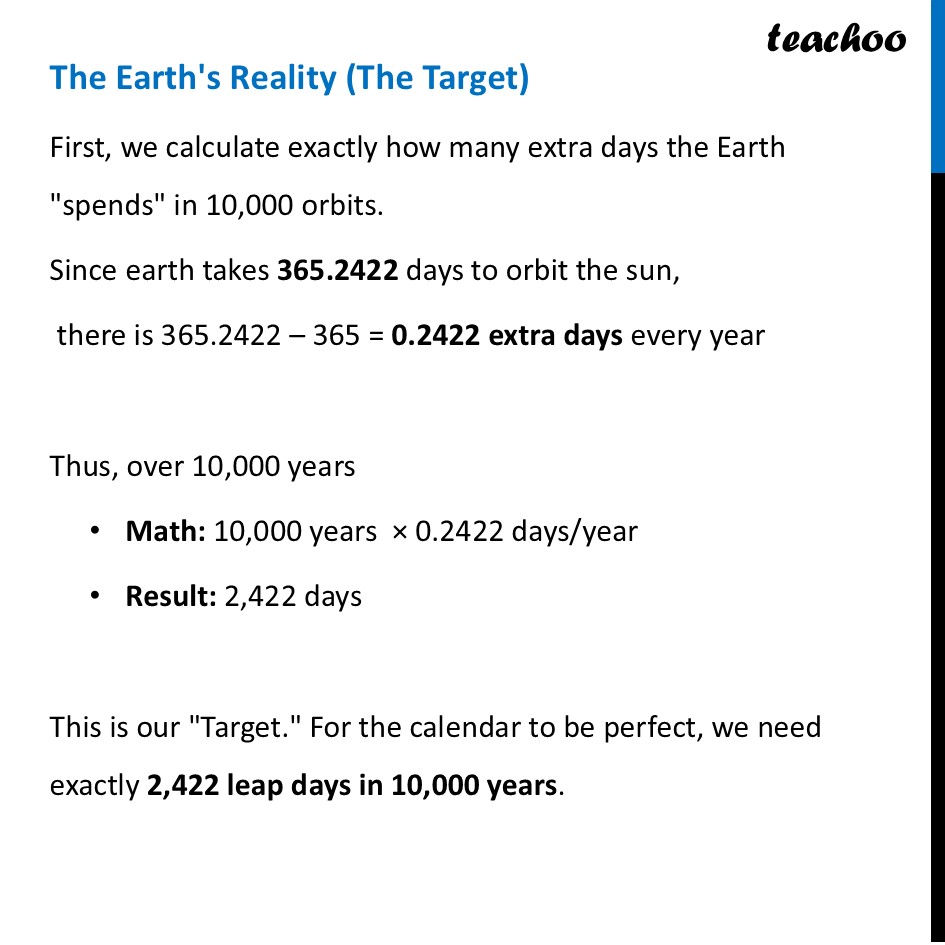
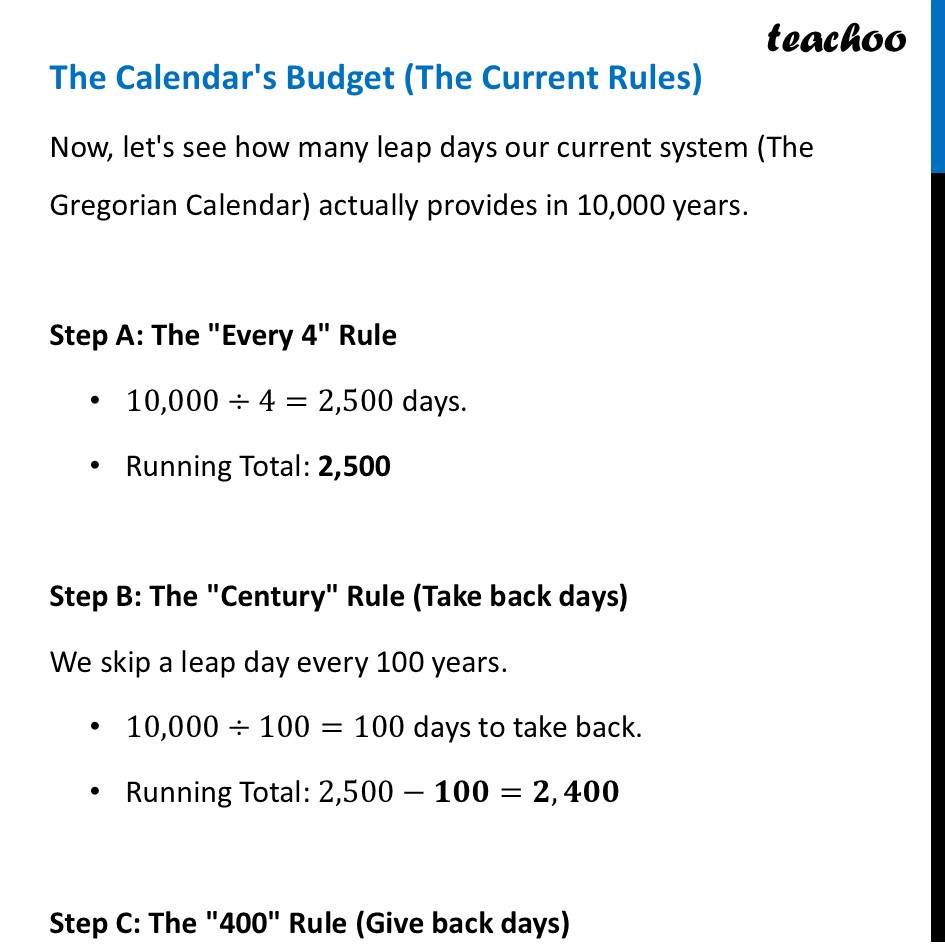
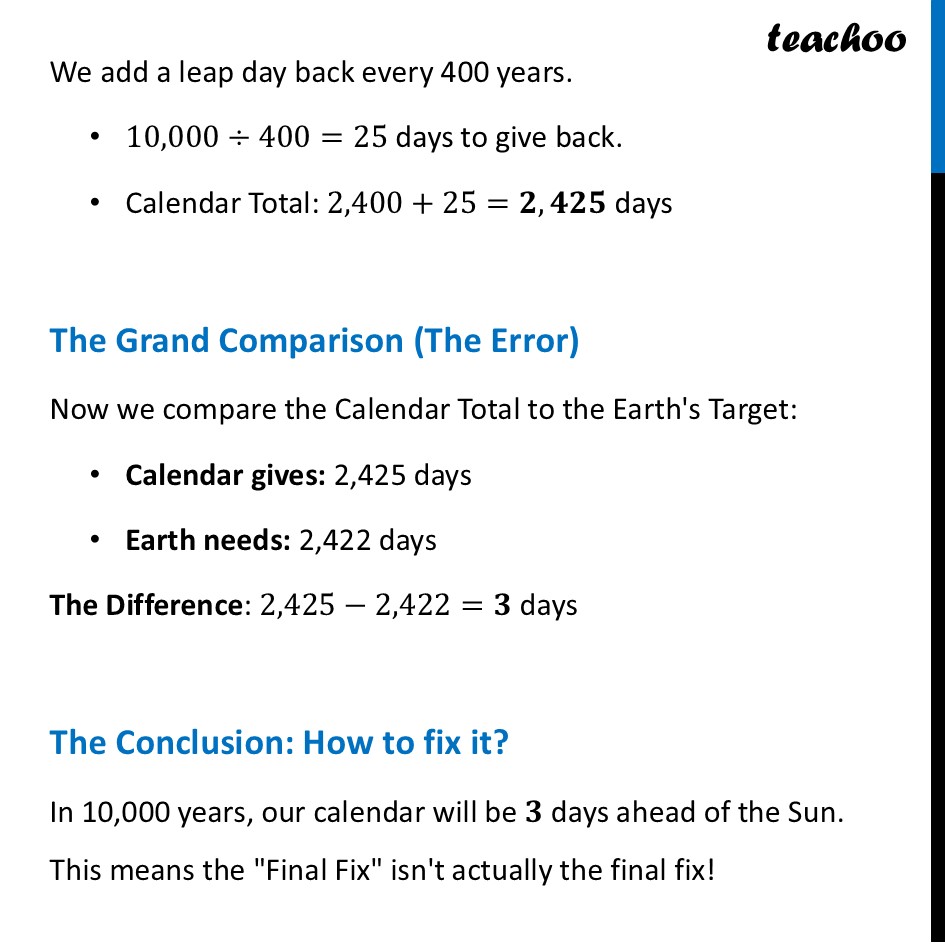
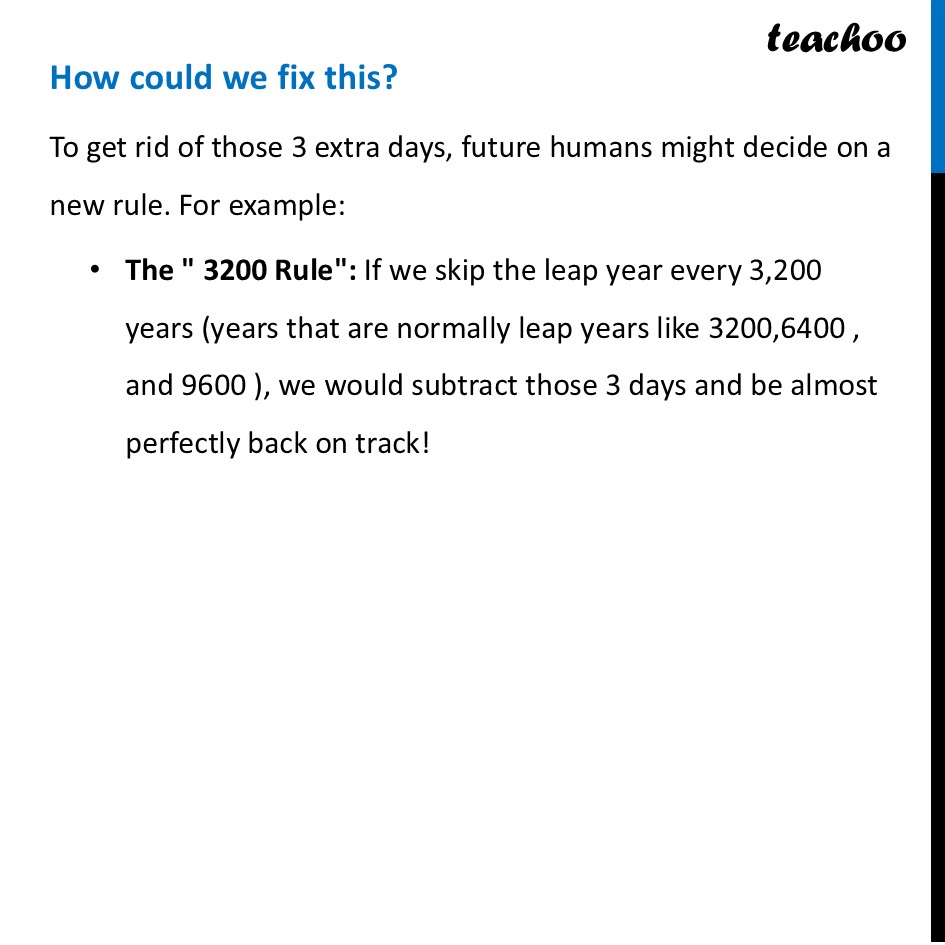
What happens over 10,000 years?The Earth's Reality (The Target) First, we calculate exactly how many extra days the Earth "spends" in 10,000 orbits. Since earth takes 365.2422 days to orbit the sun, there is 365.2422 – 365 = 0.2422 extra days every year Thus, over 10,000 years Math: 10,000 years × 0.2422 days/year Result: 2,422 days This is our "Target." For the calendar to be perfect, we need exactly 2,422 leap days in 10,000 years. The Calendar's Budget (The Current Rules) Now, let's see how many leap days our current system (The Gregorian Calendar) actually provides in 10,000 years. Step A: The "Every 4" Rule 10,000÷4=2,500 days. Running Total: 2,500 Step B: The "Century" Rule (Take back days) We skip a leap day every 100 years. 10,000÷100=100 days to take back. Running Total: 2,500−𝟏𝟎𝟎=𝟐,𝟒𝟎𝟎 Step C: The "400" Rule (Give back days) We add a leap day back every 400 years. 10,000÷400=25 days to give back. Calendar Total: 2,400+25=𝟐,𝟒𝟐𝟓 days The Grand Comparison (The Error) Now we compare the Calendar Total to the Earth's Target: Calendar gives: 2,425 days Earth needs: 2,422 days The Difference: 2,425−2,422=𝟑 days The Conclusion: How to fix it? In 10,000 years, our calendar will be 𝟑 days ahead of the Sun. This means the "Final Fix" isn't actually the final fix! How could we fix this? To get rid of those 3 extra days, future humans might decide on a new rule. For example: The " 3200 Rule": If we skip the leap year every 3,200 years (years that are normally leap years like 3200,6400 , and 9600 ), we would subtract those 3 days and be almost perfectly back on track!
