 You are here

![Dividend, Divisor, and Quotient - For Decimal Division [Teachoo] - Dividend, Divisor, and Quotient](https://cdn.teachoo.com/0455e260-604e-4cdf-8c4e-f2062f07cfb2/slide22.jpg)
Dividend, Divisor, and Quotient
Dividend, Divisor, and Quotient
Last updated at January 28, 2026 by Teachoo
Transcript
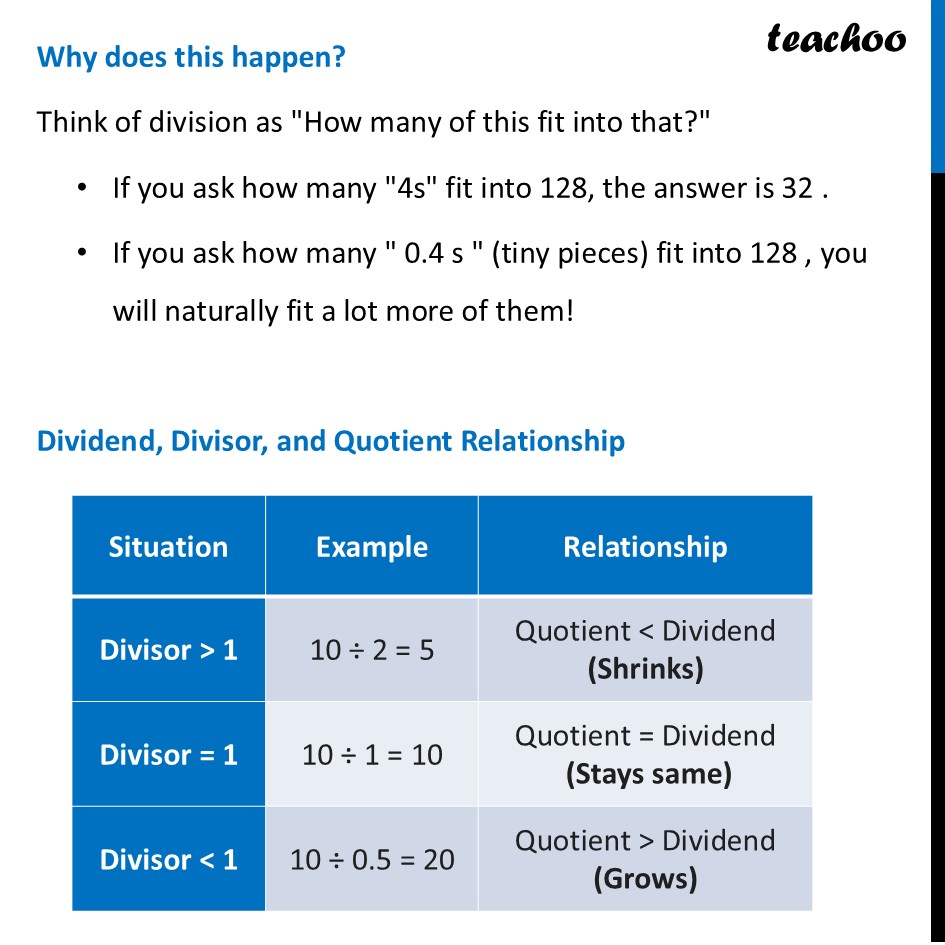
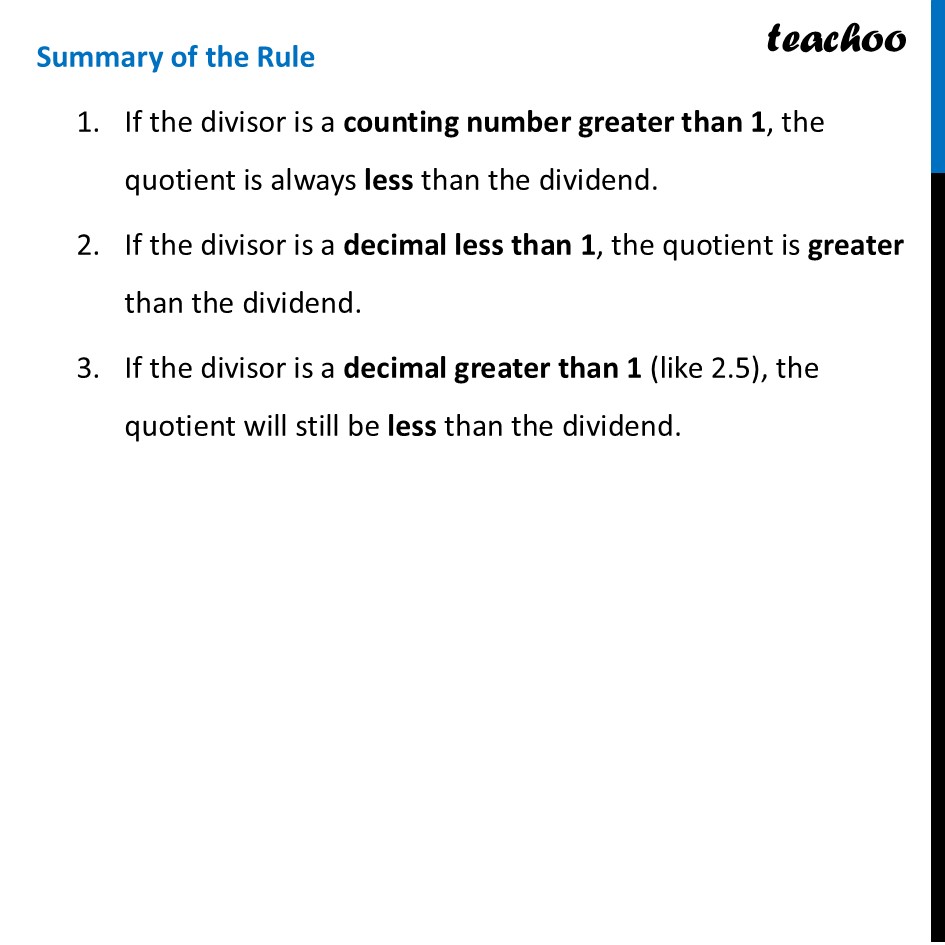
Dividend, Divisor, and QuotientUsually, when we divide two counting numbers (like 12,13,14… ), the quotient (the answer) is smaller than the dividend (the number you started with). Example: 128÷4=32. Since 32<128, the number "shrank". The Decimal Surprise When you divide by a decimal, things change. If the divisor is less than 1, the answer actually gets bigger than what you started with. Example: 128÷0.4=320. Since 320>128, the number "grew". Why does this happen? Think of division as "How many of this fit into that?" If you ask how many "4s" fit into 128, the answer is 32 . If you ask how many " 0.4 s " (tiny pieces) fit into 128 , you will naturally fit a lot more of them! Summary of the Rule If the divisor is a counting number greater than 1, the quotient is always less than the dividend. If the divisor is a decimal less than 1, the quotient is greater than the dividend. If the divisor is a decimal greater than 1 (like 2.5), the quotient will still be less than the dividend.
