
 You are here
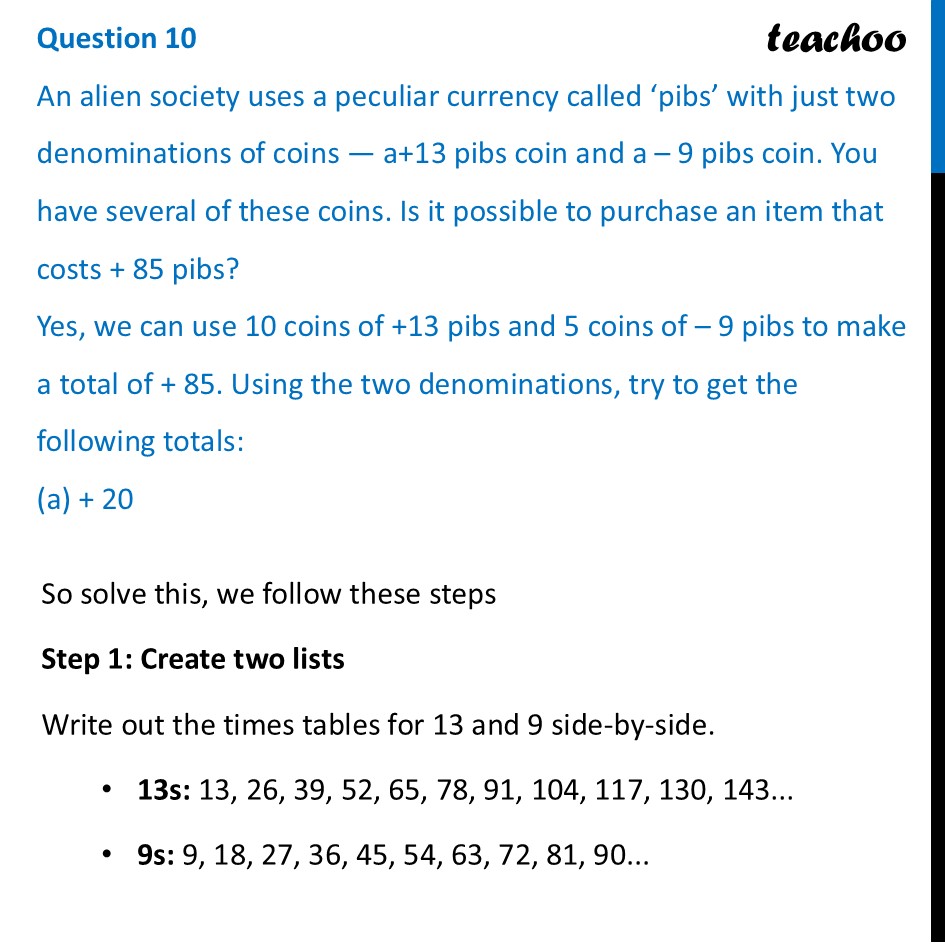
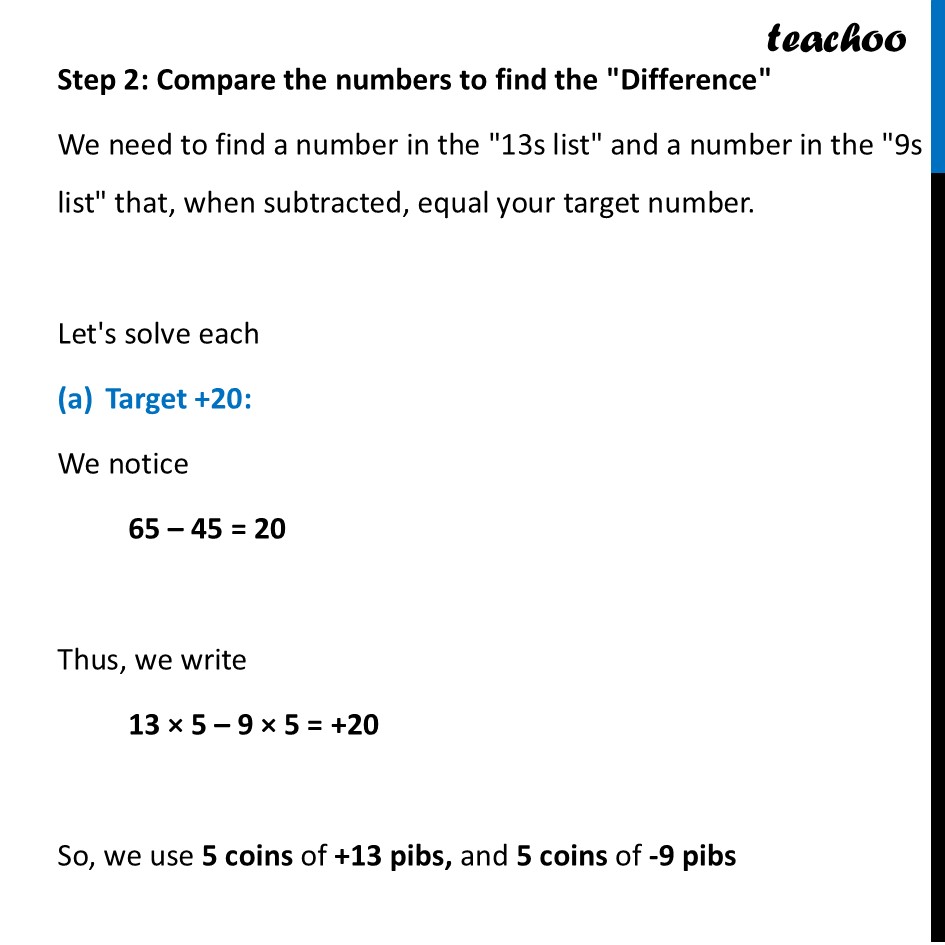
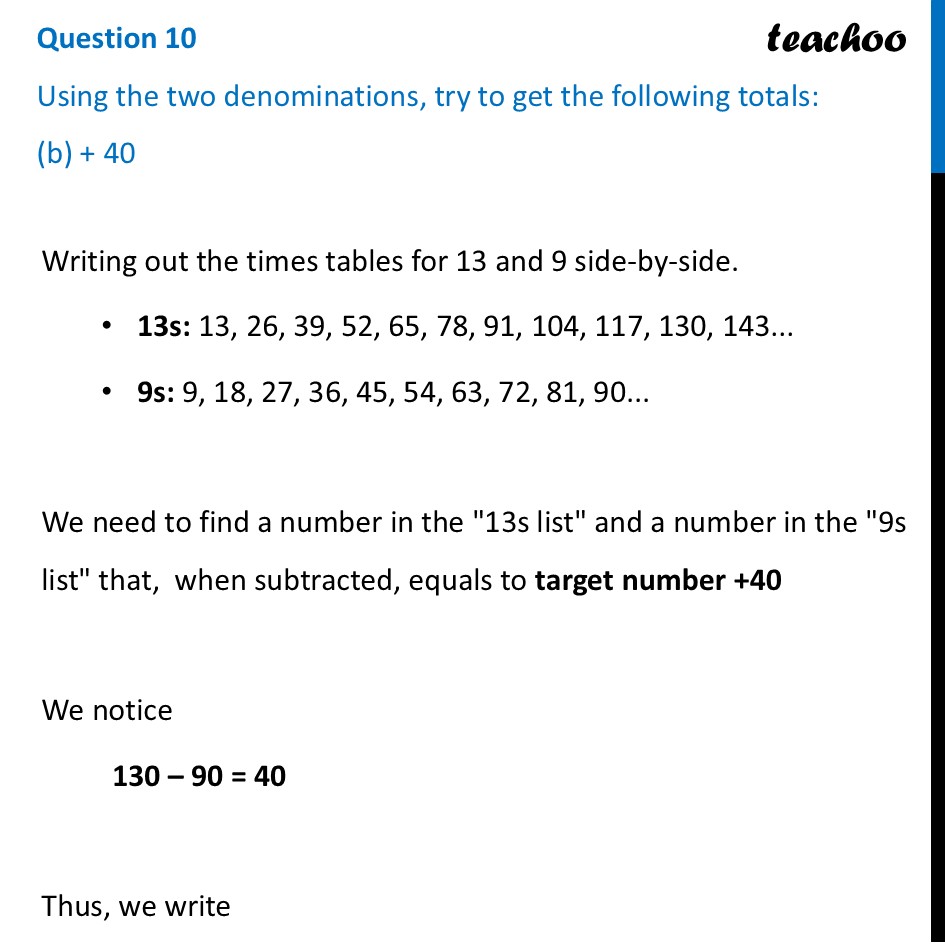
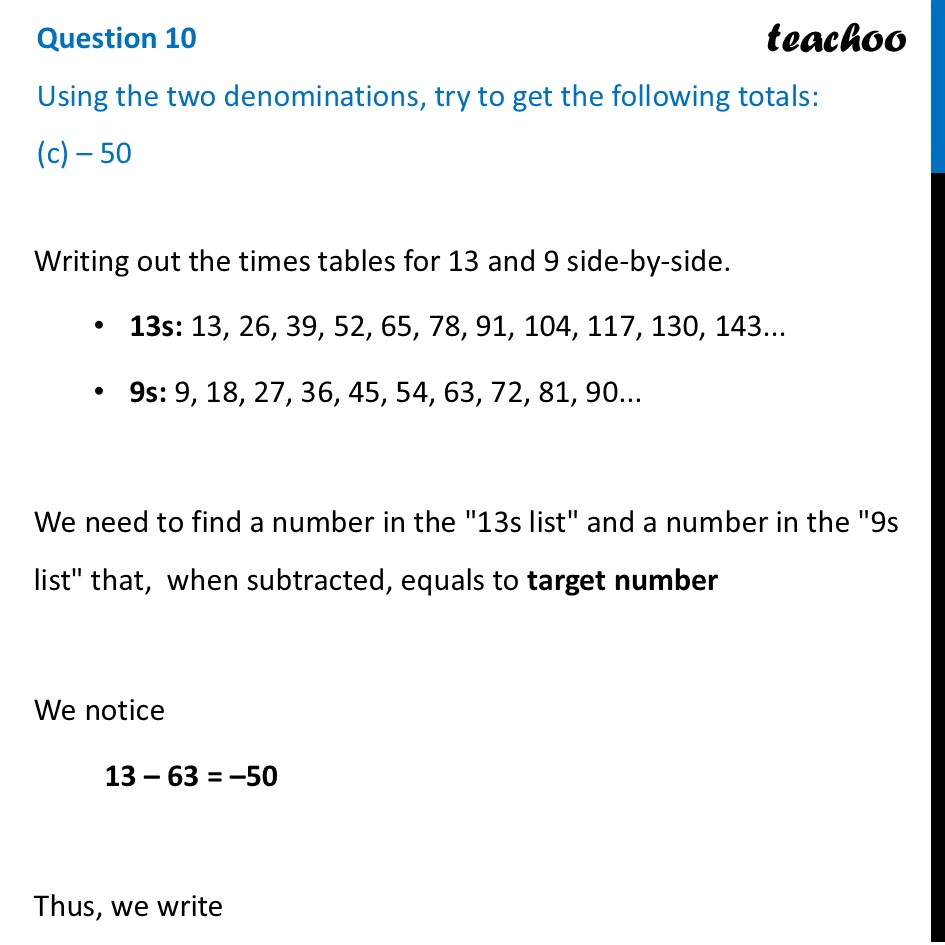
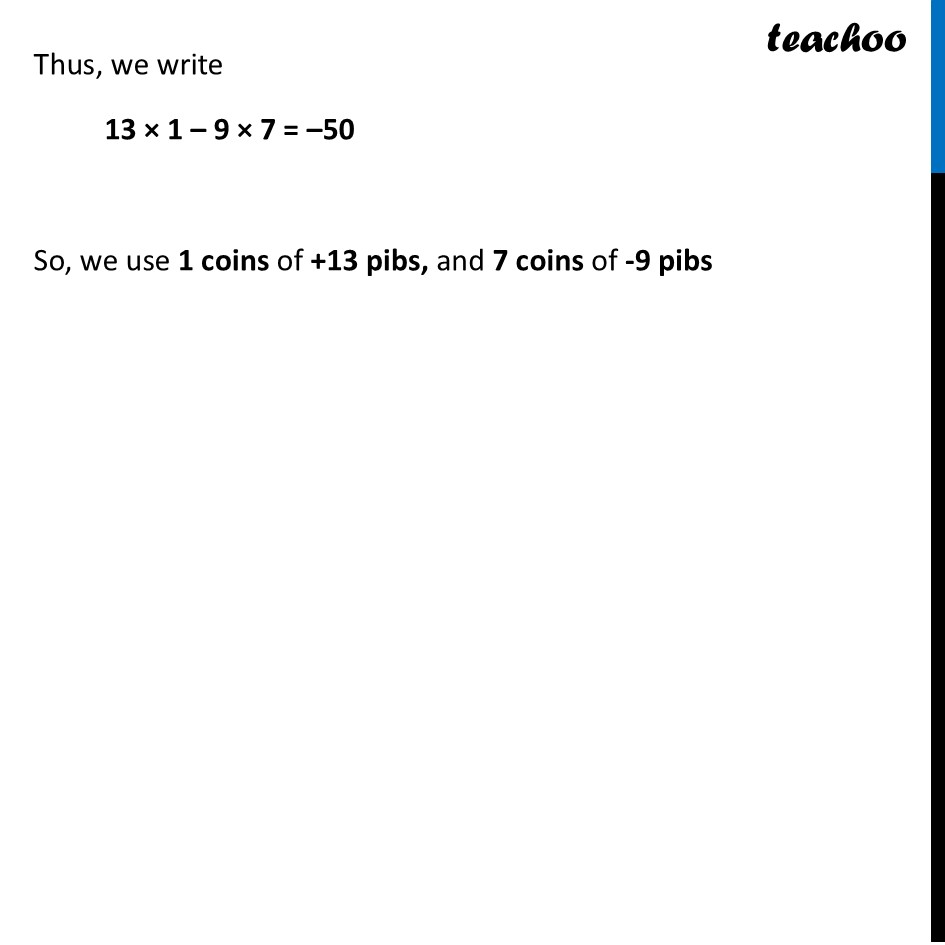
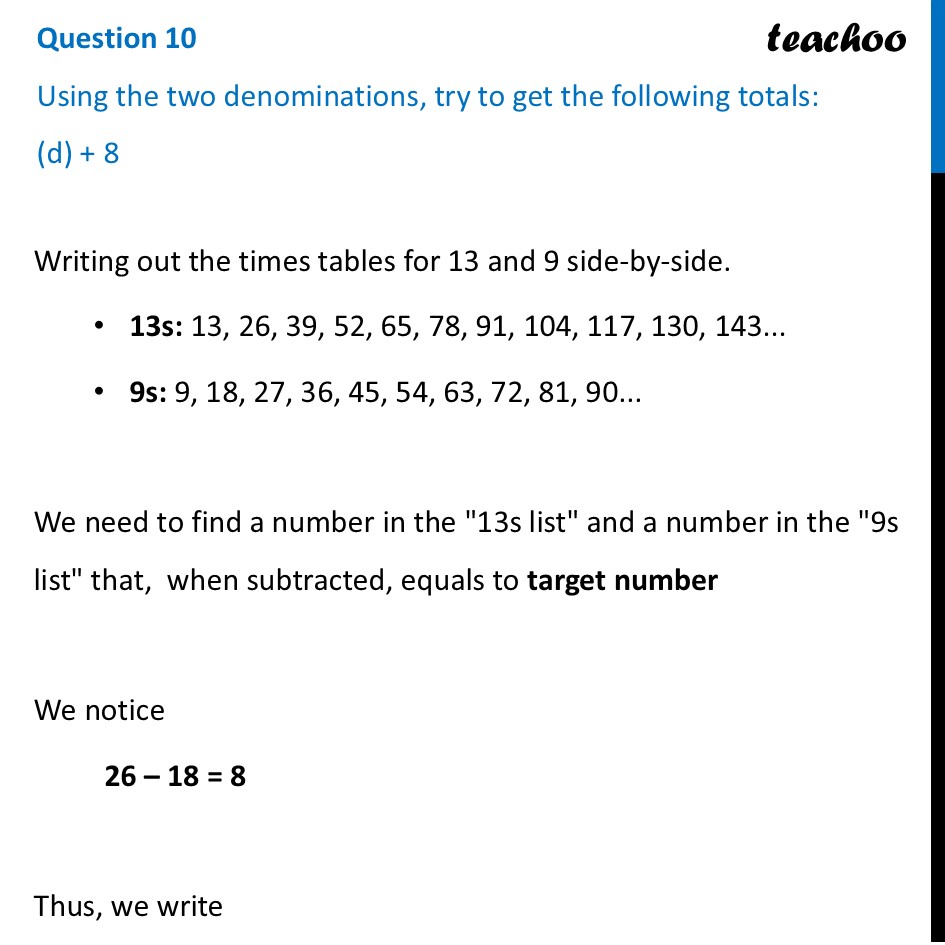
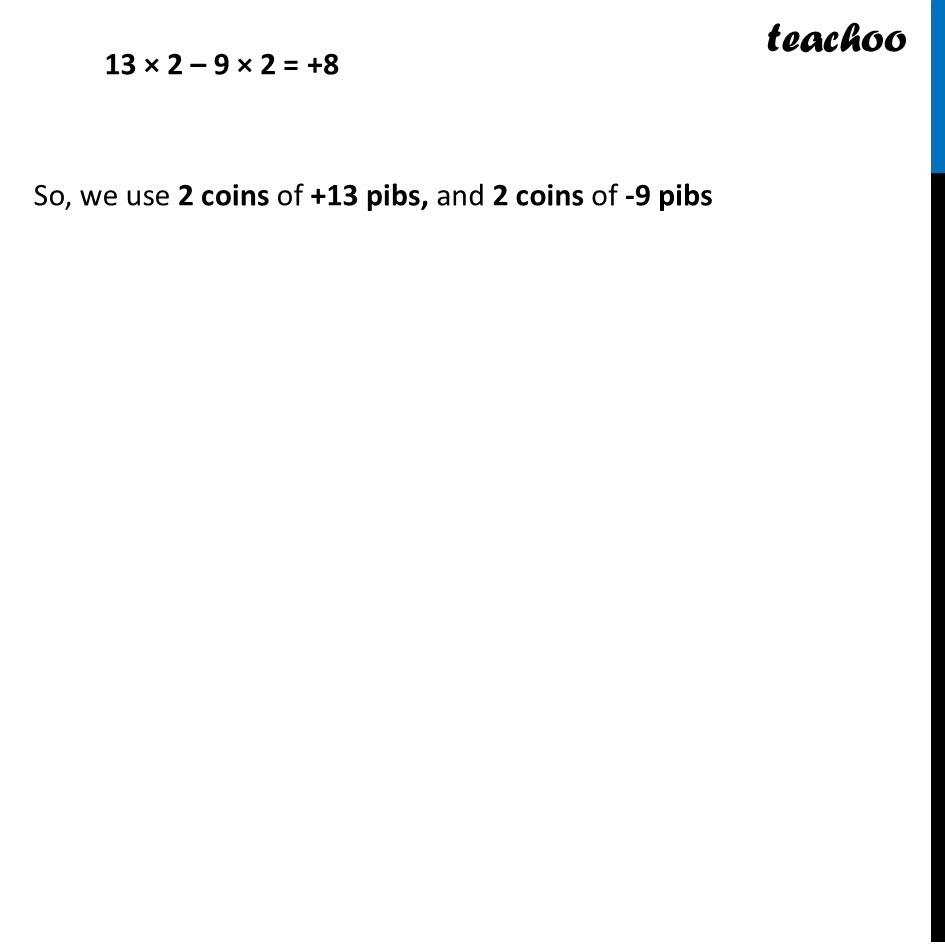
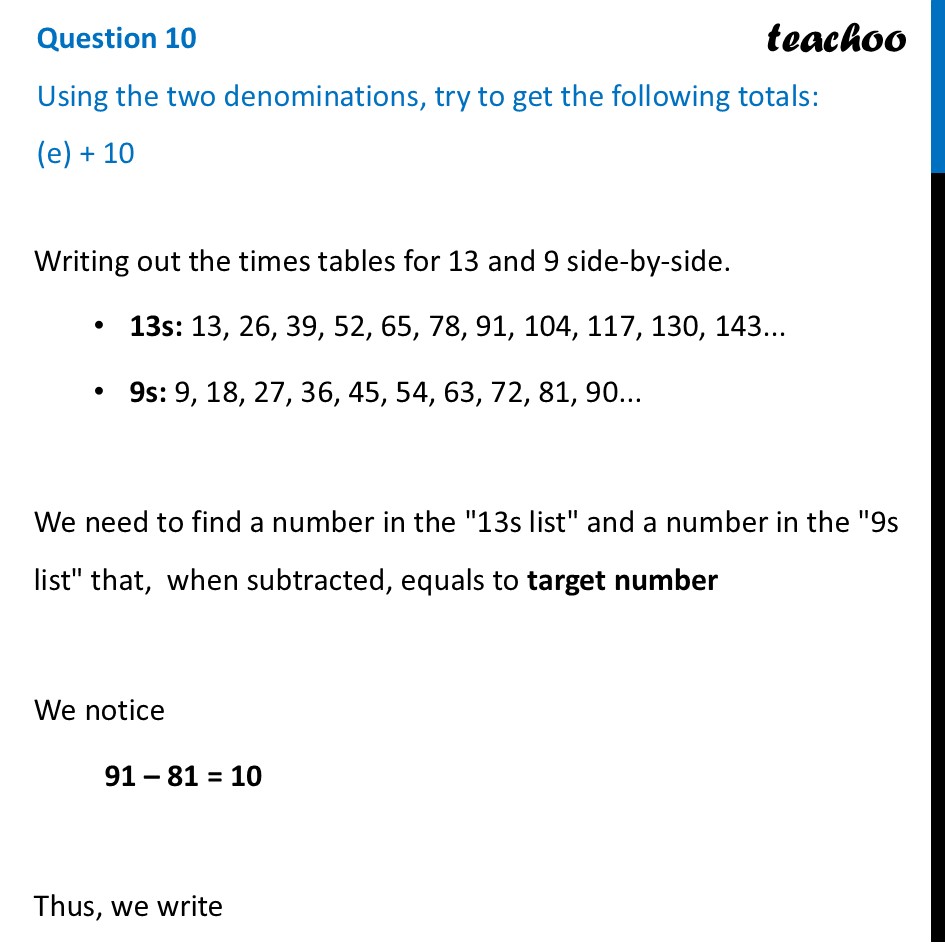
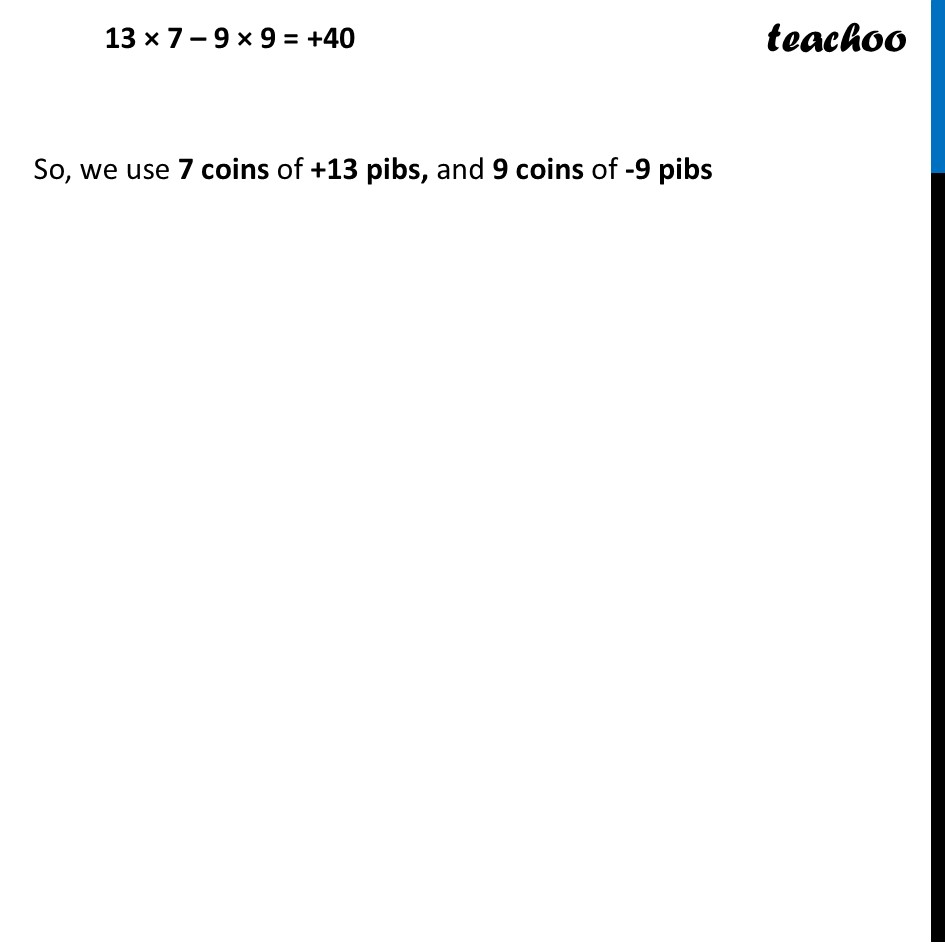
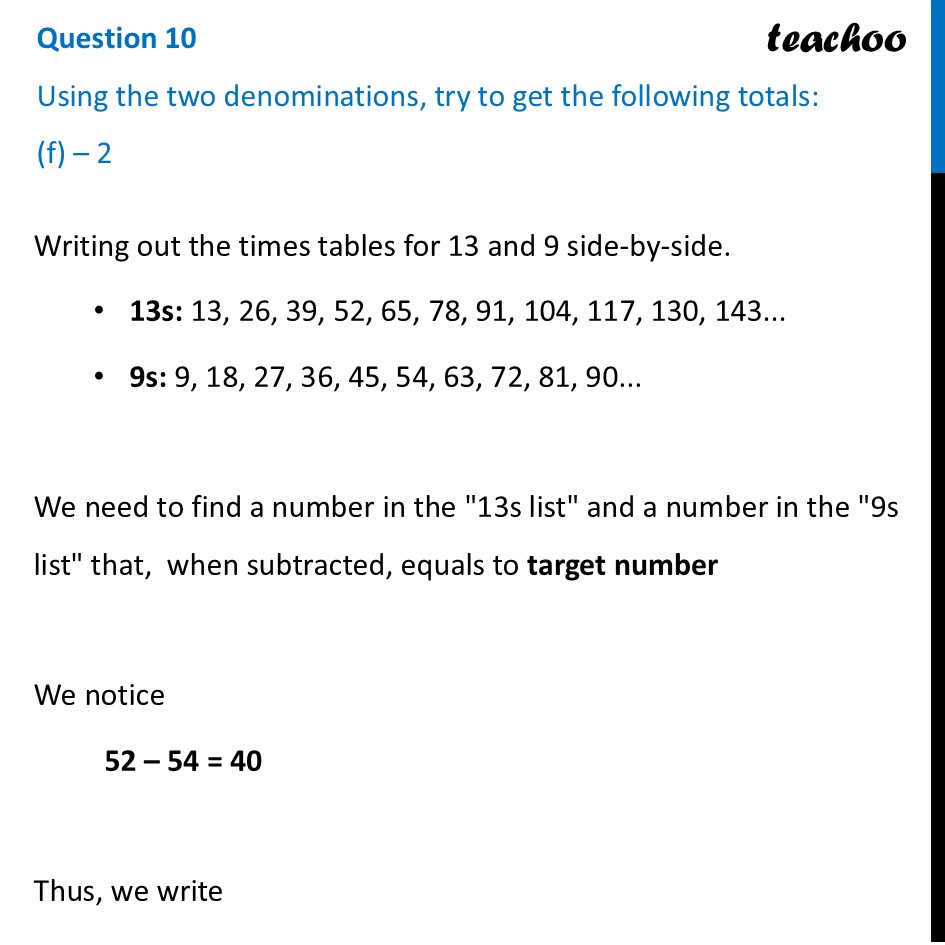
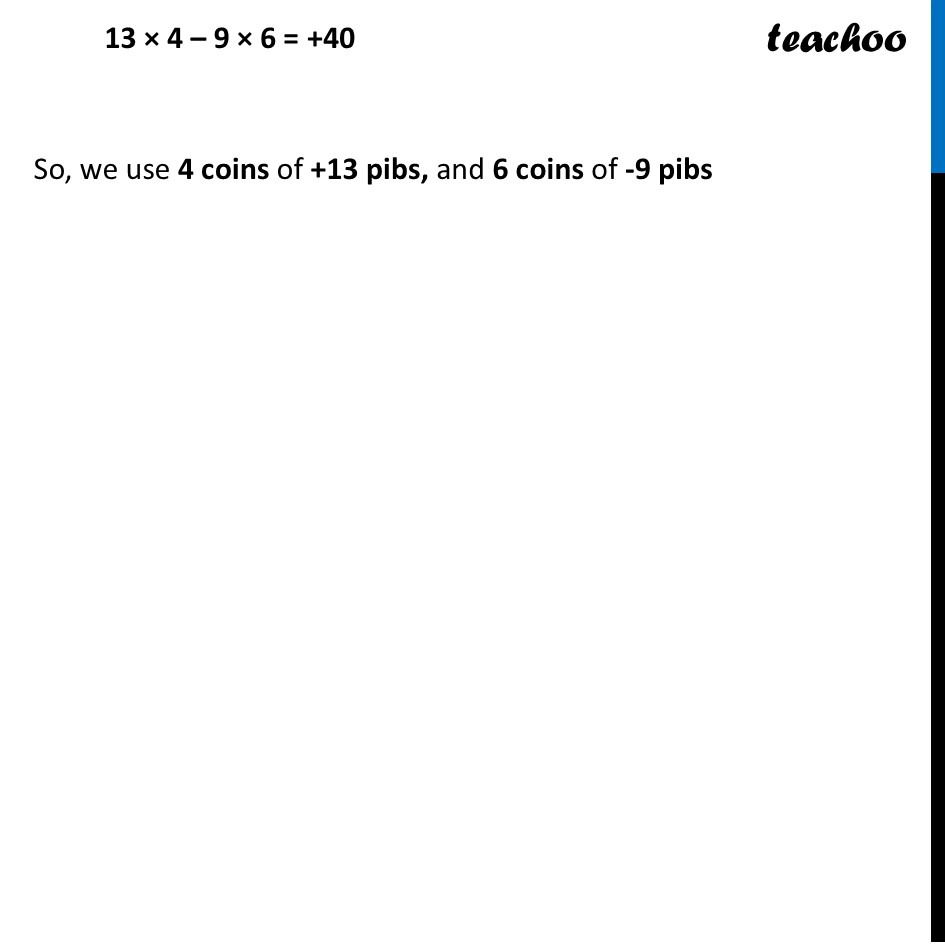
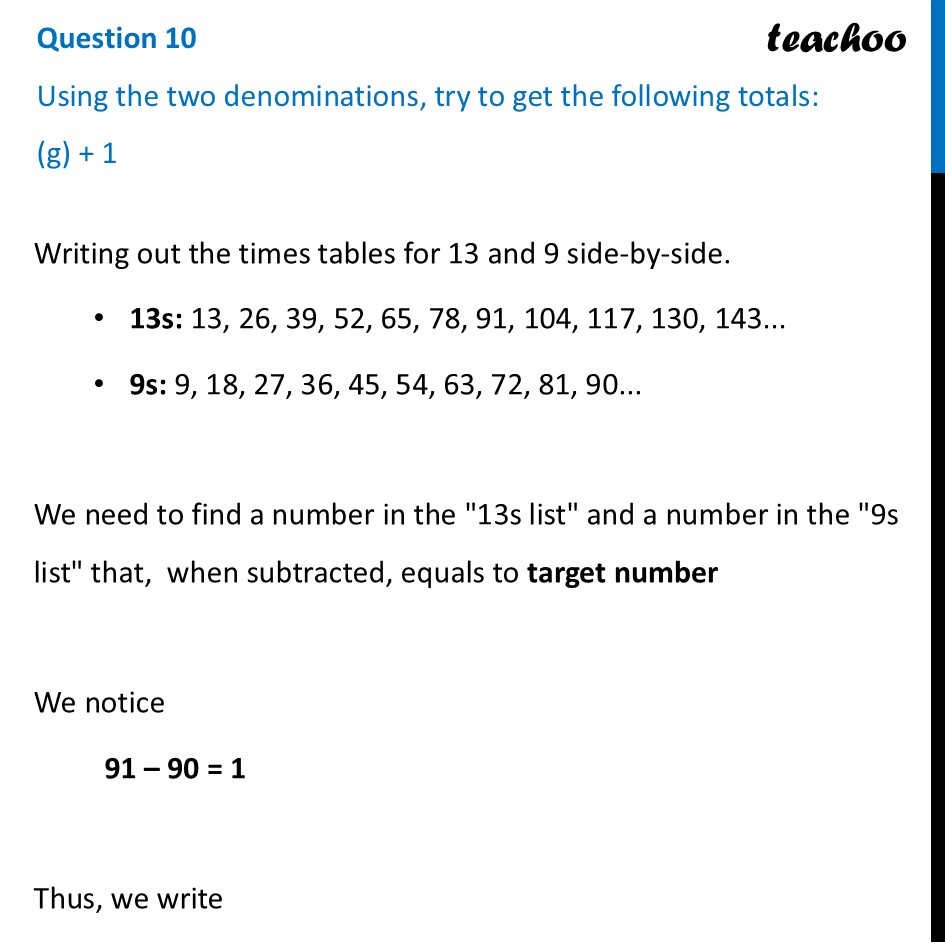
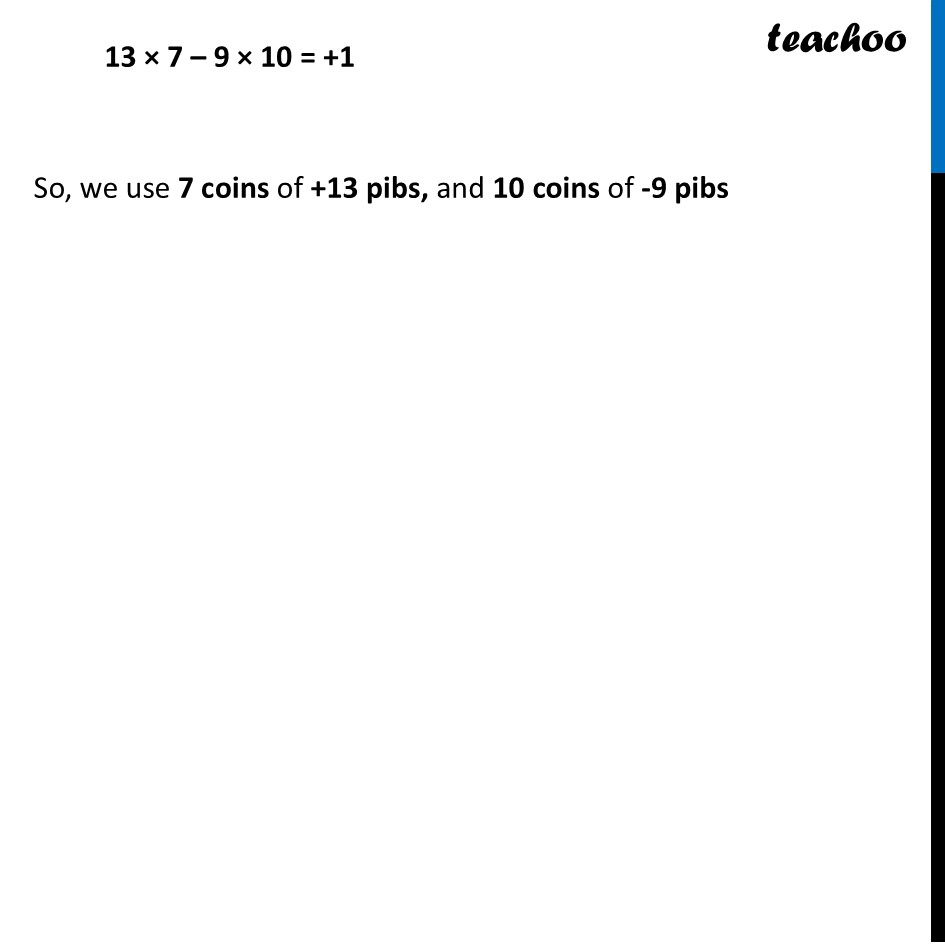
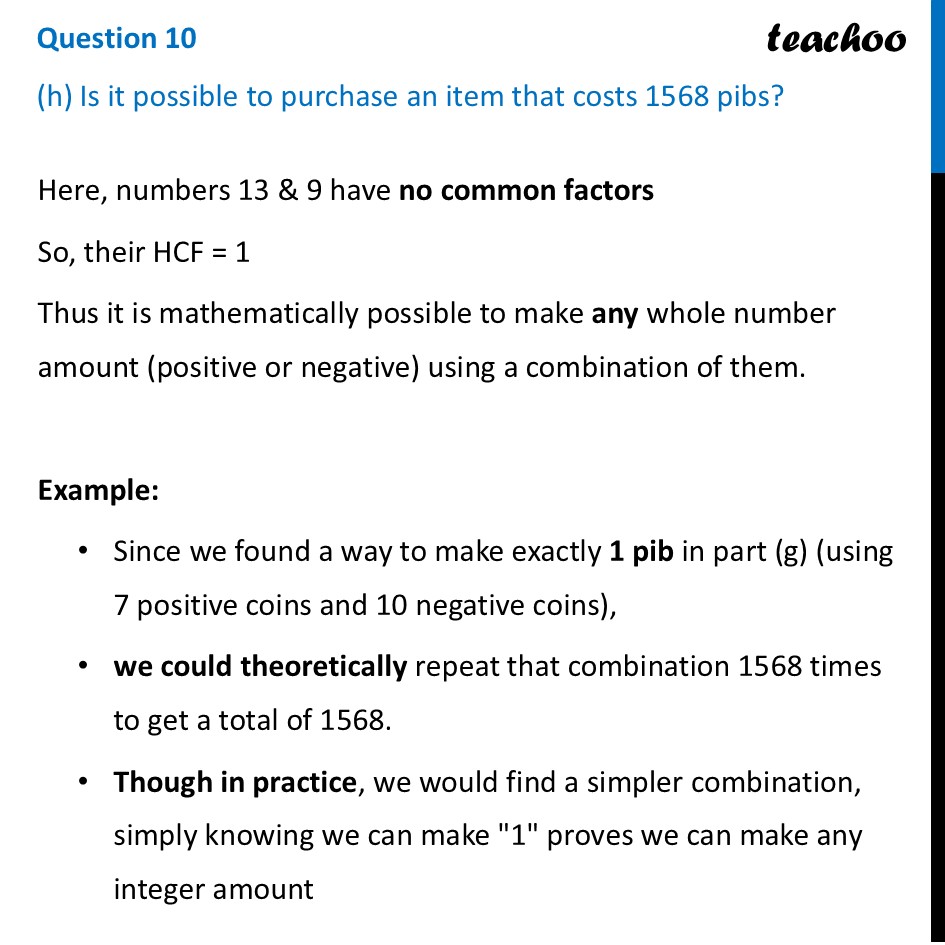
Figure it out - Page 42, 43, 44
Figure it out - Page 42, 43, 44
Last updated at January 21, 2026 by Teachoo
Transcript
Question 10 An alien society uses a peculiar currency called ‘pibs’ with just two denominations of coins — a+13 pibs coin and a – 9 pibs coin. You have several of these coins. Is it possible to purchase an item that costs + 85 pibs? Yes, we can use 10 coins of +13 pibs and 5 coins of – 9 pibs to make a total of + 85. Using the two denominations, try to get the following totals: (a) + 20So solve this, we follow these steps Step 1: Create two lists Write out the times tables for 13 and 9 side-by-side. 13s: 13, 26, 39, 52, 65, 78, 91, 104, 117, 130, 143... 9s: 9, 18, 27, 36, 45, 54, 63, 72, 81, 90... Step 2: Compare the numbers to find the "Difference" We need to find a number in the "13s list" and a number in the "9s list" that, when subtracted, equal your target number. Let's solve each Target +20: We notice 65 – 45 = 20 Thus, we write 13 × 5 – 9 × 5 = +20 So, we use 5 coins of +13 pibs, and 5 coins of -9 pibs Question 10 Using the two denominations, try to get the following totals: (b) + 40Writing out the times tables for 13 and 9 side-by-side. 13s: 13, 26, 39, 52, 65, 78, 91, 104, 117, 130, 143... 9s: 9, 18, 27, 36, 45, 54, 63, 72, 81, 90... We need to find a number in the "13s list" and a number in the "9s list" that, when subtracted, equals to target number +40 We notice 130 – 90 = 40 Thus, we write 13 × 10 – 9 × 10 = +40 So, we use 10 coins of +13 pibs, and 10 coins of -9 pibs Question 10 Using the two denominations, try to get the following totals: (c) – 50Writing out the times tables for 13 and 9 side-by-side. 13s: 13, 26, 39, 52, 65, 78, 91, 104, 117, 130, 143... 9s: 9, 18, 27, 36, 45, 54, 63, 72, 81, 90... We need to find a number in the "13s list" and a number in the "9s list" that, when subtracted, equals to target number We notice 13 – 63 = –50 Thus, we write 13 × 1 – 9 × 7 = –50 So, we use 1 coins of +13 pibs, and 7 coins of -9 pibs Question 10 Using the two denominations, try to get the following totals: (d) + 8Writing out the times tables for 13 and 9 side-by-side. 13s: 13, 26, 39, 52, 65, 78, 91, 104, 117, 130, 143... 9s: 9, 18, 27, 36, 45, 54, 63, 72, 81, 90... We need to find a number in the "13s list" and a number in the "9s list" that, when subtracted, equals to target number We notice 26 – 18 = 8 Thus, we write 13 × 2 – 9 × 2 = +8 So, we use 2 coins of +13 pibs, and 2 coins of -9 pibs Question 10 Using the two denominations, try to get the following totals: (e) + 10Writing out the times tables for 13 and 9 side-by-side. 13s: 13, 26, 39, 52, 65, 78, 91, 104, 117, 130, 143... 9s: 9, 18, 27, 36, 45, 54, 63, 72, 81, 90... We need to find a number in the "13s list" and a number in the "9s list" that, when subtracted, equals to target number We notice 91 – 81 = 10 Thus, we write 13 × 7 – 9 × 9 = +40 So, we use 7 coins of +13 pibs, and 9 coins of -9 pibs Question 10 Using the two denominations, try to get the following totals: (f) – 2Writing out the times tables for 13 and 9 side-by-side. 13s: 13, 26, 39, 52, 65, 78, 91, 104, 117, 130, 143... 9s: 9, 18, 27, 36, 45, 54, 63, 72, 81, 90... We need to find a number in the "13s list" and a number in the "9s list" that, when subtracted, equals to target number We notice 52 – 54 = 40 Thus, we write 13 × 4 – 9 × 6 = +40 So, we use 4 coins of +13 pibs, and 6 coins of -9 pibs Question 10 Using the two denominations, try to get the following totals: (g) + 1Writing out the times tables for 13 and 9 side-by-side. 13s: 13, 26, 39, 52, 65, 78, 91, 104, 117, 130, 143... 9s: 9, 18, 27, 36, 45, 54, 63, 72, 81, 90... We need to find a number in the "13s list" and a number in the "9s list" that, when subtracted, equals to target number We notice 91 – 90 = 1 Thus, we write 13 × 7 – 9 × 10 = +1 So, we use 7 coins of +13 pibs, and 10 coins of -9 pibs Question 10 (h) Is it possible to purchase an item that costs 1568 pibs?Here, numbers 13 & 9 have no common factors So, their HCF = 1 Thus it is mathematically possible to make any whole number amount (positive or negative) using a combination of them. Example: Since we found a way to make exactly 1 pib in part (g) (using 7 positive coins and 10 negative coins), we could theoretically repeat that combination 1568 times to get a total of 1568. Though in practice, we would find a simpler combination, simply knowing we can make "1" proves we can make any integer amount
