
 You are here
Brahmagupta’s Rules for Multiplication and Division of Integers
Brahmagupta’s Rules for Multiplication and Division of Integers
Last updated at January 21, 2026 by Teachoo
Transcript
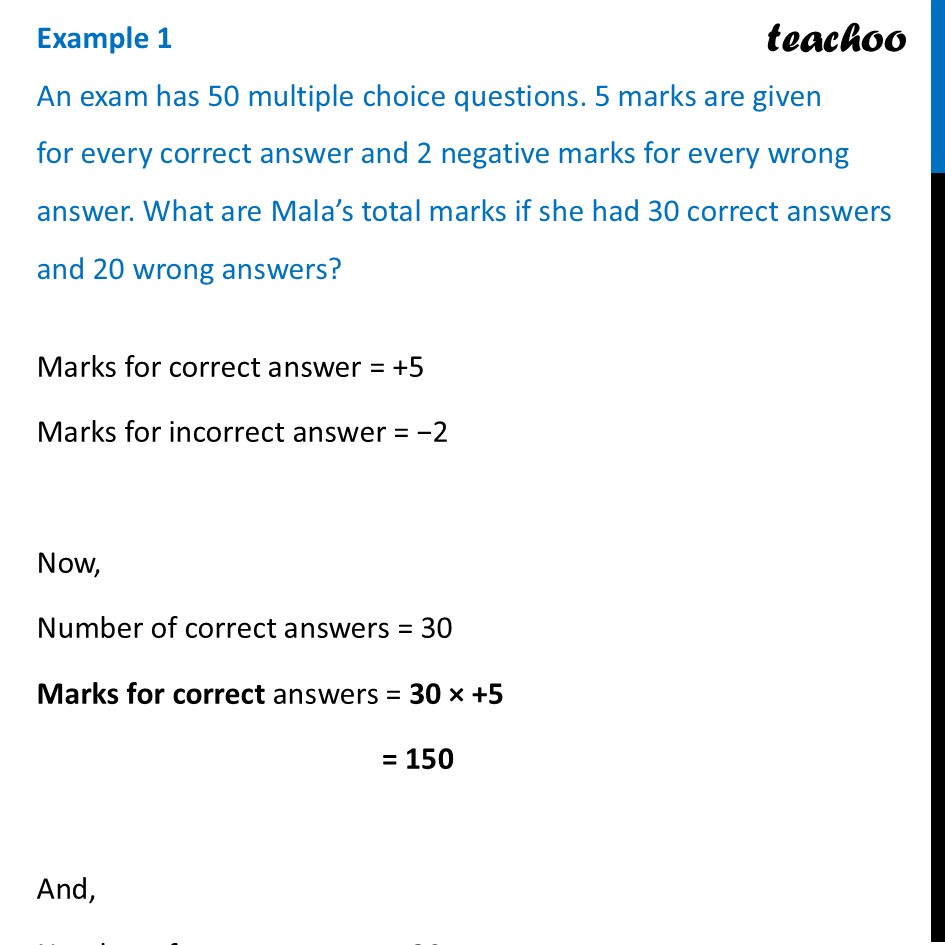
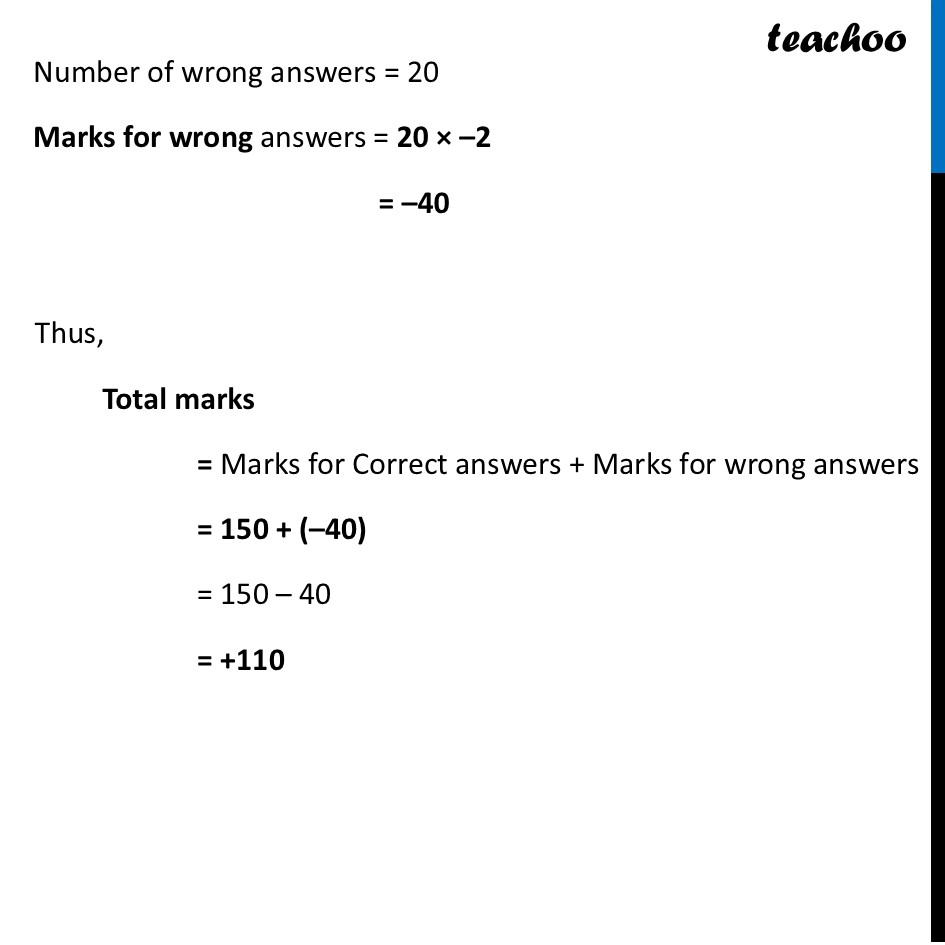
Example 1 An exam has 50 multiple choice questions. 5 marks are given for every correct answer and 2 negative marks for every wrong answer. What are Mala’s total marks if she had 30 correct answers and 20 wrong answers?Marks for correct answer = +5 Marks for incorrect answer = −2 Now, Number of correct answers = 30 Marks for correct answers = 30 × +5 = 150 And, Number of wrong answers = 20 Marks for wrong answers = 20 × –2 = –40 Thus, Total marks = Marks for Correct answers + Marks for wrong answers = 150 + (–40) = 150 – 40 = +110 Example 2 (a) There is an elevator in a mining shaft that moves above and below the ground. The elevator’s positions above the ground are represented as positive integers and positions below the ground are represented as negative integers. (a) The elevator moves 3 metres per minute. If it descends into the shaft from the ground level (0), what will be its position after one hour? Given that Elevator descends into the shaft So, it is going down Now, it moves 3 meters per minute And, we need to find position after 1 hour i.e. after 60 minutes Now, Initial Position = 0 m Position after 1 minute = 0 – 3 × 1 Position after 60 minute = 0 – 3 × 60 = –180 m Thus, elevator will be 180 metres below the ground.
