
 You are here

Digits in Disguise
Last updated at January 8, 2026 by Teachoo
Transcript
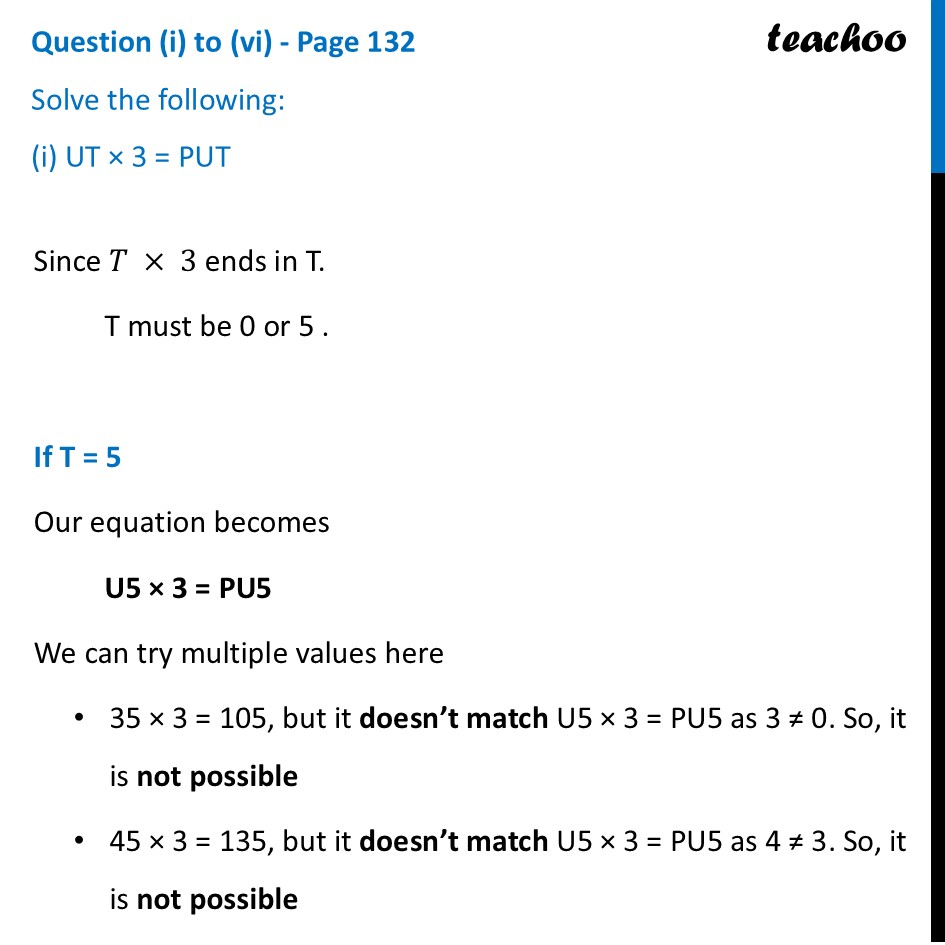
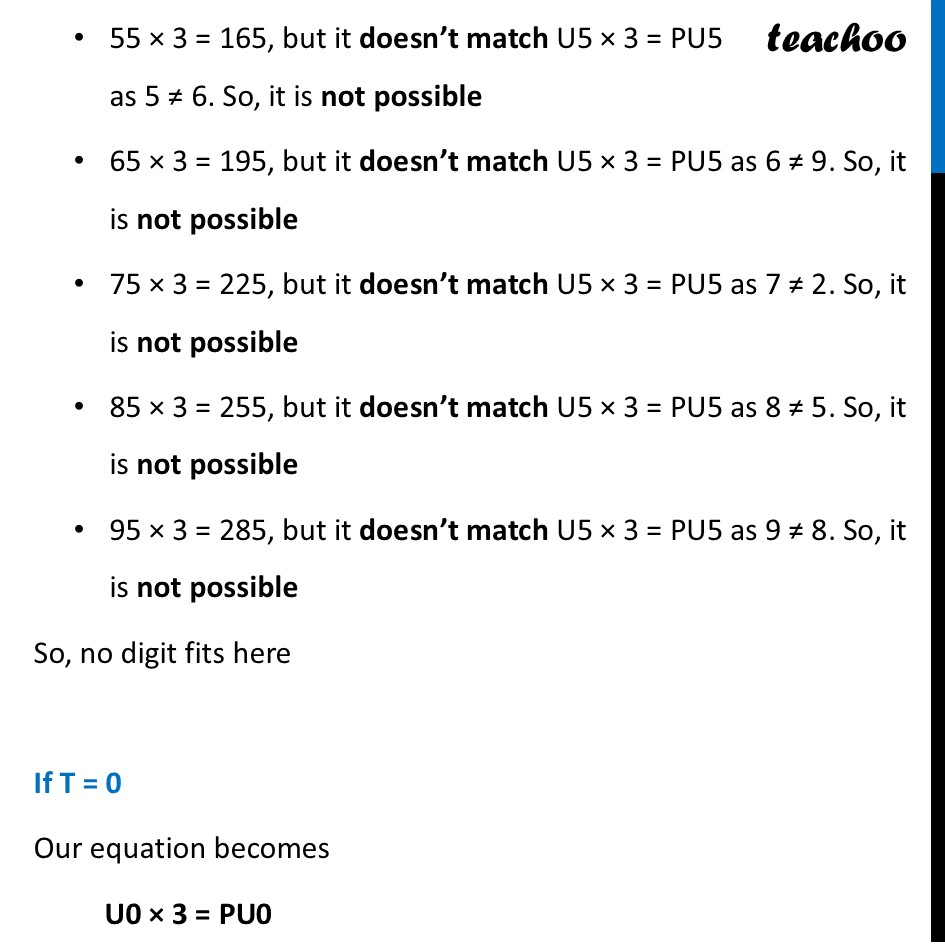
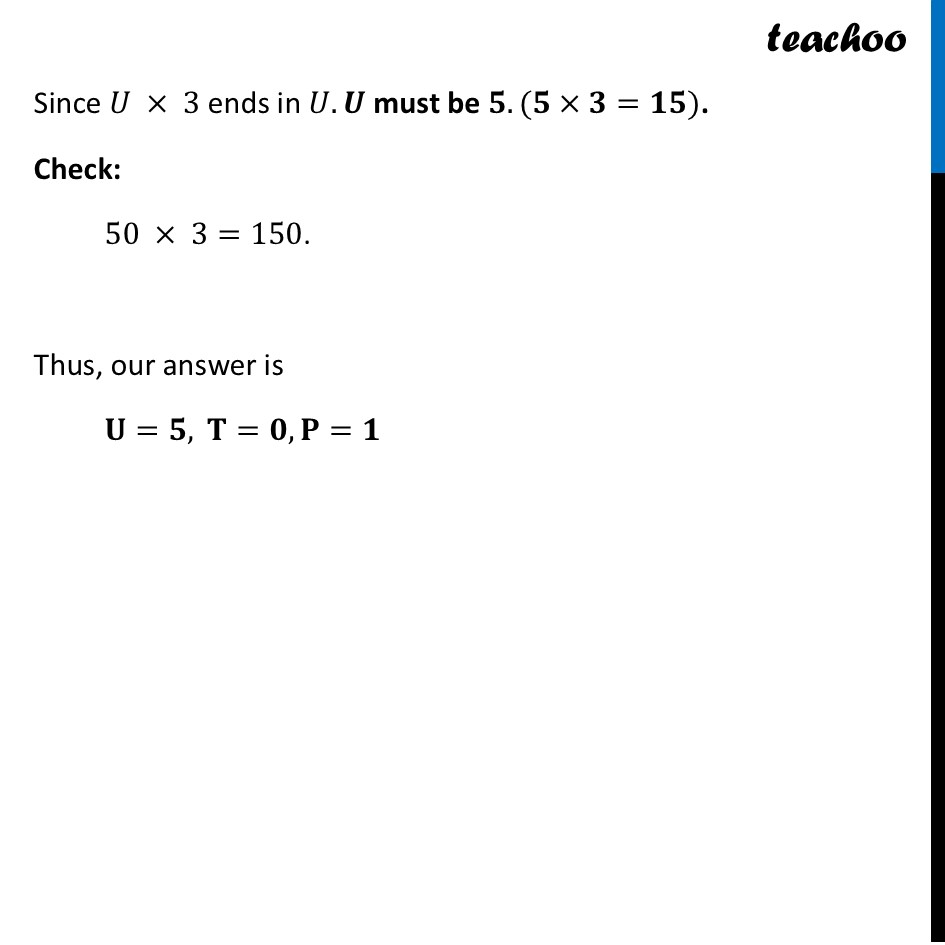
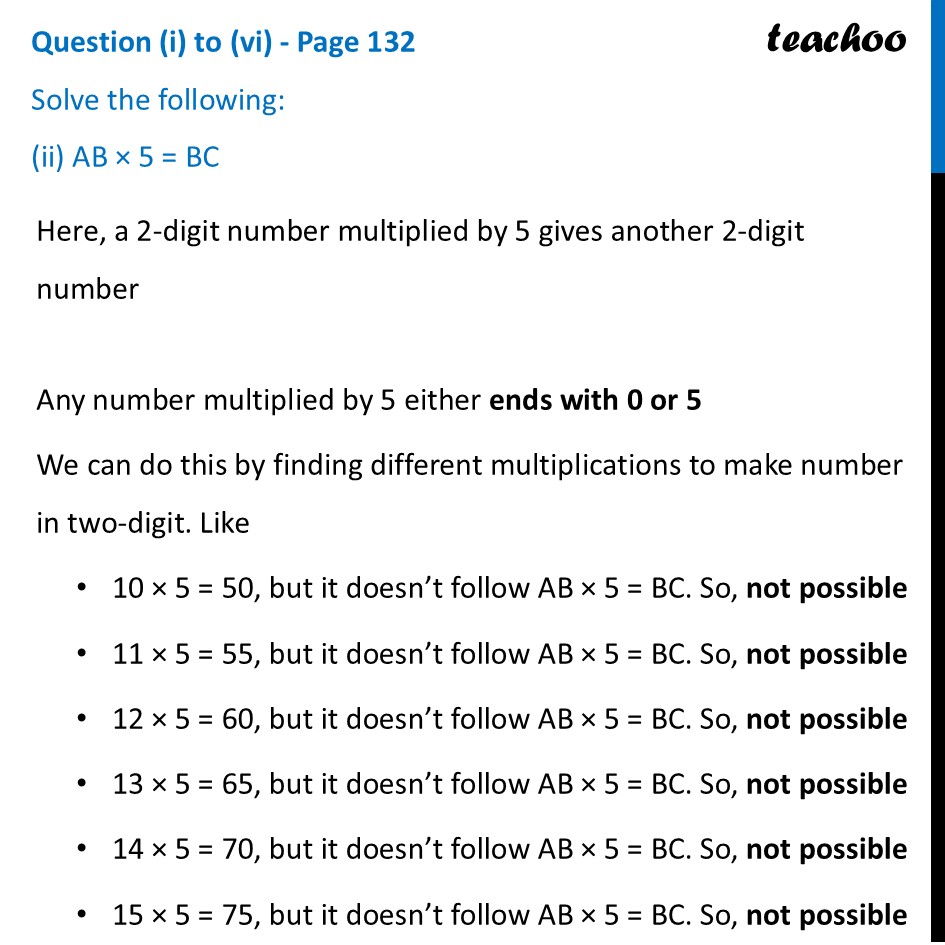
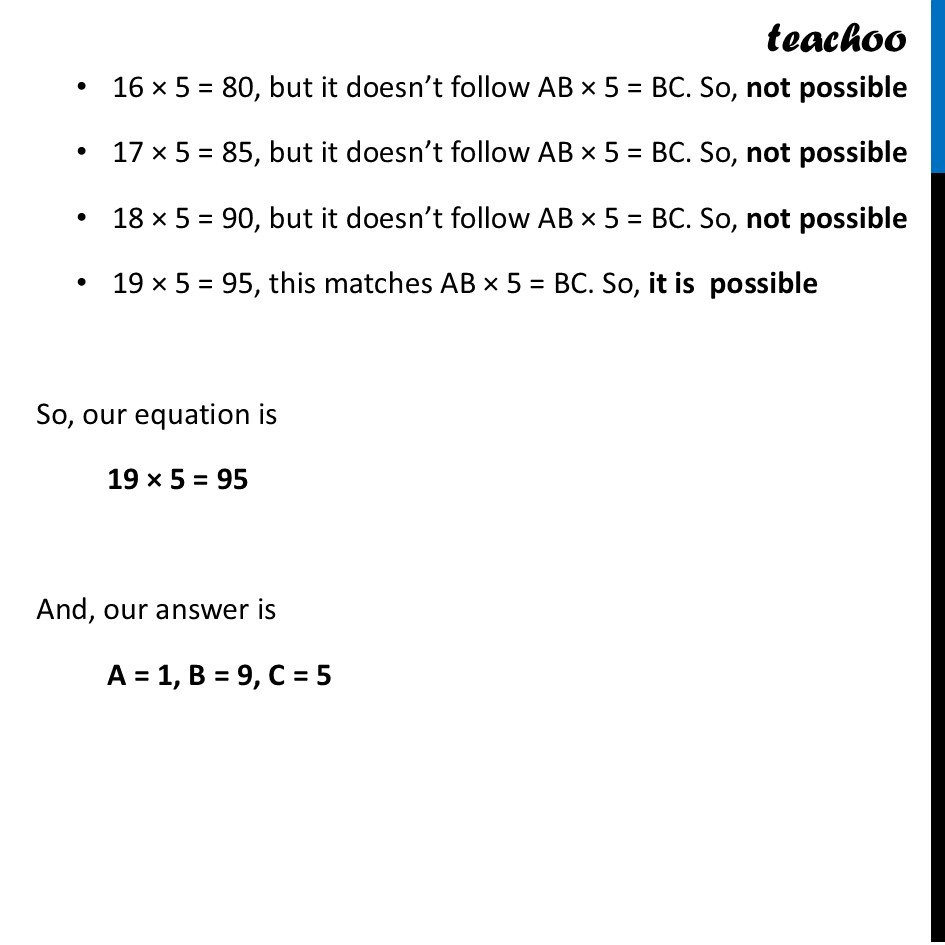
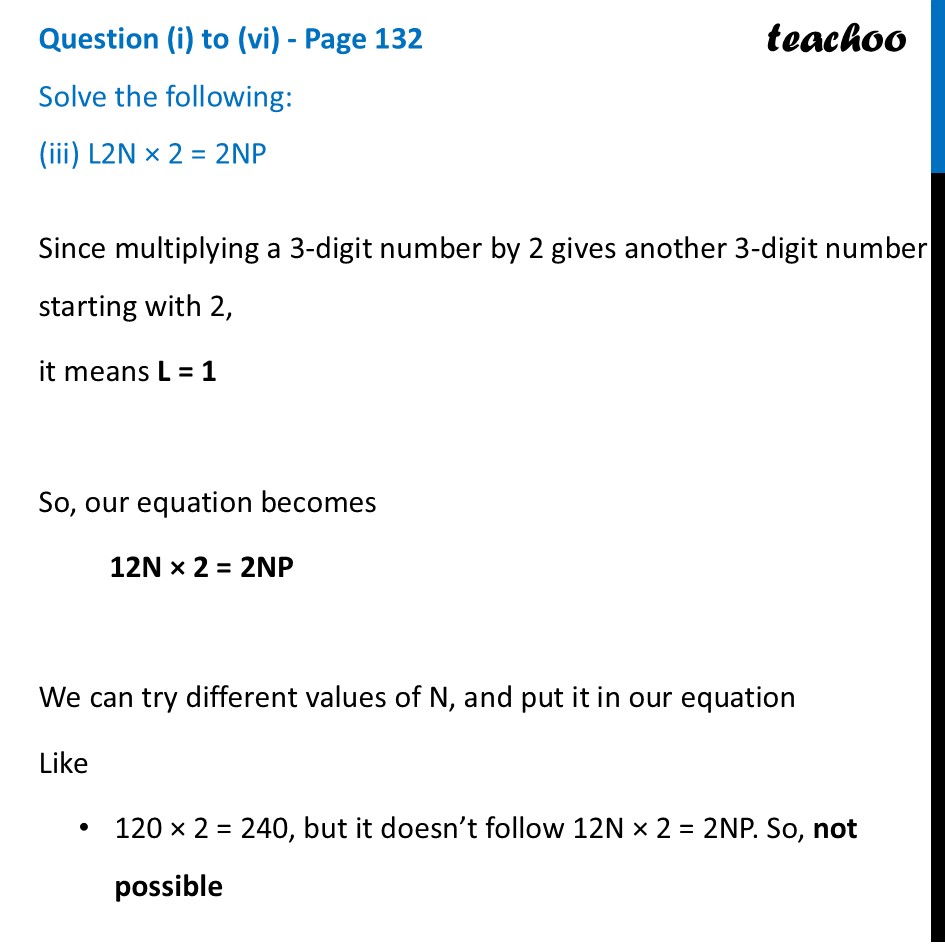
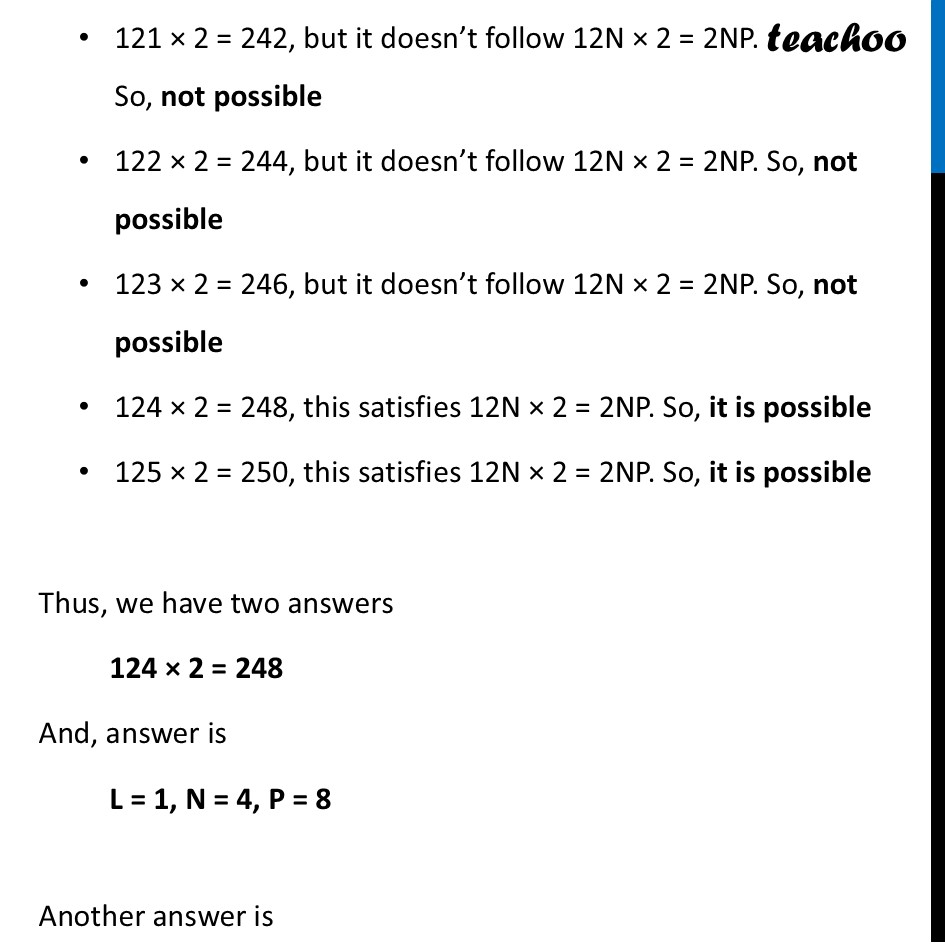
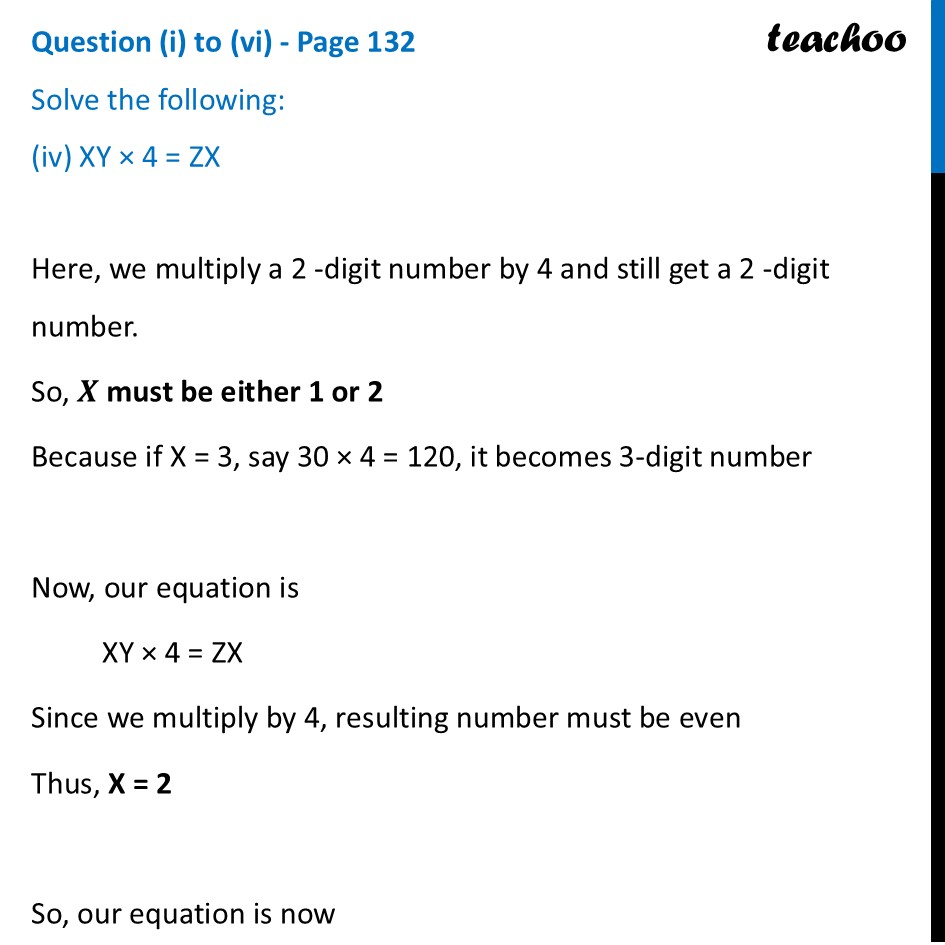
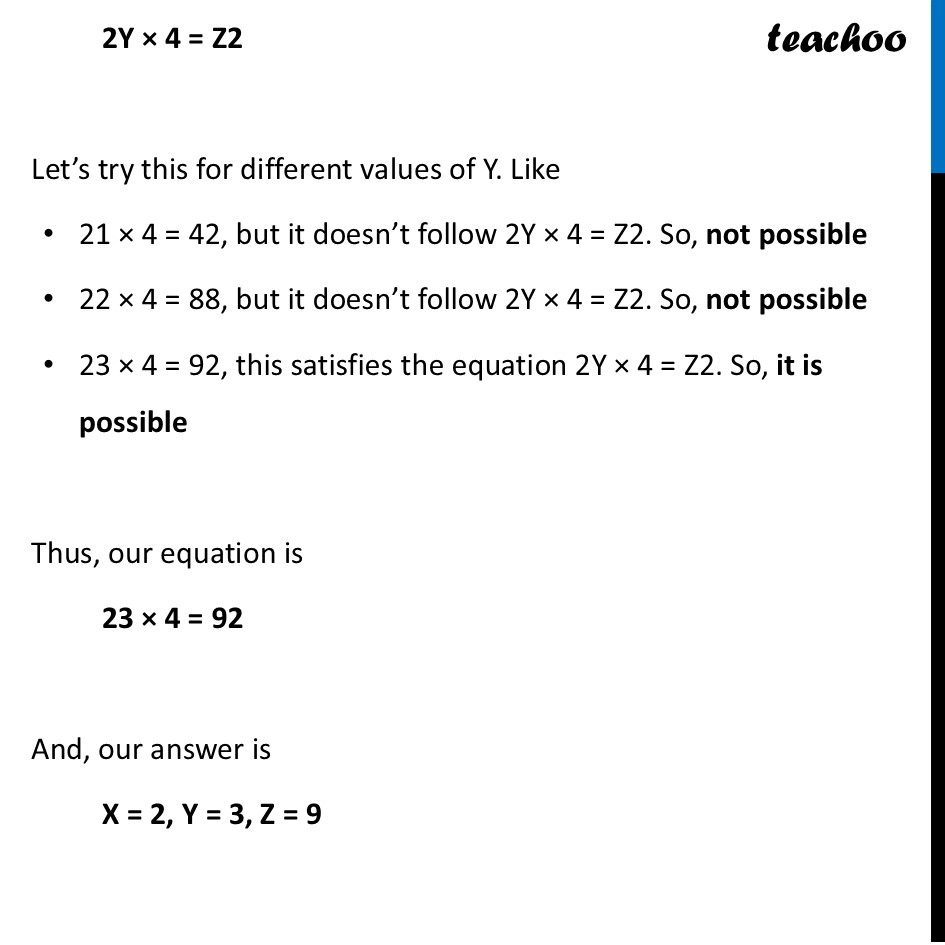
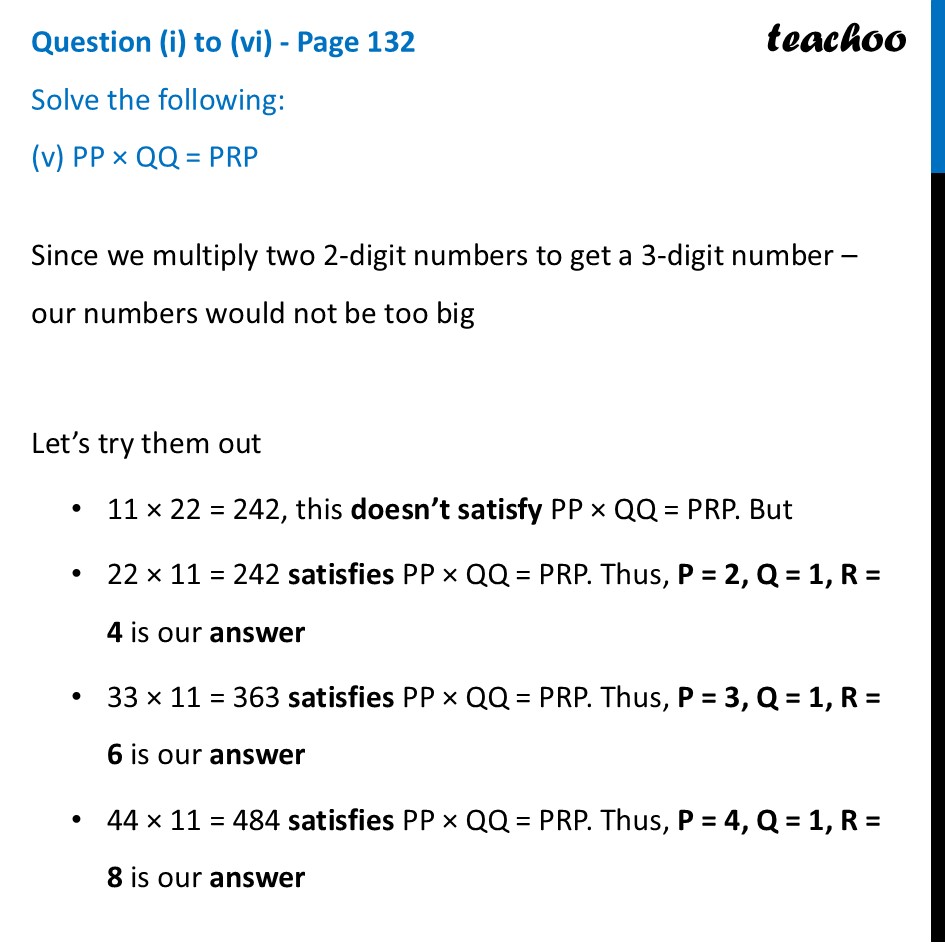
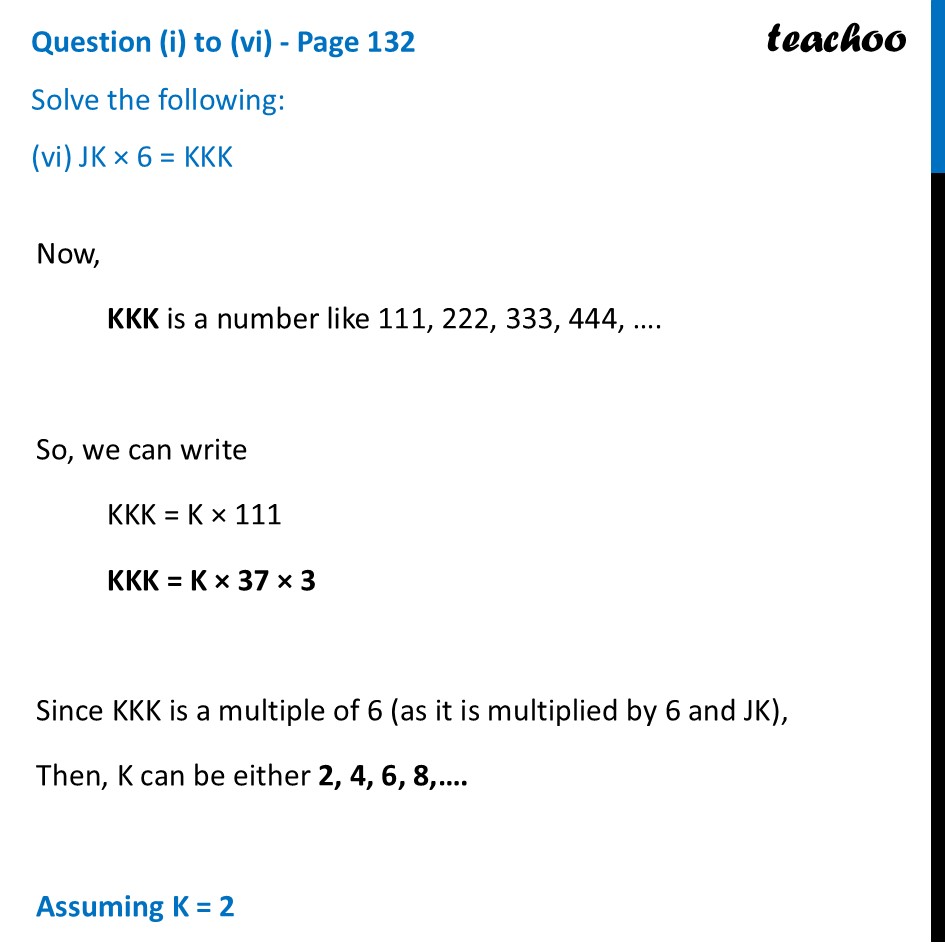
Question (i) to (vi) - Page 132 Solve the following: (i) UT × 3 = PUTSince 𝑇 × 3 ends in T. T must be 0 or 5 . If T = 5 Our equation becomes U5 × 3 = PU5 We can try multiple values here 35 × 3 = 105, but it doesn’t match U5 × 3 = PU5 as 3 ≠ 0. So, it is not possible 45 × 3 = 135, but it doesn’t match U5 × 3 = PU5 as 4 ≠ 3. So, it is not possible 55 × 3 = 165, but it doesn’t match U5 × 3 = PU5 as 5 ≠ 6. So, it is not possible 65 × 3 = 195, but it doesn’t match U5 × 3 = PU5 as 6 ≠ 9. So, it is not possible 75 × 3 = 225, but it doesn’t match U5 × 3 = PU5 as 7 ≠ 2. So, it is not possible 85 × 3 = 255, but it doesn’t match U5 × 3 = PU5 as 8 ≠ 5. So, it is not possible 95 × 3 = 285, but it doesn’t match U5 × 3 = PU5 as 9 ≠ 8. So, it is not possible So, no digit fits here If T = 0 Our equation becomes U0 × 3 = PU0 Since 𝑈 × 3 ends in 𝑈. 𝑼 must be 𝟓.(𝟓×𝟑=𝟏𝟓). Check: 50 × 3=150. Thus, our answer is 𝐔=𝟓," " 𝐓=𝟎,𝐏=𝟏 Question (i) to (vi) - Page 132 Solve the following: (ii) AB × 5 = BCHere, a 2-digit number multiplied by 5 gives another 2-digit number Any number multiplied by 5 either ends with 0 or 5 We can do this by finding different multiplications to make number in two-digit. Like 10 × 5 = 50, but it doesn’t follow AB × 5 = BC. So, not possible 11 × 5 = 55, but it doesn’t follow AB × 5 = BC. So, not possible 12 × 5 = 60, but it doesn’t follow AB × 5 = BC. So, not possible 13 × 5 = 65, but it doesn’t follow AB × 5 = BC. So, not possible 14 × 5 = 70, but it doesn’t follow AB × 5 = BC. So, not possible 15 × 5 = 75, but it doesn’t follow AB × 5 = BC. So, not possible 16 × 5 = 80, but it doesn’t follow AB × 5 = BC. So, not possible 17 × 5 = 85, but it doesn’t follow AB × 5 = BC. So, not possible 18 × 5 = 90, but it doesn’t follow AB × 5 = BC. So, not possible 19 × 5 = 95, this matches AB × 5 = BC. So, it is possible So, our equation is 19 × 5 = 95 And, our answer is A = 1, B = 9, C = 5 Question (i) to (vi) - Page 132 Solve the following: (iii) L2N × 2 = 2NPSince multiplying a 3-digit number by 2 gives another 3-digit number starting with 2, it means L = 1 So, our equation becomes 12N × 2 = 2NP We can try different values of N, and put it in our equation Like 120 × 2 = 240, but it doesn’t follow 12N × 2 = 2NP. So, not possible 121 × 2 = 242, but it doesn’t follow 12N × 2 = 2NP. So, not possible 122 × 2 = 244, but it doesn’t follow 12N × 2 = 2NP. So, not possible 123 × 2 = 246, but it doesn’t follow 12N × 2 = 2NP. So, not possible 124 × 2 = 248, this satisfies 12N × 2 = 2NP. So, it is possible 125 × 2 = 250, this satisfies 12N × 2 = 2NP. So, it is possible Thus, we have two answers 124 × 2 = 248 And, answer is L = 1, N = 4, P = 8 Another answer is 125 × 2 = 250 And, answer is L = 1, N = 5, P = 0 Question (i) to (vi) - Page 132 Solve the following: (iv) XY × 4 = ZXHere, we multiply a 2 -digit number by 4 and still get a 2 -digit number. So, 𝑿 must be either 1 or 2 Because if X = 3, say 30 × 4 = 120, it becomes 3-digit number Now, our equation is XY × 4 = ZX Since we multiply by 4, resulting number must be even Thus, X = 2 So, our equation is now 2Y × 4 = Z2 Let’s try this for different values of Y. Like 21 × 4 = 42, but it doesn’t follow 2Y × 4 = Z2. So, not possible 22 × 4 = 88, but it doesn’t follow 2Y × 4 = Z2. So, not possible 23 × 4 = 92, this satisfies the equation 2Y × 4 = Z2. So, it is possible Thus, our equation is 23 × 4 = 92 And, our answer is X = 2, Y = 3, Z = 9 Question (i) to (vi) - Page 132 Solve the following: (v) PP × QQ = PRPSince we multiply two 2-digit numbers to get a 3-digit number – our numbers would not be too big Let’s try them out 11 × 22 = 242, this doesn’t satisfy PP × QQ = PRP. But 22 × 11 = 242 satisfies PP × QQ = PRP. Thus, P = 2, Q = 1, R = 4 is our answer 33 × 11 = 363 satisfies PP × QQ = PRP. Thus, P = 3, Q = 1, R = 6 is our answer 44 × 11 = 484 satisfies PP × QQ = PRP. Thus, P = 4, Q = 1, R = 8 is our answer So, we have 3 possible solutions Question (i) to (vi) - Page 132 Solve the following: (vi) JK × 6 = KKKNow, KKK is a number like 111, 222, 333, 444, …. So, we can write KKK = K × 111 KKK = K × 37 × 3 Since KKK is a multiple of 6 (as it is multiplied by 6 and JK), Then, K can be either 2, 4, 6, 8,…. Assuming K = 2 Now, our equation becomes J2 × 6 = 222 No values of J will satisfy this Assuming K = 4 Now, our equation becomes J4 × 6 = 444 For J = 7, our equation becomes 74 × 6 = 444 This, our answer is J = 7, K = 4
