
 You are here
![[True or False] A quadrilateral whose diagonals are equal and bisect - Figure it out - Page 107](https://cdn.teachoo.com/7e5476eb-945b-4a1f-8f5a-296ab1006ed1/slide83.jpg)
Last updated at December 12, 2025 by Teachoo
Transcript
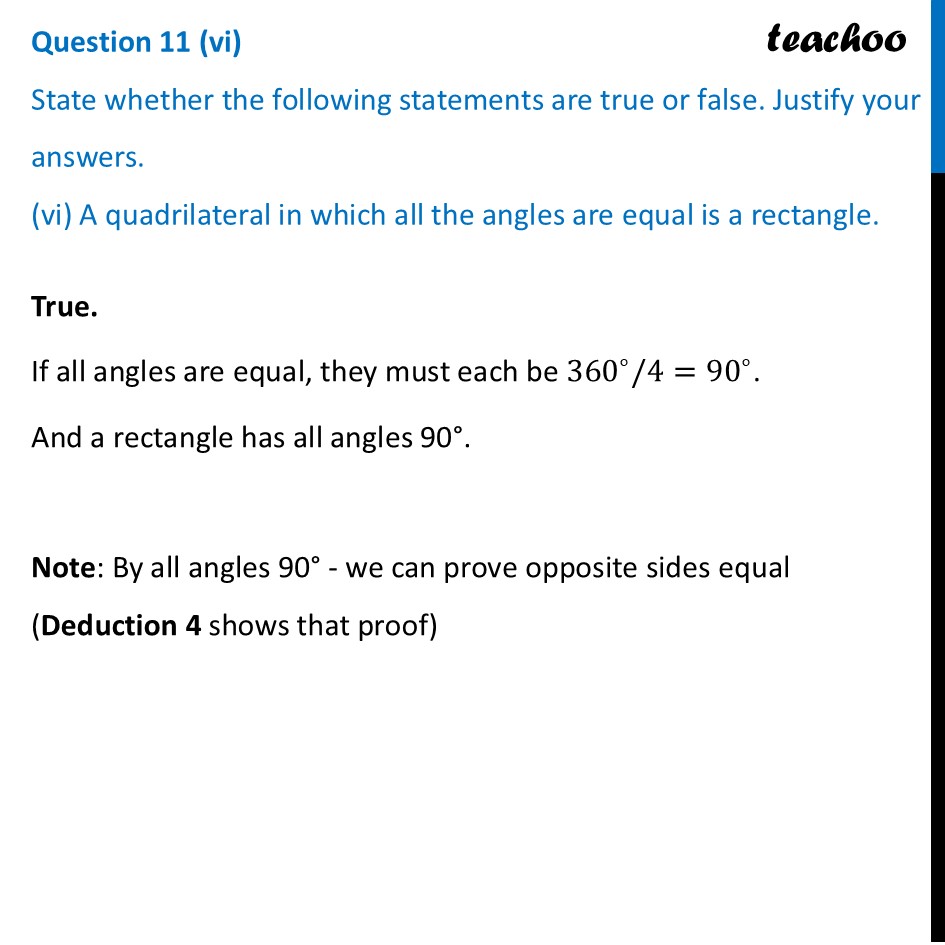
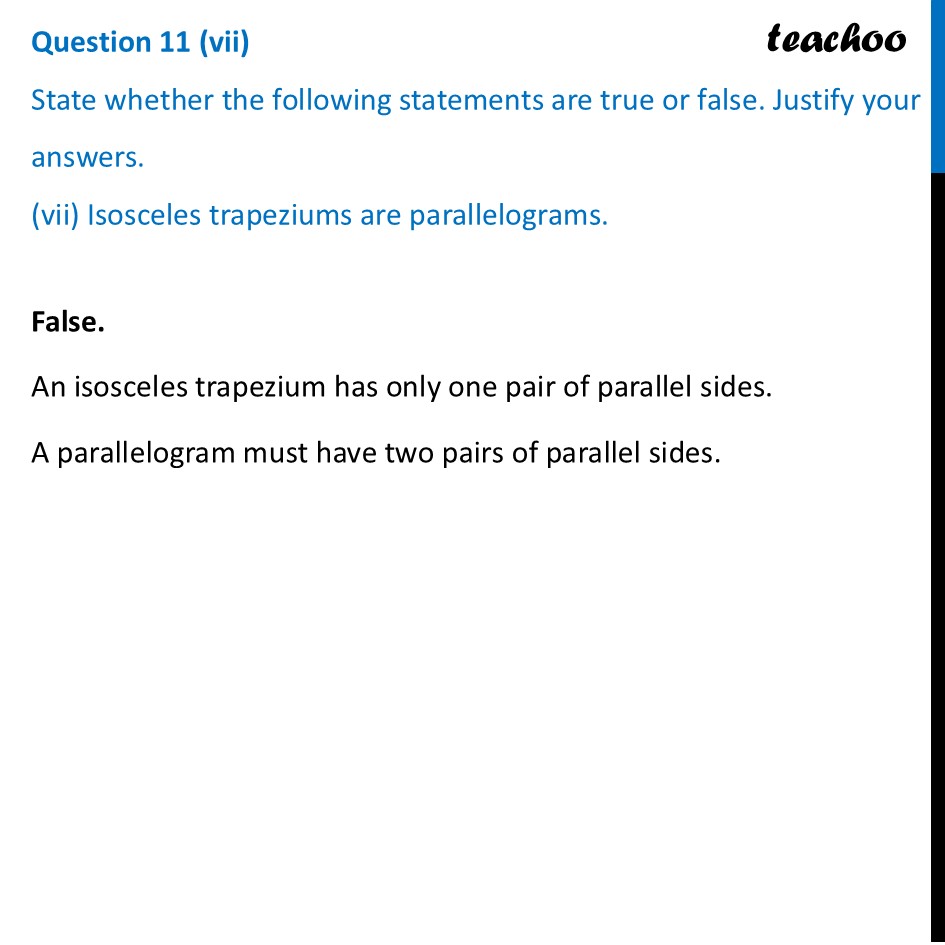
Question 11 (i) State whether the following statements are true or false. Justify your answers. (i) A quadrilateral whose diagonals are equal and bisect each other must be a square.False. This is the definition of a Rectangle. For it to be a square, the diagonals must also be perpendicular. Question 11 (ii) State whether the following statements are true or false. Justify your answers. (ii) A quadrilateral having three right angles must be a rectangle.True. The sum of angles is 360^∘. If three are 90^∘, the fourth must be 360^∘−270^∘=90^∘. A parallelogram with all right angles is a rectangle. Question 11 (iii) State whether the following statements are true or false. Justify your answers. (iii) A quadrilateral whose diagonals bisect each other must be a parallelogram.True. This is a defining property of parallelograms. Question 11 (iv) State whether the following statements are true or false. Justify your answers. (iv) A quadrilateral whose diagonals are perpendicular to each other must be a rhombus.False. It could be a Kite. A rhombus requires diagonals to be perpendicular and bisect each other. A kite has perpendicular diagonals where only one is bisected. Question 11 (v) State whether the following statements are true or false. Justify your answers. (v) A quadrilateral in which the opposite angles are equal must be a parallelogram.True. When opposite angles are equal, opposite sides are parallel. And, when opposite sides are parallel – it is a parallelogram Question 11 (vi) State whether the following statements are true or false. Justify your answers. (vi) A quadrilateral in which all the angles are equal is a rectangle.True. If all angles are equal, they must each be 360^∘/4=90^∘. And a rectangle has all angles 90°. Note: By all angles 90° - we can prove opposite sides equal (Deduction 4 shows that proof) Question 11 (vii) State whether the following statements are true or false. Justify your answers. (vii) Isosceles trapeziums are parallelograms.False. An isosceles trapezium has only one pair of parallel sides. A parallelogram must have two pairs of parallel sides.
