Construct a square with diagonal 6 cm without using a protractor. - Figure it out - Page 107

part 2 - Question 6 - Figure it out - Page 107 - Chapter 4 Class 8 - Quadrilaterals (Ganita Prakash) - Class 8 (Ganita Prakash - 1, 2 & Old NCERT)
part 3 - Question 6 - Figure it out - Page 107 - Chapter 4 Class 8 - Quadrilaterals (Ganita Prakash) - Class 8 (Ganita Prakash - 1, 2 & Old NCERT) part 4 - Question 6 - Figure it out - Page 107 - Chapter 4 Class 8 - Quadrilaterals (Ganita Prakash) - Class 8 (Ganita Prakash - 1, 2 & Old NCERT) part 5 - Question 6 - Figure it out - Page 107 - Chapter 4 Class 8 - Quadrilaterals (Ganita Prakash) - Class 8 (Ganita Prakash - 1, 2 & Old NCERT) part 6 - Question 6 - Figure it out - Page 107 - Chapter 4 Class 8 - Quadrilaterals (Ganita Prakash) - Class 8 (Ganita Prakash - 1, 2 & Old NCERT) part 7 - Question 6 - Figure it out - Page 107 - Chapter 4 Class 8 - Quadrilaterals (Ganita Prakash) - Class 8 (Ganita Prakash - 1, 2 & Old NCERT) part 8 - Question 6 - Figure it out - Page 107 - Chapter 4 Class 8 - Quadrilaterals (Ganita Prakash) - Class 8 (Ganita Prakash - 1, 2 & Old NCERT)

Take a fresh quiz. Then take another.
Every attempt is a new AI-adaptive Teachoo quiz with 7 questions, selected from your answers, mistakes, and progress.
Remove Ads
Teachoo · Class 8 Explore Class 8

Transcript

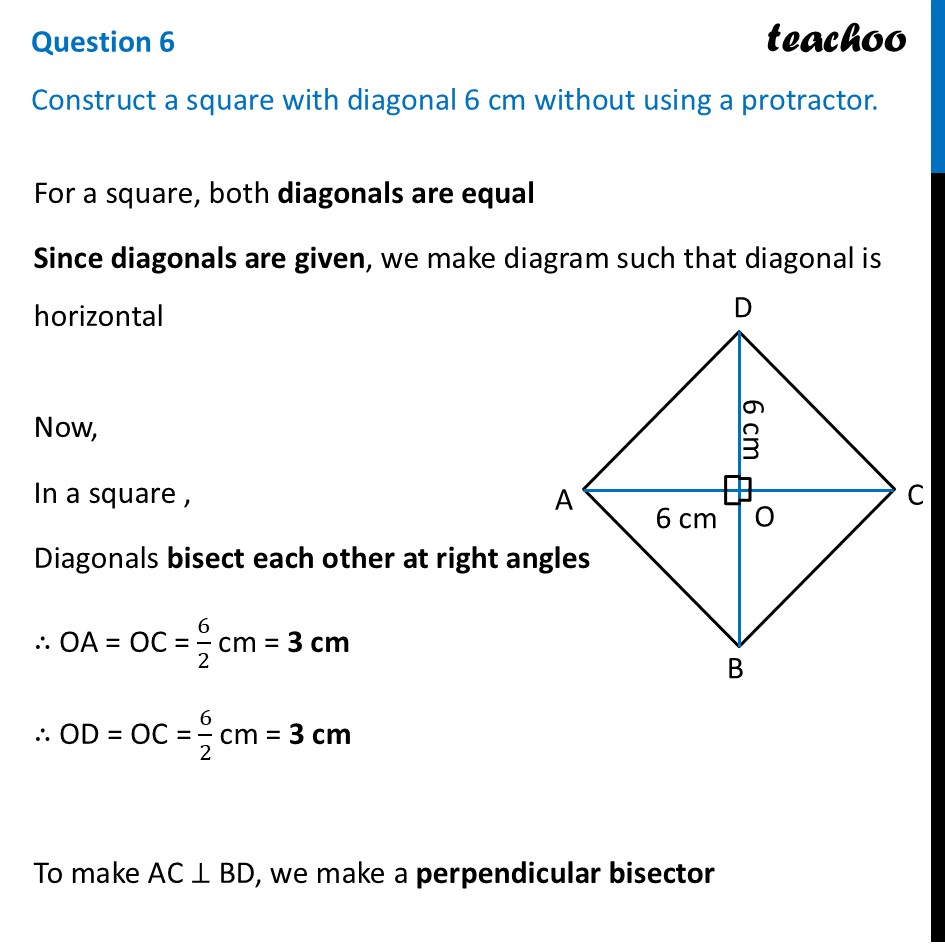
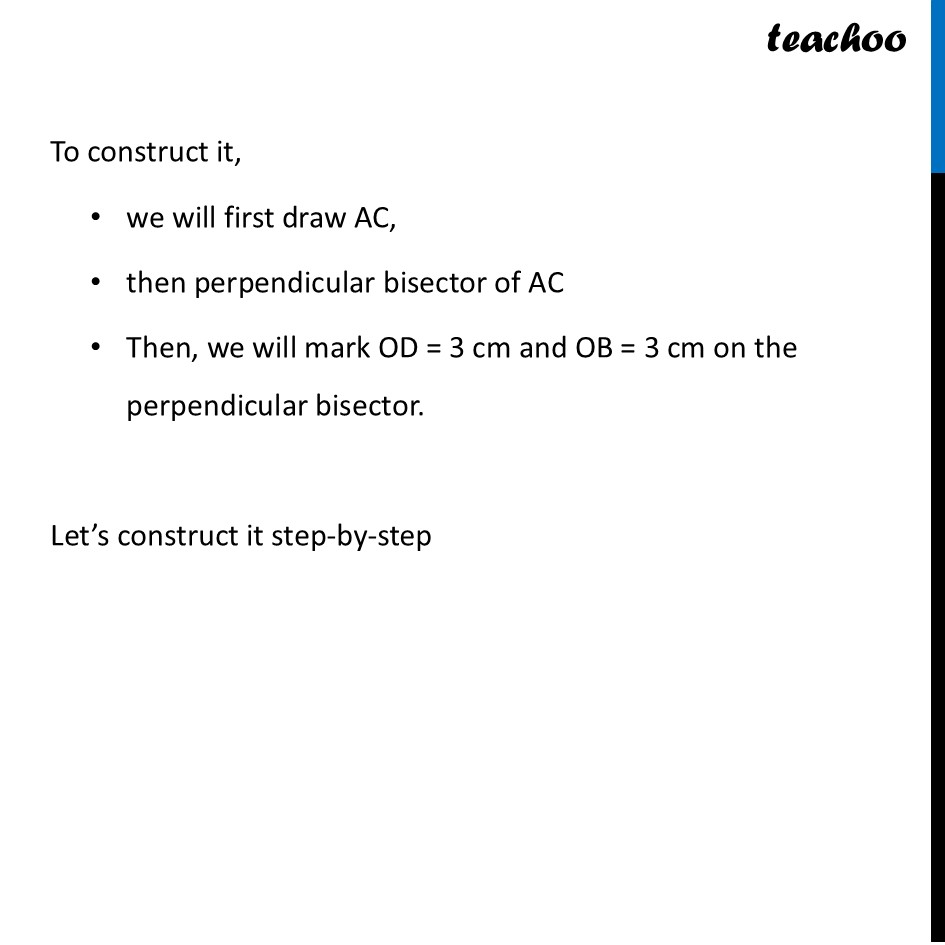
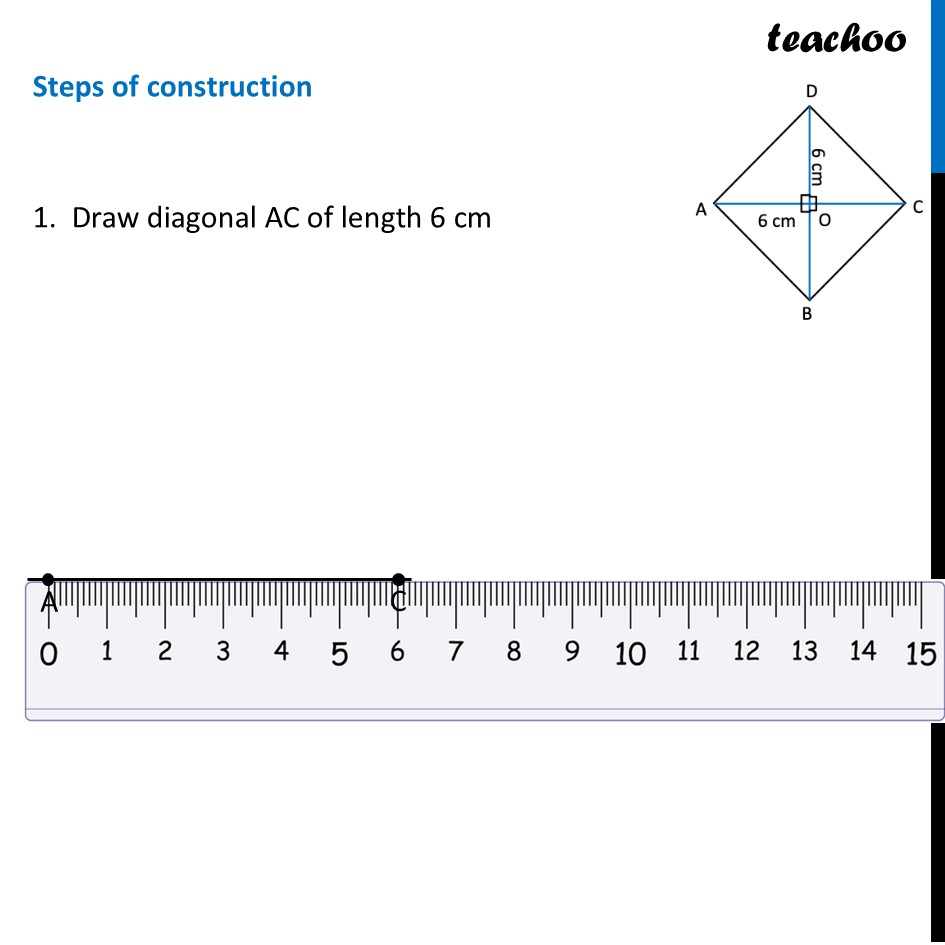
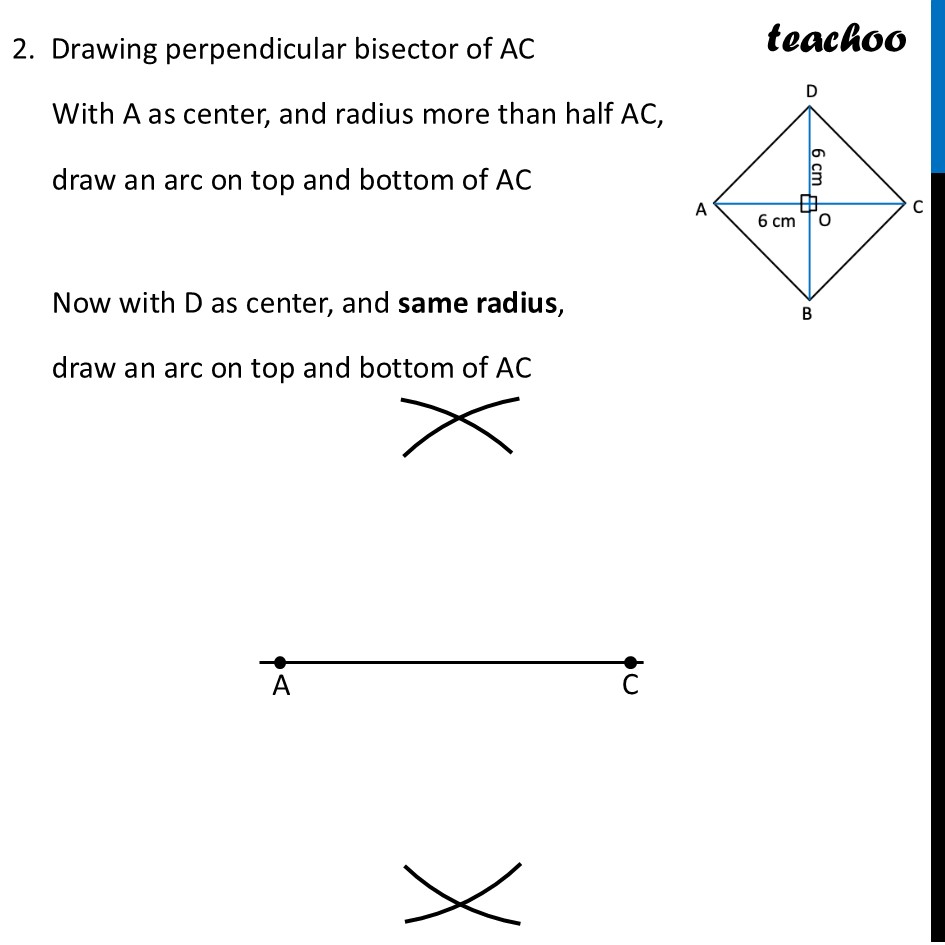
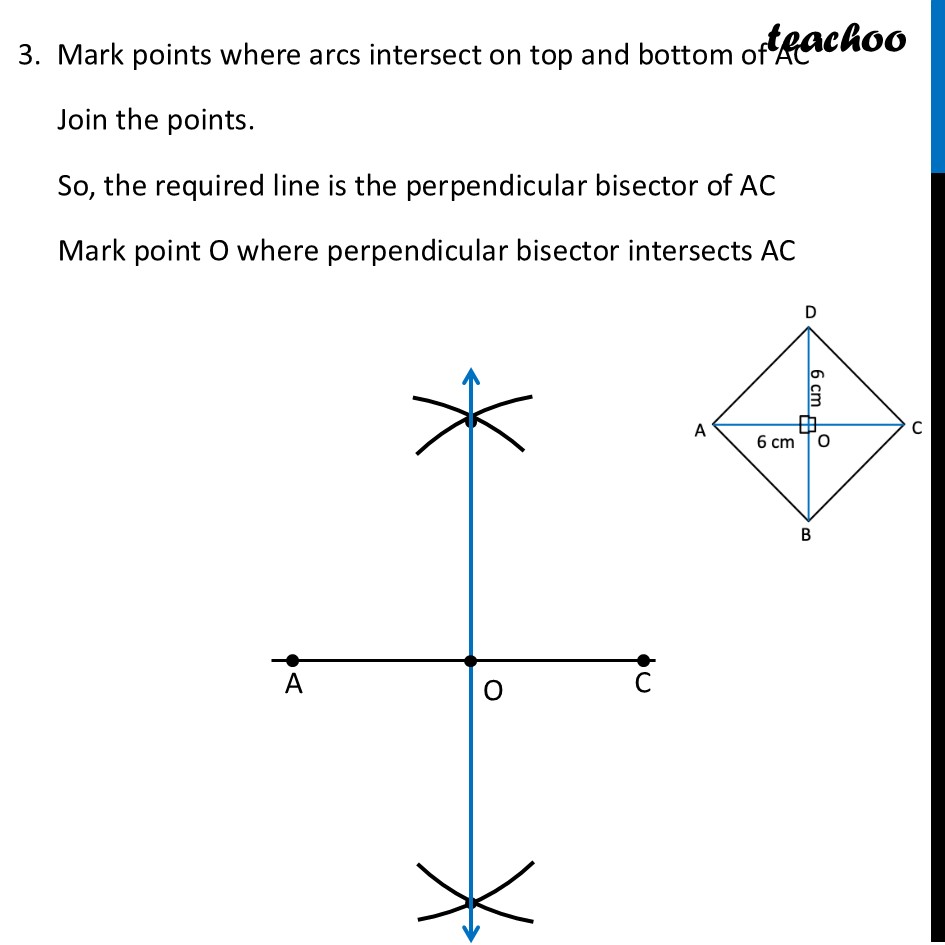
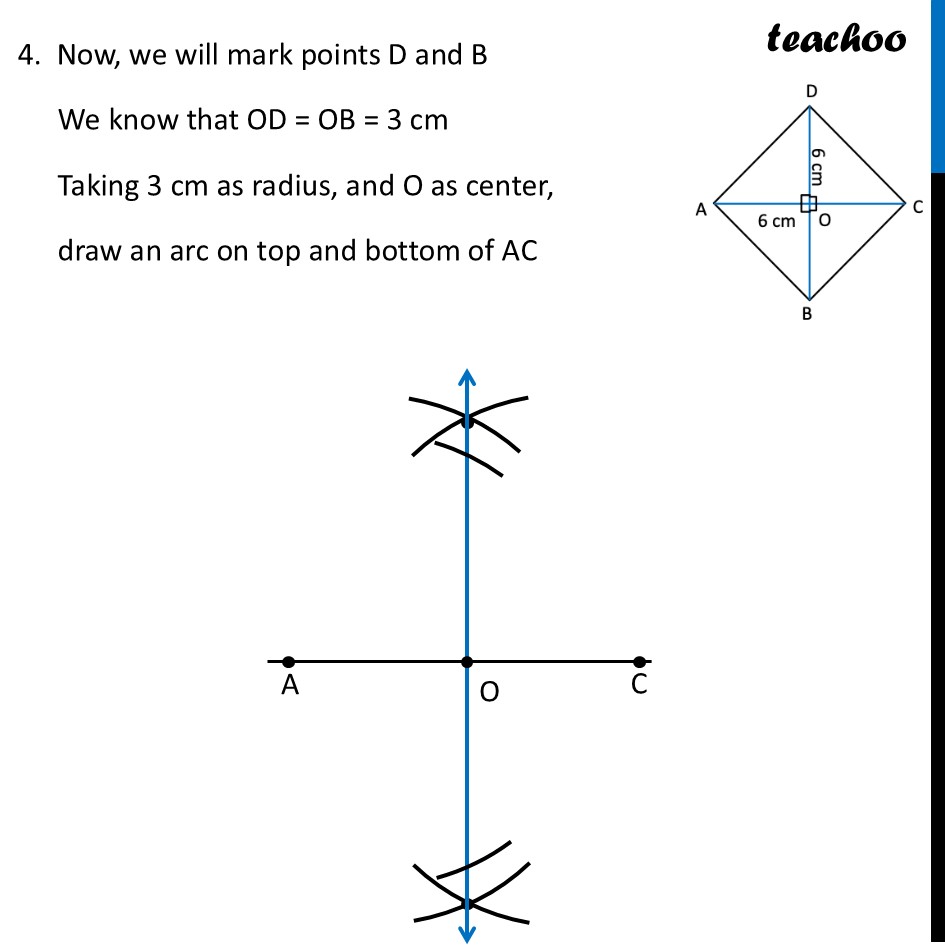
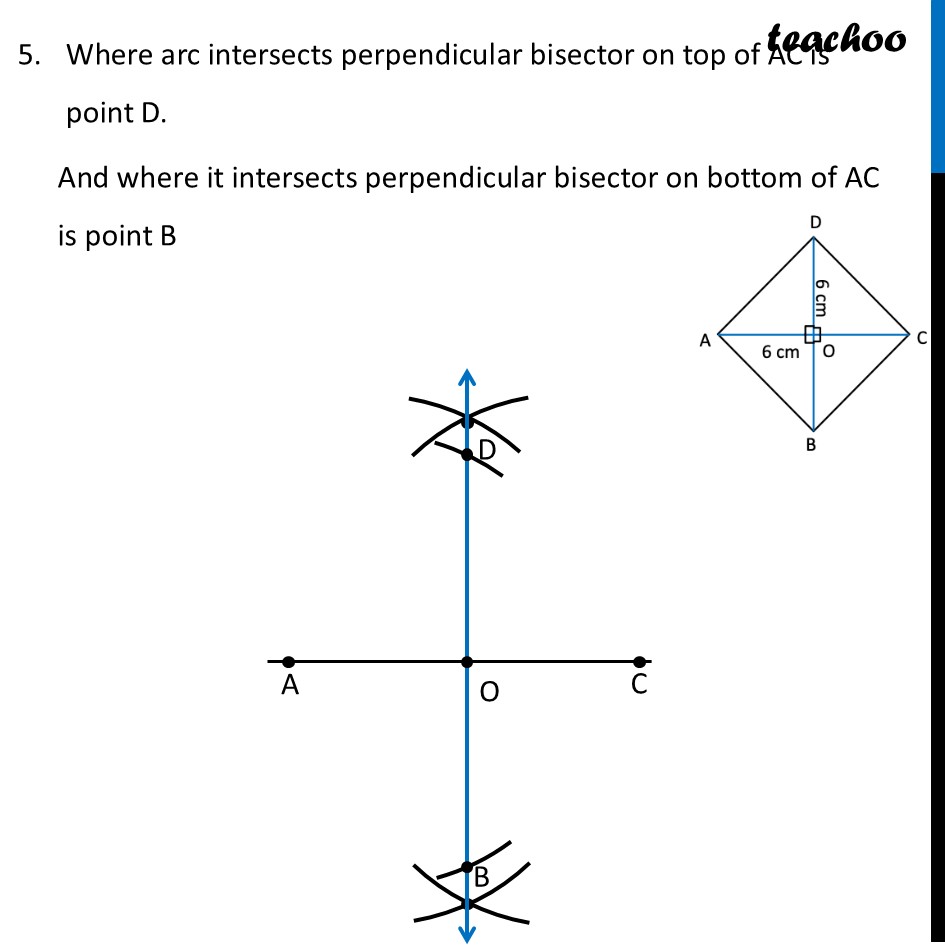
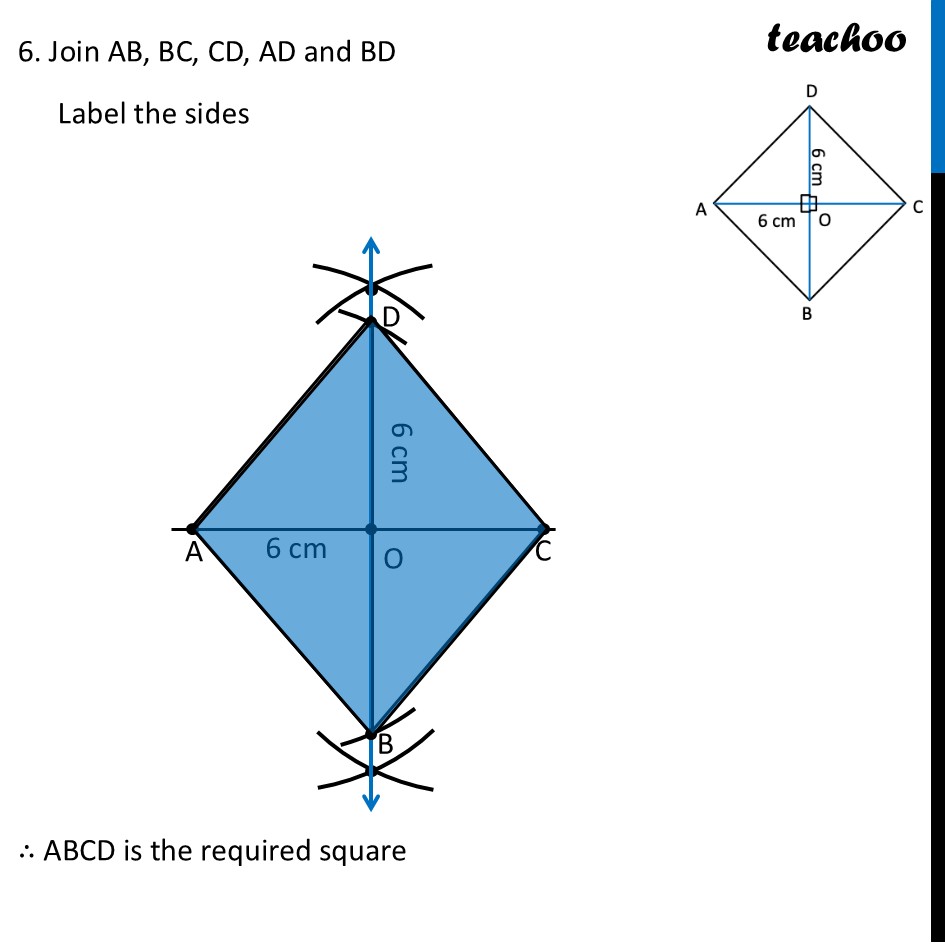
Question 6 Construct a square with diagonal 6 cm without using a protractor.For a square, both diagonals are equal Since diagonals are given, we make diagram such that diagonal is horizontal Now, In a square , Diagonals bisect each other at right angles ∴ OA = OC = 6/2 cm = 3 cm ∴ OD = OC = 6/2 cm = 3 cm To make AC ⊥ BD, we make a perpendicular bisector To construct it, we will first draw AC, then perpendicular bisector of AC Then, we will mark OD = 3 cm and OB = 3 cm on the perpendicular bisector. Let’s construct it step-by-step Steps of construction 1. Draw diagonal AC of length 6 cm 2. Drawing perpendicular bisector of AC With A as center, and radius more than half AC, draw an arc on top and bottom of AC Now with D as center, and same radius, draw an arc on top and bottom of AC 3. Mark points where arcs intersect on top and bottom of AC Join the points. So, the required line is the perpendicular bisector of AC Mark point O where perpendicular bisector intersects AC 4. Now, we will mark points D and B We know that OD = OB = 3 cm Taking 3 cm as radius, and O as center, draw an arc on top and bottom of AC Where arc intersects perpendicular bisector on top of AC is point D. And where it intersects perpendicular bisector on bottom of AC is point B 6. Join AB, BC, CD, AD and BD Label the sides ∴ ABCD is the required square

CA Maninder Singh's photo - Co-founder, Teachoo

Made by

CA Maninder Singh

CA Maninder Singh is a Chartered Accountant with 16+ years of practical experience and 20+ years of teaching experience. At Teachoo, he simplifies Accounts, Tax and GST with step-by-step examples so students can apply concepts confidently in exams and real life.

For an uninterrupted learning experience, students can use Teachoo Black to remove ads and focus better.