 You are here

![The Mechanism of Counting [Method 1, 2, 3] - Story of Numbers Class 8 - The Mechanism of Counting](https://cdn.teachoo.com/577f2d55-3da9-4bce-9dff-7510364d6b46/slide15.jpg)
The Mechanism of Counting
Last updated at November 19, 2025 by Teachoo
Transcript
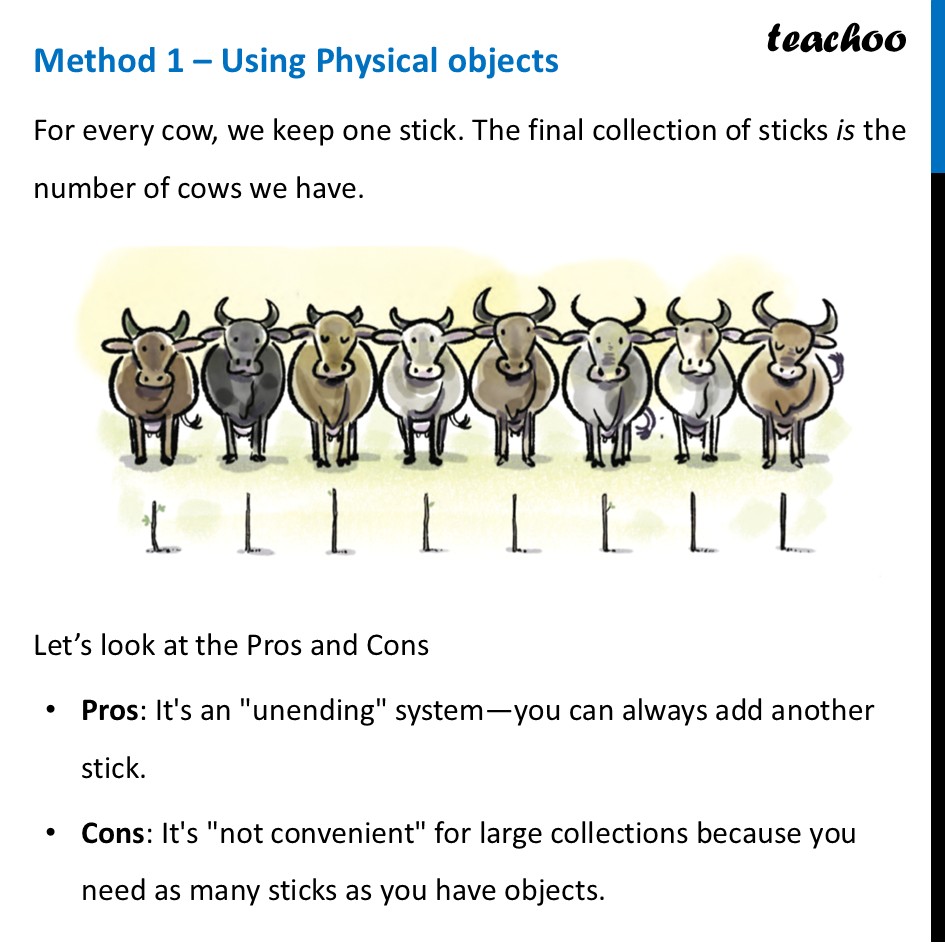
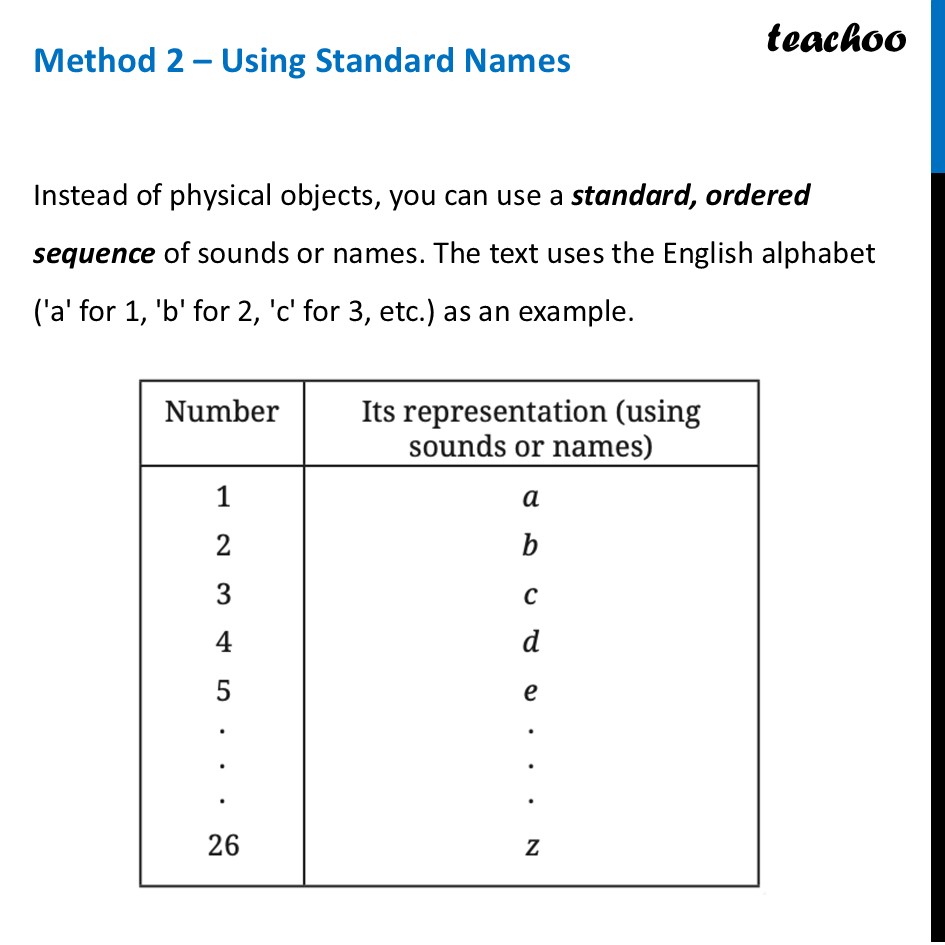
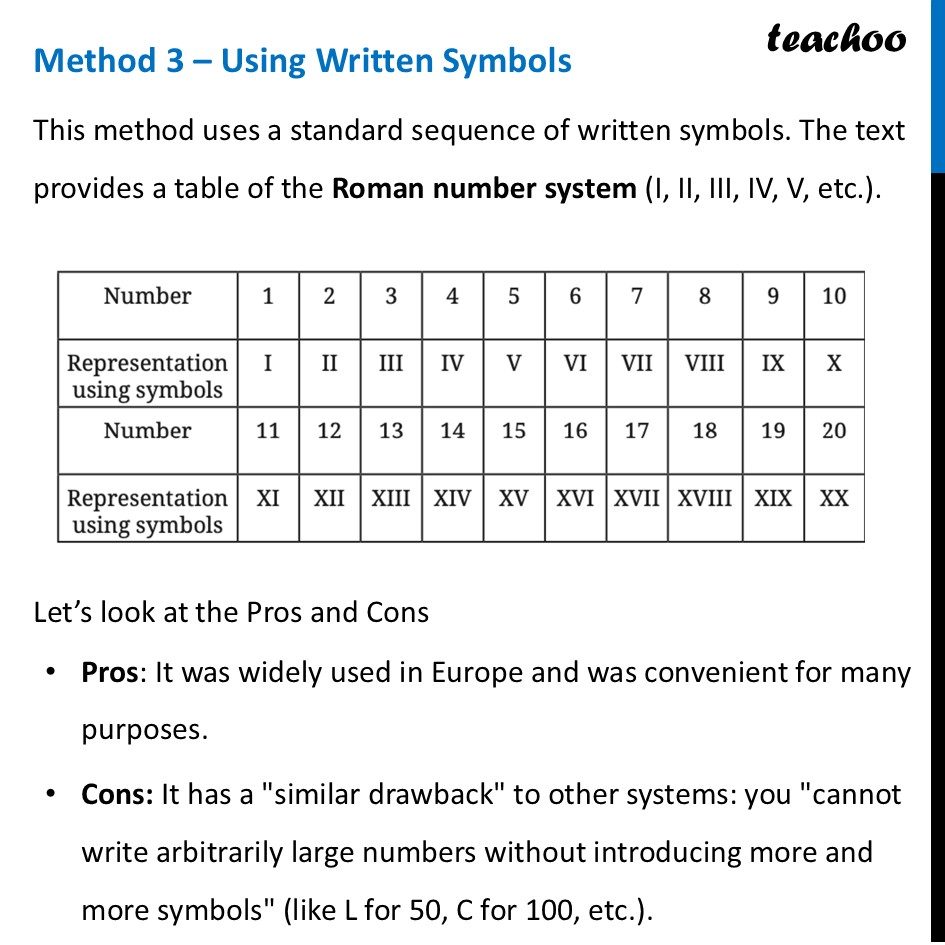
The Mechanism of CountingImagine that we are living in the Stone Age, say, around ten thousand years ago. Suppose we have a herd of cows. Here are some natural questions that we might ask about our herd - Question 1 - How do we ensure that all cows have returned safely after grazing? Question 2 - Do we have fewer cows than our neighbour? Question 3 - If there are fewer, how many more cows would we need so that we have the same number of cows as our neighbour? Let’s look at 3 different possible methods Method 1 – Using Physical objects For every cow, we keep one stick. The final collection of sticks is the number of cows we have. Let’s look at the Pros and Cons Pros: It's an "unending" system—you can always add another stick. Cons: It's "not convenient" for large collections because you need as many sticks as you have objects. Method 2 – Using Standard Names Instead of physical objects, you can use a standard, ordered sequence of sounds or names. The text uses the English alphabet ('a' for 1, 'b' for 2, 'c' for 3, etc.) as an example. Let’s look at the Pros and Cons Pros: It's convenient for the process of counting. Cons: This is "not an unending" system; it has an "obvious limitation" because it can only count up to 26 objects. Method 3 – Using Written Symbols This method uses a standard sequence of written symbols. The text provides a table of the Roman number system (I, II, III, IV, V, etc.). Let’s look at the Pros and Cons Pros: It was widely used in Europe and was convenient for many purposes. Cons: It has a "similar drawback" to other systems: you "cannot write arbitrarily large numbers without introducing more and more symbols" (like L for 50, C for 100, etc.). Number 1 2 3 4 5 6 7 8 9 10 Representation using symbols I II III IV V VI VII VIII IX X Number 11 12 13 14 15 16 17 18 19 20 Representation using symbols XI XII XIII XIV XV XVI XVII XVIII XIX XX
