End-of-Chapter Exercises

 You are here
End-of-Chapter Exercises
Last updated at November 22, 2026 by Teachoo
Transcript
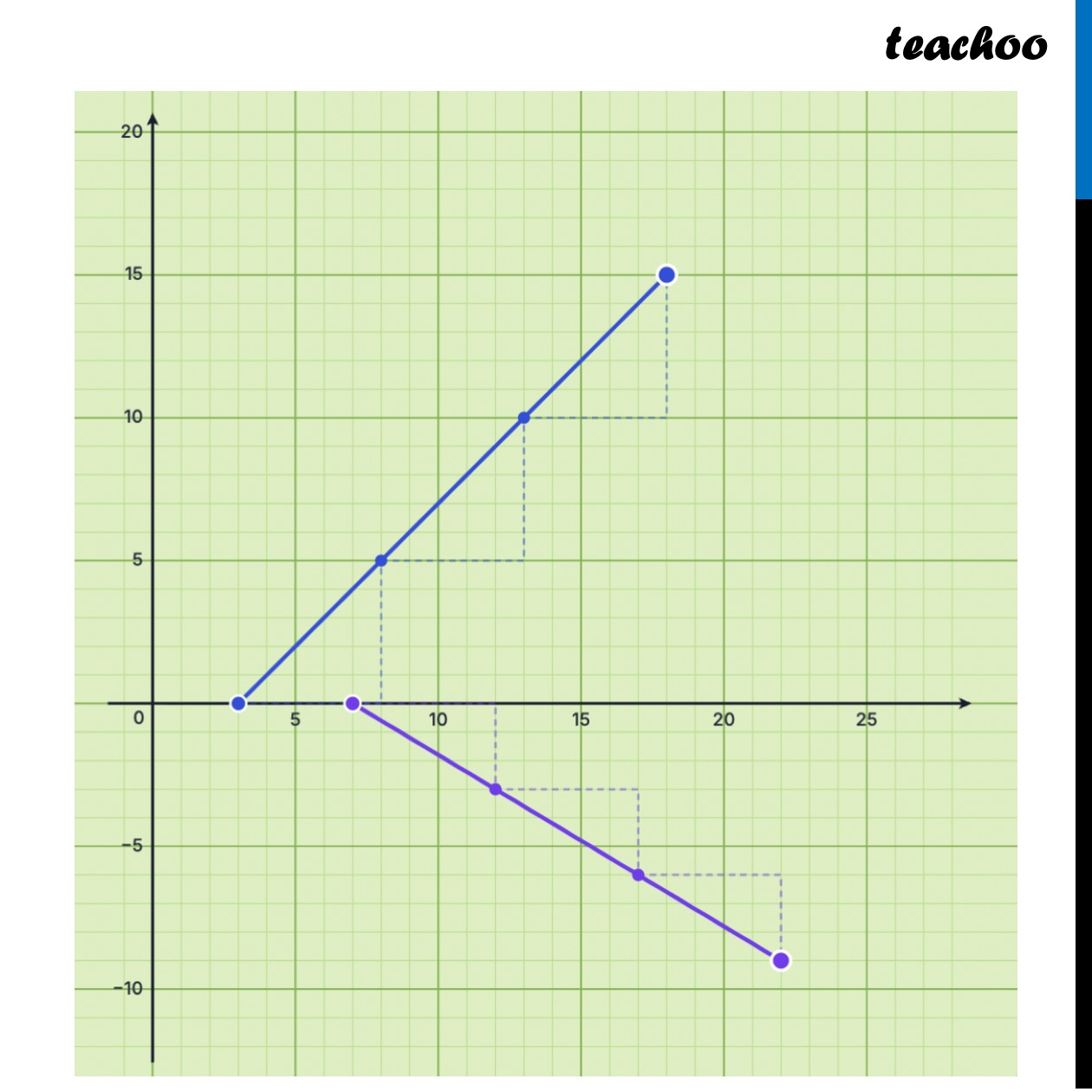
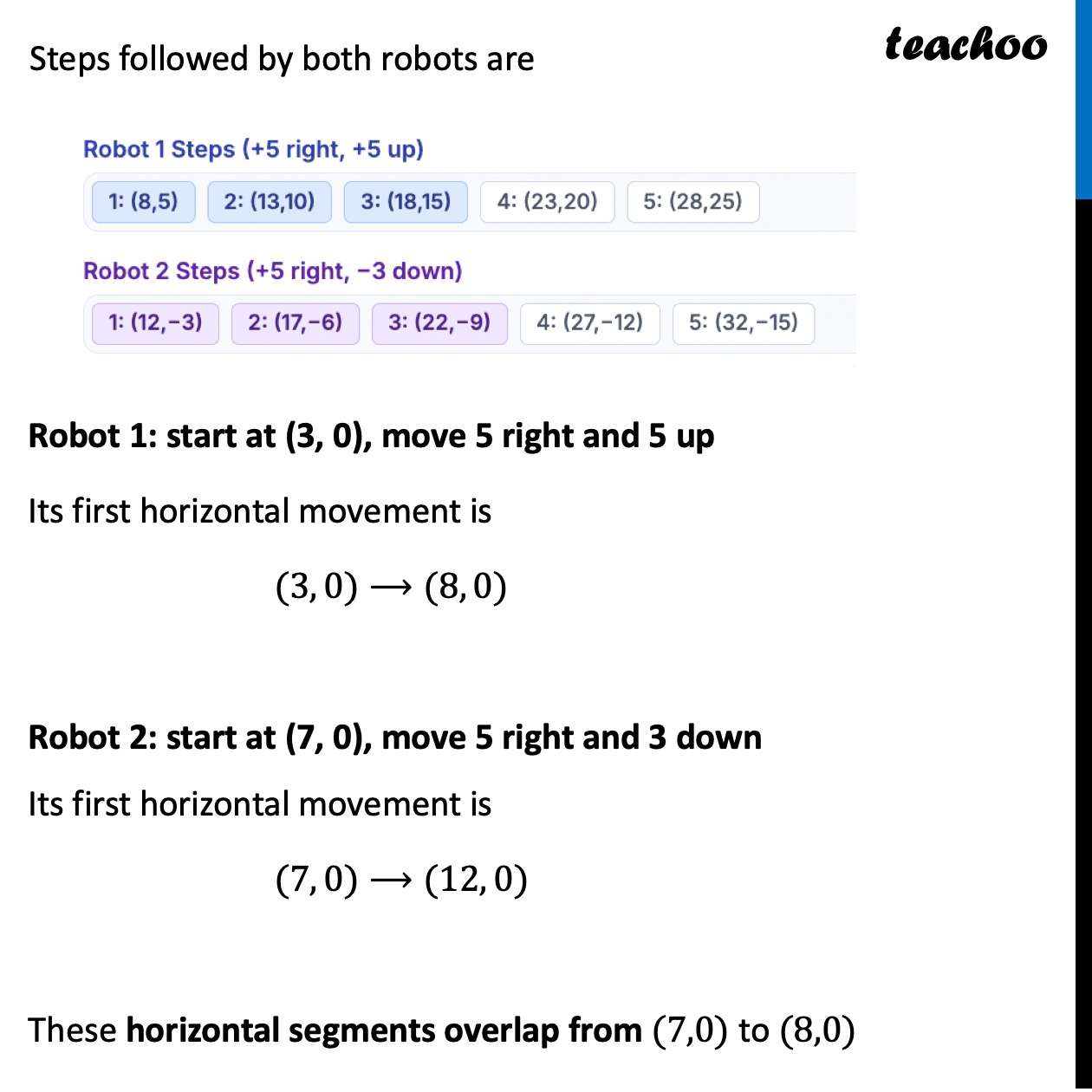
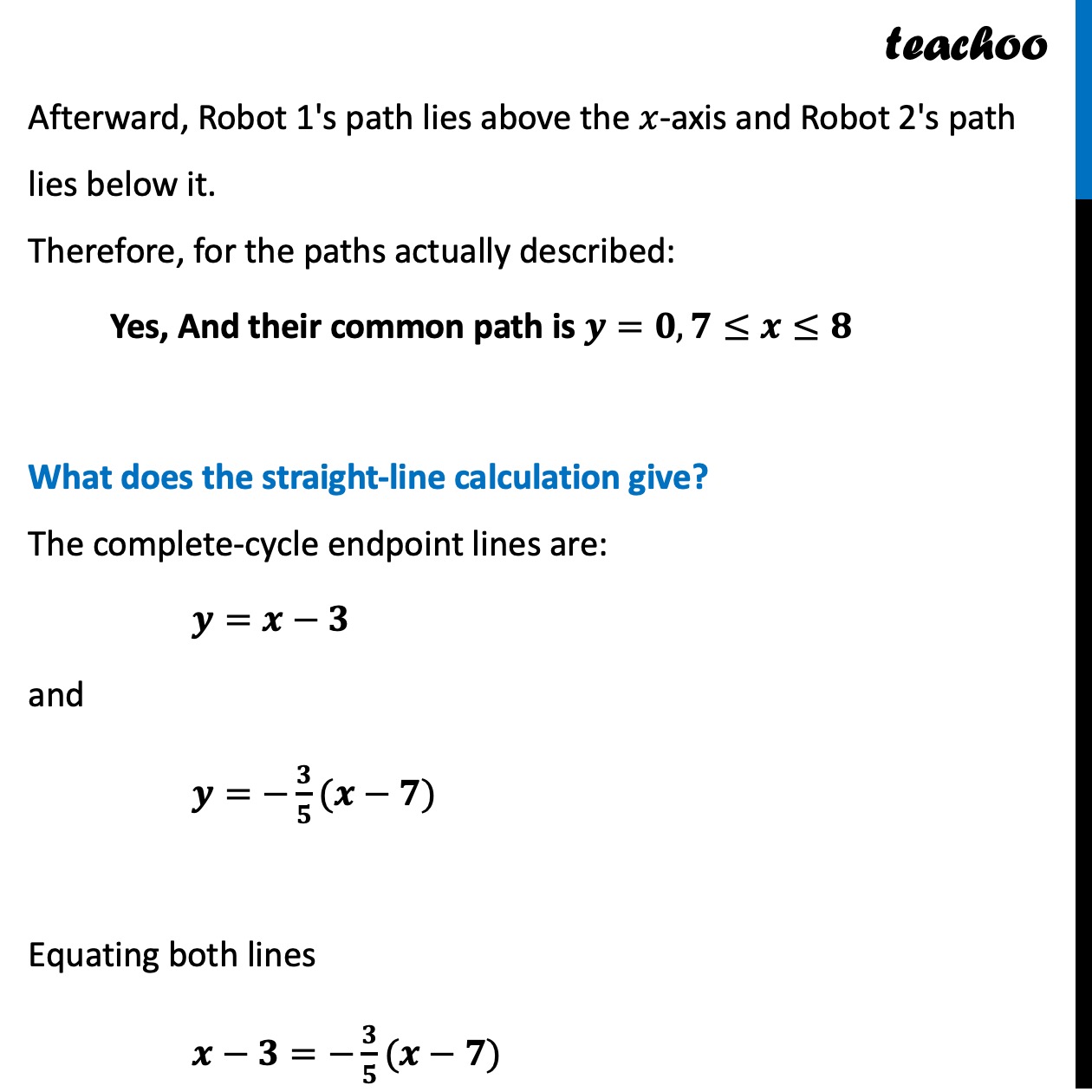
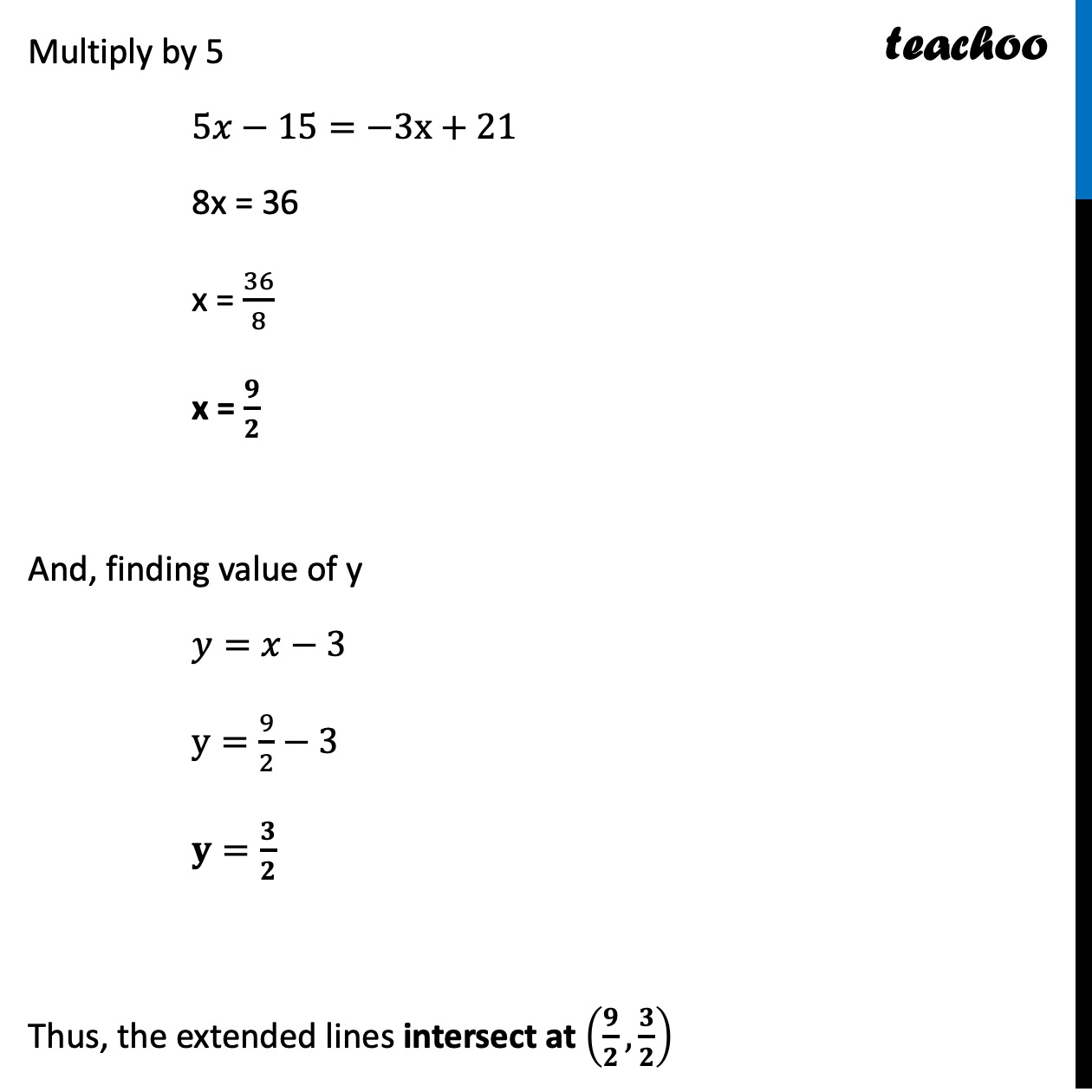
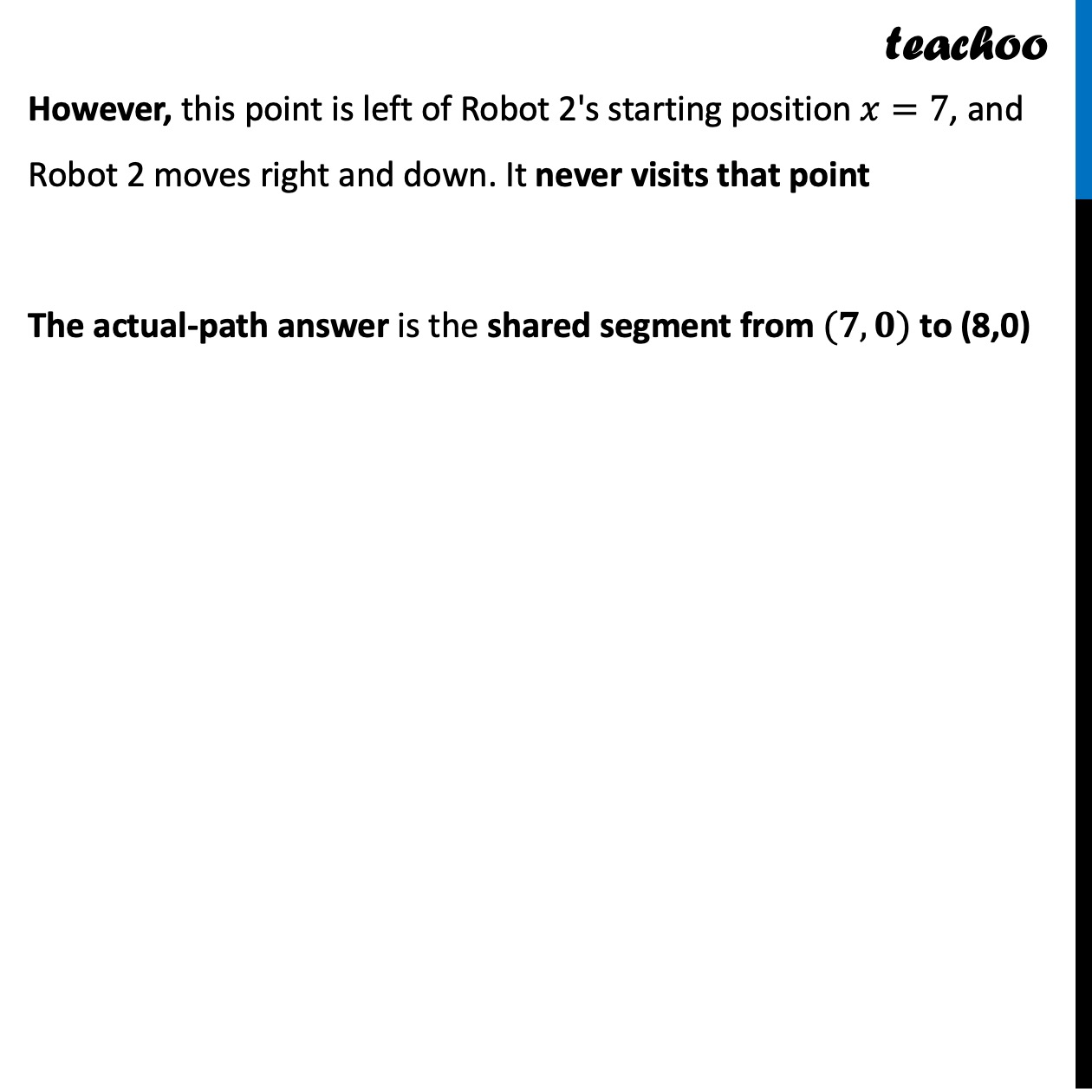
Question 11 (ii) Robot 1 starts from (3, 0) and traces a path by repeatedly moving 5 units to the right and then 5 units upward. Robot 2 starts from the point (7, 0) and repeatedly moves 5 units to the right and then 3 units downwards. Will the paths traced by these two robots intersect and if so, where? Here, we follow these steps Draw our graph Find equations of both lines (using points) Find solution of both lines Note: We can also keep drawing our graph until the lines intersect (or not) Let’s do this EEE EEE ERS eye pS NS EEE PPE narnarnarn ney Steps followed by both robots are Robot 1: start at (3, 0), move 5 right and 5 up Its first horizontal movement is (3, 0)⟶(8, 0) Robot 2: start at (7, 0), move 5 right and 3 down Its first horizontal movement is (7, 0)⟶(12, 0) These horizontal segments overlap from (7,0) to (8,0) Afterward, Robot 1's path lies above the 𝑥-axis and Robot 2's path lies below it. Therefore, for the paths actually described: Yes, And their common path is 𝒚=𝟎, 𝟕≤𝒙≤𝟖 What does the straight-line calculation give? The complete-cycle endpoint lines are: 𝒚=𝒙−𝟑 and 𝒚=−(𝟑)/(𝟓)(𝒙−𝟕) Equating both lines 𝒙−𝟑=−(𝟑)/(𝟓)(𝒙−𝟕). Multiply by 5: [5𝑥−15, =−3𝑥+21; 8𝑥=36, ⇒ 𝑥=(9)/(2).] Thus: 𝑦=(9)/(2)−3=(3)/(2). The extended lines intersect at: ((9)/(2),(3)/(2)). However, this point is left of Robot 2's starting position 𝑥=7, and Robot 2 moves right and down. It never visits that point. The actual-path answer is the shared segment from (7,0) to (8,0). Robot 1 Steps (+5 right, +5 up) 1:(8,5) 2: (13,10) += 3: (18,15) = 4: (23,20) +~—5: (28,25) Robot 2 Steps (+5 right, -3 down) 1: (12,-3) || 2:(17,-6) || 3:(22,-9) | 4:(27,-12) | 5: (32,-15) Afterward, Robot 1's path lies above the 𝑥-axis and Robot 2's path lies below it. Therefore, for the paths actually described: Yes, And their common path is 𝒚=𝟎, 𝟕≤𝒙≤𝟖 What does the straight-line calculation give? The complete-cycle endpoint lines are: 𝒚=𝒙−𝟑 and 𝒚=−(𝟑)/(𝟓)(𝒙−𝟕) Equating both lines 𝒙−𝟑=−(𝟑)/(𝟓)(𝒙−𝟕) Multiply by 5 [5𝑥−15, =−3𝑥+21; 8𝑥=36, ⇒ 𝑥=(9)/(2).] Thus: 𝑦=(9)/(2)−3=(3)/(2). The extended lines intersect at: ((9)/(2),(3)/(2)). However, this point is left of Robot 2's starting position 𝑥=7, and Robot 2 moves right and down. It never visits that point. The actual-path answer is the shared segment from (7,0) to (8,0). Multiply by 5 5𝑥−15=−3x+21 8x = 36 x = (36)/(8) x = (𝟗)/(𝟐) And, finding value of y 𝑦=𝑥−3 y=(9)/(2)−3 𝐲=(𝟑)/(𝟐) Thus, the extended lines intersect at ((𝟗)/(𝟐),(𝟑)/(𝟐)) However, this point is left of Robot 2's starting position 𝑥=7, and Robot 2 moves right and down. It never visits that point. The actual-path answer is the shared segment from (7,0) to (8,0). However, this point is left of Robot 2's starting position 𝑥=7, and Robot 2 moves right and down. It never visits that point The actual-path answer is the shared segment from (𝟕,𝟎) to (8,0)