End-of-Chapter Exercises

 You are here
End-of-Chapter Exercises
Last updated at November 22, 2026 by Teachoo
Transcript
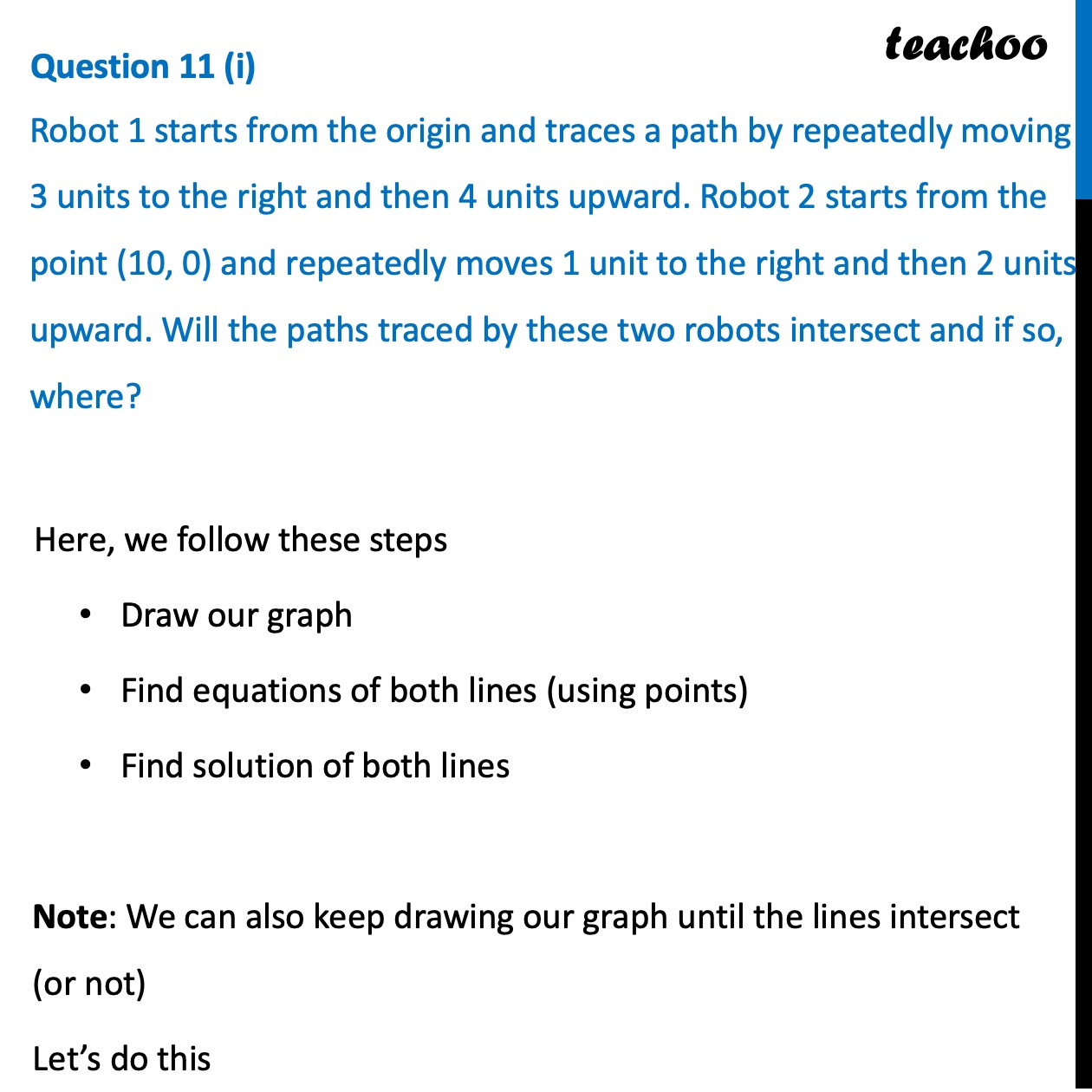
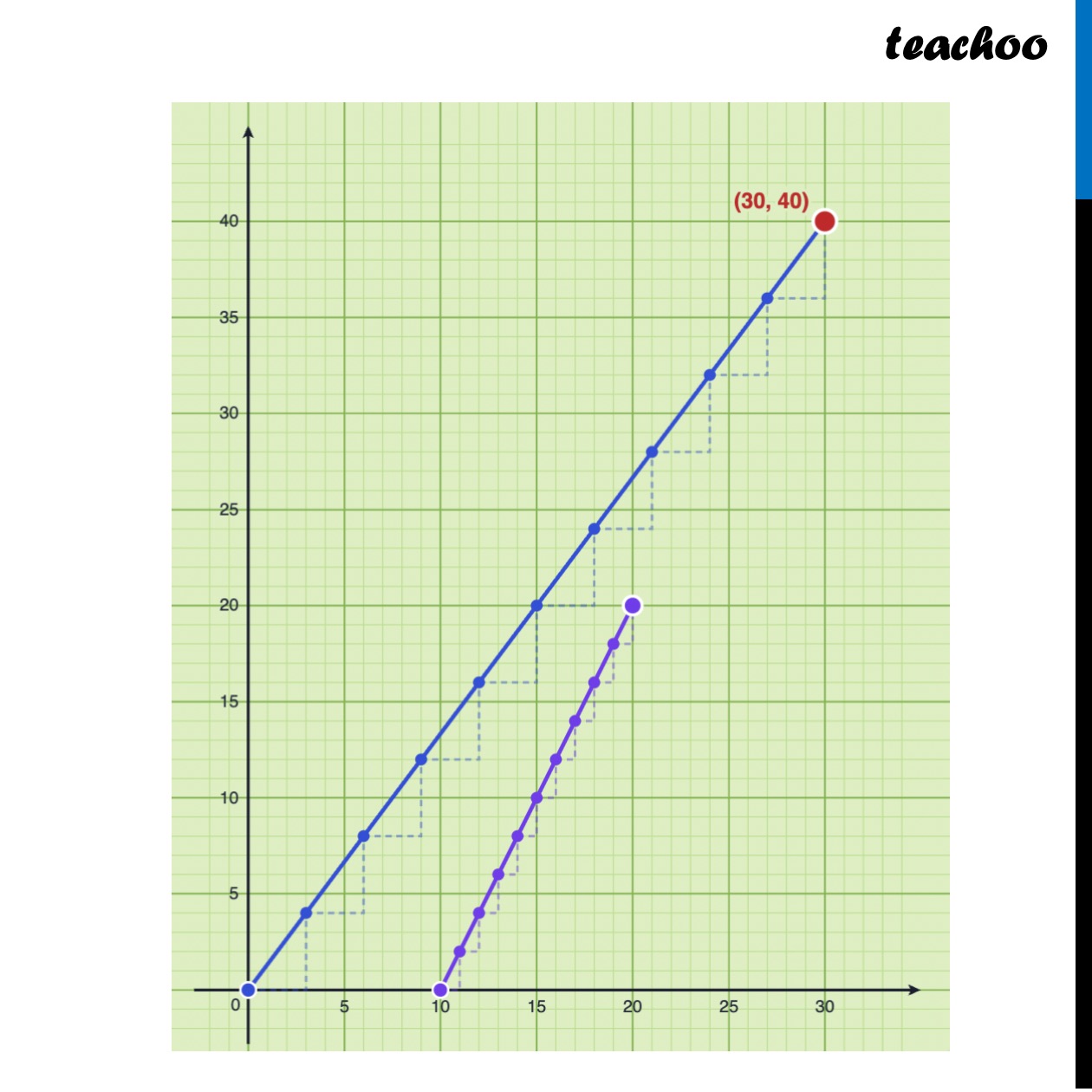
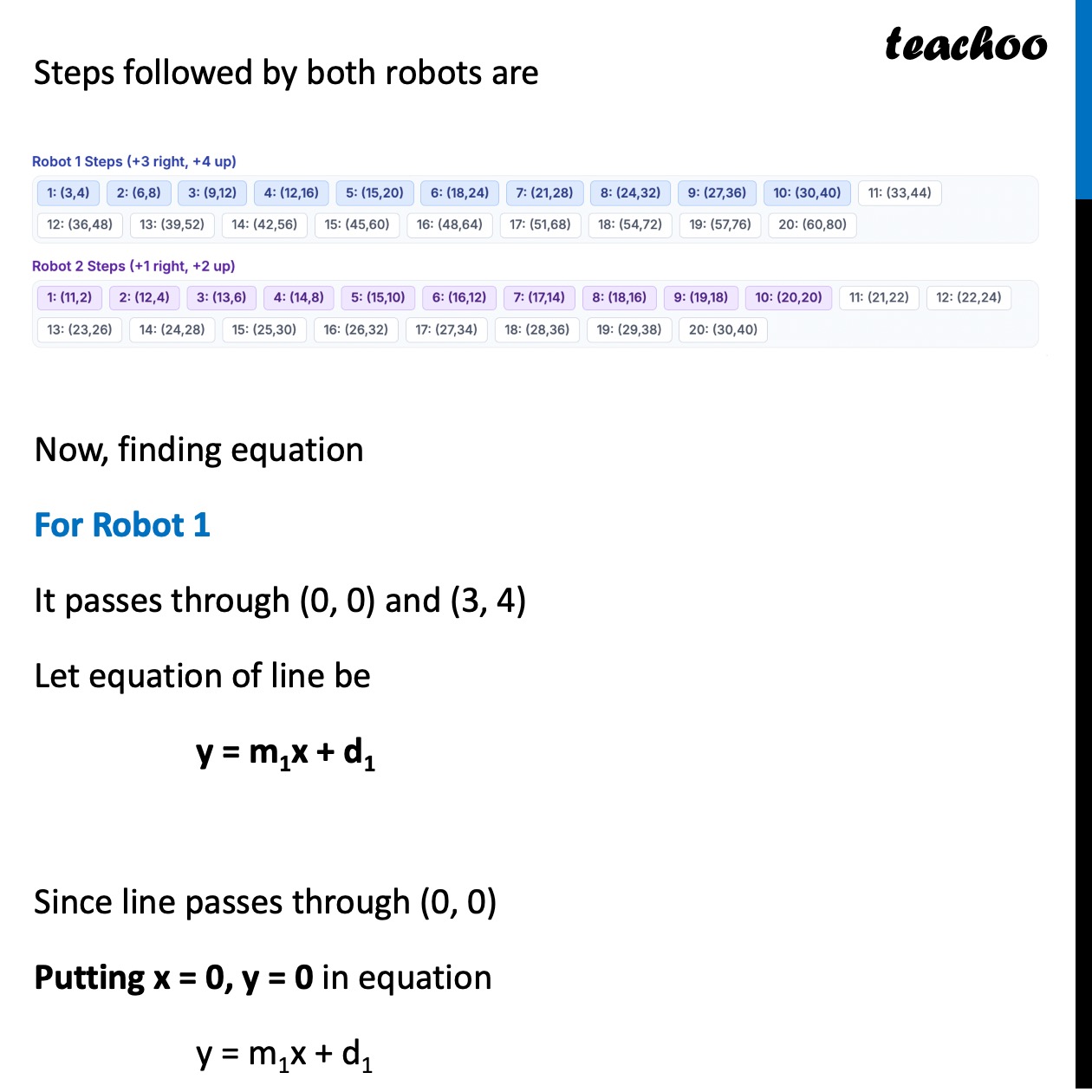
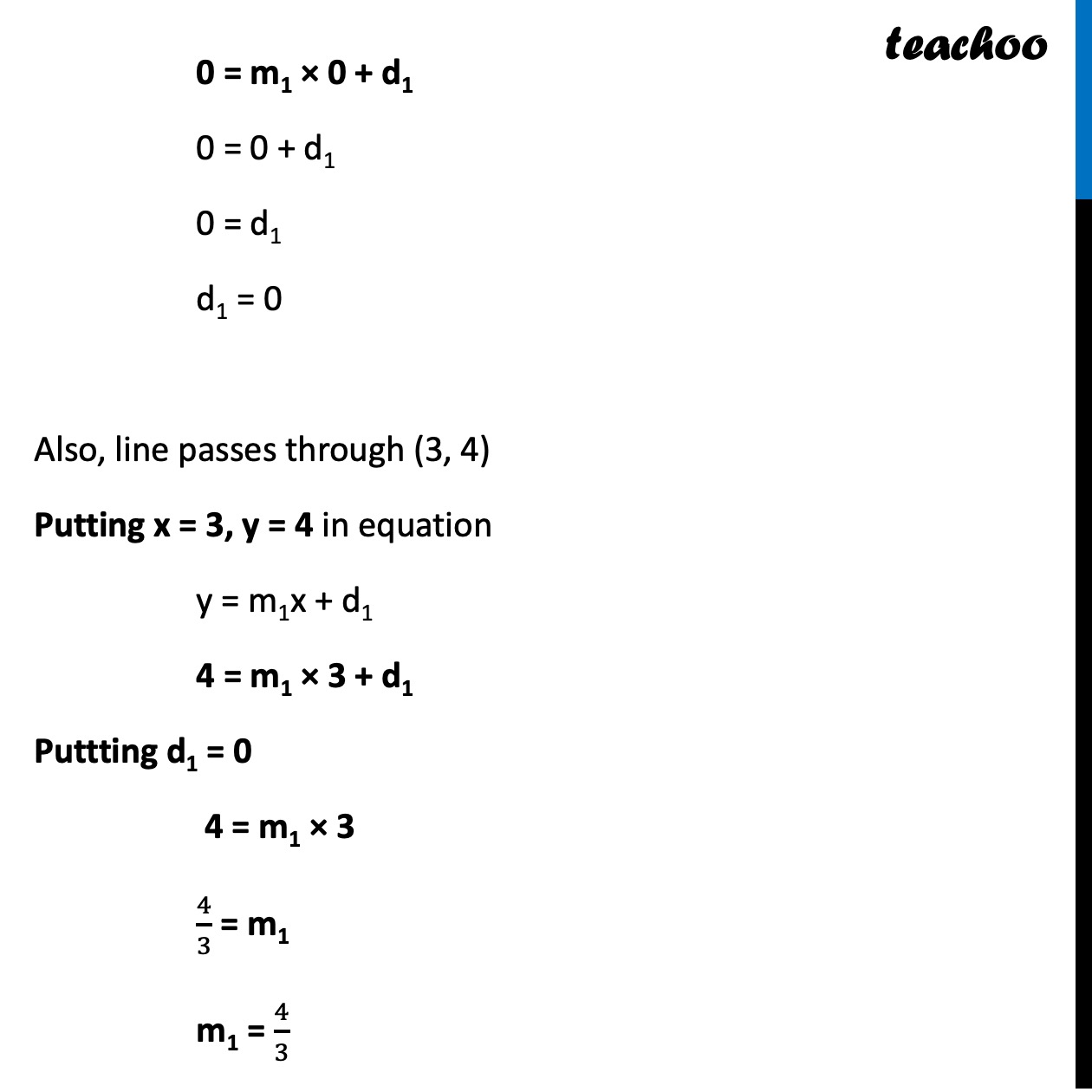
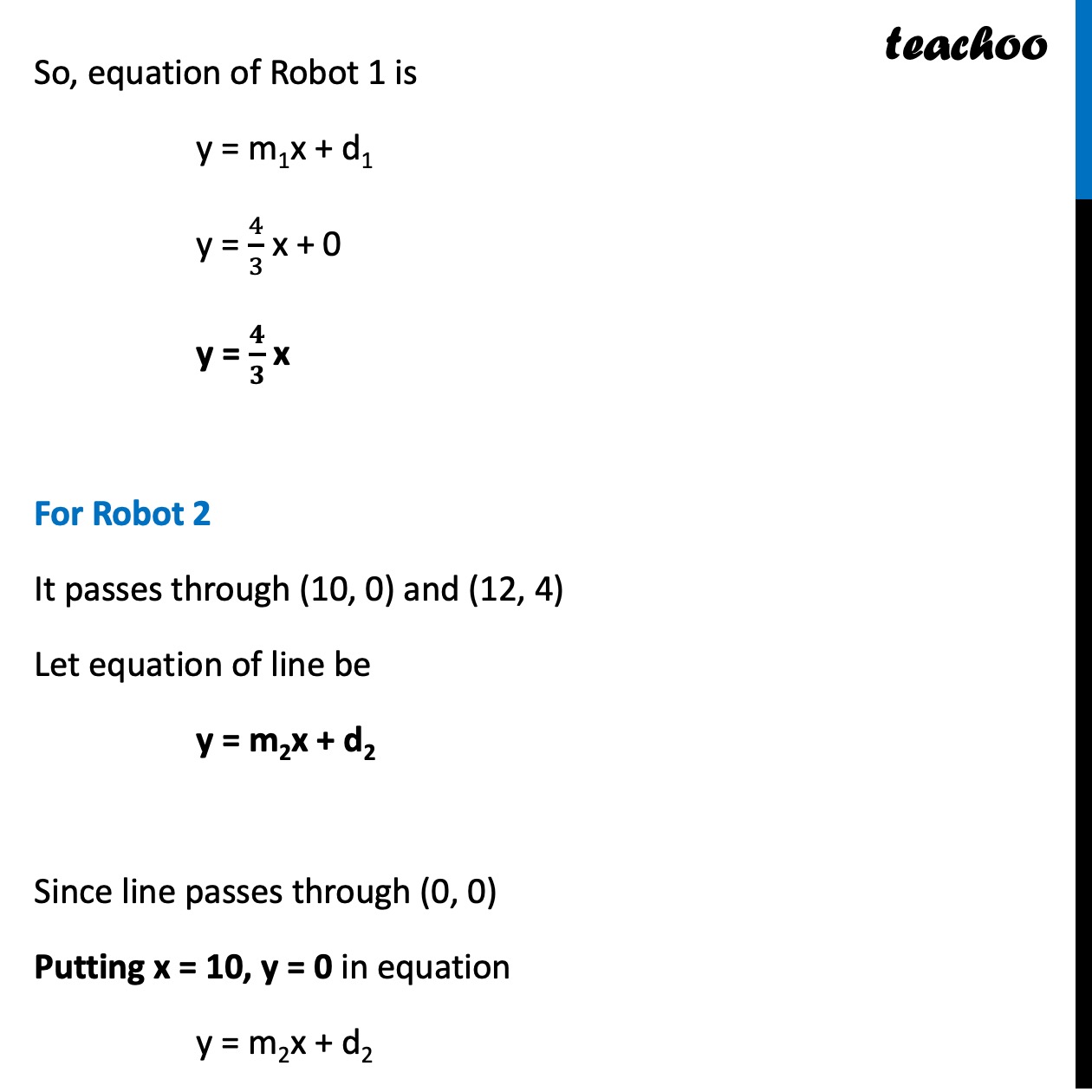
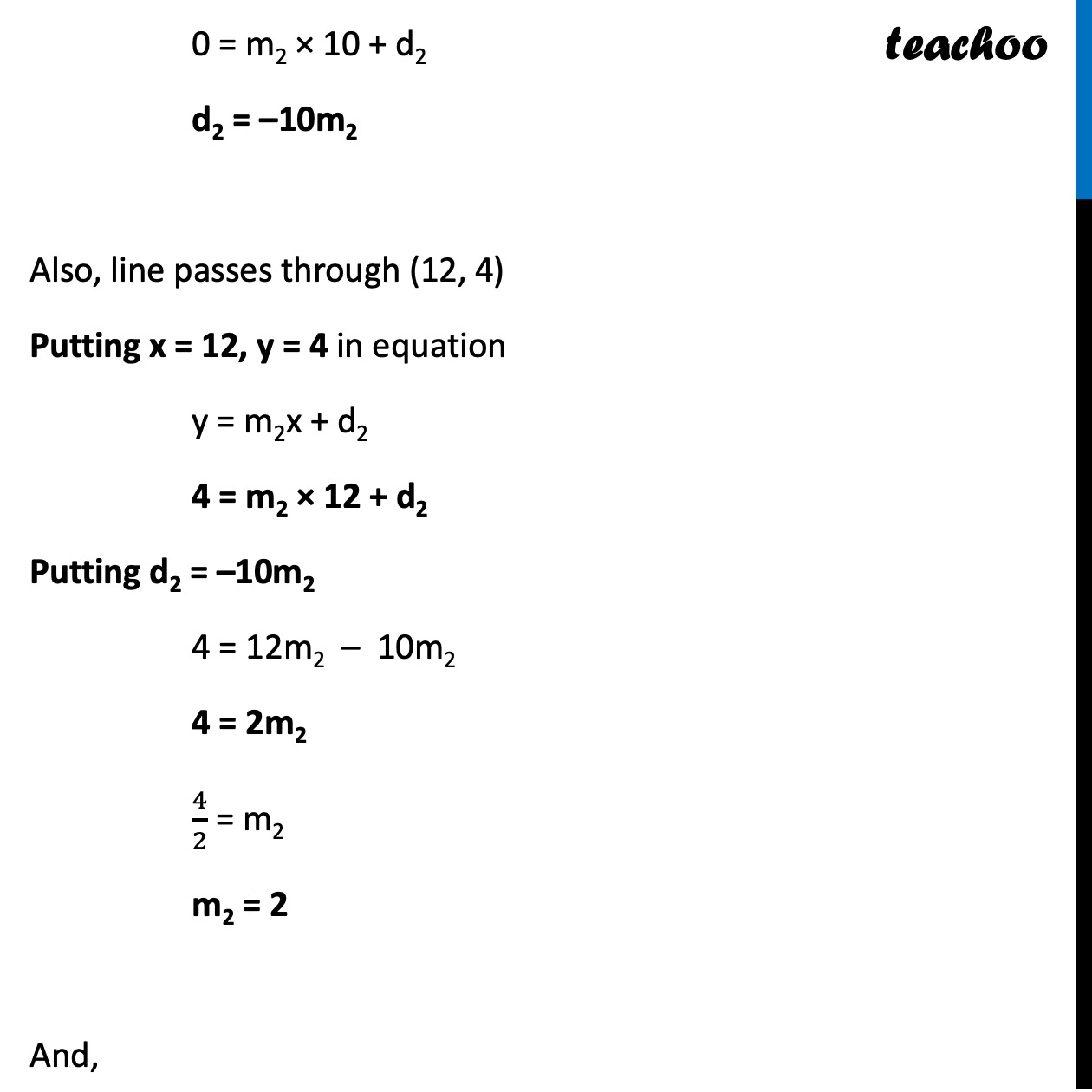
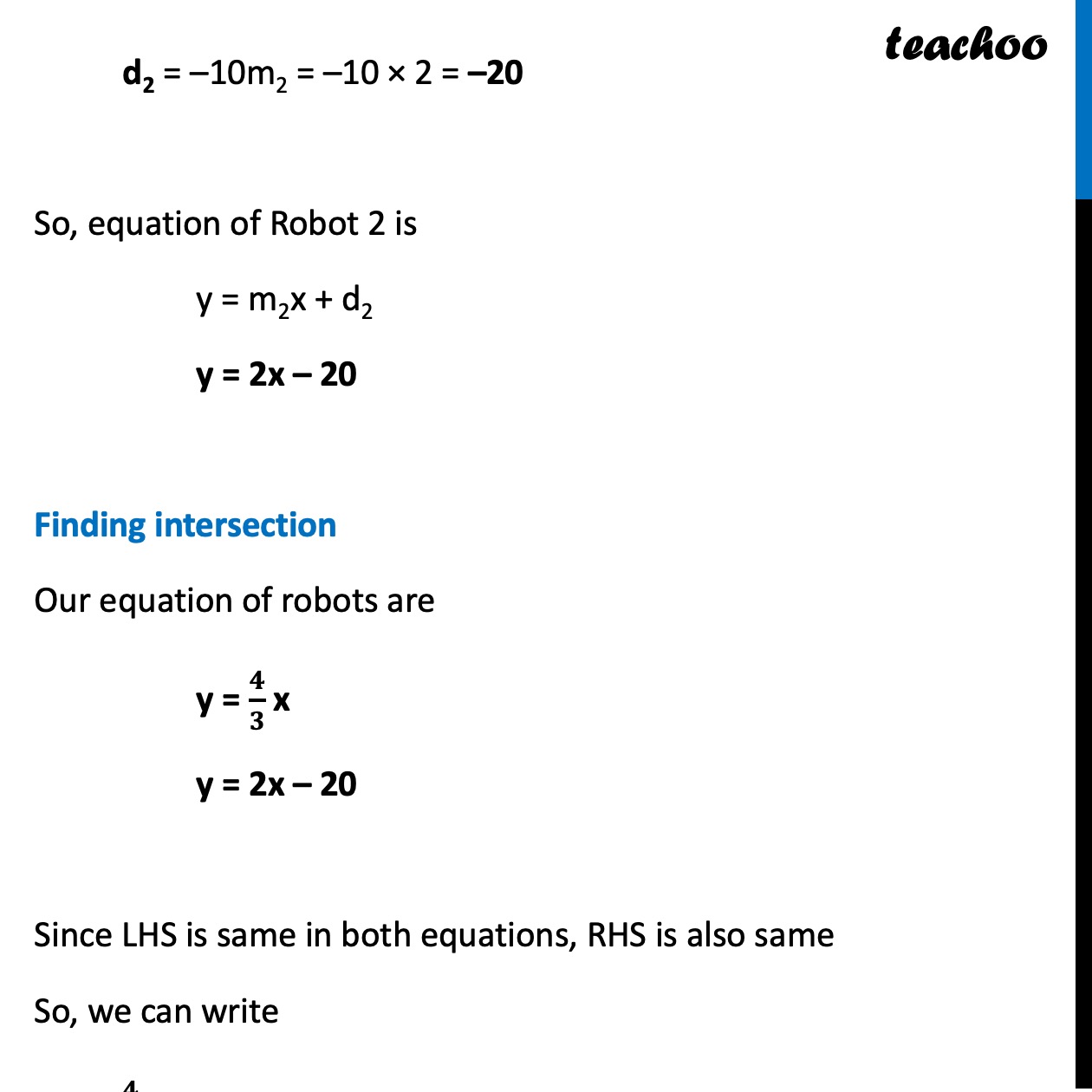
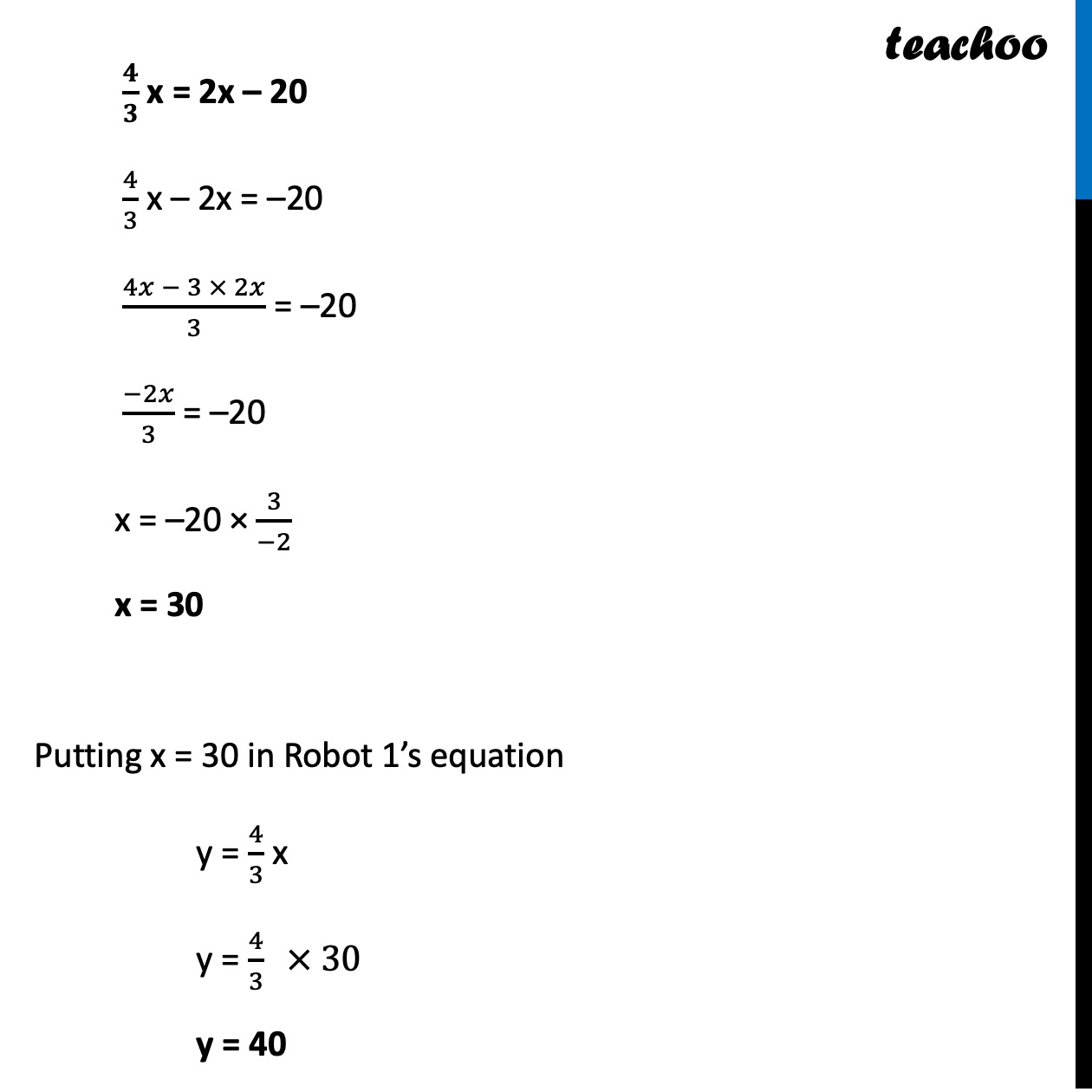
Question 11 (i) Robot 1 starts from the origin and traces a path by repeatedly moving 3 units to the right and then 4 units upward. Robot 2 starts from the point (10, 0) and repeatedly moves 1 unit to the right and then 2 units upward. Will the paths traced by these two robots intersect and if so, where? Here, we follow these steps Draw our graph Find equations of both lines (using points) Find solution of both lines Note: We can also keep drawing our graph until the lines intersect (or not) Let’s do this Steps followed by both robots are Now, finding equation For Robot 1 It passes through (0, 0) and (3, 4) Let equation of line be y = m_(1)x + d_(1) Since line passes through (0, 0) Putting x = 0, y = 0 in equation y = m_(1)x + d_(1) 0 = m_(1) × 0 + d_(1) 0 = 0 + d_(1) 0 = d_(1) d_(1) = 0 Also, line passes through (3, 4) Putting x = 3, y = 4 in equation y = m_(1)x + d_(1) 4 = m_(1) × 3 + d_(1) Puttting d_(1) = 0 4 = m_(1) × 3 (4)/(3) = m_(1) m_(1) = (4)/(3) So, equation of Robot 1 is y = m_(1)x + d_(1) y = (4)/(3) x + 0 y = (𝟒)/(𝟑) x For Robot 2 It passes through (10, 0) and (12, 4) Let equation of line be y = m_(2)x + d_(2) Since line passes through (0, 0) Putting x = 10, y = 0 in equation y = m_(2)x + d_(2) 0 = m_(2) × 10 + d_(2) d_(2) = –10m_(2) Also, line passes through (12, 4) Putting x = 12, y = 4 in equation y = m_(2)x + d_(2) 4 = m_(2) × 12 + d_(2) Putting d_(2) = –10m_(2) 4 = 12m_(2) – 10m_(2) 4 = 2m_(2) (4)/(2) = m_(2) m_(2) = 2 And, d_(2) = –10m_(2) = –10 × 2 = –20 _( ) So, equation of Robot 2 is y = m_(2)x + d_(2) y = 2x – 20 Finding intersection Our equation of robots are y = (𝟒)/(𝟑) x y = 2x – 20 Since LHS is same in both equations, RHS is also same So, we can write (𝟒)/(𝟑) x = 2x – 20 (4)/(3) x – 2x = –20 (4𝑥 − 3 × 2𝑥)/(3) = –20 (−2𝑥)/(3) = –20 x = –20 × (3)/(−2) x = 30 Putting x = 30 in Robot 1’s equation y = (4)/(3) x y = (4)/(3) × 30 y = 40 So, both paths intersect at (30, 40) Robot 1 Steps (+3 right, +4 up) 1:(3,4) 2:(6,8) 3:(9,12) 4: (12,16) 5: (15,20) ~—- 6: (18,24) ~—- 7: (21,28) + ~—- 8: (24,32) + ~—-9: (27,36) ~— 10: (30,40) ~—11: (33,44) 12: (36,48) 13: (39,52) 14: (42,56) = 15: (45,60) 16: (48,64) = 17: (51,68) = 18: (54,72) ~—-19: (57,76) 20: (60,80) Robot 2 Steps (+1 right, +2 up) 1:(11,2) | 2:(12,4) 3: (13,6) 4: (14,8) 5: (15,10) += 6: (16,12) 7: (17,14) ~—s8: (18,16) 9: (19,18) 10: (20,20) ~— 11: (21,22) ~~ 12: (22,24) 13: (23,26) 14:(24,28) 15:(25,30) 16: (26,32) += 17: (27,34) +~— 18: (28,36) 19: (29,38) 20: (30,40) 0 = m_(1) × 0 + d_(1) 0 = 0 + d_(1) 0 = d_(1) d_(1) = 0 Also, line passes through (3, 4) Putting x = 3, y = 4 in equation y = m_(1)x + d_(1) 4 = m_(1) × 3 + d_(1) Puttting d_(1) = 0 4 = m_(1) × 3 (4)/(3) = m_(1) m_(1) = (4)/(3) So, equation of Robot 1 is y = m_(1)x + d_(1) y = (4)/(3) x + 0 y = (𝟒)/(𝟑) x For Robot 2 It passes through (10, 0) and (12, 4) Let equation of line be y = m_(2)x + d_(2) Since line passes through (0, 0) Putting x = 10, y = 0 in equation y = m_(2)x + d_(2) 0 = m_(2) × 10 + d_(2) d_(2) = –10m_(2) Also, line passes through (12, 4) Putting x = 12, y = 4 in equation y = m_(2)x + d_(2) 4 = m_(2) × 12 + d_(2) Putting d_(2) = –10m_(2) 4 = 12m_(2) – 10m_(2) 4 = 2m_(2) (4)/(2) = m_(2) m_(2) = 2 And, d_(2) = –10m_(2) = –10 × 2 = –20 _( ) So, equation of Robot 2 is y = m_(2)x + d_(2) y = 2x – 20 Finding intersection Our equation of robots are y = (𝟒)/(𝟑) x y = 2x – 20 Since LHS is same in both equations, RHS is also same So, we can write (𝟒)/(𝟑) x = 2x – 20 (4)/(3) x – 2x = –20 (4𝑥 − 3 × 2𝑥)/(3) = –20 (−2𝑥)/(3) = –20 x = –20 × (3)/(−2) x = 30 Putting x = 30 in Robot 1’s equation y = (4)/(3) x y = (4)/(3) × 30 y = 40 So, both paths intersect at (30, 40) So, equation of Robot 1 is y = m_(1)x + d_(1) y = (4)/(3) x + 0 y = (𝟒)/(𝟑) x For Robot 2 It passes through (10, 0) and (12, 4) Let equation of line be y = m_(2)x + d_(2) Since line passes through (0, 0) Putting x = 10, y = 0 in equation y = m_(2)x + d_(2) 0 = m_(2) × 10 + d_(2) d_(2) = –10m_(2) Also, line passes through (12, 4) Putting x = 12, y = 4 in equation y = m_(2)x + d_(2) 4 = m_(2) × 12 + d_(2) Putting d_(2) = –10m_(2) 4 = 12m_(2) – 10m_(2) 4 = 2m_(2) (4)/(2) = m_(2) m_(2) = 2 And, d_(2) = –10m_(2) = –10 × 2 = –20 _( ) So, equation of Robot 2 is y = m_(2)x + d_(2) y = 2x – 20 Finding intersection Our equation of robots are y = (𝟒)/(𝟑) x y = 2x – 20 Since LHS is same in both equations, RHS is also same So, we can write (𝟒)/(𝟑) x = 2x – 20 (4)/(3) x – 2x = –20 (4𝑥 − 3 × 2𝑥)/(3) = –20 (−2𝑥)/(3) = –20 x = –20 × (3)/(−2) x = 30 Putting x = 30 in Robot 1’s equation y = (4)/(3) x y = (4)/(3) × 30 y = 40 So, both paths intersect at (30, 40) 0 = m_(2) × 10 + d_(2) d_(2) = –10m_(2) Also, line passes through (12, 4) Putting x = 12, y = 4 in equation y = m_(2)x + d_(2) 4 = m_(2) × 12 + d_(2) Putting d_(2) = –10m_(2) 4 = 12m_(2) – 10m_(2) 4 = 2m_(2) (4)/(2) = m_(2) m_(2) = 2 And, d_(2) = –10m_(2) = –10 × 2 = –20 _( ) So, equation of Robot 2 is y = m_(2)x + d_(2) y = 2x – 20 Finding intersection Our equation of robots are y = (𝟒)/(𝟑) x y = 2x – 20 Since LHS is same in both equations, RHS is also same So, we can write (𝟒)/(𝟑) x = 2x – 20 (4)/(3) x – 2x = –20 (4𝑥 − 3 × 2𝑥)/(3) = –20 (−2𝑥)/(3) = –20 x = –20 × (3)/(−2) x = 30 Putting x = 30 in Robot 1’s equation y = (4)/(3) x y = (4)/(3) × 30 y = 40 So, both paths intersect at (30, 40) d_(2) = –10m_(2) = –10 × 2 = –20 _( ) So, equation of Robot 2 is y = m_(2)x + d_(2) y = 2x – 20 Finding intersection Our equation of robots are y = (𝟒)/(𝟑) x y = 2x – 20 Since LHS is same in both equations, RHS is also same So, we can write (𝟒)/(𝟑) x = 2x – 20 (4)/(3) x – 2x = –20 (4𝑥 − 3 × 2𝑥)/(3) = –20 (−2𝑥)/(3) = –20 x = –20 × (3)/(−2) x = 30 Putting x = 30 in Robot 1’s equation y = (4)/(3) x y = (4)/(3) × 30 y = 40 So, both paths intersect at (30, 40) (𝟒)/(𝟑) x = 2x – 20 (4)/(3) x – 2x = –20 (4𝑥 − 3 × 2𝑥)/(3) = –20 (−2𝑥)/(3) = –20 x = –20 × (3)/(−2) x = 30 Putting x = 30 in Robot 1’s equation y = (4)/(3) x y = (4)/(3) × 30 y = 40 So, both paths intersect at (30, 40) So, both paths intersect at (30, 40)
