End-of-Chapter Exercises

 You are here
End-of-Chapter Exercises
Last updated at November 22, 2026 by Teachoo
Transcript
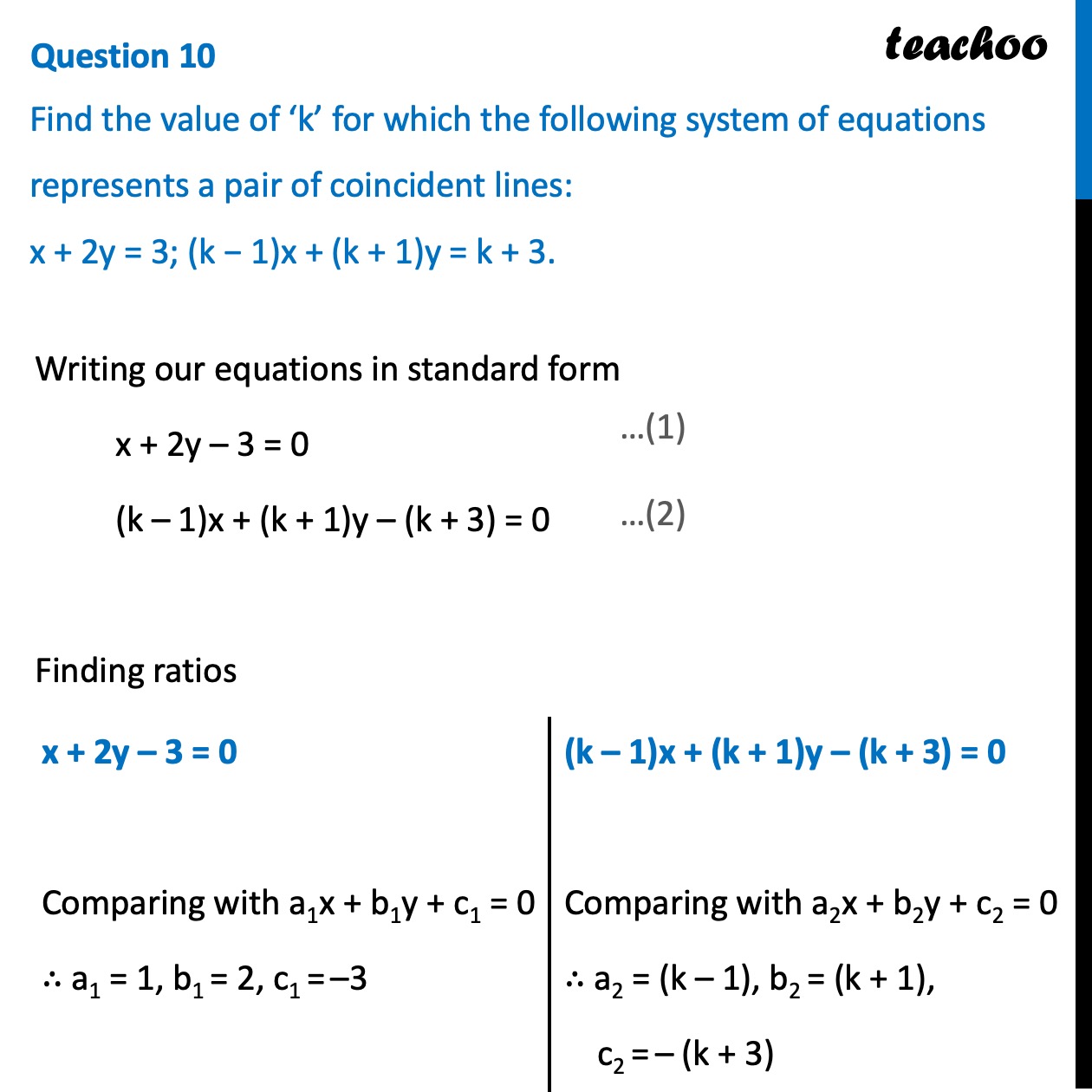
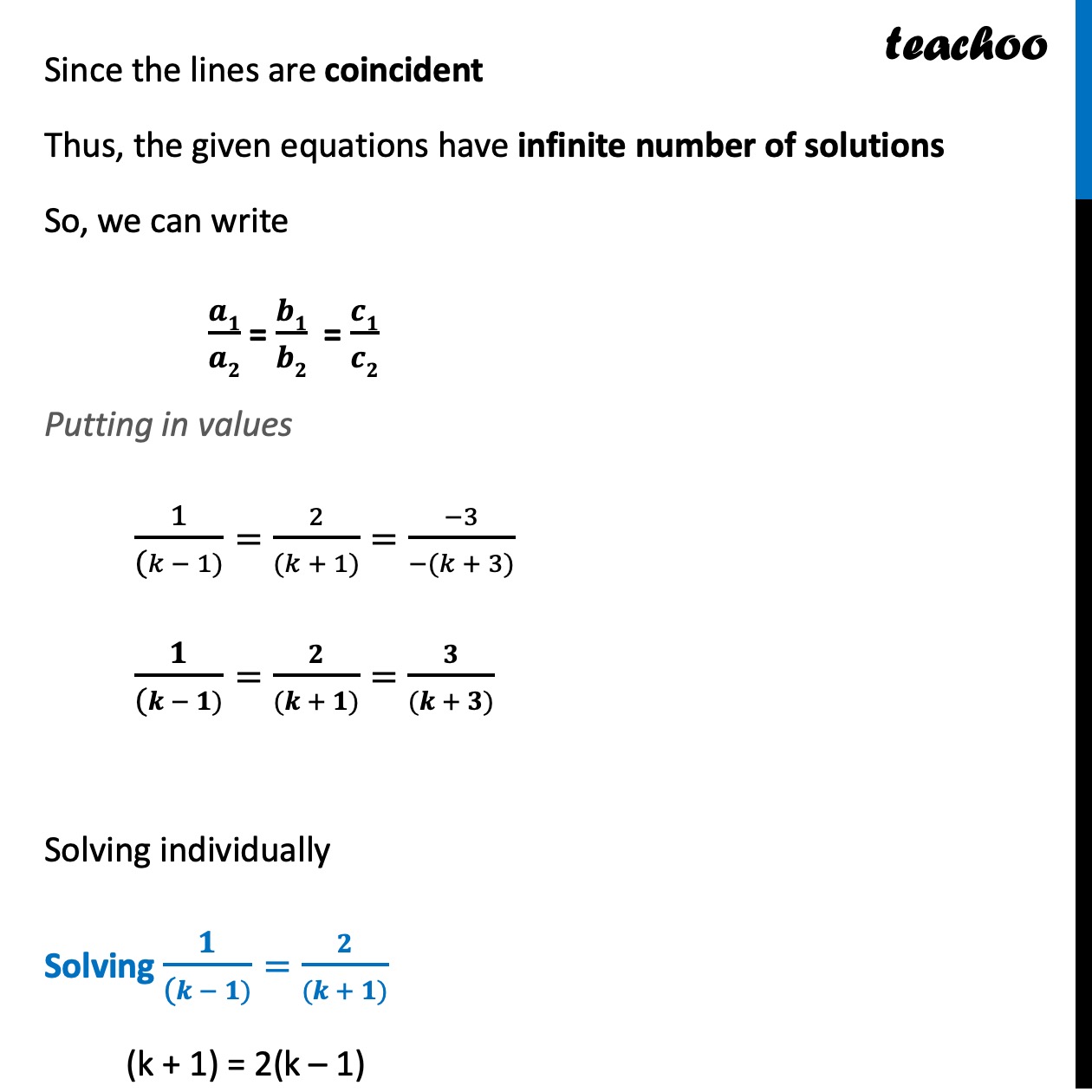
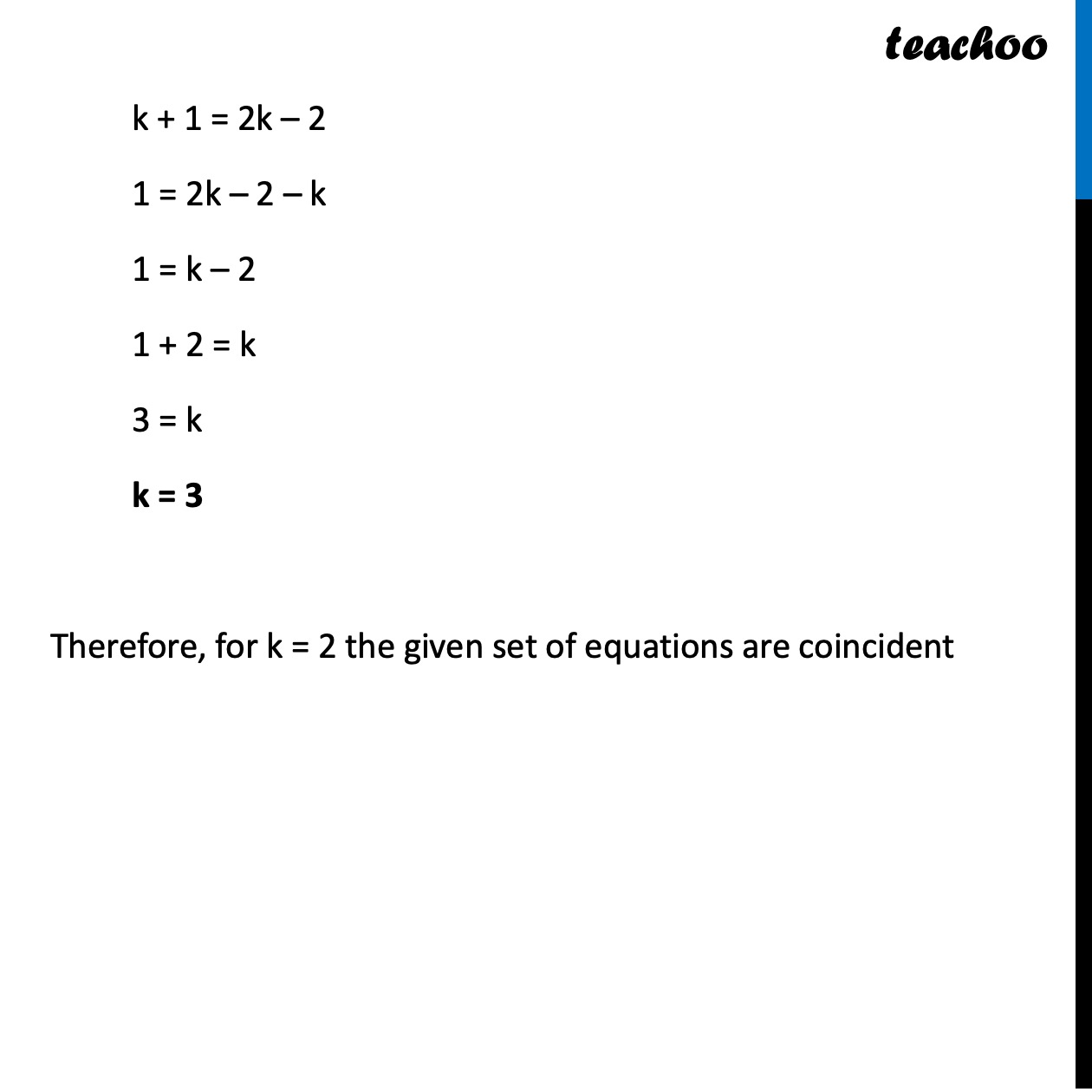
Question 10 Find the value of ‘k’ for which the following system of equations represents a pair of coincident lines: x + 2y = 3; (k − 1)x + (k + 1)y = k + 3. Writing our equations in standard form x + 2y – 3 = 0 (k – 1)x + (k + 1)y – (k + 3) = 0 Finding ratios …(1) …(2) x + 2y – 3 = 0 Comparing with a_(1)x + b_(1)y + c_(1) = 0 ∴ a_(1) = 1, b_(1 )= 2, c_(1 )=_( )–3 (k – 1)x + (k + 1)y – (k + 3) = 0 Comparing with a_(2)x + b_(2)y + c_(2) = 0 ∴ a_(2) = (k – 1), b_(2 )= (k + 1), c_(2 )=_( )– (k + 3) Since the lines are coincident Thus, the given equations have infinite number of solutions So, we can write (𝒂𝟏)/(𝒂𝟐) = (𝒃𝟏)/(𝒃𝟐) = (𝒄𝟏)/(𝒄𝟐) Putting in values (1)/((𝑘 − 1))=(2)/((𝑘 + 1))=(−3)/(−(𝑘 + 3)) (𝟏)/((𝒌 − 𝟏))=(𝟐)/((𝒌 + 𝟏))=(𝟑)/((𝒌 + 𝟑)) Solving individually Solving (𝟏)/((𝒌 − 𝟏))=(𝟐)/((𝒌 + 𝟏)) (k + 1) = 2(k – 1) k + 1 = 2k – 2 1 = 2k – 2 – k 1 = k – 2 1 + 2 = k 3 = k k = 3 Therefore, for k = 2 the given set of equations are coincident