Exercise Set 13.5

 You are here
Exercise Set 13.5
Last updated at November 22, 2026 by Teachoo
Transcript
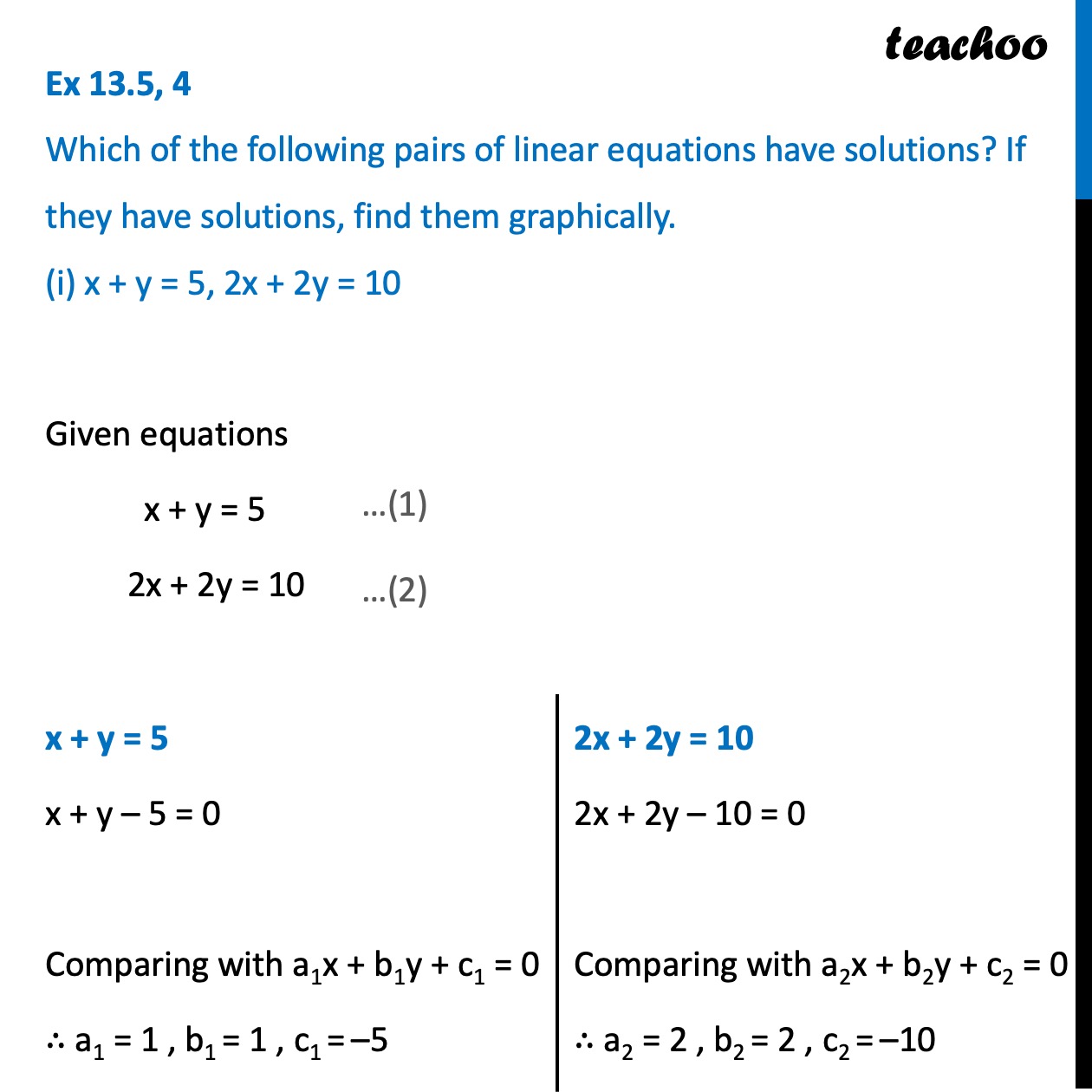
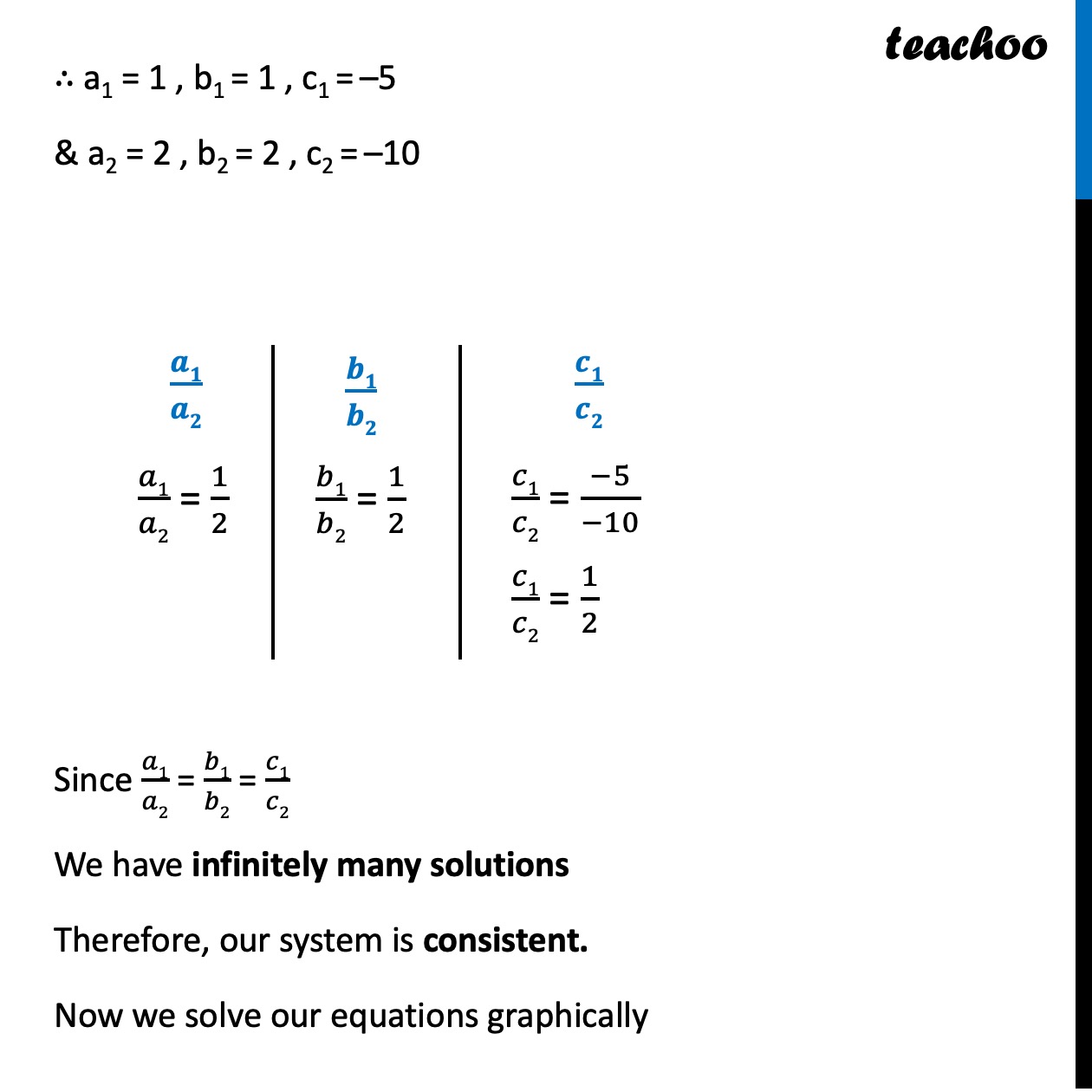
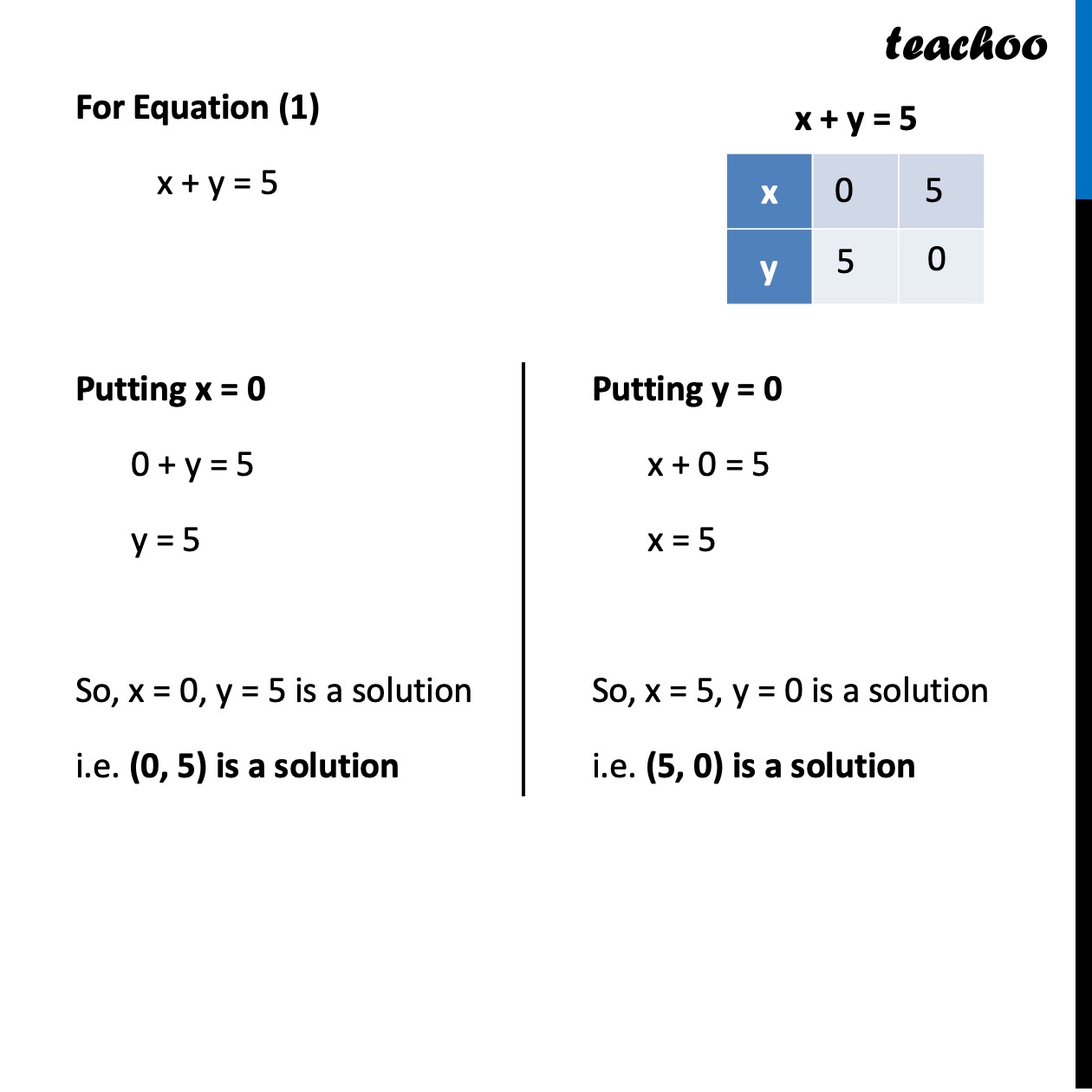
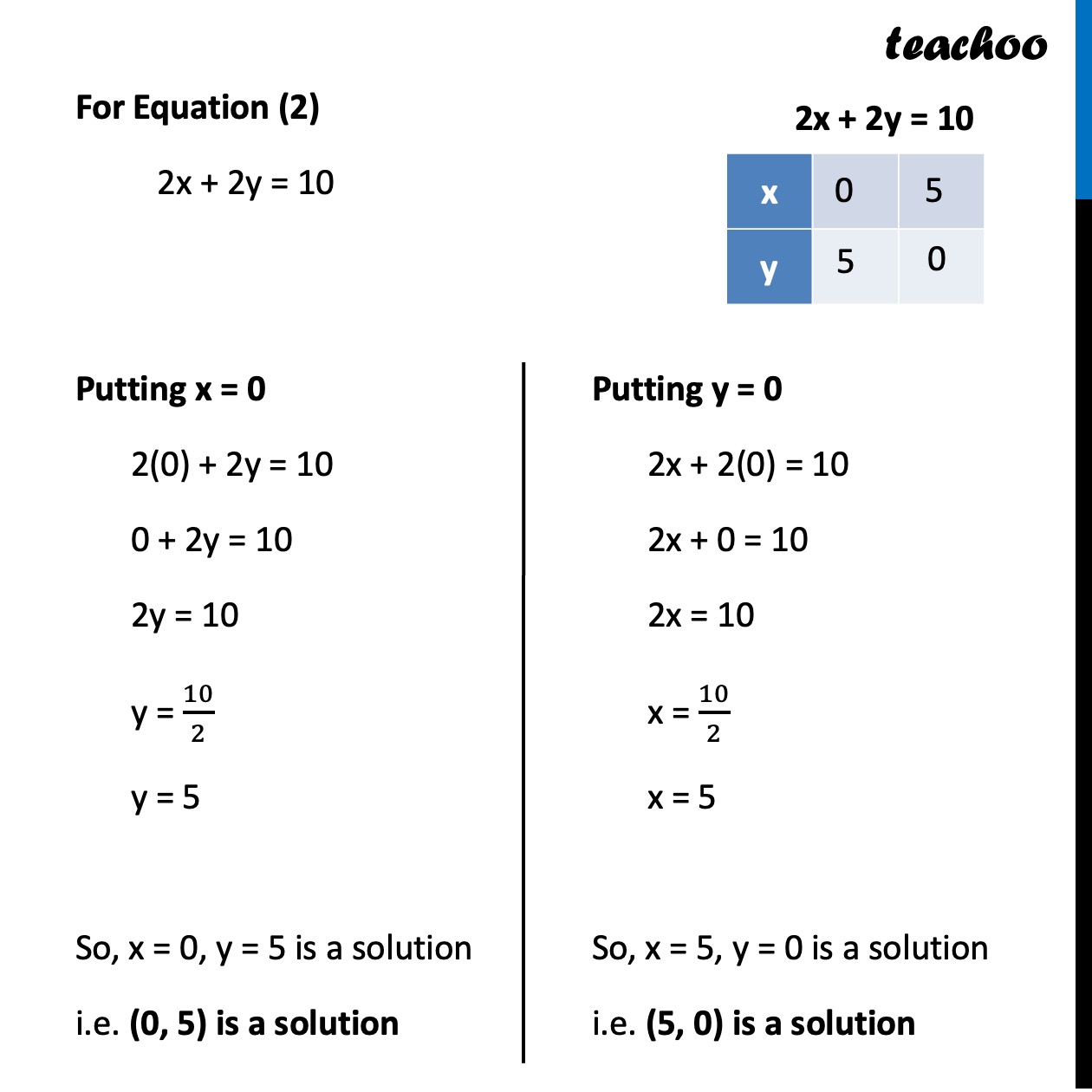
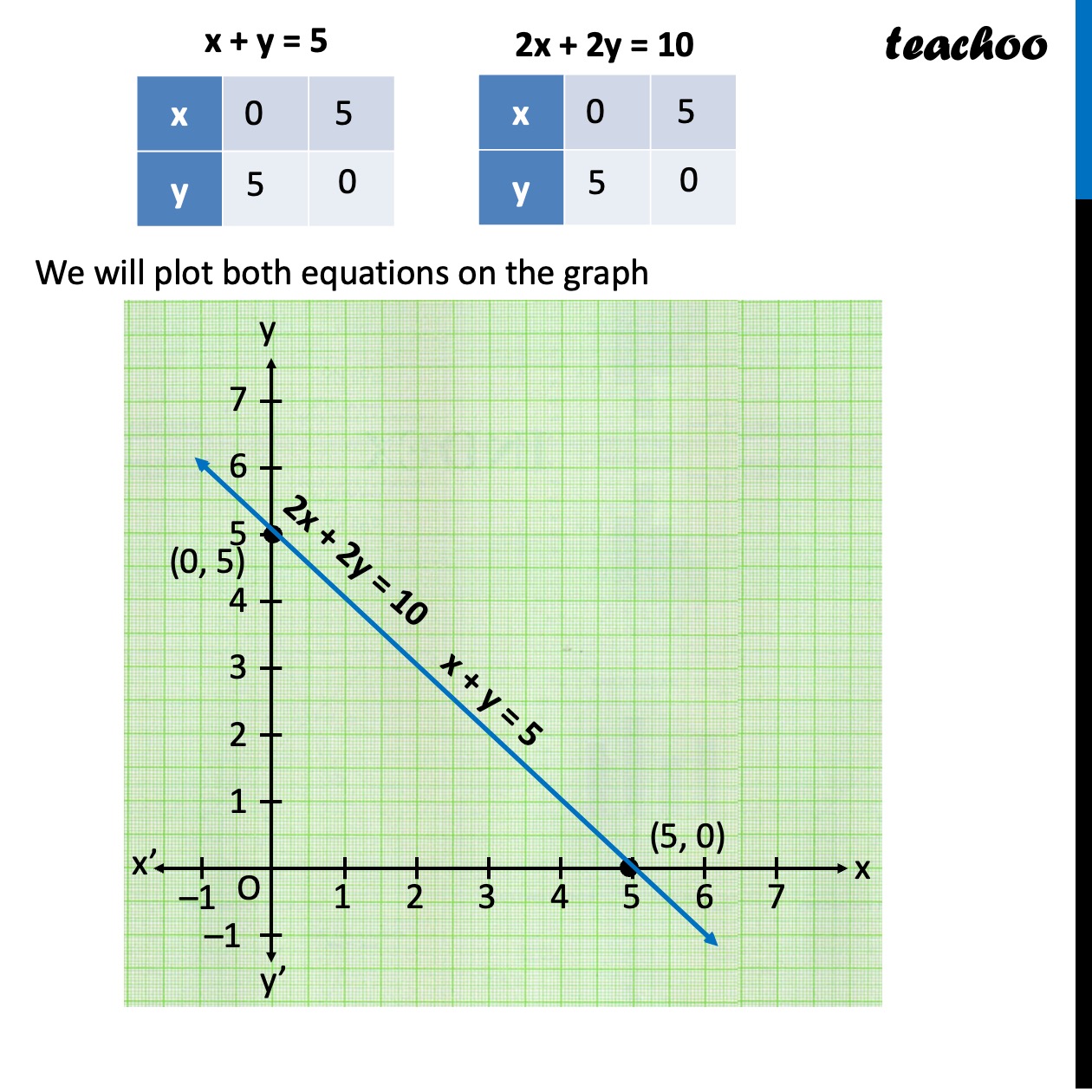
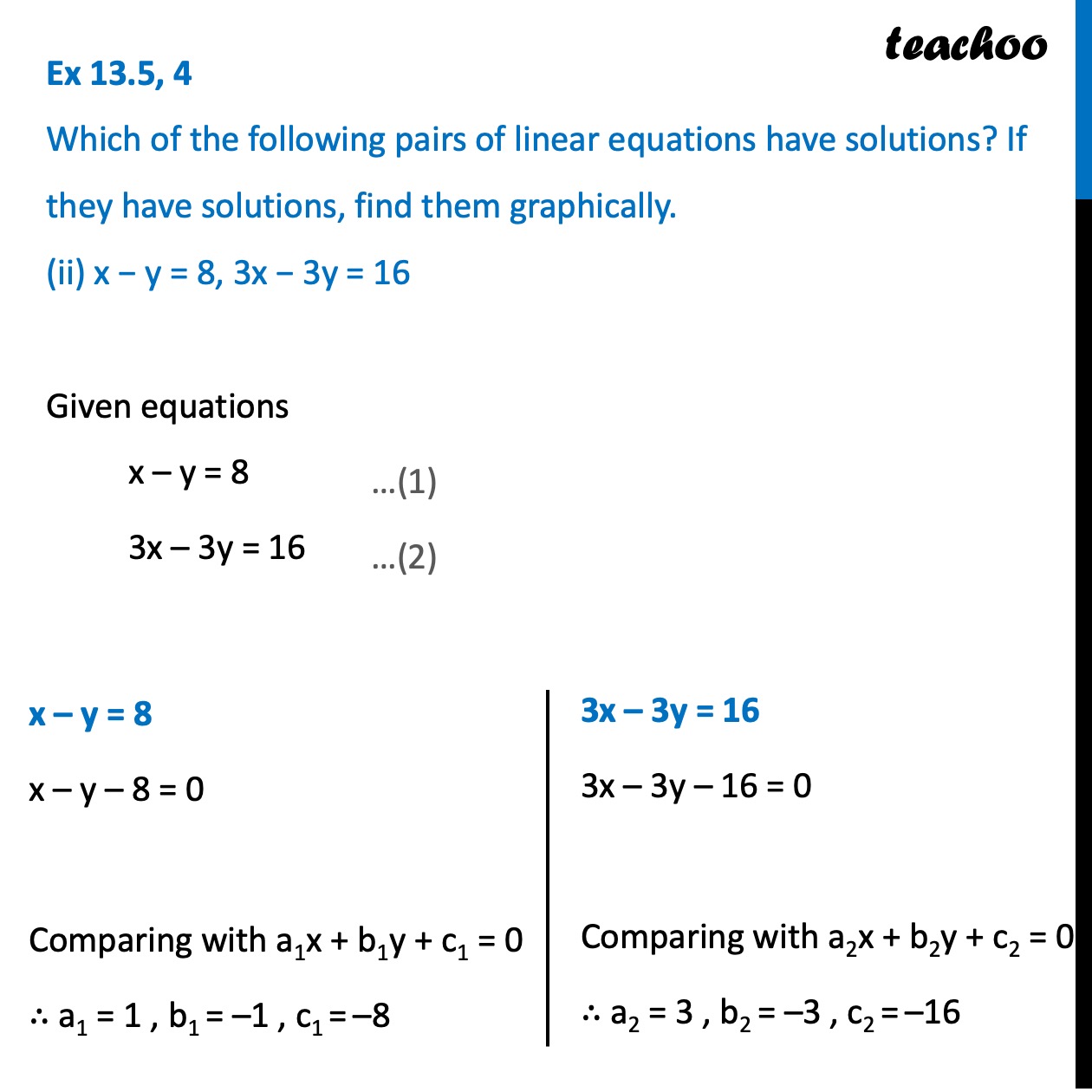
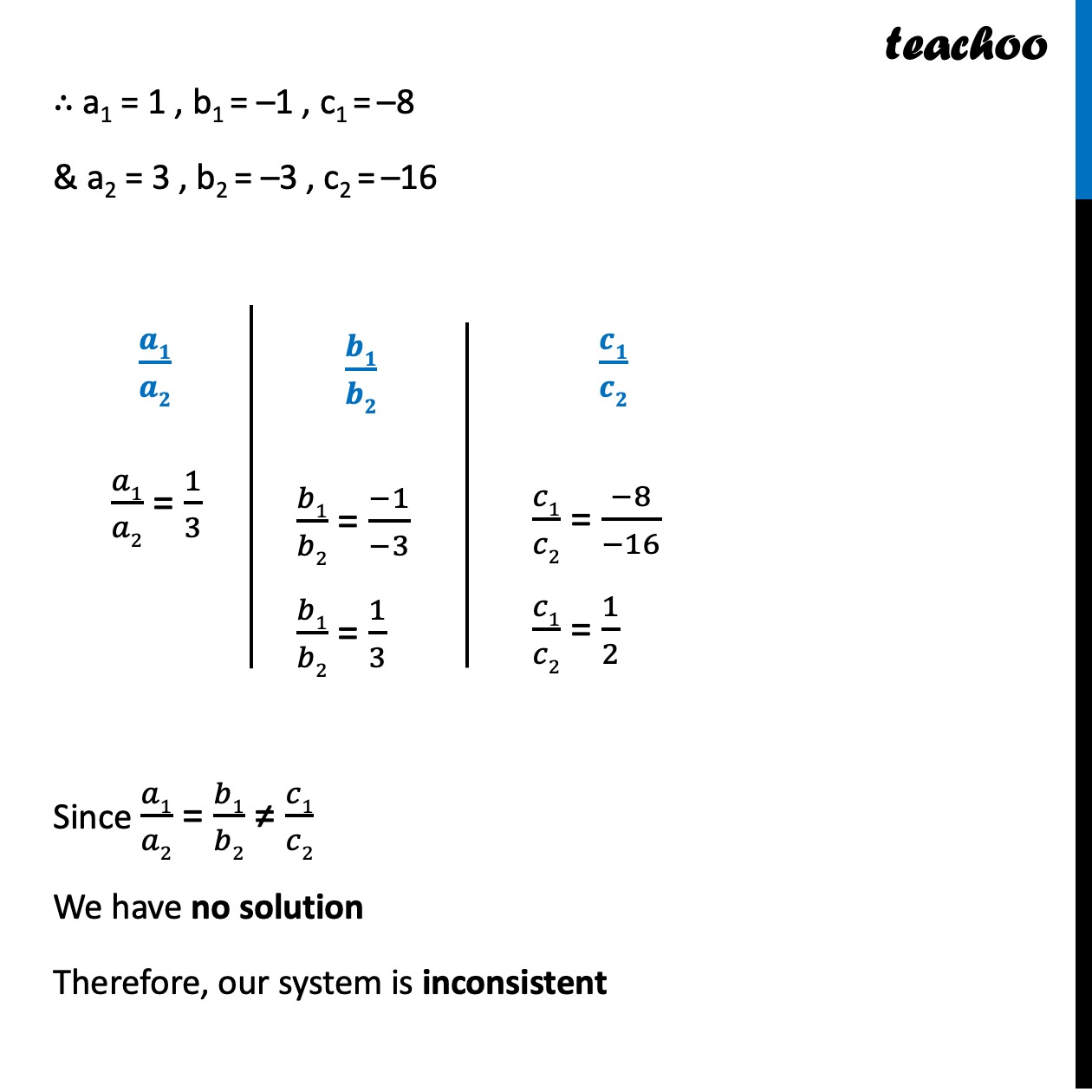
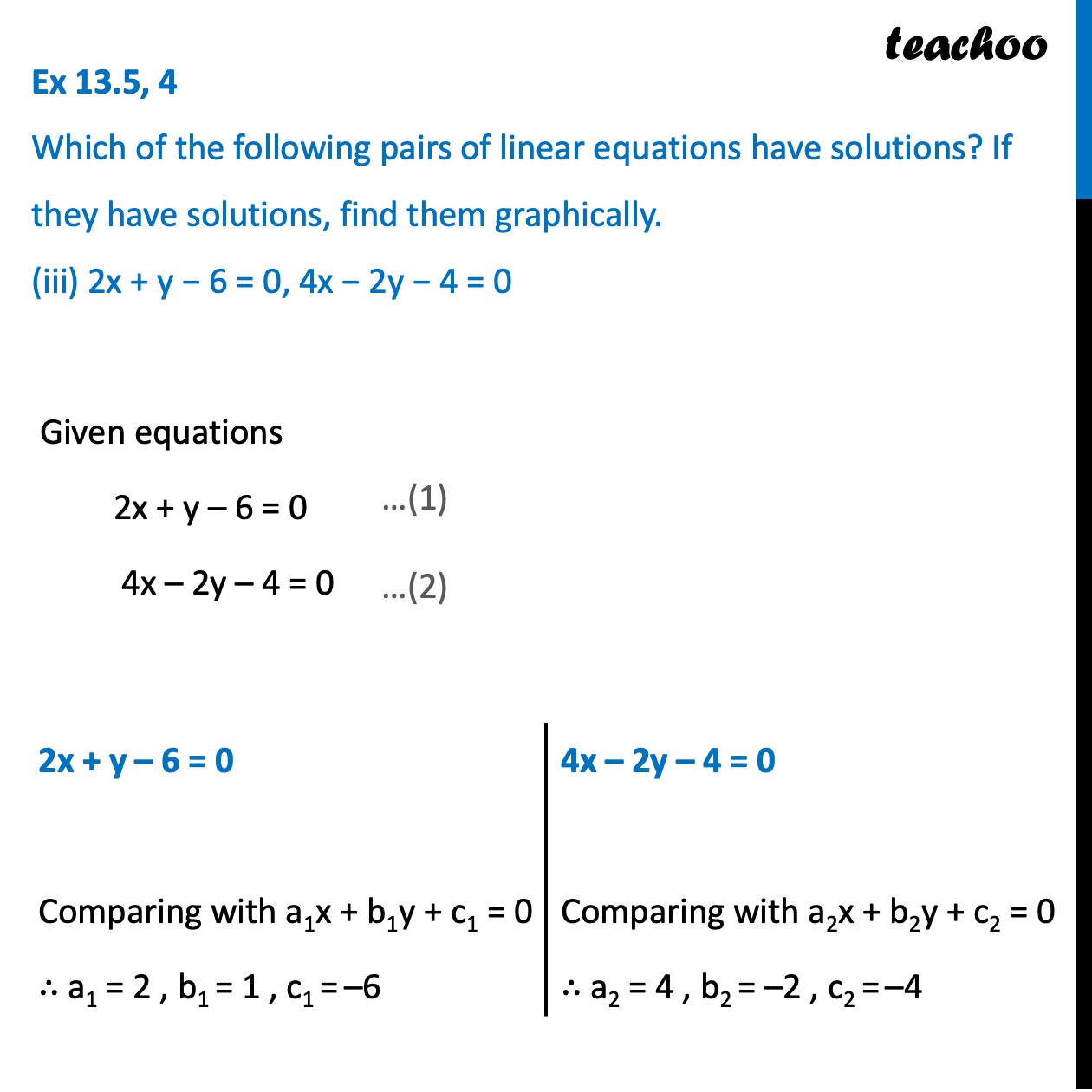
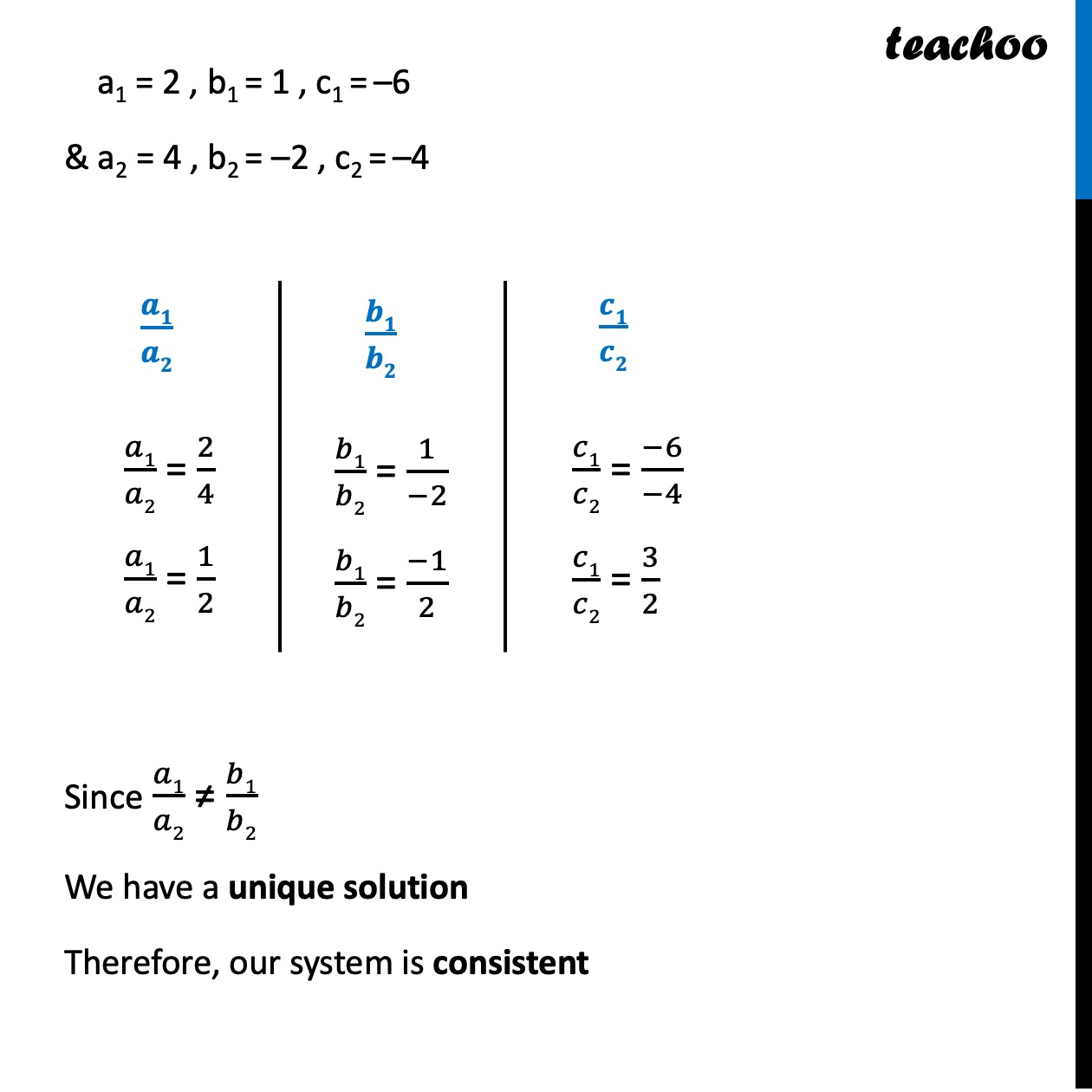
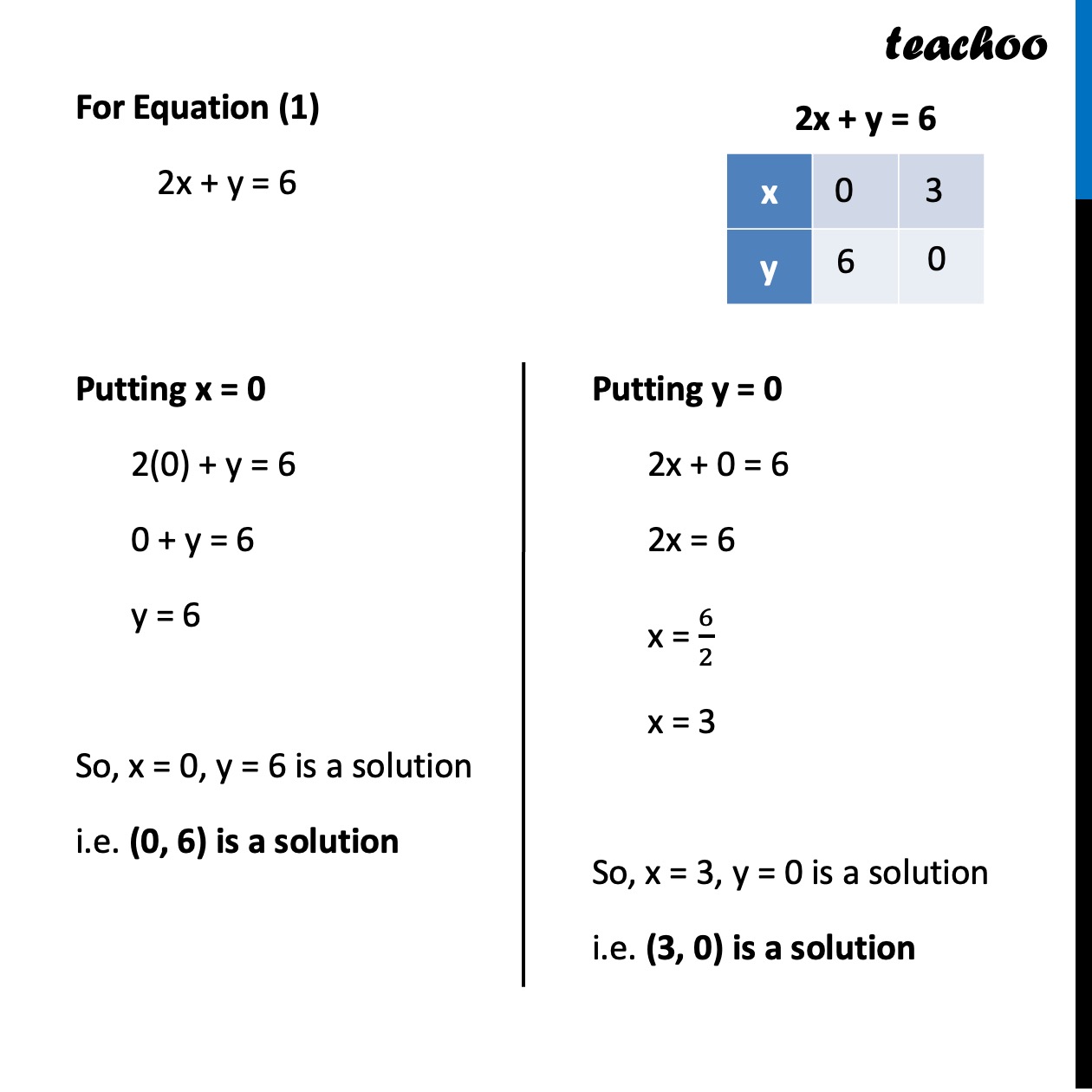
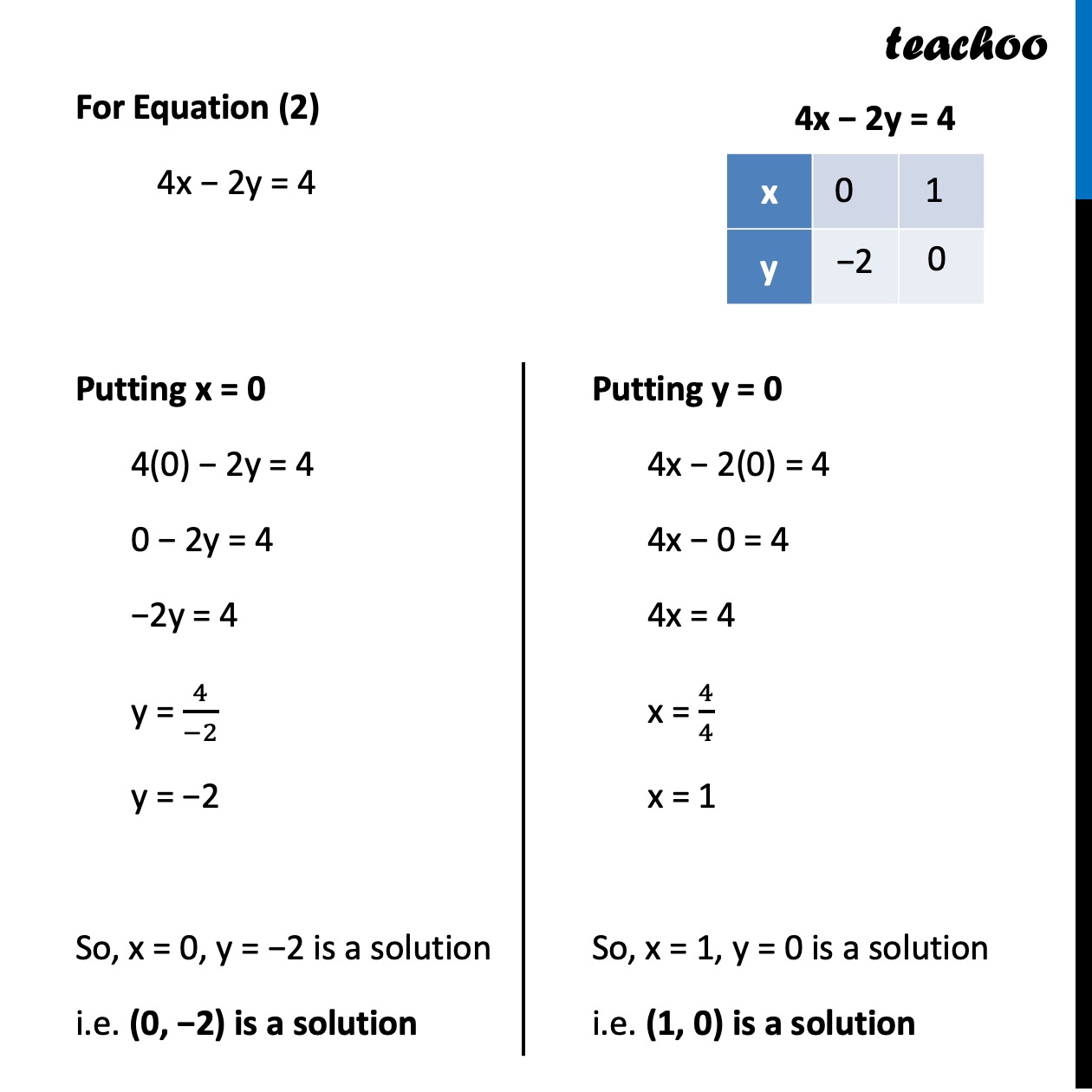
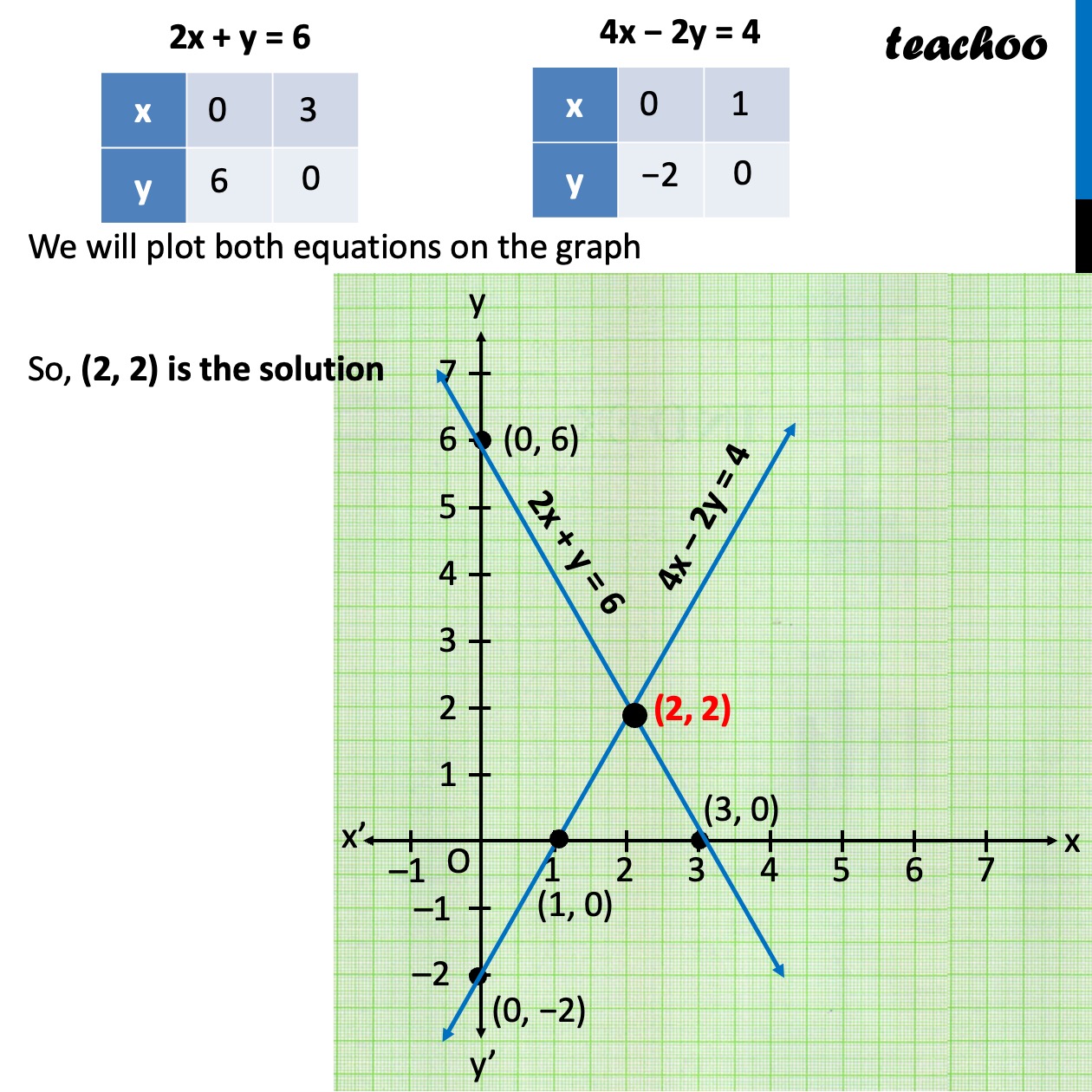
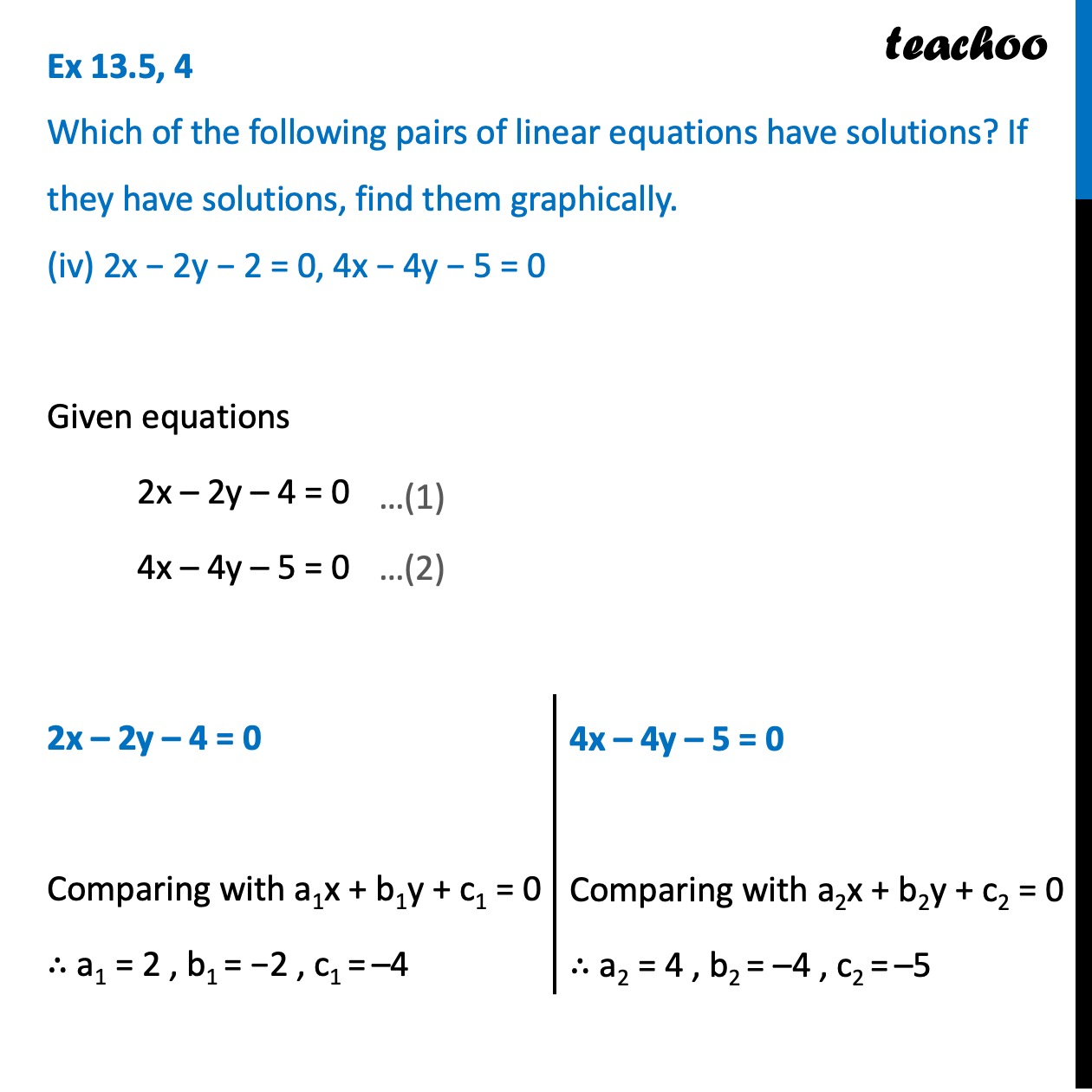
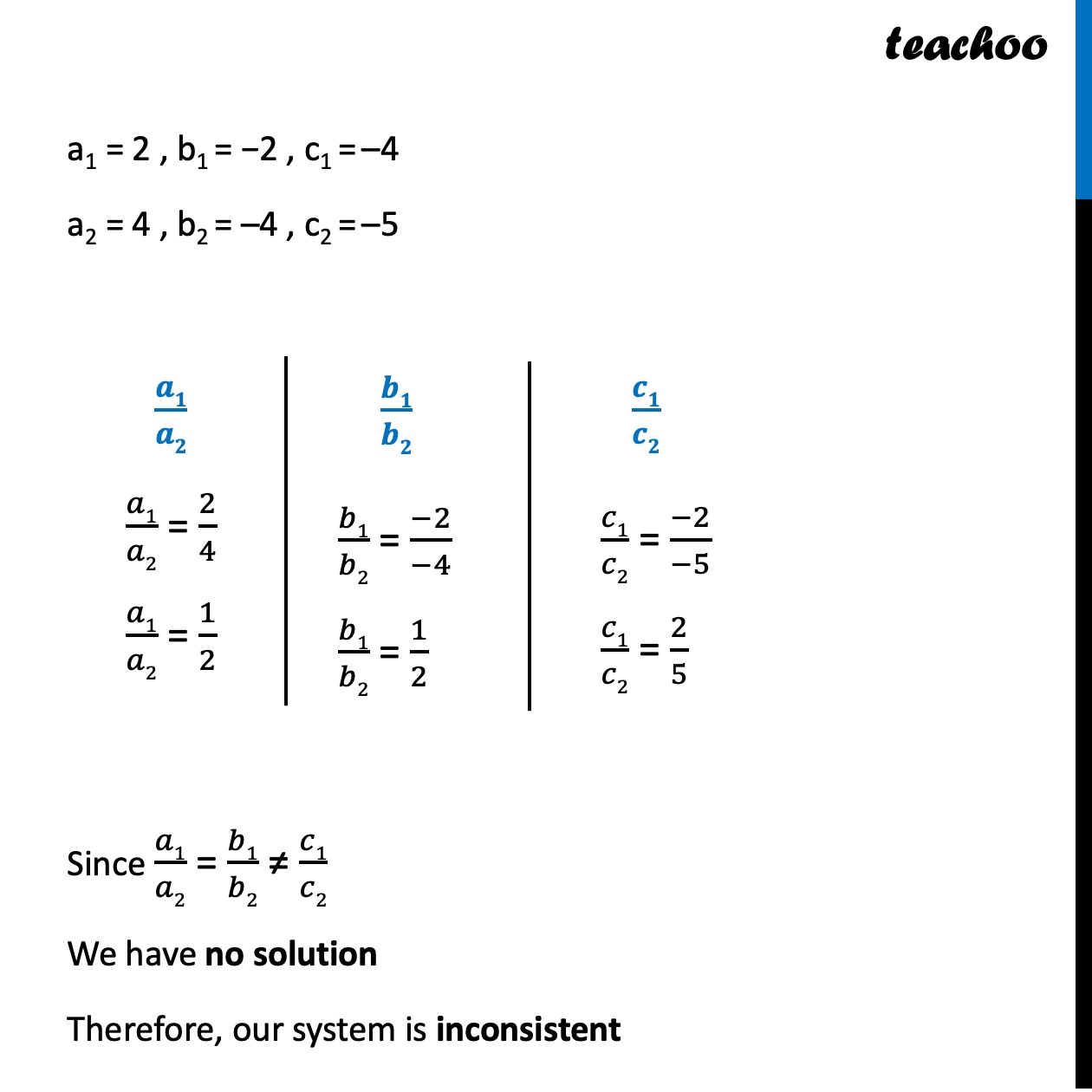
Ex 13.5, 4 Which of the following pairs of linear equations have solutions? If they have solutions, find them graphically. (i) x + y = 5, 2x + 2y = 10 Given equations x + y = 5 2x + 2y = 10 …(1) …(2) x + y = 5 x + y – 5 = 0 Comparing with a_(1)x + b_(1)y + c_(1) = 0 ∴ a_(1) = 1 , b_(1 )= 1 , c_(1 )=_( )–5 2x + 2y = 10 2x + 2y – 10 = 0 Comparing with a_(2)x + b_(2)y + c_(2) = 0 ∴ a_(2) = 2 , b_(2 )= 2 , c_(2 )=_( )–10 ∴ a_(1) = 1 , b_(1 )= 1 , c_(1 )=_( )–5 & a_(2) = 2 , b_(2 )= 2 , c_(2 )=_( )–10 Since (𝑎1)/(𝑎2) = (𝑏1)/(𝑏2) = (𝑐1)/(𝑐2) We have infinitely many solutions Therefore, our system is consistent. Now we solve our equations graphically (𝑎1)/(𝑎2) = (1)/(2) (𝒂𝟏)/(𝒂𝟐) (𝑏1)/(𝑏2) = (1)/(2) (𝒃𝟏)/(𝒃𝟐) (𝑐1)/(𝑐2) = (−5)/(−10) (𝑐1)/(𝑐2) = (1)/(2) (𝒄𝟏)/(𝒄𝟐) For Equation (1) x + y = 5 Putting x = 0 0 + y = 5 y = 5 So, x = 0, y = 5 is a solution i.e. (0, 5) is a solution Putting y = 0 x + 0 = 5 x = 5 So, x = 5, y = 0 is a solution i.e. (5, 0) is a solution x | | y | | 0 5 5 0 x + y = 5 For Equation (2) 2x + 2y = 10 Putting x = 0 2(0) + 2y = 10 0 + 2y = 10 2y = 10 y = (10)/(2) y = 5 So, x = 0, y = 5 is a solution i.e. (0, 5) is a solution Putting y = 0 2x + 2(0) = 10 2x + 0 = 10 2x = 10 x = (10)/(2) x = 5 So, x = 5, y = 0 is a solution i.e. (5, 0) is a solution x | | y | | 0 5 5 0 2x + 2y = 10 We will plot both equations on the graph O 1 2 –1 –1 x’ 2 3 4 5 6 7 1 3 4 5 6 7 x y’ y (0, 5) 2x + 2y = 10 (5, 0) x + y = 5 x | | y | | 0 5 5 0 x + y = 5 x | | y | | 0 5 5 0 2x + 2y = 10 Ex 13.5, 4 Which of the following pairs of linear equations have solutions? If they have solutions, find them graphically. (ii) x − y = 8, 3x − 3y = 16 Given equations x – y = 8 3x – 3y = 16 …(1) …(2) x – y = 8 x – y – 8 = 0 Comparing with a_(1)x + b_(1)y + c_(1) = 0 ∴ a_(1) = 1 , b_(1 )= –1 , c_(1 )=_( )–8 3x – 3y = 16 3x – 3y – 16 = 0 Comparing with a_(2)x + b_(2)y + c_(2) = 0 ∴ a_(2) = 3 , b_(2 )= –3 , c_(2 )=_( )–16 ∴ a_(1) = 1 , b_(1 )= –1 , c_(1 )=_( )–8 & a_(2) = 3 , b_(2 )= –3 , c_(2 )=_( )–16 Since (𝑎1)/(𝑎2) = (𝑏1)/(𝑏2) ≠ (𝑐1)/(𝑐2) We have no solution Therefore, our system is inconsistent (𝑎1)/(𝑎2) = (1)/(3) (𝒂𝟏)/(𝒂𝟐) (𝑏1)/(𝑏2) = (−1)/(−3) (𝑏1)/(𝑏2) = (1)/(3) (𝒃𝟏)/(𝒃𝟐) (𝑐1)/(𝑐2) = (−8)/(−16) (𝑐1)/(𝑐2) = (1)/(2) (𝒄𝟏)/(𝒄𝟐) Ex 13.5, 4 Which of the following pairs of linear equations have solutions? If they have solutions, find them graphically. (iii) 2x + y − 6 = 0, 4x − 2y − 4 = 0 Given equations 2x + y – 6 = 0 4x – 2y – 4 = 0 …(1) …(2) 2x + y – 6 = 0 Comparing with a_(1)x + b_(1)y + c_(1) = 0 ∴ a_(1) = 2 , b_(1 )= 1 , c_(1 )=_( )–6 4x – 2y – 4 = 0 Comparing with a_(2)x + b_(2)y + c_(2) = 0 ∴ a_(2) = 4 , b_(2 )= –2 , c_(2 )=_( )–4 a_(1) = 2 , b_(1 )= 1 , c_(1 )=_( )–6 & a_(2) = 4 , b_(2 )= –2 , c_(2 )=_( )–4 Since (𝑎1)/(𝑎2) ≠ (𝑏1)/(𝑏2) We have a unique solution Therefore, our system is consistent (𝑎1)/(𝑎2) = (2)/(4) (𝑎1)/(𝑎2) = (1)/(2) (𝒂𝟏)/(𝒂𝟐) (𝑏1)/(𝑏2) = (1)/(−2) (𝑏1)/(𝑏2) = (−1)/(2) (𝒃𝟏)/(𝒃𝟐) (𝑐1)/(𝑐2) = (−6)/(−4) (𝑐1)/(𝑐2) = (3)/(2) (𝒄𝟏)/(𝒄𝟐) For Equation (1) 2x + y = 6 Putting x = 0 2(0) + y = 6 0 + y = 6 y = 6 So, x = 0, y = 6 is a solution i.e. (0, 6) is a solution Putting y = 0 2x + 0 = 6 2x = 6 x = (6)/(2) x = 3 So, x = 3, y = 0 is a solution i.e. (3, 0) is a solution x | | y | | 0 6 3 0 2x + y = 6 For Equation (2) 4x − 2y = 4 Putting x = 0 4(0) − 2y = 4 0 − 2y = 4 −2y = 4 y = (4)/(−2) y = −2 So, x = 0, y = −2 is a solution i.e. (0, −2) is a solution Putting y = 0 4x − 2(0) = 4 4x − 0 = 4 4x = 4 x = (4)/(4) x = 1 So, x = 1, y = 0 is a solution i.e. (1, 0) is a solution x | | y | | 0 −2 1 0 4x − 2y = 4 We will plot both equations on the graph So, (2, 2) is the solution O 1 2 –1 –2 –1 x’ 2 3 4 5 6 7 1 3 4 5 6 7 x y’ y (3, 0) (0, 6) 2x + y = 6 (0, −2) 4x − 2y = 4 x | | y | | 0 6 3 0 2x + y = 6 x | | y | | 0 −2 1 0 4x − 2y = 4 (1, 0) (2, 2) Ex 13.5, 4 Which of the following pairs of linear equations have solutions? If they have solutions, find them graphically. (iv) 2x − 2y − 2 = 0, 4x − 4y − 5 = 0 Given equations 2x – 2y – 4 = 0 4x – 4y – 5 = 0 …(1) …(2) 2x – 2y – 4 = 0 Comparing with a_(1)x + b_(1)y + c_(1) = 0 ∴ a_(1) = 2 , b_(1 )= −2 , c_(1 )=_( )–4 4x – 4y – 5 = 0 Comparing with a_(2)x + b_(2)y + c_(2) = 0 ∴ a_(2) = 4 , b_(2 )= –4 , c_(2 )=_( )–5 a_(1) = 2 , b_(1 )= −2 , c_(1 )=_( )–4 a_(2) = 4 , b_(2 )= –4 , c_(2 )=_( )–5 Since (𝑎1)/(𝑎2) = (𝑏1)/(𝑏2) ≠ (𝑐1)/(𝑐2) We have no solution Therefore, our system is inconsistent (𝑎1)/(𝑎2) = (2)/(4) (𝑎1)/(𝑎2) = (1)/(2) (𝒂𝟏)/(𝒂𝟐) (𝑏1)/(𝑏2) = (−2)/(−4) (𝑏1)/(𝑏2) = (1)/(2) (𝒃𝟏)/(𝒃𝟐) (𝑐1)/(𝑐2) = (−2)/(−5) (𝑐1)/(𝑐2) = (2)/(5) (𝒄𝟏)/(𝒄𝟐)