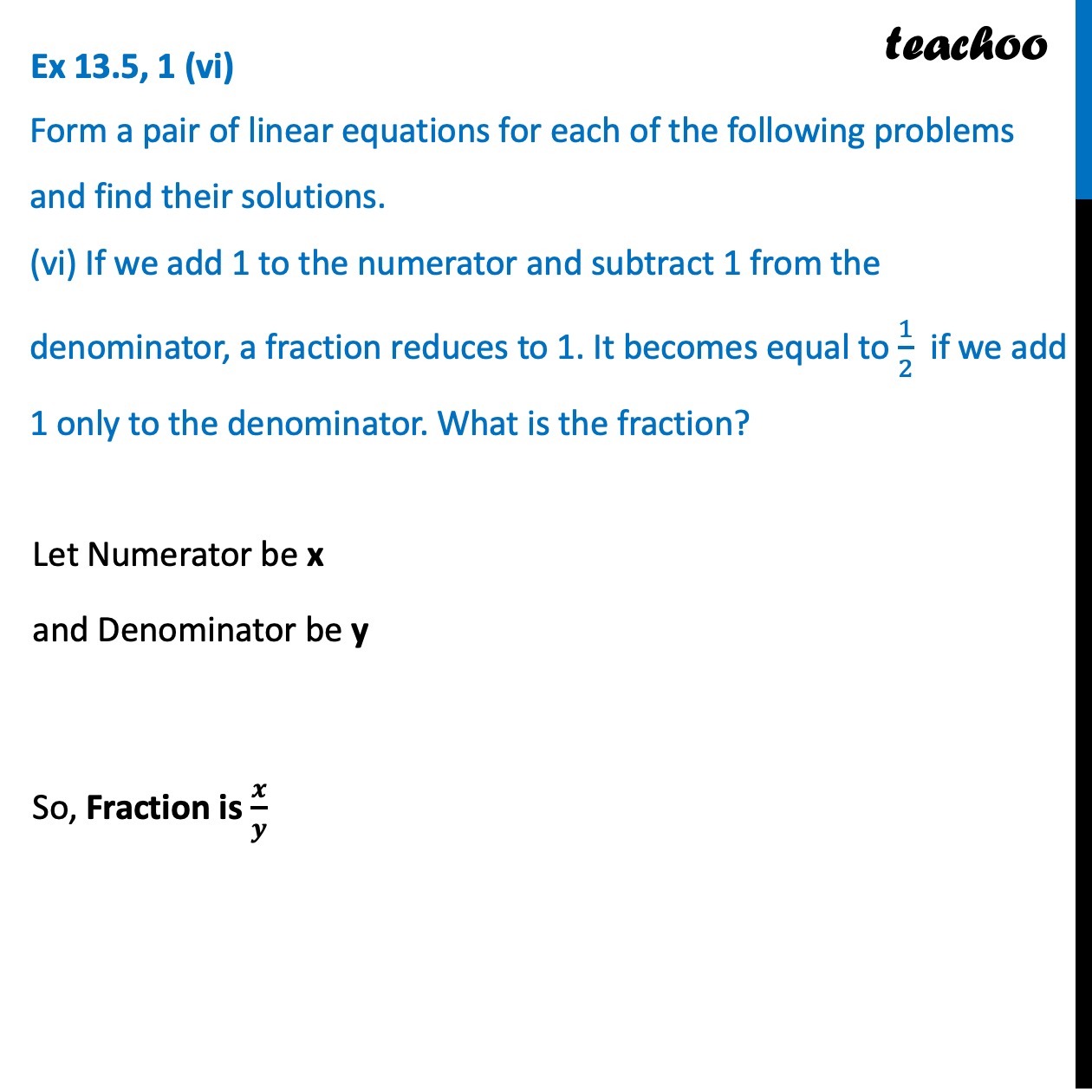
Ex 13.5, 1 (vi): Form a pair of linear equations for each of the following problems and find their solutions. (vi) If we add 1 to the numerator and subtract 1 from the denominator, a fraction reduces to 1. It becomes equal to (1)/(2) if…

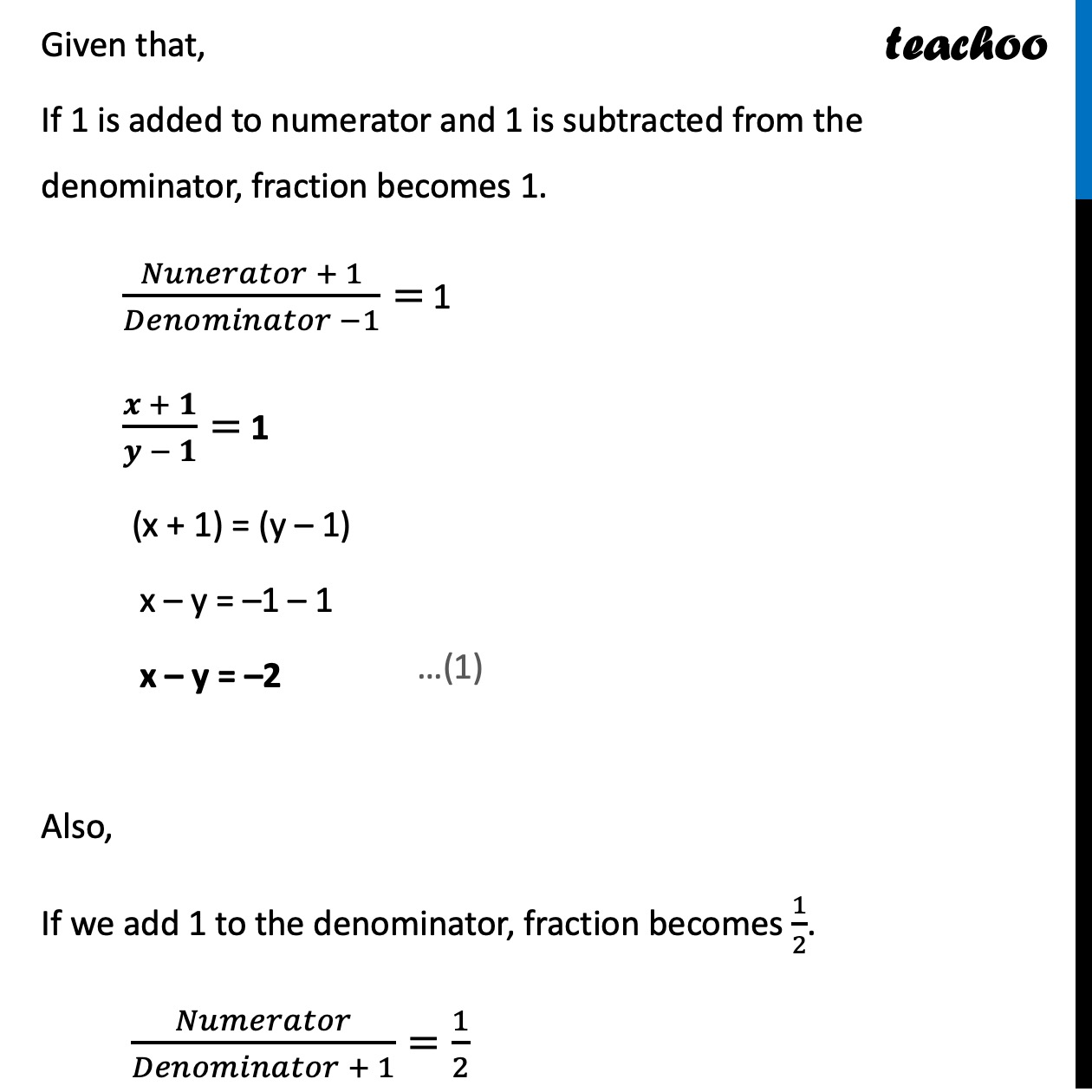
Ex 13.5, 1 (vi): Given that, If 1 is added to numerator and 1 is subtracted from the denominator, fraction becomes 1. (๐‘๐‘ข๐‘›๐‘’๐‘Ÿ๐‘Ž๐‘ก๐‘œ๐‘Ÿ + 1)/(๐ท๐‘’๐‘›๐‘œ๐‘š๐‘–๐‘›๐‘Ž๐‘ก๐‘œ๐‘Ÿ −1)= 1 (๐’™ + ๐Ÿ)/(๐’š − ๐Ÿ)= 1 (x + 1) = (y – 1) x – y = –1 – 1 x – y = –2 Also, If we add 1…

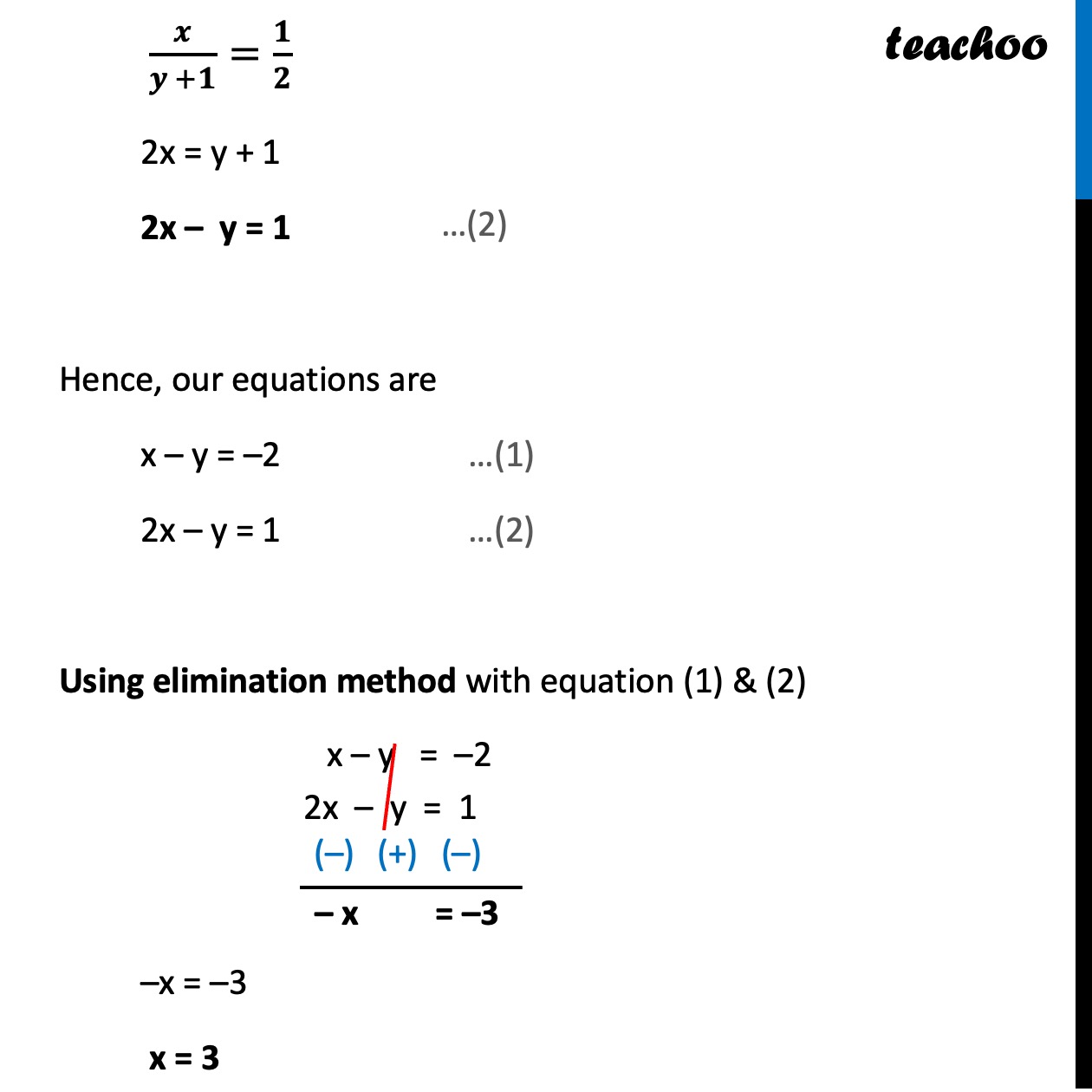
Ex 13.5, 1 (vi): (๐’™)/(๐’š +๐Ÿ)=(๐Ÿ)/(๐Ÿ) 2x = y + 1 2x – y = 1 Hence, our equations are x – y = –2 …(1) 2x – y = 1 …(2) Using elimination method with equation (1) & (2) –x = –3 x = 3 …(2) x – y = –2 (–) (+) – x = –3

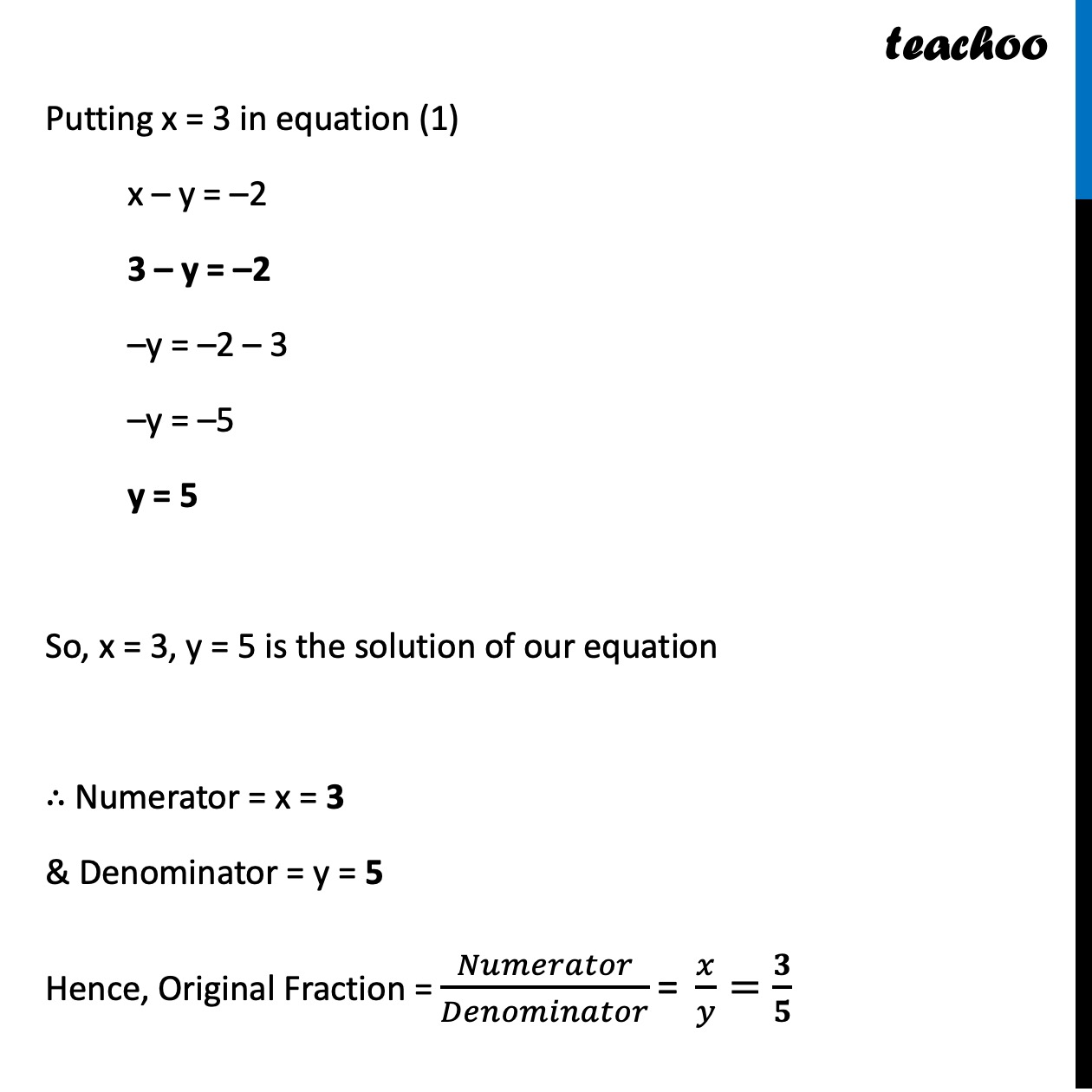
Ex 13.5, 1 (vi): Putting x = 3 in equation (1) x – y = –2 3 – y = –2 –y = –2 – 3 –y = –5 y = 5 So, x = 3, y = 5 is the solution of our equation ∴ Numerator = x = 3 & Denominator = y = 5 Hence, Original Fraction =…

Remove Ads
Teachoo ยท Class 9 Explore Class 9

Transcript

Ex 13.5, 1 (vi) Form a pair of linear equations for each of the following problems and find their solutions. (vi) If we add 1 to the numerator and subtract 1 from the denominator, a fraction reduces to 1. It becomes equal to (1)/(2) if we add 1 only to the denominator. What is the fraction? Let Numerator be x and Denominator be y So, Fraction is (๐’™)/(๐’š) Given that, If 1 is added to numerator and 1 is subtracted from the denominator, fraction becomes 1. (๐‘๐‘ข๐‘›๐‘’๐‘Ÿ๐‘Ž๐‘ก๐‘œ๐‘Ÿ + 1)/(๐ท๐‘’๐‘›๐‘œ๐‘š๐‘–๐‘›๐‘Ž๐‘ก๐‘œ๐‘Ÿ โˆ’1)= 1 (๐’™ + ๐Ÿ)/(๐’š โˆ’ ๐Ÿ)= 1 (x + 1) = (y โ€“ 1) x โ€“ y = โ€“1 โ€“ 1 x โ€“ y = โ€“2 Also, If we add 1 to the denominator, fraction becomes (1)/(2). (๐‘๐‘ข๐‘š๐‘’๐‘Ÿ๐‘Ž๐‘ก๐‘œ๐‘Ÿ)/(๐ท๐‘’๐‘›๐‘œ๐‘š๐‘–๐‘›๐‘Ž๐‘ก๐‘œ๐‘Ÿ + 1)=(1)/(2) โ€ฆ(1) (๐’™)/(๐’š +๐Ÿ)=(๐Ÿ)/(๐Ÿ) 2x = y + 1 2x โ€“ y = 1 Hence, our equations are x โ€“ y = โ€“2 โ€ฆ(1) 2x โ€“ y = 1 โ€ฆ(2) Using elimination method with equation (1) & (2) โ€“x = โ€“3 x = 3 โ€ฆ(2) 2x โ€“ y = 1 x โ€“ y = โ€“2 (โ€“) (+) (โ€“) โ€“ x = โ€“3 Putting x = 3 in equation (1) x โ€“ y = โ€“2 3 โ€“ y = โ€“2 โ€“y = โ€“2 โ€“ 3 โ€“y = โ€“5 y = 5 So, x = 3, y = 5 is the solution of our equation โˆด Numerator = x = 3 & Denominator = y = 5 Hence, Original Fraction = (๐‘๐‘ข๐‘š๐‘’๐‘Ÿ๐‘Ž๐‘ก๐‘œ๐‘Ÿ)/(๐ท๐‘’๐‘›๐‘œ๐‘š๐‘–๐‘›๐‘Ž๐‘ก๐‘œ๐‘Ÿ)= (๐‘ฅ)/(๐‘ฆ)=(๐Ÿ‘)/(๐Ÿ“)

CA Maninder Singh's photo - Co-founder, Teachoo

Made by

CA Maninder Singh

CA Maninder Singh is a Chartered Accountant qualified since 2010 and an educator teaching since 2006. At Teachoo, he draws on his accounting and tax experience to explain Accounts, Income Tax and GST through step-by-step lessons and practical examples.

For an uninterrupted learning experience, students can use Teachoo Black to remove ads and focus better.