Exercise Set 13.5

 You are here
Exercise Set 13.5
Last updated at November 22, 2026 by Teachoo
Transcript
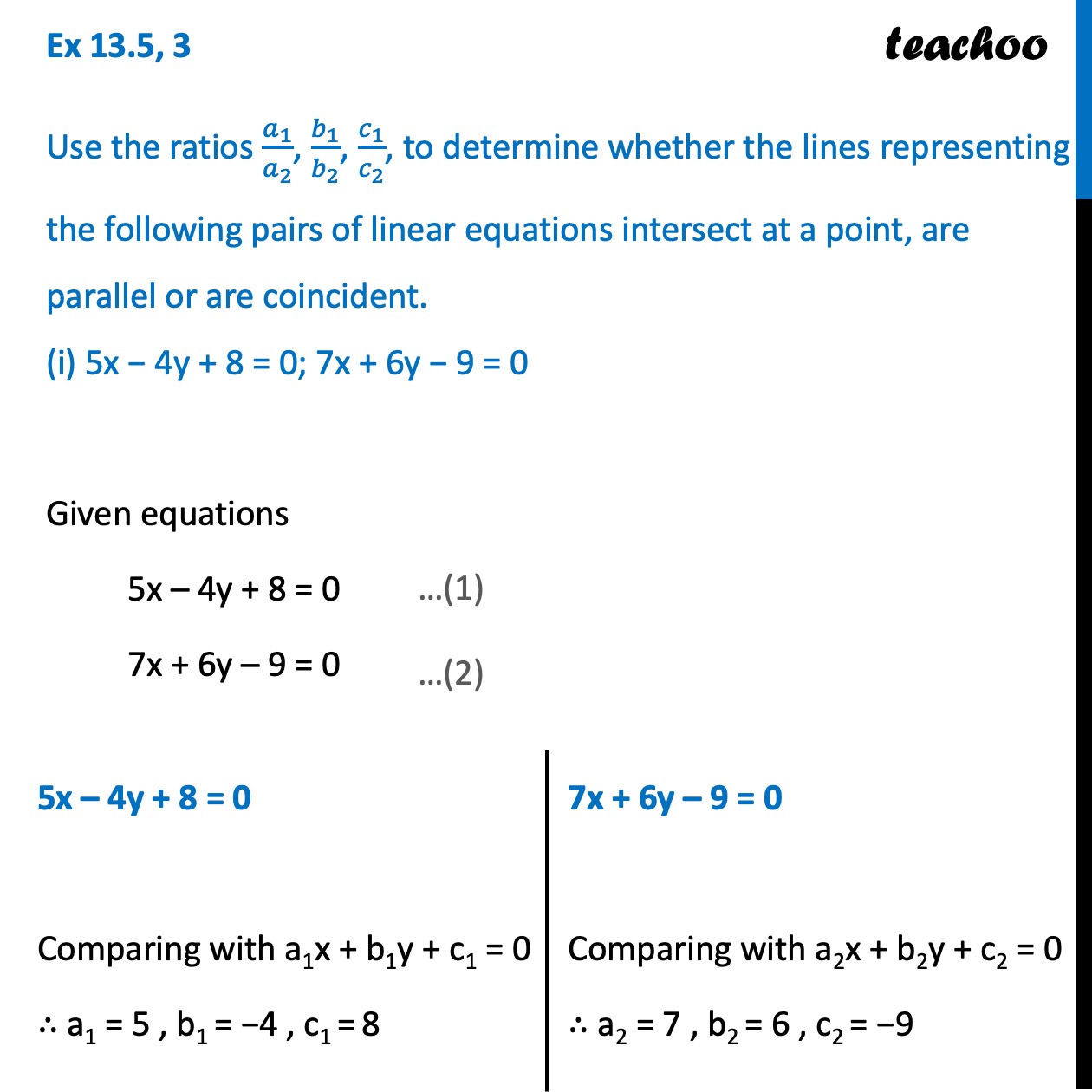
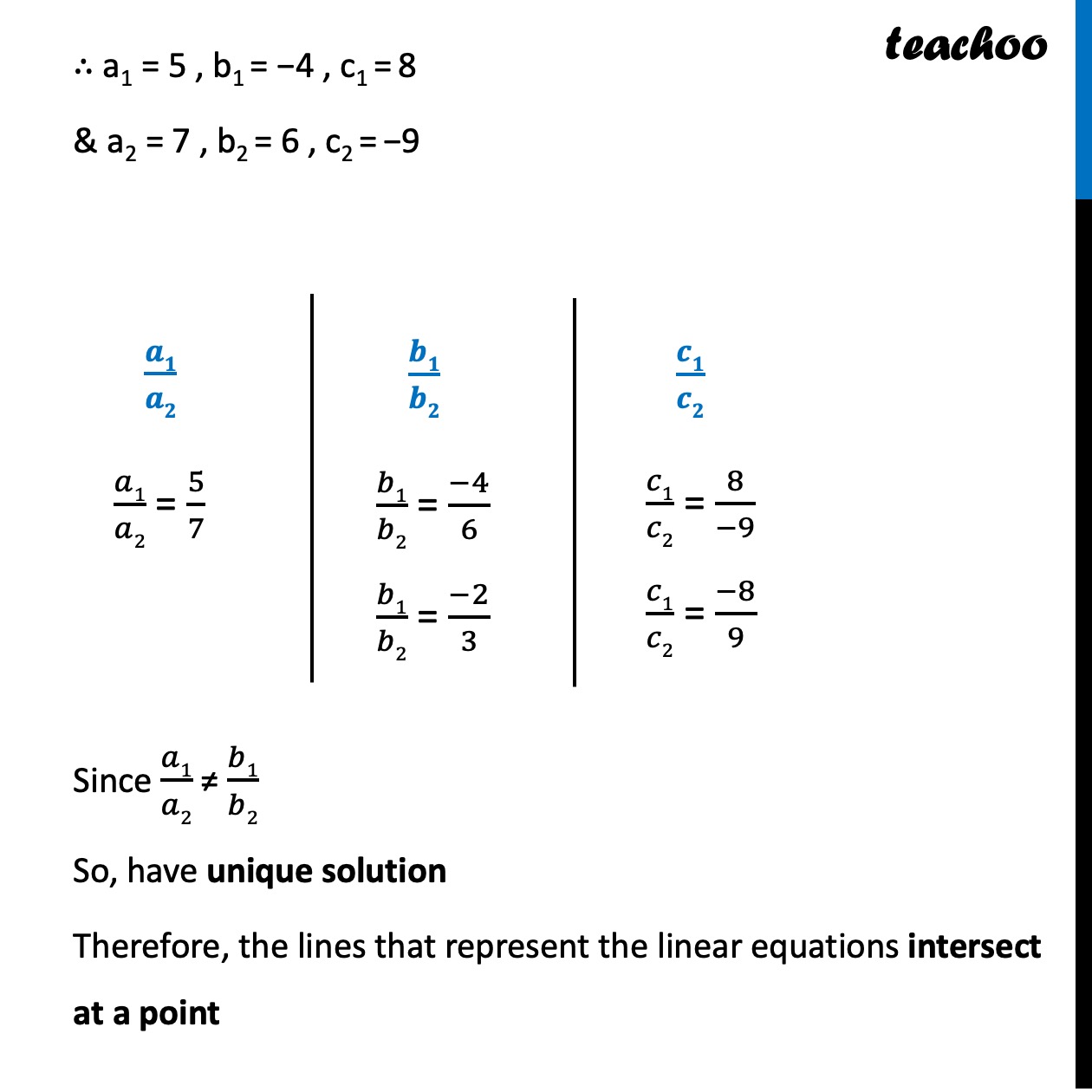
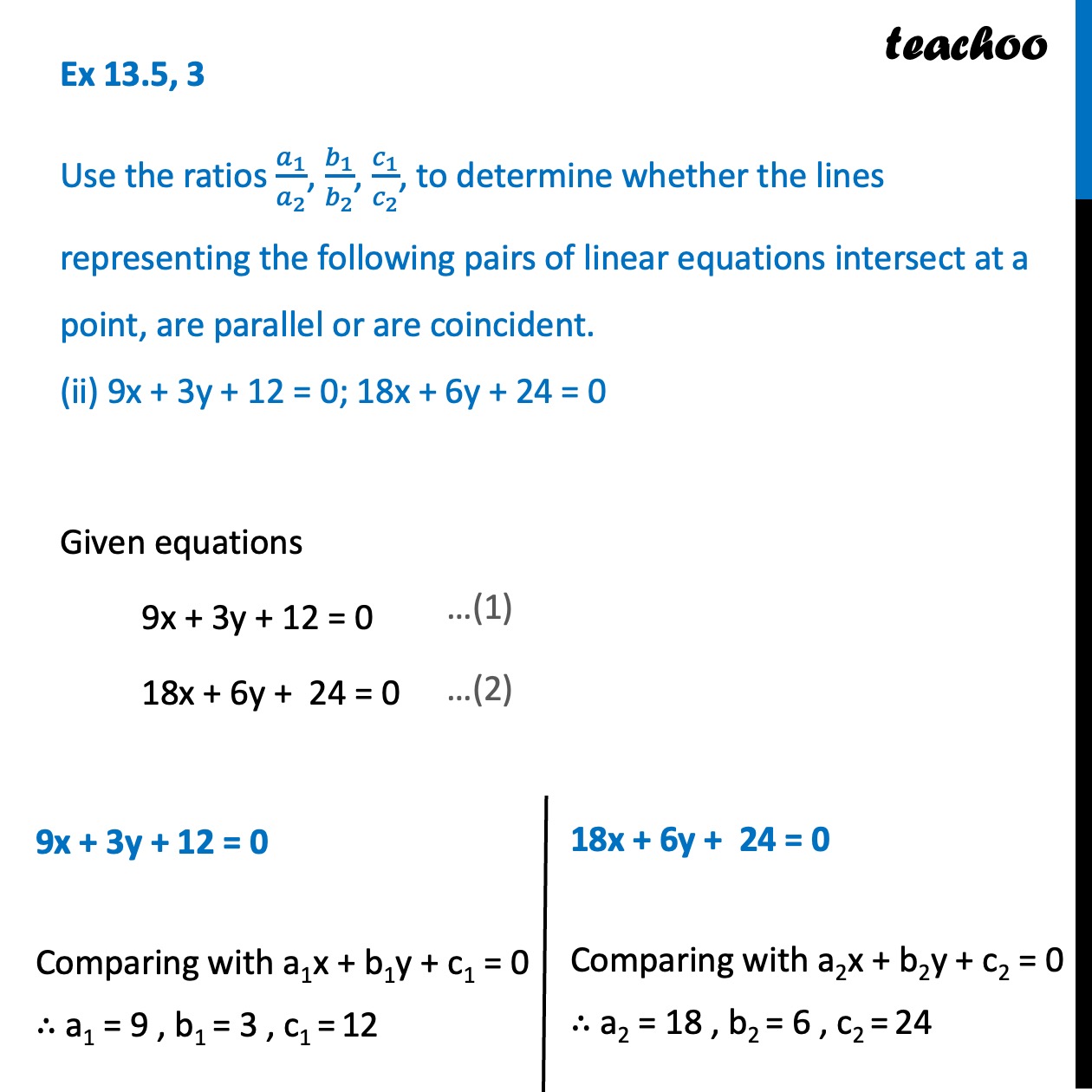
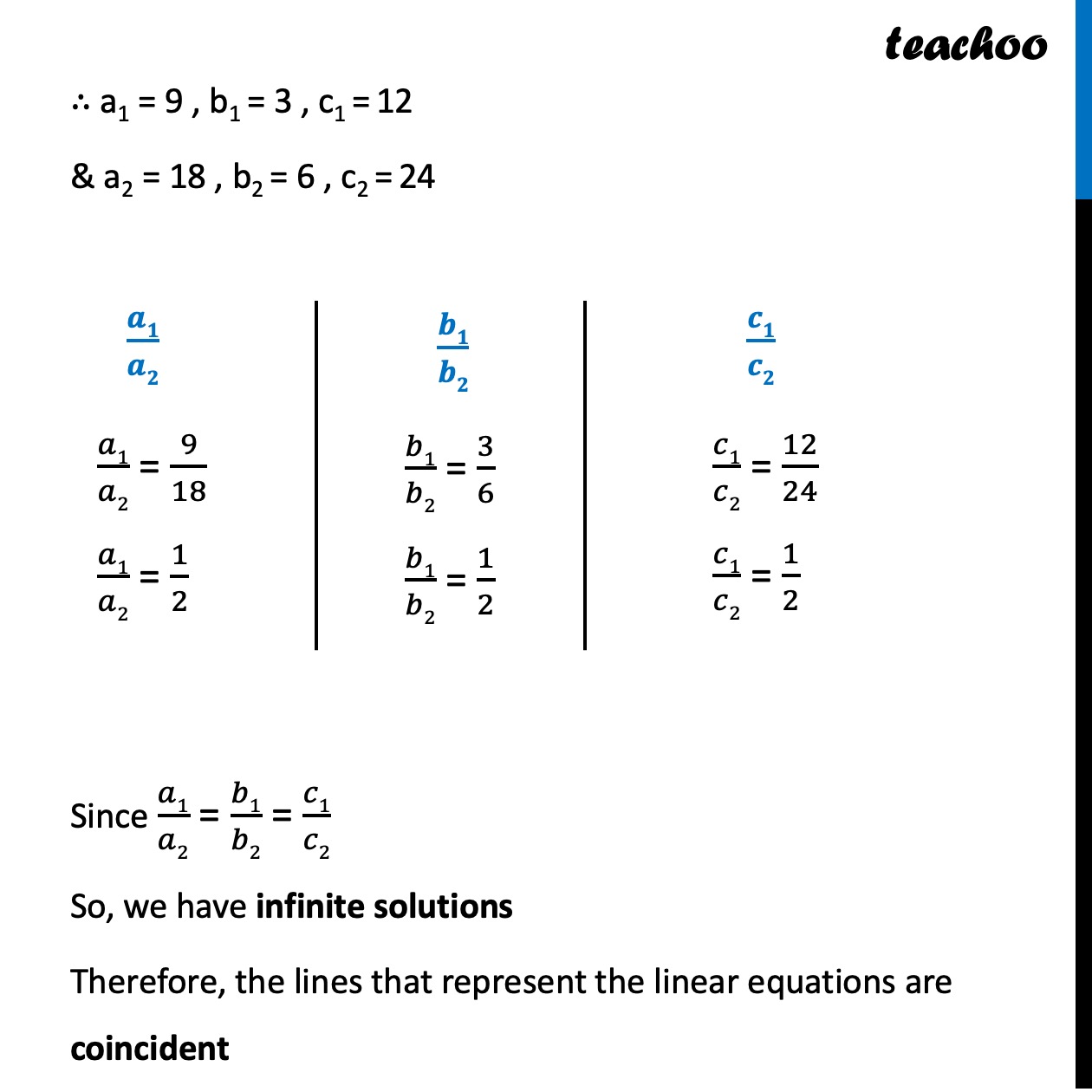
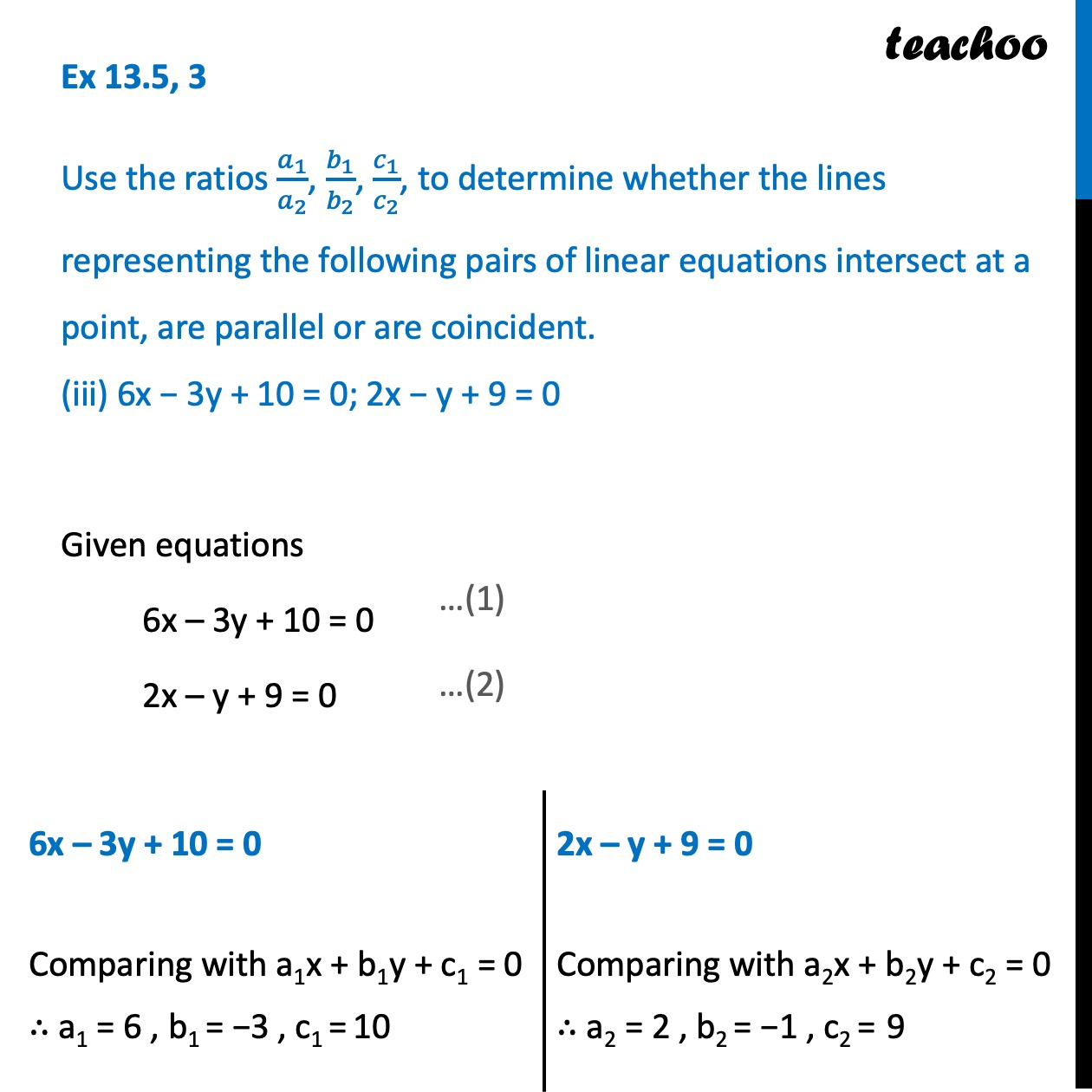
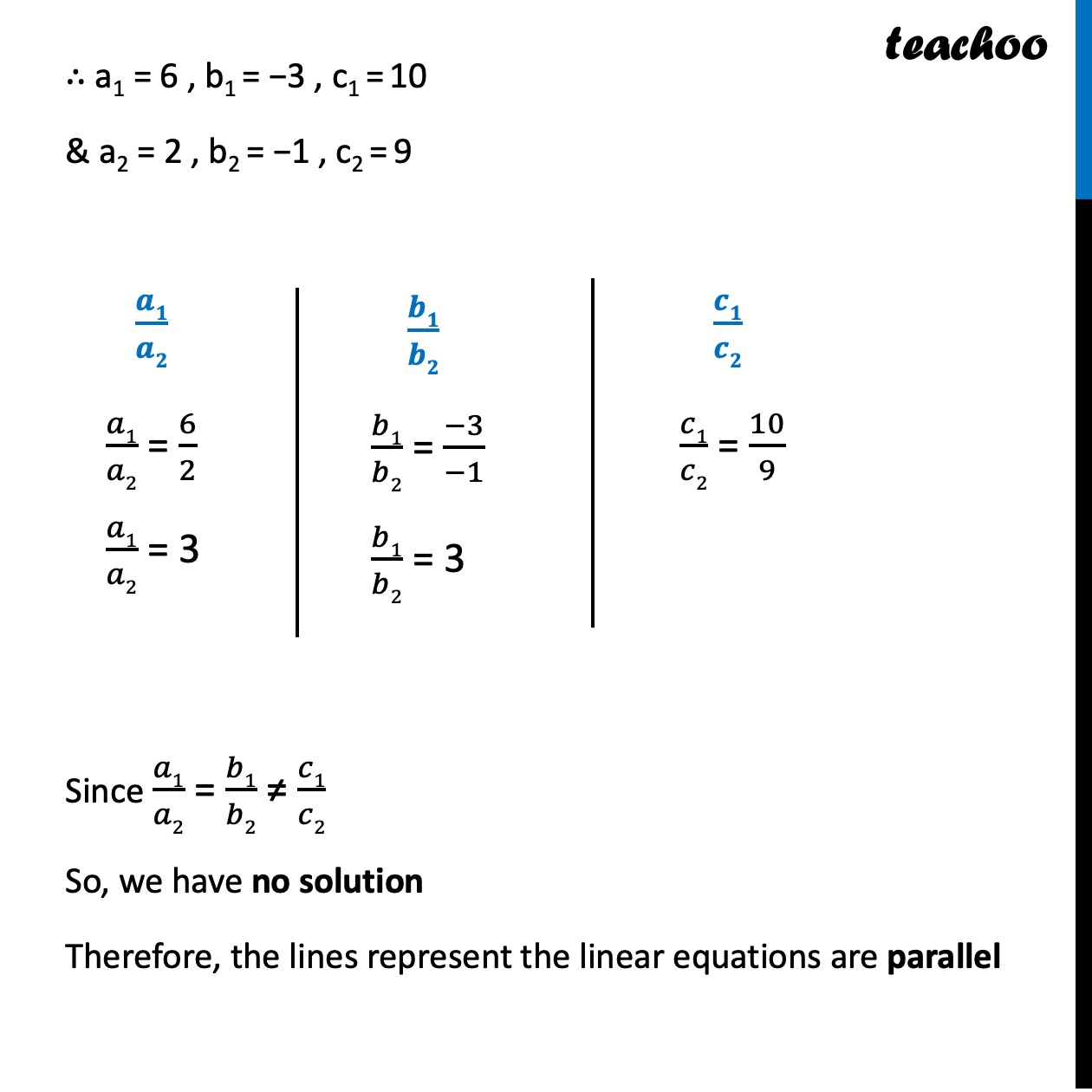
Ex 13.5, 3 Use the ratios (𝑎_(1))/(𝑎_(2)), (𝑏_(1))/(𝑏_(2)), (𝑐_(1))/(𝑐_(2)), to determine whether the lines representing the following pairs of linear equations intersect at a point, are parallel or are coincident. (i) 5x − 4y + 8 = 0; 7x + 6y − 9 = 0 Given equations 5x – 4y + 8 = 0 7x + 6y – 9 = 0 …(1) …(2) 5x – 4y + 8 = 0 Comparing with a_(1)x + b_(1)y + c_(1) = 0 ∴ a_(1) = 5 , b_(1 )= −4 , c_(1 )=_( )8 7x + 6y – 9 = 0 Comparing with a_(2)x + b_(2)y + c_(2) = 0 ∴ a_(2) = 7 , b_(2 )= 6 , c_(2 )= −9 ∴ a_(1) = 5 , b_(1 )= −4 , c_(1 )=_( )8 & a_(2) = 7 , b_(2 )= 6 , c_(2 )=_( )−9 Since (𝑎1)/(𝑎2) ≠ (𝑏1)/(𝑏2) So, have unique solution Therefore, the lines that represent the linear equations intersect at a point (𝑎1)/(𝑎2) = (5)/(7) (𝒂𝟏)/(𝒂𝟐) (𝑏1)/(𝑏2) = (−4)/(6) (𝑏1)/(𝑏2) = (−2)/(3) (𝒃𝟏)/(𝒃𝟐) (𝑐1)/(𝑐2) = (8)/(−9) (𝑐1)/(𝑐2) = (−8)/(9) (𝒄𝟏)/(𝒄𝟐) Ex 13.5, 3 Use the ratios (𝑎_(1))/(𝑎_(2)), (𝑏_(1))/(𝑏_(2)), (𝑐_(1))/(𝑐_(2)), to determine whether the lines representing the following pairs of linear equations intersect at a point, are parallel or are coincident. (ii) 9x + 3y + 12 = 0; 18x + 6y + 24 = 0 Given equations 9x + 3y + 12 = 0 18x + 6y + 24 = 0 …(1) …(2) 9x + 3y + 12 = 0 Comparing with a_(1)x + b_(1)y + c_(1) = 0 ∴ a_(1) = 9 , b_(1 )= 3 , c_(1 )=_( )12 18x + 6y + 24 = 0 Comparing with a_(2)x + b_(2)y + c_(2) = 0 ∴ a_(2) = 18 , b_(2 )= 6 , c_(2 )=_( )24 ∴ a_(1) = 9 , b_(1 )= 3 , c_(1 )=_( )12 & a_(2) = 18 , b_(2 )= 6 , c_(2 )=_( )24 Since (𝑎1)/(𝑎2) = (𝑏1)/(𝑏2) = (𝑐1)/(𝑐2) So, we have infinite solutions Therefore, the lines that represent the linear equations are coincident (𝑎1)/(𝑎2) = (9)/(18) (𝑎1)/(𝑎2) = (1)/(2) (𝒂𝟏)/(𝒂𝟐) (𝑏1)/(𝑏2) = (3)/(6) (𝑏1)/(𝑏2) = (1)/(2) (𝒃𝟏)/(𝒃𝟐) (𝑐1)/(𝑐2) = (12)/(24) (𝑐1)/(𝑐2) = (1)/(2) (𝒄𝟏)/(𝒄𝟐) Ex 13.5, 3 Use the ratios (𝑎_(1))/(𝑎_(2)), (𝑏_(1))/(𝑏_(2)), (𝑐_(1))/(𝑐_(2)), to determine whether the lines representing the following pairs of linear equations intersect at a point, are parallel or are coincident. (iii) 6x − 3y + 10 = 0; 2x − y + 9 = 0 Given equations 6x – 3y + 10 = 0 2x – y + 9 = 0 …(1) …(2) 6x – 3y + 10 = 0 Comparing with a_(1)x + b_(1)y + c_(1) = 0 ∴ a_(1) = 6 , b_(1 )= −3 , c_(1 )=_( )10 2x – y + 9 = 0 Comparing with a_(2)x + b_(2)y + c_(2) = 0 ∴ a_(2) = 2 , b_(2 )= −1 , c_(2 )=_( )9 ∴ a_(1) = 6 , b_(1 )= −3 , c_(1 )=_( )10 & a_(2) = 2 , b_(2 )= −1 , c_(2 )=_( )9 Since (𝑎1)/(𝑎2) = (𝑏1)/(𝑏2) ≠ (𝑐1)/(𝑐2) So, we have no solution Therefore, the lines represent the linear equations are parallel (𝑎1)/(𝑎2) = (6)/(2) (𝑎1)/(𝑎2) = 3 (𝒂𝟏)/(𝒂𝟐) (𝑏1)/(𝑏2) = (−3)/(−1) (𝑏1)/(𝑏2) = 3 (𝒃𝟏)/(𝒃𝟐) (𝑐1)/(𝑐2) = (10)/(9) (𝒄𝟏)/(𝒄𝟐)