
 You are here
- The ECI is an autonomous, permanent constitutional body.
- It has the superintendence, direction and control of the entire electoral process in India.
- It was established on 25 January 1950.
- It derives its authority from the Constitution under Articles 324 to 329.
- These Articles define its powers, duties and functions.
- The ECI does not supervise Panchayat and Municipal elections.
Beyond the textbook. Local self-government elections are conducted by separate State Election Commissions. The book does not mention them.
| Level | Officer | Role |
|---|---|---|
| State level | Chief Electoral Officer (CEO) | Appointed by the ECI from among civil servants, in consultation with the State Government, to supervise all election work in the state |
| District and local level | District Magistrates, Sub-Divisional Magistrates, Tahsildars | Designated as District Election Officers, Returning Officers and Electoral Registration Officers to conduct election work locally |
- The ECI performs four primary functions.
- It creates the electoral roll.
- It decides the schedule and dates for elections.
- It registers political parties and allocates symbols.
- It ensures free and fair elections.
- Official enumerators visit households across every constituency to collect voter data.
- The rolls are organised polling-station-wise.
- A formal claims and objections window settles disputes before the roll is published.
- The ECI also conducts a Special Intensive Revision (SIR) of the rolls.
- SIR stands for Special Intensive Revision of the electoral roll.
- It is a full clean-up and update of the whole roll.
- SIR adds eligible citizens, particularly youth turning 18.
- It deletes deceased, duplicate or shifted voters.
- It also removes the names of people who are not citizens of India.
Beyond the textbook. SIR is a house-to-house re-verification, deeper than the routine yearly revision. Booth Level Officers hand out pre-filled enumeration forms and collect them back. A draft roll is published, objections are heard, and only then does the final roll come out. The ECI draws this power from Article 324 and Section 21(3) of RPA 1950.
- The machinery is activated when a five-year term ends, or a House is dissolved.
- The ECI manages complex scheduling across thousands of polling locations.
- It finalises dates after examining weather conditions and agricultural cycles.
- It also considers school and university exams, and major festivals.
- Political parties must register with the ECI to contest elections.
- The ECI enforces inner-party democracy through periodic organisational elections.
- It classifies parties as recognised national, recognised state, or registered-unrecognised.
- It allots official election symbols to recognised parties.
- It acts as a quasi-judicial body in disputes over party splits, recognition and symbols.
![Election Commission of India - Elections - [Teachoo] - Concepts](https://cdn.teachoo.com/c8478601-80a5-40ee-99ff-7193e1620878/an-evm-with-braille.jpg)
- For elections to be meaningful, the whole process must be fair and transparent.
- If fairness is not ensured, public confidence in electoral institutions may weaken.
- An election can still be held, and yet lose its democratic value.
When an election loses its democratic value
- Candidates are influenced by personal favours.
- Votes are not counted accurately.
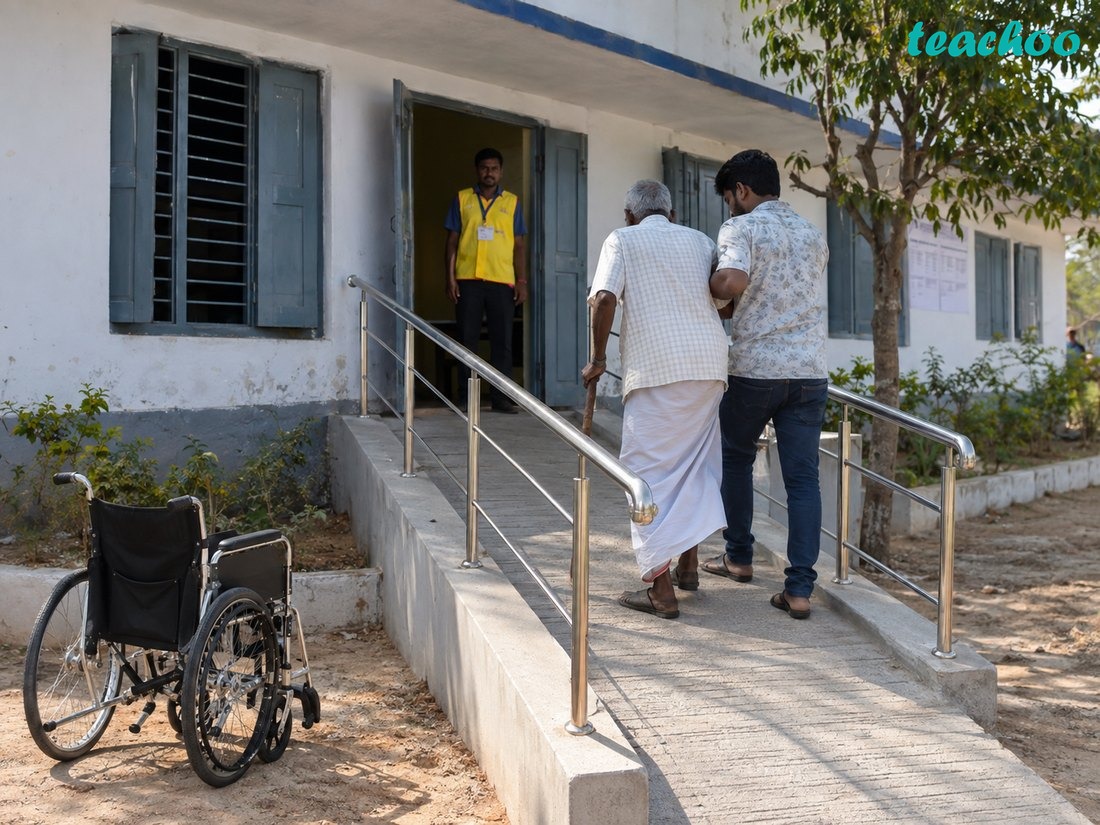
- Some people cannot exercise their right to vote because of accessibility problems.
- So democracy is not limited to conducting elections.
- It also means keeping the electoral process inclusive, impartial and trustworthy.
What the ECI does about it
- Its initiatives focus on infrastructure accessibility.
- They also focus on technology-assisted inclusion.
- They are aimed at Persons with Disabilities (PwDs), senior citizens, transgender persons and Particularly Vulnerable Tribal Groups (PVTGs).
- Voting from home covers senior citizens above 85 years of age.
- It also covers persons with disabilities with a benchmark disability of 40%.
- It was extended across India for the first time during the 2024 General Elections.
- Figure 7.7 shows an EVM with Braille and Figure 7.8 shows voting from home, under the theme "No Voter to Be Left Behind".
- India has over 96.8 crore eligible voters, spread across diverse regions and terrains.
- This is distinct from the electoral exercise anywhere else in the world.
- The ECI manages it autonomously and ensures free and fair elections nationwide.
- To carry out its work it makes extensive use of information and communication technologies, and of e-governance.
| App or platform | Who it is for | What it does |
|---|---|---|
| Suvidha | Candidates and parties | Online nomination filing, and real-time permissions for rallies, vehicles and loudspeakers |
| ERONET | Election officials | Standardised database processing and online maintenance of electoral rolls |
| Sugam | Election officials | Vehicle management, tracking government vehicles, driver details and fuel |
| ETPBS | Service voters | Electronically Transmitted Postal Ballot System, letting service personnel vote from outside their constituency |
| Voter Helpline App | General voters | New voter registration, status check, polling booth details and election updates |
| Saksham App | Persons with Disabilities | Wheelchair requests, registration, and locating accessible polling booths |
| cVIGIL App | General citizens | Real-time reporting of Model Code of Conduct violations, with auto-location tracking |
- You will turn 18 in a few years. As a responsible citizen, you should register yourself as a voter. Find out the various steps of the procedure for registration and the list of required documents for the same. Discuss, with anyone who has just turned 18 and has registered as a voter, the ease or difficulty faced in the voter registration process.
Show Answer
Sample answer.
- The digital interface allows fast verification.
- Delays can occur if the documents do not match, or where web connectivity is poor.
- Do you know what ETPBS is? ETPBS stands for Electronically Transmitted Postal Ballot System. It enables service voters to cast their vote on an electronically received postal ballot from their preferred location, which is outside their originally assigned voting constituency. Find out who are classified as service voters and who can vote using ETPBS?
Show Answer
Sample answer. The book itself answers the first part. The second part is answered below.
Who is a service voter
Who can vote using ETPBS
- Only service voters, and the spouses who live with them, vote through ETPBS.
- They stay enrolled in their own home constituency.
- The ballot is sent to them electronically, wherever they are posted.
- They print it, mark it by hand, and post the sealed envelope back to the Returning Officer.
- It must reach the officer before counting begins, or it is not counted.
Beyond the textbook. Service voters are defined in Section 20(8) of RPA 1950. Members of the armed forces and of Army Act forces may instead appoint a proxy to vote for them; a State police member posted outside the State, a government employee posted abroad and a spouse cannot use a proxy. ETPBS is one-way: the ballot goes out electronically but comes back by post. Other postal-ballot voters, such as notified voters, electors on election duty and absentee voters aged 85 and above, do not use ETPBS.
- Every year, 25 January is celebrated as National Voters' Day.
- There is a voters' pledge that citizens take on that day.
- In it, citizens pledge to uphold the democratic traditions of the country.
- They pledge to uphold the dignity of free, fair and peaceful elections.
- They pledge to vote in every election fearlessly.
- They pledge not to be influenced by religion, race, caste, community, language or any inducement.
- The International Election Visitors' Programme (IEVP) is a flagship ECI initiative.
- It is for international cooperation with Election Management Bodies (EMBs).
- The ECI has signed Memorandums of Understanding with 28 EMBs.
- It has also signed with three global bodies: IFES, International IDEA and the United Nations.
Show answer
On 25 January 1950.
Show answer
Articles 324 to 329.
Show answer
The cVIGIL App.
Show answer
It gives Persons with Disabilities accessible registration and polling booth services.
Show answer
False. Municipal elections are conducted by State Election Commissions.
- The key contrast is between (d) and (e).
- A person in prison as a convict or an undertrial cannot vote at all.
- A person under preventive detention can vote, by post.
- The most important is creating the electoral roll.
- No other function can work if the roll itself is wrong.
- If an eligible voter's name is missing, that citizen loses the vote completely.
- If a dead or duplicate name stays, a false vote can be cast in that name.
- Every other step, from the schedule to the counting, rests on a correct roll.
- Any of the four may be argued as most important, if the reasons are good.
What it is
- SIR stands for Special Intensive Revision of the electoral roll.
- It is a house-to-house re-verification of the whole roll.
- It is deeper than the routine yearly revision.
- Booth Level Officers give out pre-filled enumeration forms and collect them back.
- A draft roll is published, objections are heard, and then the final roll comes out.
Objectives
Why it is necessary
- A wrong roll can leave a genuine citizen without a vote.
- It can also let a false vote be cast in a dead or duplicate name.
- Both weaken trust in the result.
- The ECI draws this power from Article 324 and Section 21(3) of RPA 1950.
A simple plan for a one-minute video.
| Step | What to do |
|---|---|
| Choose | Pick one topic, for example No Voter to be Left Behind |
| Research | Take facts from the ECI website, such as home voting and the Saksham facility |
| Script | Write about 120 words. Open with a question, give three facts, end with an appeal |
| Shoot | Record on a phone in a quiet room, in landscape |
| Add | Put in a title card and simple captions |
| Share | Show it in class, or at a school voter awareness programme |
- The ECI is an autonomous, permanent constitutional body, established on 25 January 1950.
- It derives its authority from the Constitution under Articles 324 to 329.
- Its four functions are the electoral roll, the schedule, party registration, and free and fair elections.
