
 You are here
In short:
An election is a process through which citizens exercise their right to vote.
What is an election?
- An election is a process through which citizens exercise their right to vote.
- Through it they fulfil their responsibility in a democratic society.
- Regular and periodic elections lie at the core of any democracy.
- They ensure that public representatives remain accountable to the people.
How an election works
Citizens vote
every adult exercises the right to vote
↓
Representatives are chosen
the people's choice decides who governs
↓
Elections come round again
regularly and periodically
↓
Representatives stay accountable to the people - this is why elections lie at the core of any democracy
What is the difference between direct and indirect elections?
| Type of election | Meaning | Key examples in India |
|---|---|---|
| Direct elections | Citizens vote directly to choose their representatives or leaders | Members of the Lok Sabha; Members of the Vidhan Sabha (MLAs); local bodies such as Panchayats and Municipalities |
| Indirect elections | Citizens vote for representatives, who then elect the leaders | The President of India; the Vice President of India; members of the Rajya Sabha |
Why can an elected government not continue without fresh elections?
- Periodic elections keep those who decide on behalf of citizens accountable.
- Fresh elections give voters the choice to renew a mandate.
- They also give voters the choice to remove non-performing representatives.
Why a mandate has to be renewed
A five-year term ends
the mandate given by the voters runs out
↓
Fresh elections are held
voters look at what was done with that mandate
↓
Voters can renew the mandate, or remove a non-performing representative
What are the core pillars of elections in a democracy?
Pillar
What it means
Accountability
Elected representatives are answerable to the electorate through periodic mandates
Representation
Citizens choose leaders to voice their interests, values and local needs
Equality
Every citizen's vote carries equal weight under universal adult franchise
Legitimacy
A government chosen fairly has the legal and moral authority to govern
![Why Do Elections Matter? - Elections - [Teachoo] - Concepts](https://cdn.teachoo.com/c63c437e-1f67-4d62-8f4b-c6f0ebbdd7ab/fig-7.1-importance-of-elections-in-a-democracy.jpg)
Fig 7.1 - Importance of elections in a democracy
- Fill in the two empty boxes to indicate why elections are important for democratic functioning, and discuss how each one of them is ensured through elections.
Show Answer
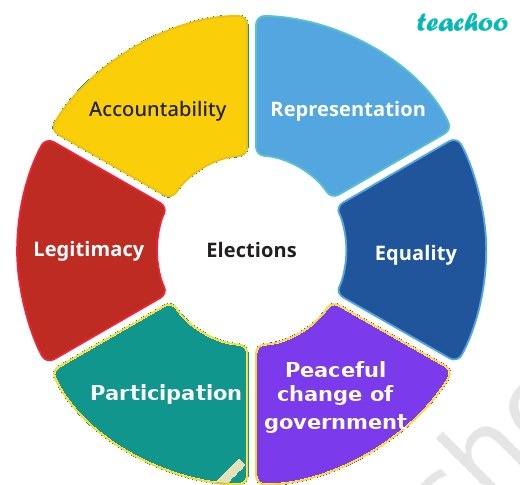
The completed figure - the two empty boxes filled in
The empty box
How elections ensure it
Participation
Every adult citizen takes part in choosing the government
Peaceful change of government
Power changes hands through votes, not through force
📜 Don't Miss Out
- The scientific study of elections is called psephology.
- The term comes from the Greek word psephos, meaning pebble.
- Logy means systematic study.
- In ancient Greece, voting was conducted by dropping pebbles into urns.
Questions from the Book
Q3. Elections are the soul of a democracy. Do you agree? Why or why not?
Yes, I agree, for these reasons.
- Elections are the only way citizens choose who will govern them.
- They give every citizen an equal voice, as each vote carries equal weight.
- They keep representatives accountable, because they must face the voters again.
- They give the government legitimacy, that is, the moral right to govern.
- They allow power to change hands peacefully, without force.
- But elections alone are not enough.
- They must also be free and fair, or the result does not reflect the people's will.
Q5. Why should you vote? Arrange the following in the descending order of your choice. Discuss the reasons for your choice.
This is a personal choice, so any order is correct if the reasons are good. One possible order is given below.
| Order | Reason | Why it is placed here |
|---|---|---|
| 1 | Opportunity to choose my representative | This is the main purpose of a vote |
| 2 | Strengthens democracy | A high turnout makes the government truly representative |
| 3 | Opportunity to change the non-performing representative | This is how voters hold leaders accountable |
| 4 | Makes me a responsible person | This is a personal gain, not a gain for the country |
📝 What Have We Learned
- An election is a process through which citizens exercise their right to vote.
- Regular and periodic elections lie at the core of any democracy.
- Elections give representation, equality, legitimacy and accountability.
