You are here
page 153
In short:
Equal voting rights did not give equal representation, so seats were reserved.
1. Did women always have the right to vote? How was India's experience different?
![Women and Democracy in India - Democracy - [Teachoo] - Concepts](https://cdn.teachoo.com/ec235754-c366-41bc-bf67-2db2e4e102af/the-indelible-ink-mark.jpg)
The indelible ink mark
- No.
- In many countries women had to fight for years to get the vote.
| Country | Year women got full voting rights | How |
|---|---|---|
| USA | 1920 | After decades of protests |
| Britain | 1928 | After a long struggle |
| India | 1950 | Given straight away with the Constitution |
- In India, when the Constitution came into force in 1950, Universal Adult Franchise was given to all citizens - men and women - with no discrimination .
- Indian women did not have to go to court or protest for years to get it.
- So on the question of voting , Indian women started equal from day one.
2. Did equal voting rights give women equal participation?
Voting and participation
one did not bring the other
Women could VOTE
From 1950
Choose who decides
Example:
a rule on paper
But few BECAME leaders
Social prejudices act as barriers
Example:
what actually happened
- No.
- This is where the gap appears.
- Social prejudices continue to act as barriers.
- So fewer women reach politics than their numbers should allow.
Women could do this from 1950
But this did not follow
Vote
for their leaders
Become
the leaders
Choose who decides
Sit in the body that decides
- Voting is about choosing .
- Participation is about deciding .
- Getting the first does not give you the second.
3. What was done to close this gap?
- The chapter says empowerment of women starts with their active participation in institutions of decision-making .
- So the Constitution reserved seats for women in local bodies.
- Reservation makes sure women are not just voters outside the room, but members inside it.
4. How does reservation work in Panchayats and Municipalities?
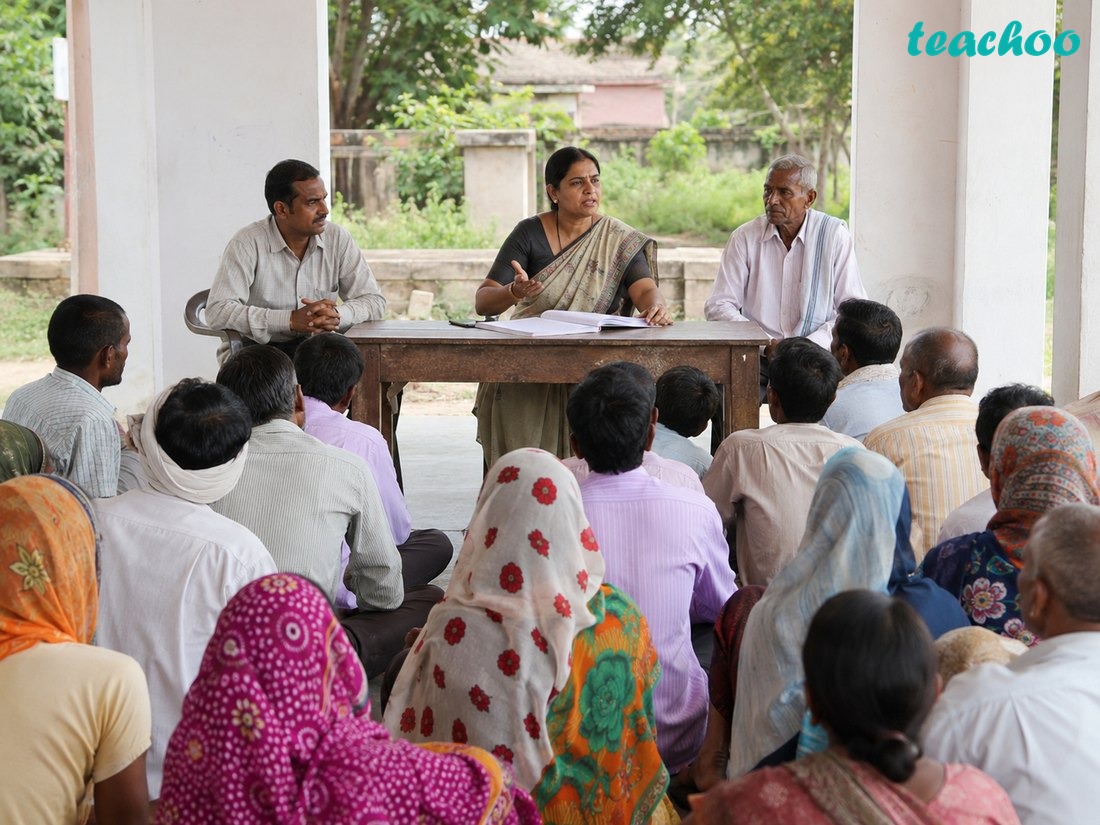
A woman heading a village council
Reservation for women
not less than one-third
Article 243(d)
Every Panchayat
One-third of seats
Example:
21 States and 2 UTs give 50%
Article 243(t)
Every Municipality
One-third of seats
Example:
as of 2023, 17 States and 1 UT give 50%
| Article | Where it applies | Seats reserved | States that give more |
|---|---|---|---|
| Article 243(d) | Every Panchayat | Not less than one-third of seats filled by direct election | 21 States and 2 Union Territories give 50% |
| Article 243(t) | Every Municipality | Not less than one-third of seats filled by direct election | As of 2023, 17 States and 1 Union Territory give 50% |
- Direct election means people vote for that member themselves.
- The Constitution fixes one-third as the minimum .
- Many states have raised it to half .
Let's Explore
5. Why does greater representation of women improve democracy?
- The book asks: India continues to work towards more inclusive institutions.
- Discuss in class the advantages of increased representation of women in the legislature.
- Problems women face get discussed - health, safety, clean water, childcare.
- If nobody in the room faces these problems, they are easy to forget.
- Half the country gets a say.
- Women are about half of all voters.
- More viewpoints make better decisions - the same reason a multi-party system helps.
- It changes what girls think is possible.
- When women take decisions, more women come forward.
- It has worked: the South Manubankul Gram Panchayat in Tripura brought women into decision-making and improved health, sanitation and jobs, and was praised at the national level.
- One point to remember: reservation gives women a place in the room.
- Real change also needs social prejudices to go, so their voice truly counts.
6. What does this whole story tell us about democracy?
- That democracy is not only about voting and elections .
- Women had the vote from 1950 , and were still not equally represented .
- Voting was only the first step .
- Reaching decision-making bodies was the next.
- This matches what the book says elsewhere: democracy " is not limited to elections alone".
The chain in short
Votes, representation and reservation
Equal voting rights
1950
Not equal representation
social prejudices
Reservation of seats
Articles 243(d) and 243(t)
↓
Women brought into Panchayats and Municipalities
1. In which years did women get full voting rights in the USA, Britain and India?
Show answer
USA in 1920, Britain in 1928, India in 1950.
2. Why did Indian women not have to struggle for the vote?
Show answer
Because Universal Adult Franchise was given to all citizens without discrimination when the Constitution came into force in 1950.
3. Why was reservation needed even though women could already vote?
Show answer
Because voting only means choosing leaders. Social prejudices kept women out of decision-making bodies, so seats were reserved to bring them in.
4. What do Articles 243(d) and 243(t) provide?
Show answer
Not less than one-third of seats filled by direct election are reserved for women - Article 243(d) in every Panchayat, Article 243(t) in every Municipality.
5. How many States and UTs give 50% reservation, and where?
Show answer
21 States and 2 Union Territories in Panchayati Raj Institutions; as of 2023, 17 States and 1 Union Territory in Urban Local Bodies.