
 You are here
![7.1 Conduction of Heat - Heat Transfer in Nature - [Teachoo] - Concepts](https://cdn.teachoo.com/test/bbcb4f3f-247a-4b08-a51f-835fad4286b5/image-a-metal-spoon-resting-in-a-hot-cup-of-tea-with-a-colour-gradient-along-the-spoon-from-red-at-the-hot-end-to-blue-at-the-cool-handle-e.png)
Pema watches her grandmother cook thukpa in a metal pan.
She wonders: why are cooking utensils made of metals?
Palden answers: metals are good conductors of heat.
What is Conduction?
It transfers heat from the hotter part to the cooler part.
Particles do not move.
They only pass heat to the next particle.
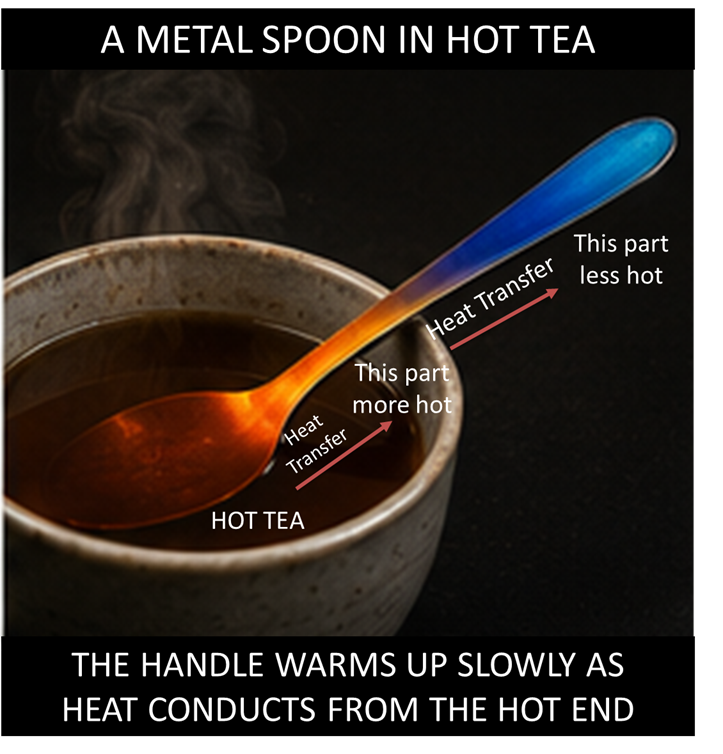
- A heated particle passes heat to the next one.
- This continues along the chain.
- The particles themselves do not move from their positions.
- In solids, heat is transferred mainly through conduction .
-
Good conductors
allow heat to pass through easily.
Examples: iron, aluminium, copper, steel.
-
Poor conductors (insulators)
resist heat flow.
Examples: wood, glass, clay, porcelain, air.
Definition
It transfers heat from the hotter part to the cooler part.
A heated particle passes heat to its neighbour.
That neighbour passes it further — like a chain.
The particles themselves do not move.
⚠️
Caution
— This activity must be carried out under the supervision of a teacher or an adult.
What to do
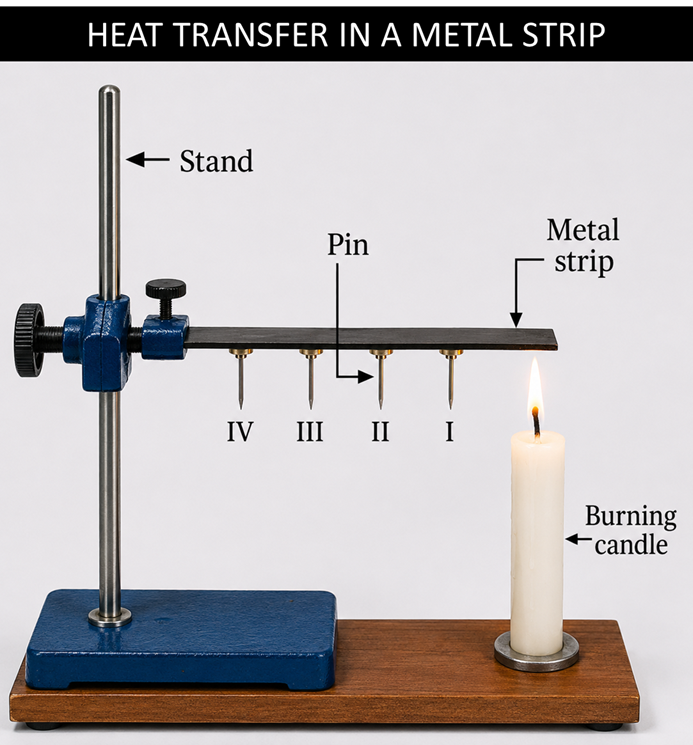
- Take a 15 cm strip of aluminium or iron. Attach four pins (I, II, III, IV) with wax, spaced about 2 cm apart.
- Secure the strip to a stand. Heat the end away from the stand with a candle or spirit lamp.
- Predict the order in which the pins will fall. Record prediction and observation below.
Table 7.1 — Falling of Pins
| Pin falling first — Prediction | Pin falling first — Observation | Reason for what you observed |
|---|---|---|
| Pin I (closest to the candle) | Pin I fell first, then II, then III, then IV | Heat travels by conduction from the hot end; wax closest to the flame melts first, dropping pin I |
Why Do the Pins Fall in Order? — Conduction Step by Step
Step 1 — Candle heats the metal strip at pin I end
The candle flame transfers heat to the strip. Particles at the hot end vibrate faster.
Step 2 — Heat passes particle to particle along the strip
Each heated particle transfers energy to its neighbour.
Particles do not move from their positions.
Particles do not move from their positions.
Step 3 — Wax near pin I melts first → pin I falls
As heat reaches each pin location, the wax melts. Pin I (nearest) falls first, then II, III, IV in order.
Conclusion — Heat moved from hot end to cold end
This is
conduction
: heat flows through a solid from hotter part to cooler part without particle movement.
Good Conductors vs Poor Conductors
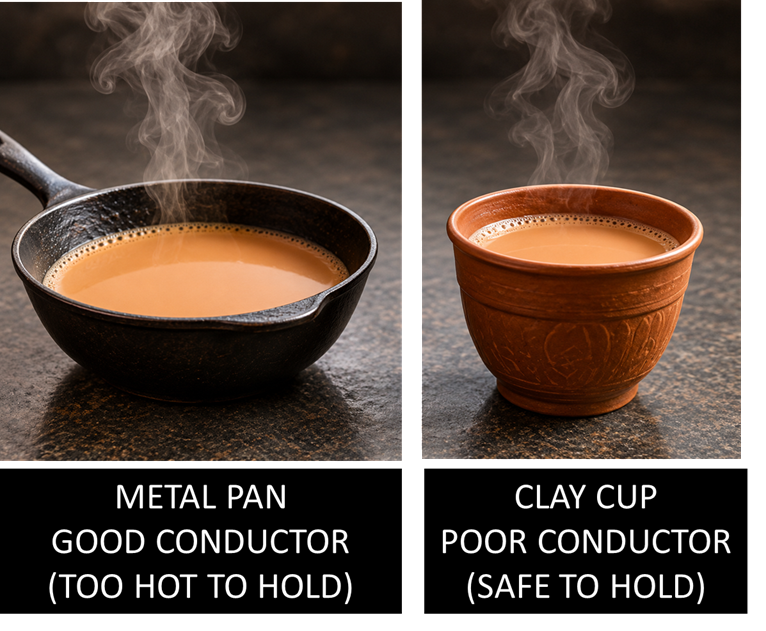
Good Conductors
Poor Conductors (Insulators)
Allow heat to pass through easily
Do not allow heat to pass through easily
All metals — iron, steel, aluminium, copper
Wood, glass, clay, porcelain, air
Used for cooking utensils — heat reaches food quickly
Used for handles, tea cups — safe to touch when hot
Pins fall quickly in Activity 7.1
Pins would not fall if strip were made of wood or glass
Table 7.2 — List of Good or Poor Conductors of Heat
| S.No. | Material | Good or Poor Conductor of Heat |
|---|---|---|
| 1 | Steel | Good conductor |
| 2 | Wood | Poor conductor — wood does not allow heat to pass through easily |
| 3 | Glass | Poor conductor — that is why glass cups keep tea hot longer |
| 4 | Clay / Porcelain | Poor conductor — clay cups retain heat; coffee/tea stays hot longer |
| 5 | Air | Poor conductor — trapped air in wool, hollow bricks acts as insulator |
| 6 | Aluminium | Good conductor — used in cooking pans and pressure cookers |
Quick fact: Clay and porcelain cups keep tea or coffee
hot longer
because they are
poor conductors
— heat escapes very slowly through them.
Why Do We Wear Woollen Clothes in Winter?
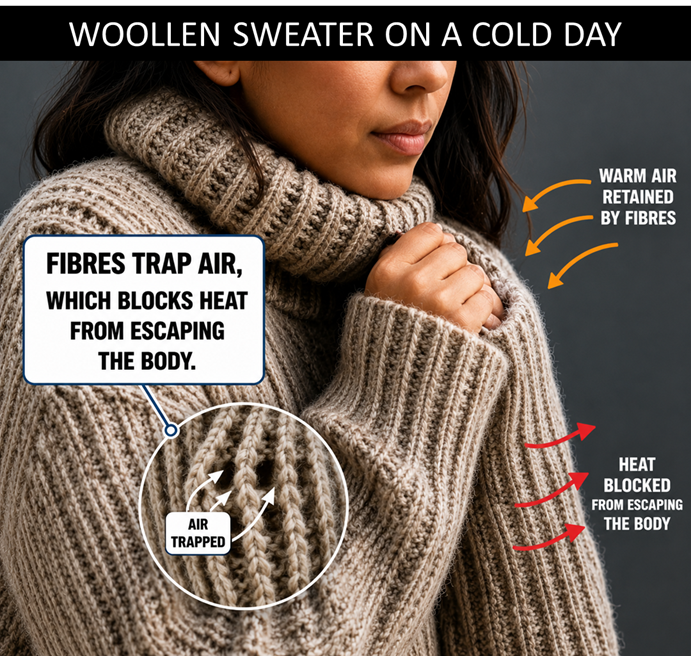
In winters, we wear Woollen fabric and multiple clothing layers
-
Woolen Fabric
traps air in its pores
.
Air is a poor conductor.
It blocks heat from escaping.
This is why we feel warm wearing wool. -
We wear multiple clothing layers to escape cold
Air between clothing layers acts as a poor conductor .
It keeps us warm by reducing heat loss. -
Which is better?
Two thin Blankets or one Thick Blanket?Two thin blankets with air between them are warmer.One thick blanket has no air gap → less insulation.The air gap acts as an insulating layer.
🏠
Fascinating Fact — Himalayan Houses
- In Uttarkashi (Uttarakhand), walls have two wooden layers.
- The gap is filled with cow dung and mud .
- Wood and mud are poor conductors of heat.
- They trap heat inside the house.
- The house stays warm even in extremely cold winters.
- Houses also use hollow bricks .
- Trapped air inside is a poor conductor.
- Keeps homes cool in summer and warm in winter.
✓ Quick Check — Section 7.1
-
Why are cooking utensils made of metals?
Show Answer
Metals are good conductors of heat .
They allow heat to pass through easily.
Heat from the flame reaches the food quickly. -
Why does pin I fall before pin II in Activity 7.1?
Show Answer
Pin I is closest to the candle flame .
Heat travels by conduction along the strip from the hot end.
Wax at pin I melts first → pin I falls first. -
Why are handles of cooking pans made of wood or plastic?
Show Answer
Wood and plastic are poor conductors of heat .
They block heat from passing through.
The handle stays cool — safe to hold.
📋 NCERT Question 1(i) — Saucepan Materials
Your father bought a saucepan made of two different materials, A and B, as shown in Fig. 7.14. The materials A and B have the following properties— (a) Both A and B are good conductors (b) Both A and B are poor conductors (c) A is good conductor and B is poor conductor (d) A is poor conductor and B is good conductor
View Answer →
📋 NCERT Question 7 — Hollow Bricks
Why are hollow bricks used to construct outer walls of houses in hot regions?
View Answer →
📋 NCERT Question 2 — Cold Lassi Tumbler
A leaky tumbler of cold lassi is placed inside another tumbler — will this keep the lassi cold longer?
View Answer →
