
 You are here
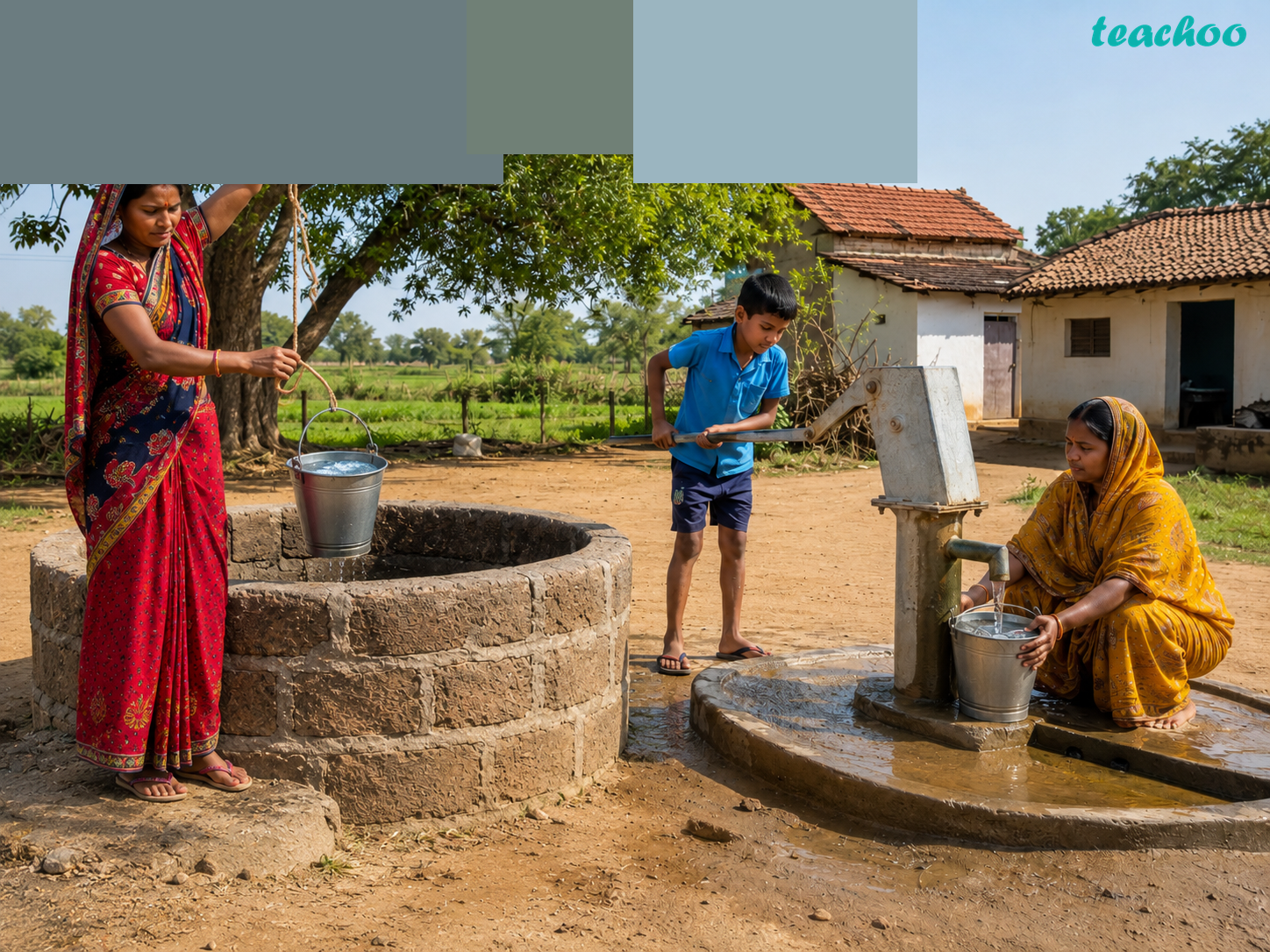
People draw groundwater from wells and handpumps.
Where does this water come from?
Let us understand
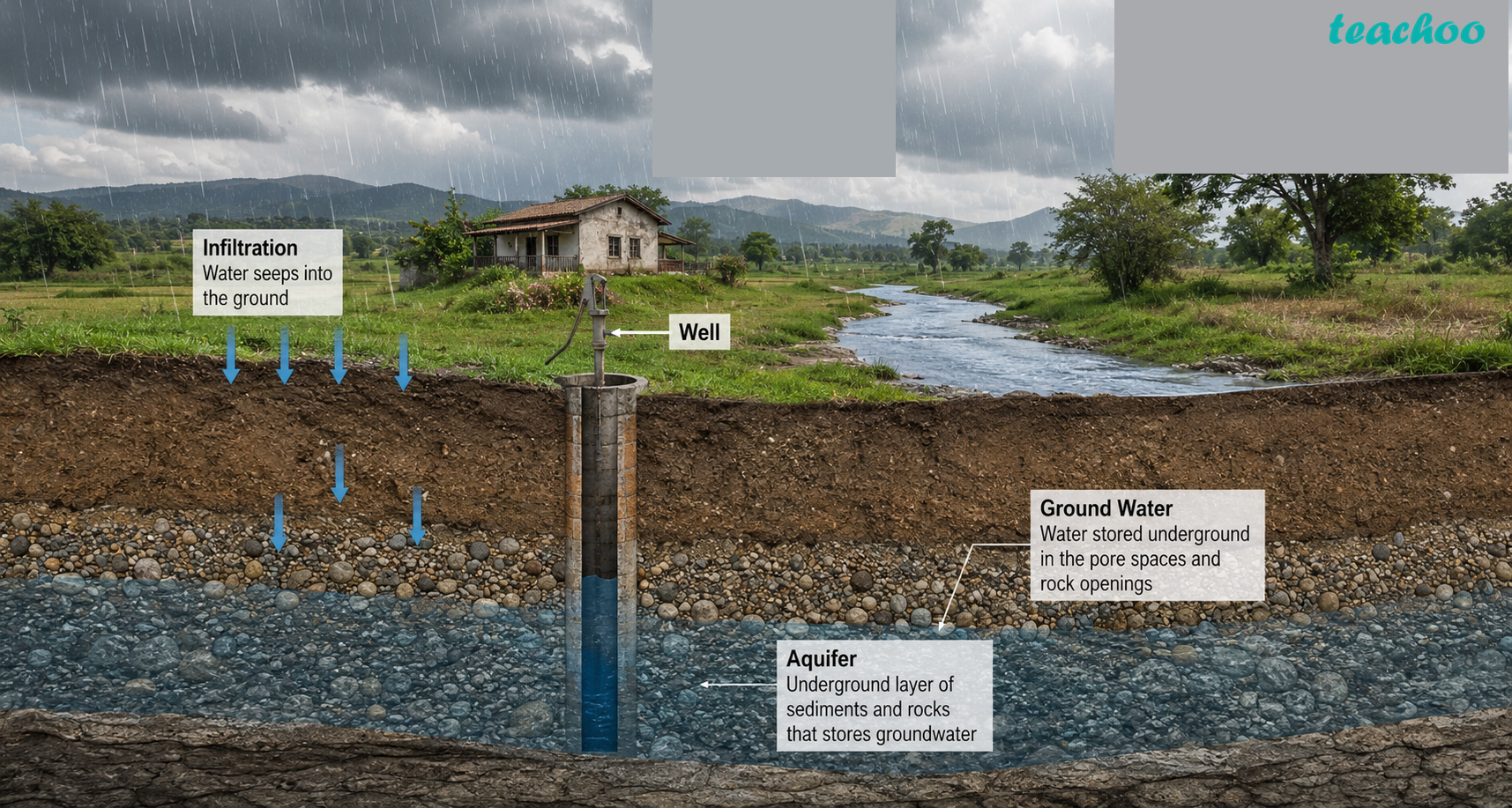
- Explanation:-
- When Rainwater fall s on the Earth’s surface. some rainwater seeps into the soil .
- This seeping of water into the ground is called infiltration .
- The water moves down through soil, sand, and small cracks in rocks.
- This stored underground water is called groundwater .
- Groundwater is stored in underground layers of sediments and rocks called aquifers .
- A well is dug deep enough to reach the aquifer to collect the water
-
Summary
So, wells collect water from groundwater stored in aquifers after rainwater infiltrates into the ground .
Key Terms
Infiltration — When surface water seeps through soil and rocks, it is called Infiltration
Groundwater — The water that seeps underground is called Groundwater.
It gets stored in the pore spaces of sediments and rocks.
Aquifer — It is the underground layer of sediment or rock.
It stores groundwater.
What to do
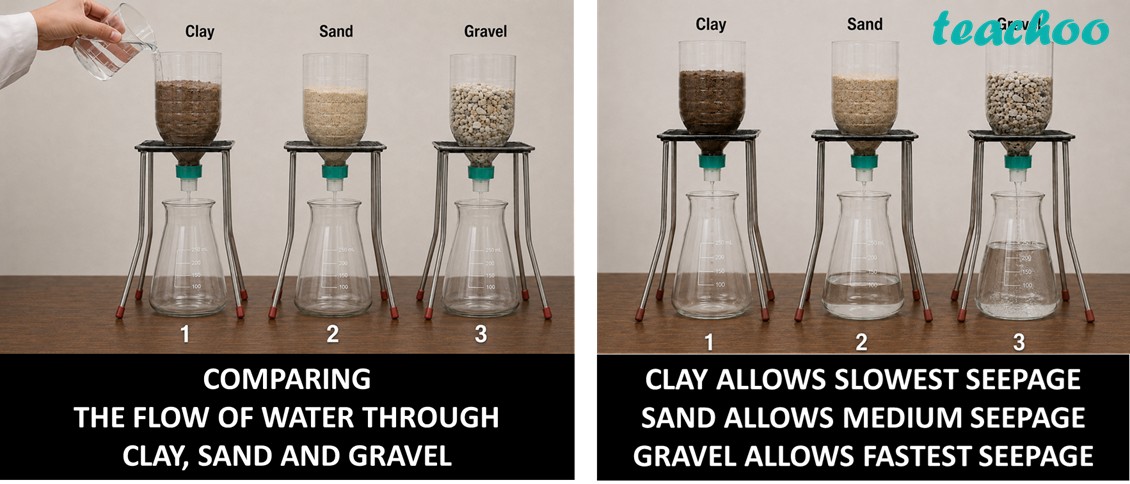
- Take three 1 L plastic bottles, cut in the middle, make a small hole in each cap. Invert each.
- Fill: Bottle 1 with clay, Bottle 2 with sand, Bottle 3 with gravel.
- Place a beaker under each. Add 200 mL of water to each. Collect seepage for 10 minutes.
Table 7.5 — Seepage of Water
| Bottles filled with | Prediction (very slow / slow / fast) | Observation (very slow / slow / fast) |
|---|---|---|
| Bottle 1 — Clay | Very slow | Very slow — clay has tiny pore spaces that strongly resist water flow |
| Bottle 2 — Sand | Slow | Slow — sand pores are larger than clay but smaller than gravel |
| Bottle 3 — Gravel | Fast | Fast — gravel has the widest, most open and connected spaces for water to flow through |
🏝
Science and Society — Ice Stupa (Ladakh)
- During spring in Ladakh, mountain streams dry up.
- This causes water scarcity .
- Engineer Sonam Wangchuk innovated the Ice Stupa to solve this.
- In winter, mountain stream water is piped underground.
- It reaches lower altitudes this way.
- It is sprayed into freezing air.
- It freezes layer by layer.
- It forms a tall cone-shaped structure .
- The cone shape has less surface area exposed to sunlight.
- This helps the stupa last longer into summer.
- The ice stupa melts slowly in spring and summer .
- It provides fresh water for farming.
- This is when natural streams are still dry.
📋 NCERT Question 9 — Water Seepage and Groundwater
Explain how water seeps through the surface of the Earth and gets stored as groundwater.
View Answer →
✓ Quick Check — Section 7.4
-
Which allows faster seepage of water — clay or gravel? Why?
Show Answer
Gravel allows faster seepage.
Its particles have wider spaces than clay.
Wider spaces = easier water flow. -
What is the role of the water cycle in replenishing groundwater?
Show Answer
Rainwater seeps into ground through infiltration .
It recharges aquifers continuously.
The water cycle ensures groundwater is always replenished.
