
 You are here
Question
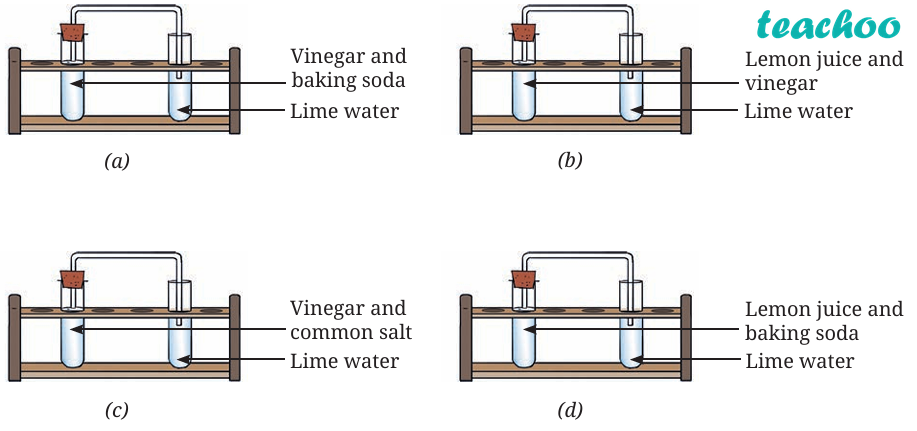
The experiments shown below (a, b, c, and d) were performed. Find out in which case(s) did lime water turn milky and why?
(a) Vinegar + baking soda → lime water
(b) Lemon juice + vinegar → lime water
(c) Vinegar + common salt → lime water
(d) Lemon juice + baking soda → lime water
Show answer
Answer
The lime water turns milky in setups
(a)
and
(d)
.
Why (a) and (d) turn milky:
- Both setups combine an acid (vinegar or lemon juice) with a carbonate (baking soda).
- The reaction releases carbon dioxide gas .
- When CO₂ passes through lime water, it forms calcium carbonate (white, insoluble) — turning the lime water milky.
Why (b) and (c) do NOT turn milky:
- (b) Lemon juice + vinegar: Both are acids . They don't react with each other to release CO₂.
- (c) Vinegar + common salt: Common salt (sodium chloride) is not a carbonate . Vinegar doesn't react with salt to release CO₂.
- No carbon dioxide is produced in these two cases, so lime water stays clear.
