![[Class 8] The graphs show the sunrise and sunset times across the - Figure it out - Page 127-132](https://cdn.teachoo.com/9118bd4e-eed3-407b-bb7c-acf8def53c82/slide136.jpg)
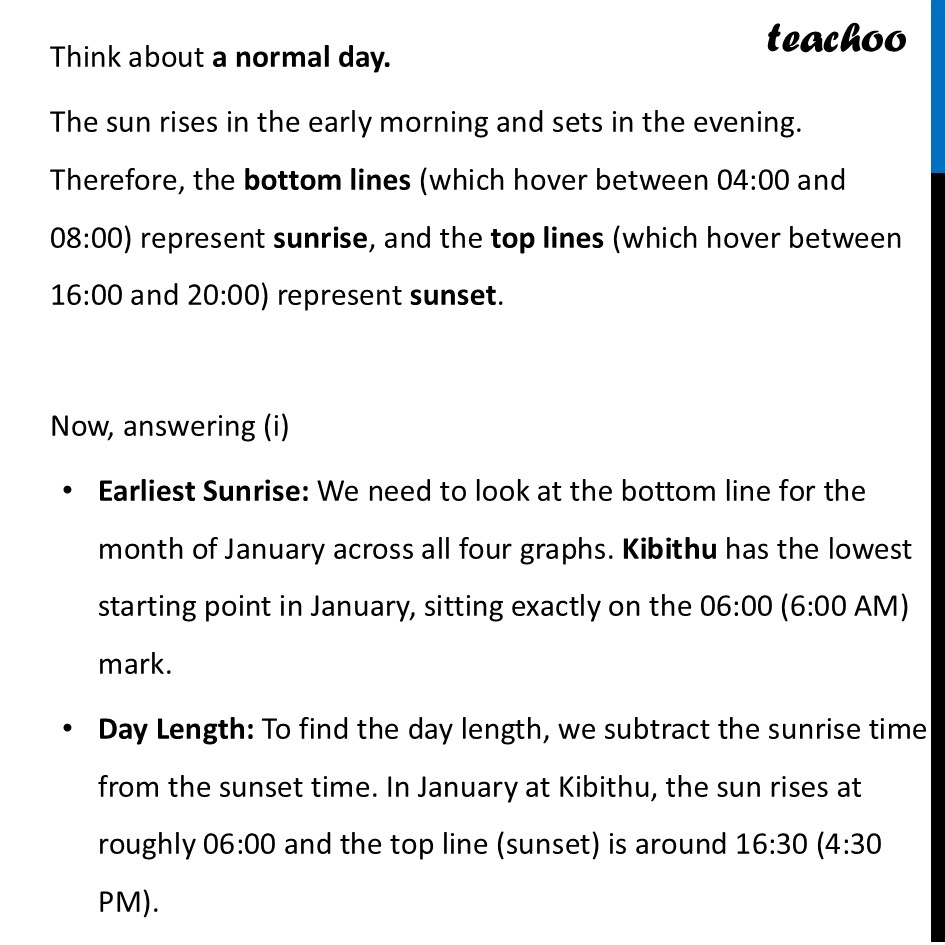

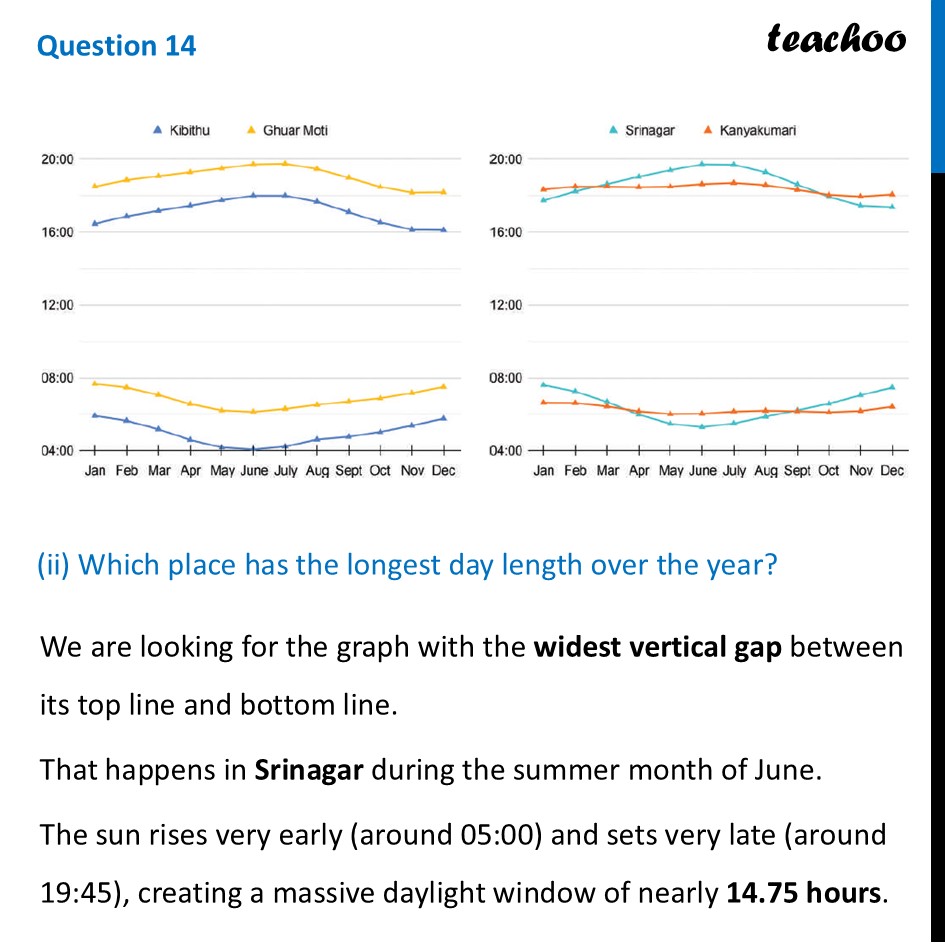
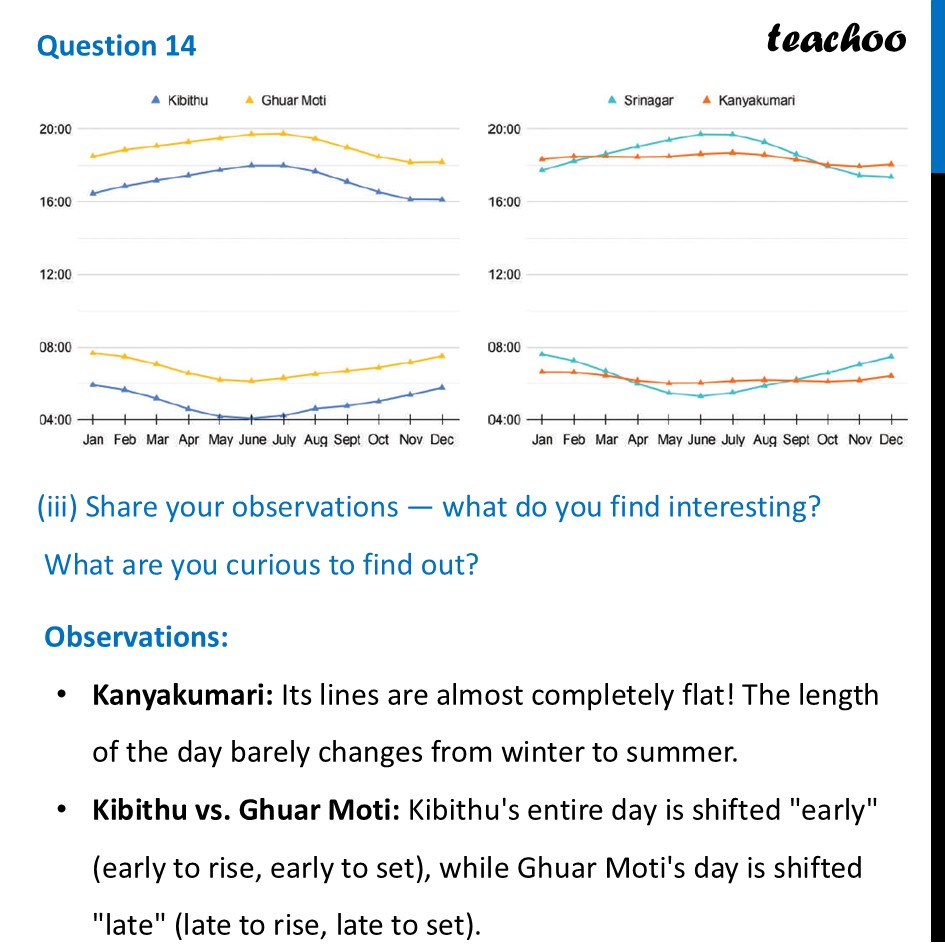

Figure it out - Page 127-132

 You are here
Last updated at March 5, 2026 by Teachoo
Transcript
Question 14 The following graphs show the sunrise and sunset times across the year at 4 locations in India. Observe how the graphs are organised. Are you able to identify which lines indicate the sunrise and which indicate the sunset? Answer the following questions based on the graphs: (i) At which place does the sun rise the earliest in January? What is the approximate day length at this place in January?Think about a normal day. The sun rises in the early morning and sets in the evening. Therefore, the bottom lines (which hover between 04:00 and 08:00) represent sunrise, and the top lines (which hover between 16:00 and 20:00) represent sunset. Now, answering (i) Earliest Sunrise: We need to look at the bottom line for the month of January across all four graphs. Kibithu has the lowest starting point in January, sitting exactly on the 06:00 (6:00 AM) mark. Day Length: To find the day length, we subtract the sunrise time from the sunset time. In January at Kibithu, the sun rises at roughly 06:00 and the top line (sunset) is around 16:30 (4:30 PM). Calculation: From 06:00 to 16:30 is a gap of 10.5 hours (or 10 hours and 30 minutes).Question 14 (ii) Which place has the longest day length over the year?We are looking for the graph with the widest vertical gap between its top line and bottom line. That happens in Srinagar during the summer month of June. The sun rises very early (around 05:00) and sets very late (around 19:45), creating a massive daylight window of nearly 14.75 hours. Question 14 (iii) Share your observations — what do you find interesting? What are you curious to find out? Observations: Kanyakumari: Its lines are almost completely flat! The length of the day barely changes from winter to summer. Kibithu vs. Ghuar Moti: Kibithu's entire day is shifted "early" (early to rise, early to set), while Ghuar Moti's day is shifted "late" (late to rise, late to set). Curiosities (The "Why"): As your teacher, I would hope this makes you wonder why Kanyakumari is so stable while Srinagar varies so much! It is entirely based on geography. Kanyakumari is very close to the equator, where day length stays a consistent 12 hours. Srinagar is much further north, meaning it experiences extreme summer daylight and shorter winter daylight due to the tilt of the Earth.
