
 You are here
![[Class 8] For each statement below, determine whether its always true - Figure it out - Page 122, 123](https://cdn.teachoo.com/edbd85a6-a3d9-486e-9a8b-21f3f7d6d18c/slide81.jpg)

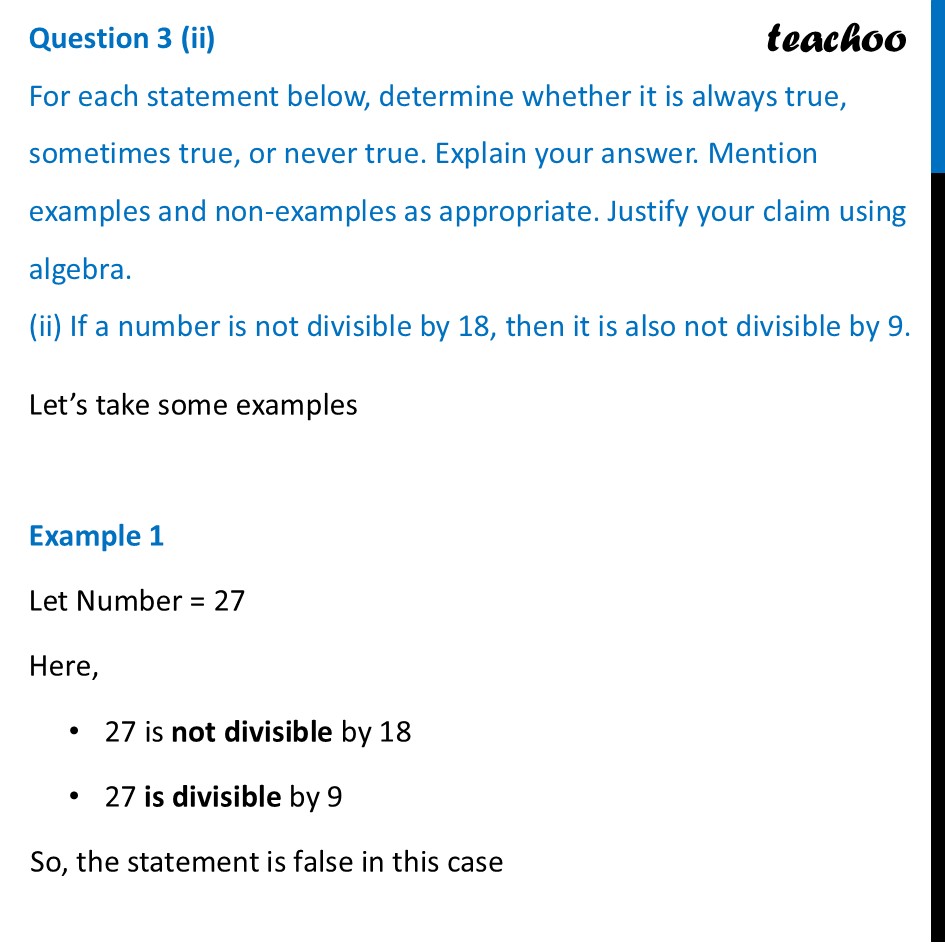
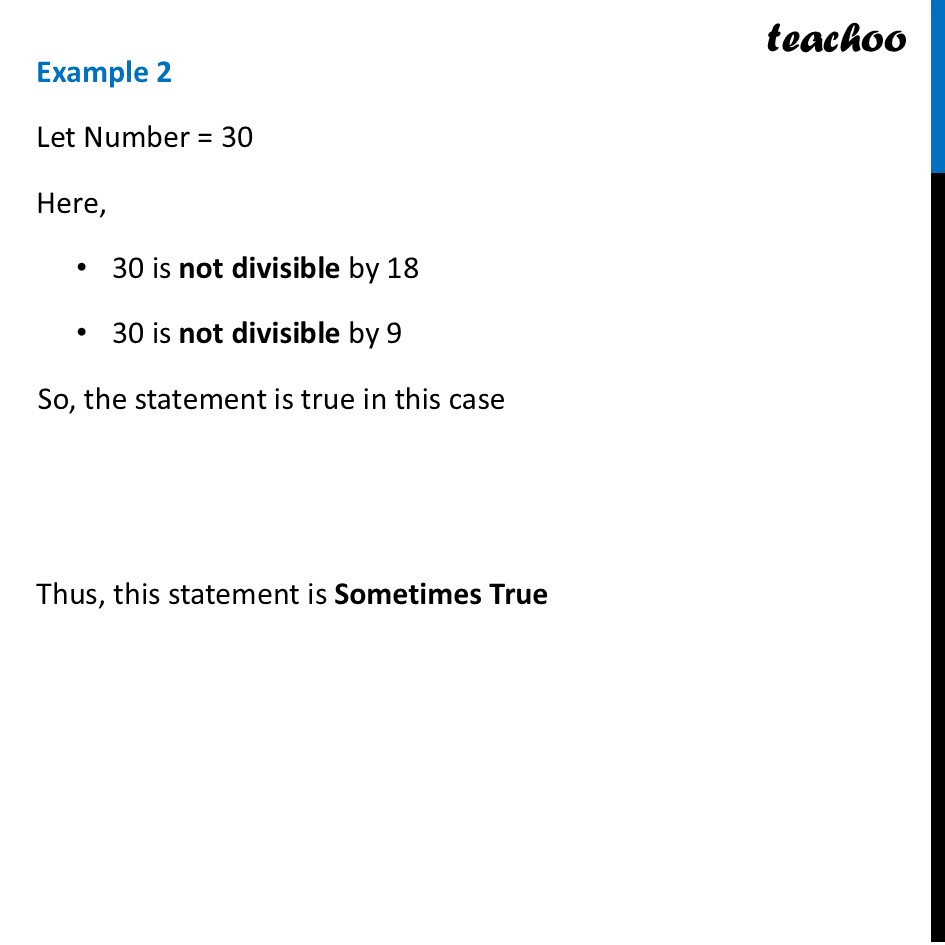
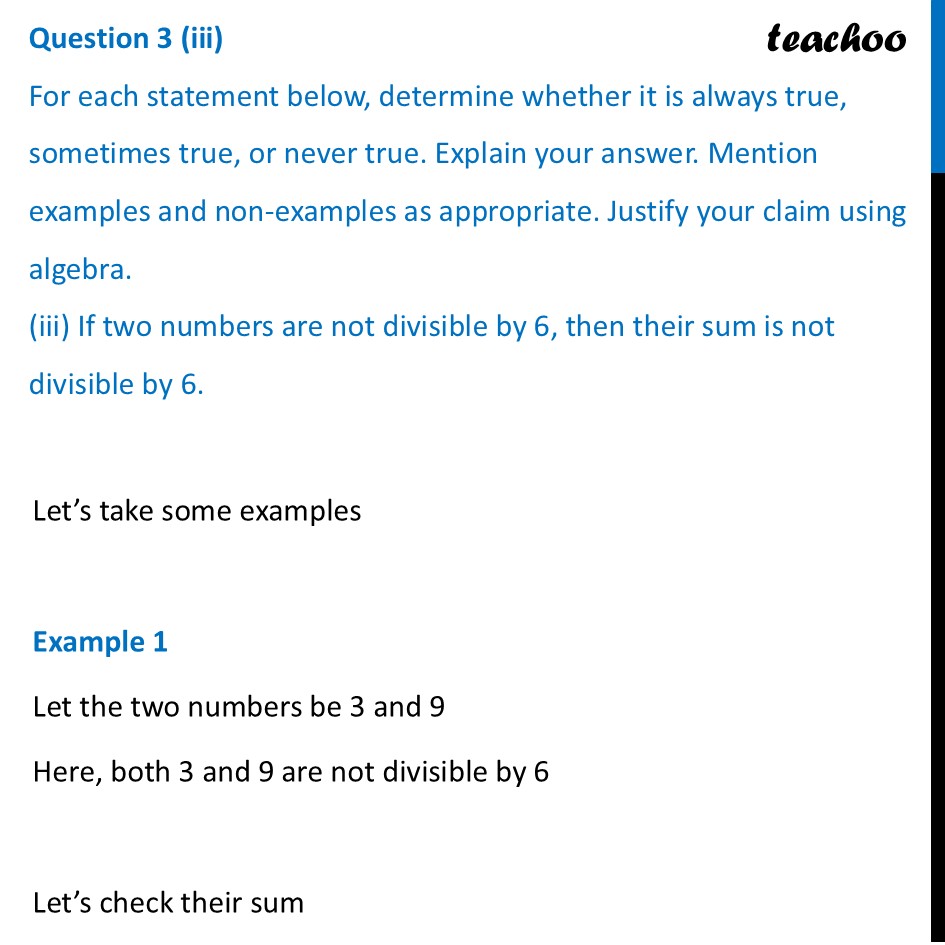
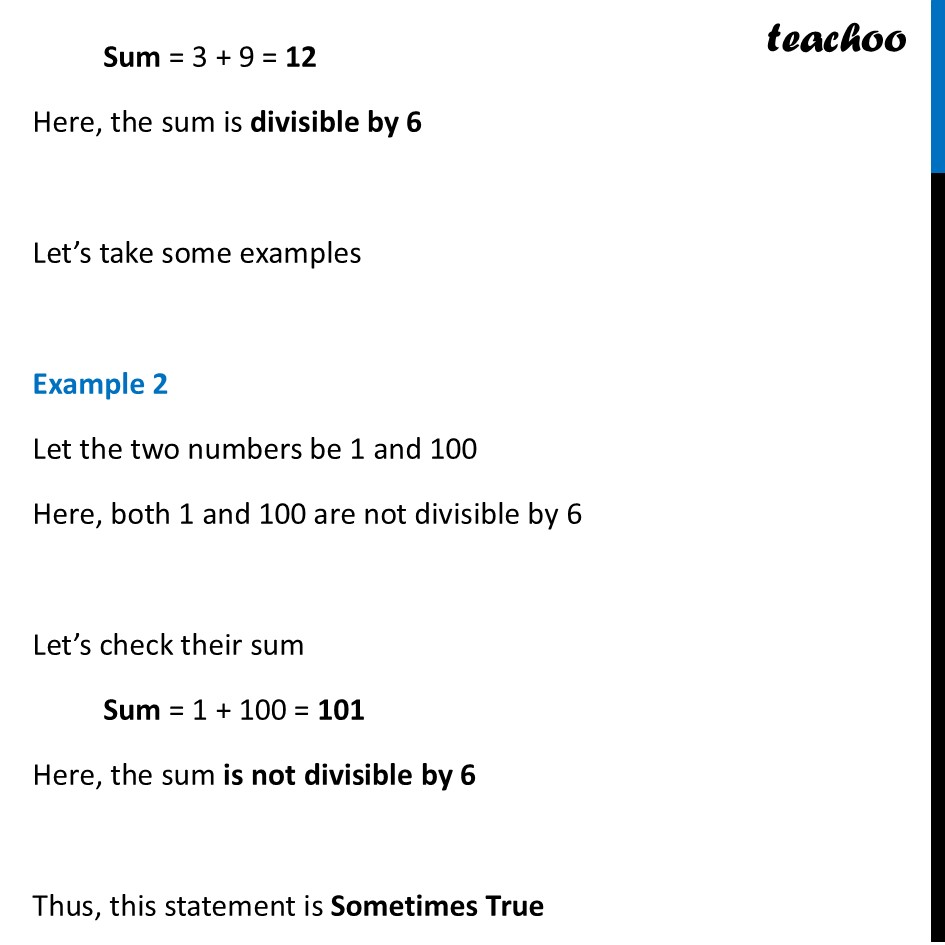
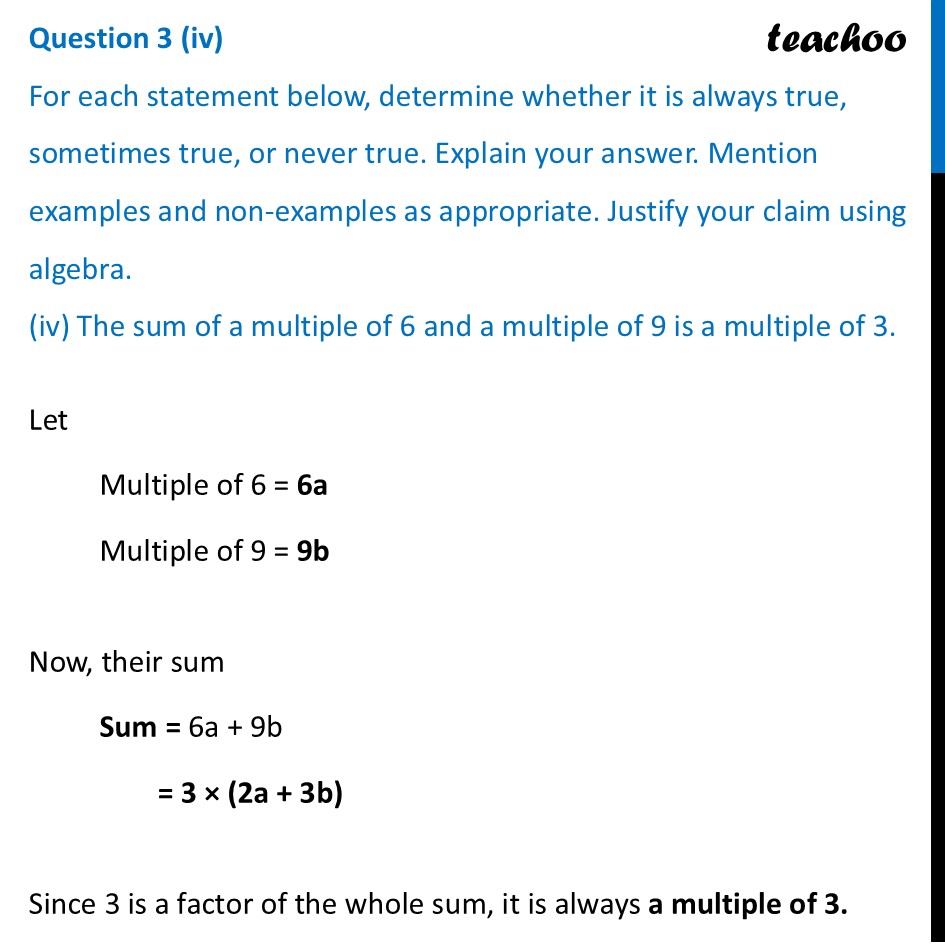

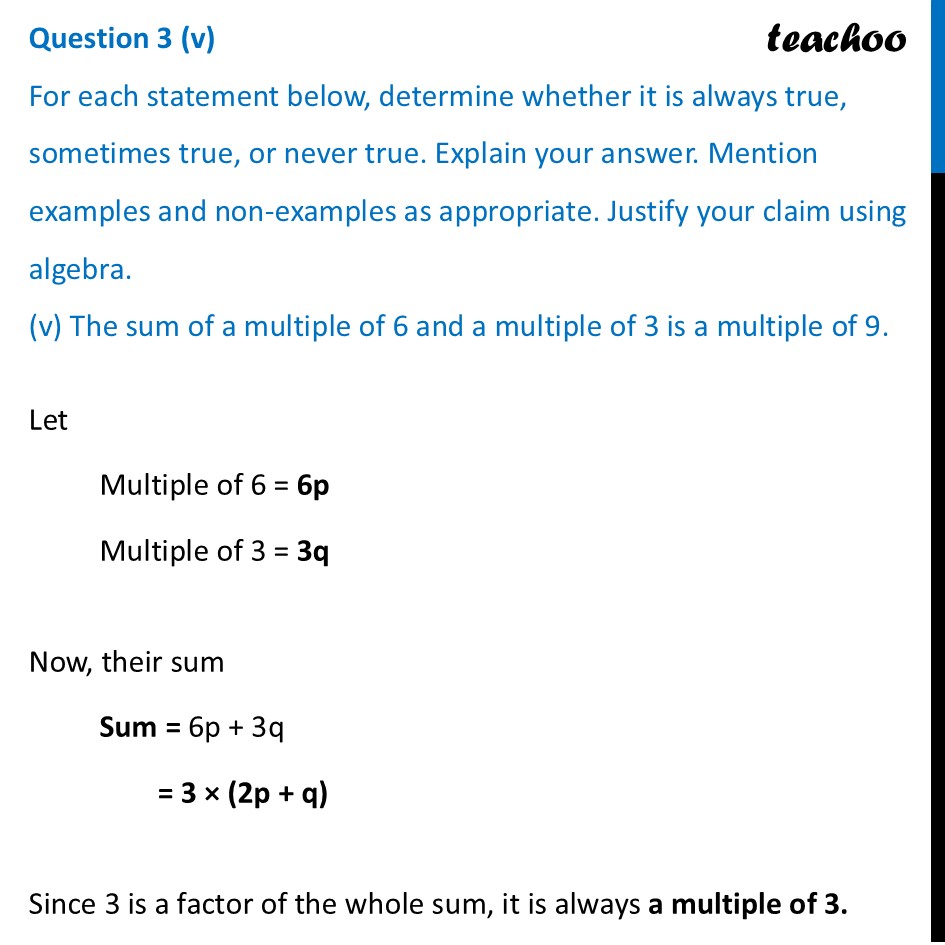
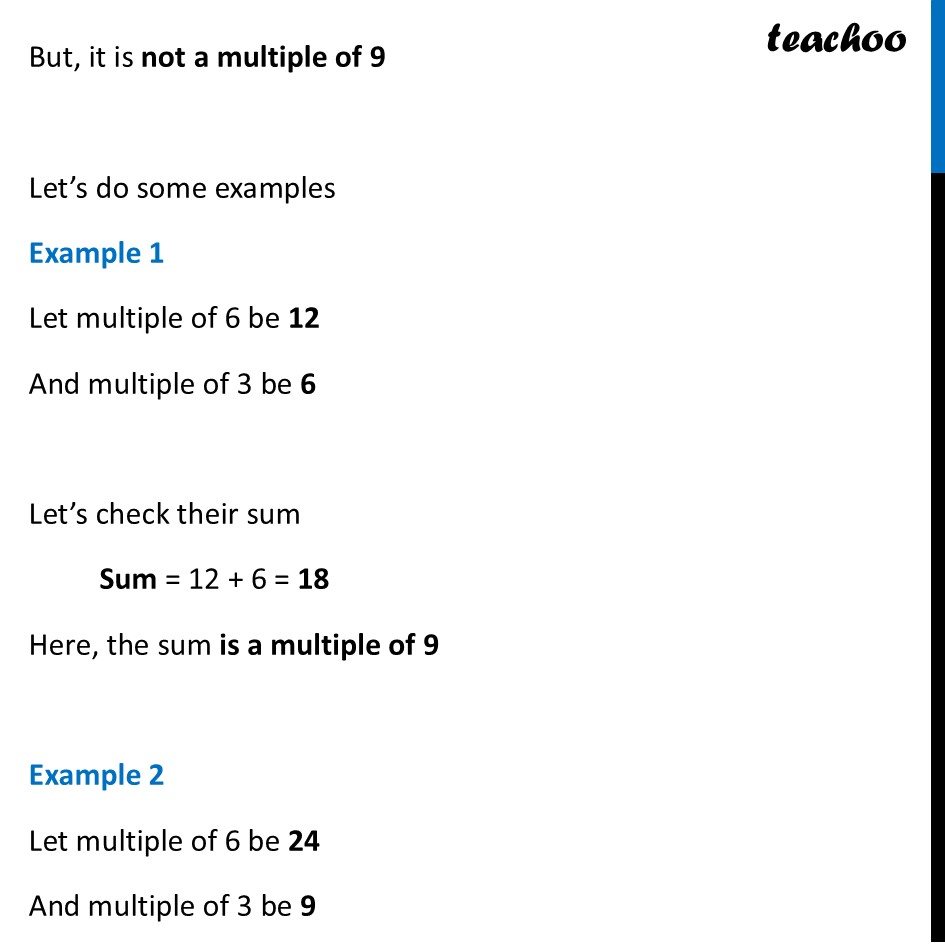
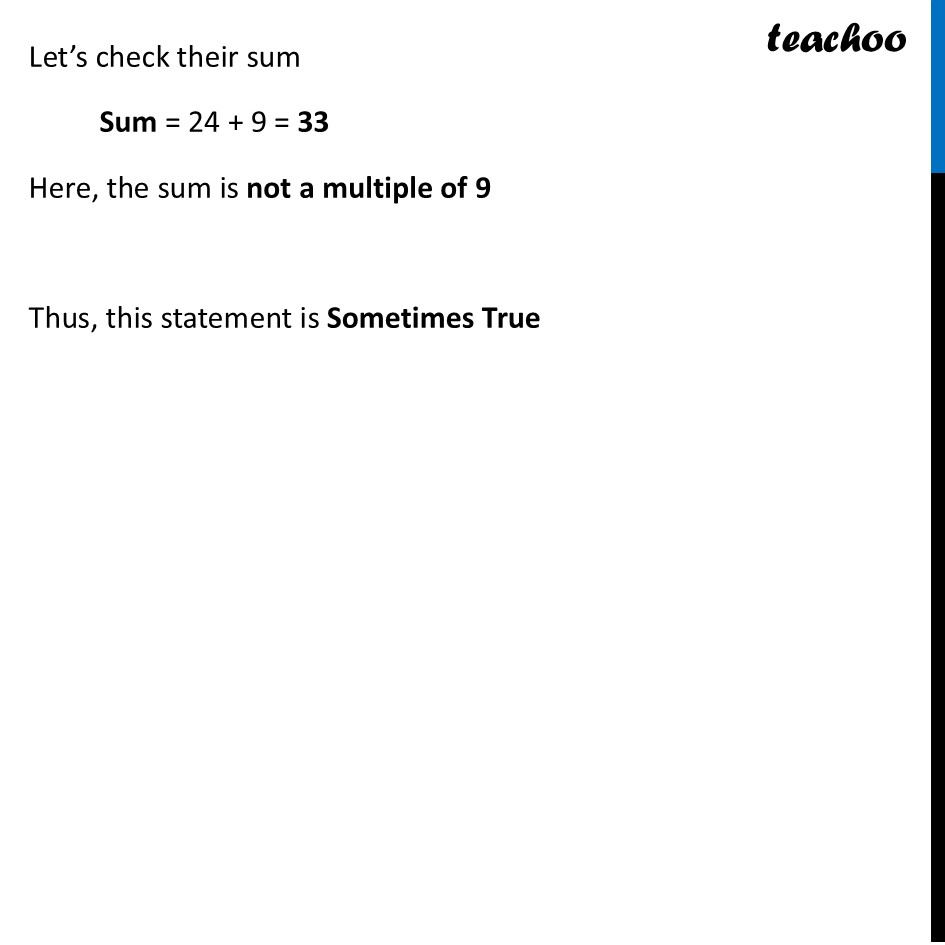
Figure it out - Page 122, 123
Last updated at January 7, 2026 by Teachoo
Transcript
Question 3 (i) For each statement below, determine whether it is always true, sometimes true, or never true. Explain your answer. Mention examples and non-examples as appropriate. Justify your claim using algebra. (i) The sum of two even numbers is a multiple of 3.Since we have two even numbers Let the numbers be 2m and 2n Now, sum of these numbers Sum = 2(m + n). This is always divisible by 2, but only divisible by 3 if (m+n) is a multiple of 3. Let’s take some examples Example 1 Let numbers be 2 and 4 Sum = 2 + 4 = 6 It is a multiple of 3 Example 2 Let numbers be 4 and 6 Sum = 4 + 6 = 10 It is not a multiple of 3 Thus, this statement is Sometimes True Question 3 (ii) For each statement below, determine whether it is always true, sometimes true, or never true. Explain your answer. Mention examples and non-examples as appropriate. Justify your claim using algebra. (ii) If a number is not divisible by 18, then it is also not divisible by 9.Let’s take some examples Example 1 Let Number = 27 Here, 27 is not divisible by 18 27 is divisible by 9 So, the statement is false in this case Example 2 Let Number = 30 Here, 30 is not divisible by 18 30 is not divisible by 9 So, the statement is true in this case Thus, this statement is Sometimes True Question 3 (iii) For each statement below, determine whether it is always true, sometimes true, or never true. Explain your answer. Mention examples and non-examples as appropriate. Justify your claim using algebra. (iii) If two numbers are not divisible by 6, then their sum is not divisible by 6.Let’s take some examples Example 1 Let the two numbers be 3 and 9 Here, both 3 and 9 are not divisible by 6 Let’s check their sum Sum = 3 + 9 = 12 Here, the sum is divisible by 6 Let’s take some examples Example 2 Let the two numbers be 1 and 100 Here, both 1 and 100 are not divisible by 6 Let’s check their sum Sum = 1 + 100 = 101 Here, the sum is not divisible by 6 Question 3 (iv) For each statement below, determine whether it is always true, sometimes true, or never true. Explain your answer. Mention examples and non-examples as appropriate. Justify your claim using algebra. (iv) The sum of a multiple of 6 and a multiple of 9 is a multiple of 3.Let Multiple of 6 = 6a Multiple of 9 = 9b Now, their sum Sum = 6a + 9b = 3 × (2a + 3b) Since 3 is a factor of the whole sum, it is always a multiple of 3. Thus, this statement is Always True Question 3 (v) For each statement below, determine whether it is always true, sometimes true, or never true. Explain your answer. Mention examples and non-examples as appropriate. Justify your claim using algebra. (v) The sum of a multiple of 6 and a multiple of 3 is a multiple of 9.Let Multiple of 6 = 6p Multiple of 3 = 3q Now, their sum Sum = 6p + 3q = 3 × (2p + q) Since 3 is a factor of the whole sum, it is always a multiple of 3. But, it is not a multiple of 9 Let’s do some examples Example 1 Let multiple of 6 be 12 And multiple of 3 be 6 Let’s check their sum Sum = 12 + 6 = 18 Here, the sum is a multiple of 9 Example 1 Let multiple of 6 be 24 And multiple of 3 be 9 Let’s check their sum Sum = 24 + 9 = 33 Here, the sum is not a multiple of 9 Thus, this statement is Sometimes True But, it is not a multiple of 9 Let’s do some examples Example 1 Let multiple of 6 be 12 And multiple of 3 be 6 Let’s check their sum Sum = 12 + 6 = 18 Here, the sum is a multiple of 9 Example 2 Let multiple of 6 be 24 And multiple of 3 be 9 Let’s check their sum Sum = 24 + 9 = 33 Here, the sum is not a multiple of 9 Thus, this statement is Sometimes True
