 You are here


Always, Sometimes, or Never
Last updated at January 7, 2026 by Teachoo
Transcript
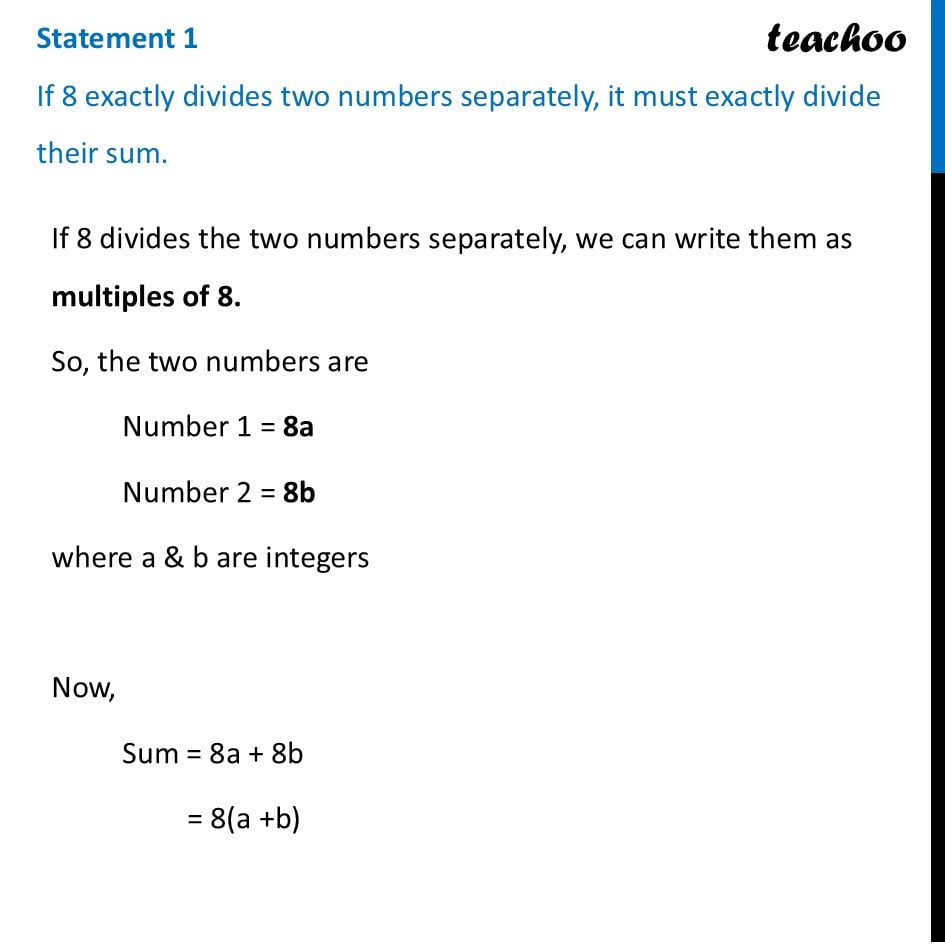
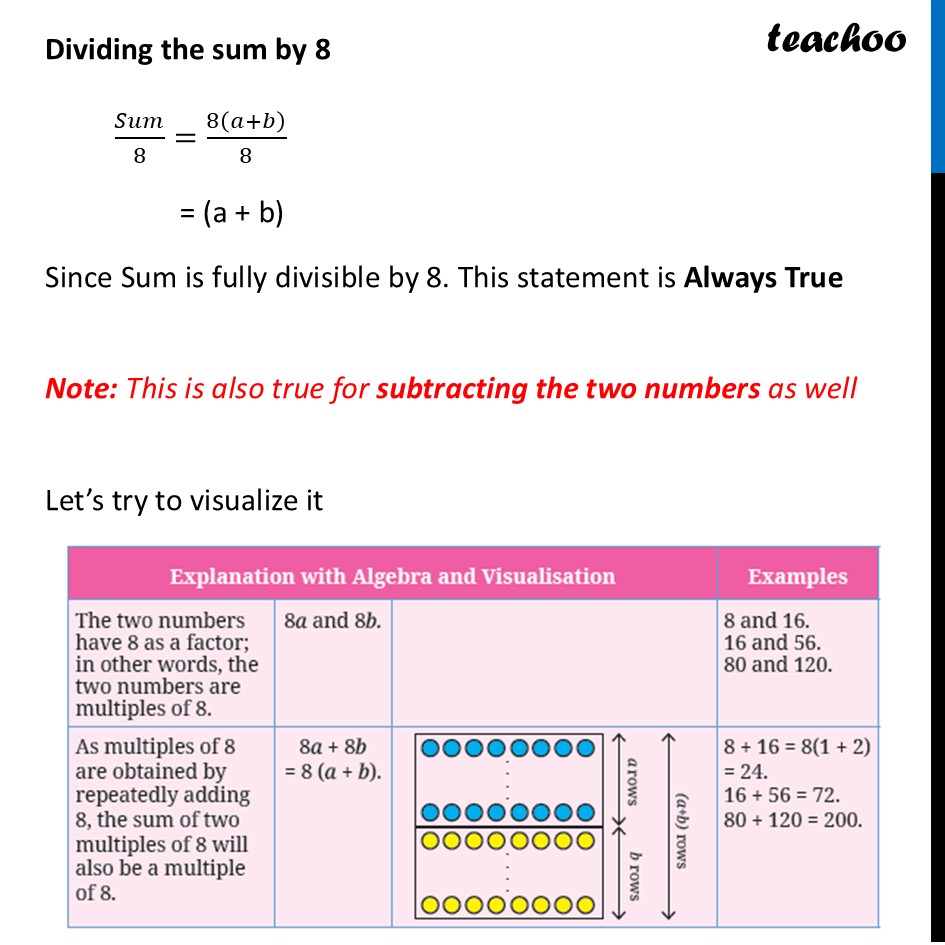
Statement 1 If 8 exactly divides two numbers separately, it must exactly divide their sum.If 8 divides the two numbers separately, we can write them as multiples of 8. So, the two numbers are Number 1 = 8a Number 2 = 8b where a & b are integers Now, Sum = 8a + 8b = 8(a +b) Dividing the sum by 8 𝑆𝑢𝑚/8=8(𝑎+𝑏)/8 = (a + b) Since Sum is fully divisible by 8. This statement is Always True Note: This is also true for subtracting the two numbers as well Let’s try to visualize it Explanation with Algebra and Visualisation Examples The two numbers have 8 as a factor; in other words, the two numbers are multiples of 8 . and . 8 and 16. 16 and 56. 80 and 120. As multiples of 8 are obtained by repeatedly adding 8, the sum of two multiples of 8 will also be a multiple of 8 . Another way to visualize it would be Q1. If 8 divides two numbers separately, it must divide their sum. ALWAYS TRUE Number A (Multiple of 8) 16 Number B (Multiple of 8) Total Height: 40. Since , it fits perfectly! Explanation: Imagine building a tower with LEGO bricks that are 8 -studs high. If you stack a block of 8 on top of another block of 8 , the total height is still a multiple of 8 .
