
 You are here
Sum of Consecutive Numbers
Last updated at January 7, 2026 by Teachoo
Transcript
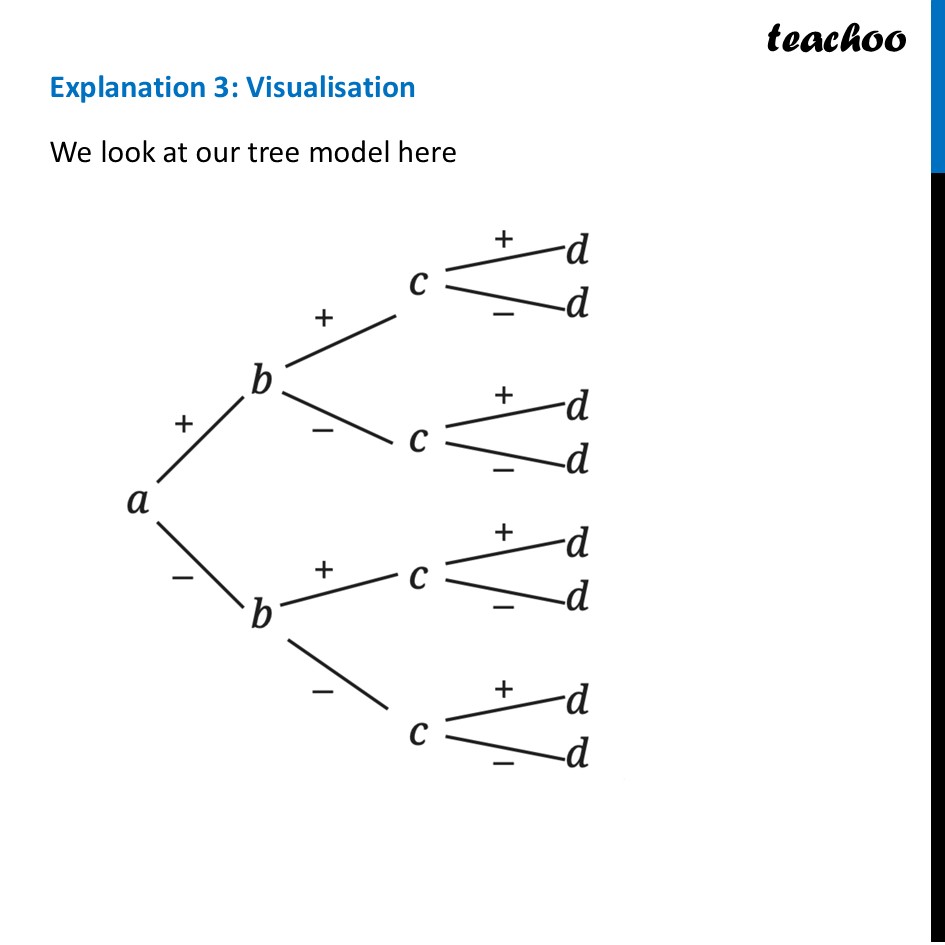
Explanation of Pattern for Adding & Subtracting 4 consecutive numbersWe can explain this in 3 ways Explanation 1: The "Switching" Trick Imagine you have a math problem: 5+2=7 Now, change the plus to a minus: 5−2=3 The answer changed from 7 to 3 . The difference is 4 . Notice that 4 is equal to 2×2. The Rule: Whenever you change a + sign to a - sign in a sum, you are subtracting that number twice (once because you took it away, and once because you added the negative version). " Change "=2 ×" (the number)" Since 2 times anything is always an even number, flipping a sign changes the total by an even amount. Thus, we can say If you start with an Even number and subtract an Even number, you stay Even. If you start with an Odd number and subtract an Even number, you stay Odd. So, all 8 combinations will have the same parity (they will all be odd, or all be even). Explanation 2: Odd and Even Rules Let's look at our 4 consecutive numbers: 3, 4, 5, 6 . We have two Odds (3,5). We have two Evens (4,6). In math: Odd ± Odd = Even ( Example: 3+5=8) Even ± Even = Even ( Example: 4+6=10) So, if we combine the two odds, we get an Even. If we combine the two evens, we get an Even. Finally, Even + Even = Even. This proves that for 4 consecutive numbers, the result is always Even! Explanation 3: Visualisation We look at our tree model here The Token Model (The "Cookie Trick") The book mentions "Tokens." Let's imagine them as Cookies. Positive (+) means you HAVE cookies. Negative ( - ) means you OWE cookies (you have to give them away). The Big Question: Why does the result stay Even or Odd, no matter what? Let's look at just one number, say 3. Scenario A (+3): You HAVE 3 cookies. Scenario B (-3): You switch the sign. Now you OWE 3 cookies. What is the difference? To go from "Having 3" to "Owing 3," two things happen: You lose the 3 cookies you had. You go down another 3 because you owe them. Total change =6 cookies. The Magic Rule: The number 𝟔 is an EVEN number. In math, if you add or subtract an Even number, you never change the "Parity" (whether a number is odd or even). If you start at an Odd number and move 6 steps, you land on Odd. If you start at an Even number and move 6 steps, you land on Even. Conclusion: Every time you flip a plus to a minus in this game, you are just moving the total by an Even amount (like 2,4,6,8... ). Because you are moving by even steps, you will never switch from Odd to Even (or Even to Odd). You stay on the same team!
