What about the following groups? In which group will each child get - Questions - Page 168 to 172

part 2 - Question 2 (Page 169) - Questions - Page 168 to 172 - Chapter 7 Class 6 - Fractions (Ganita Prakash) - Class 6 (Ganita Prakash & Old NCERT)
part 3 - Question 2 (Page 169) - Questions - Page 168 to 172 - Chapter 7 Class 6 - Fractions (Ganita Prakash) - Class 6 (Ganita Prakash & Old NCERT)

Remove Ads

Transcript

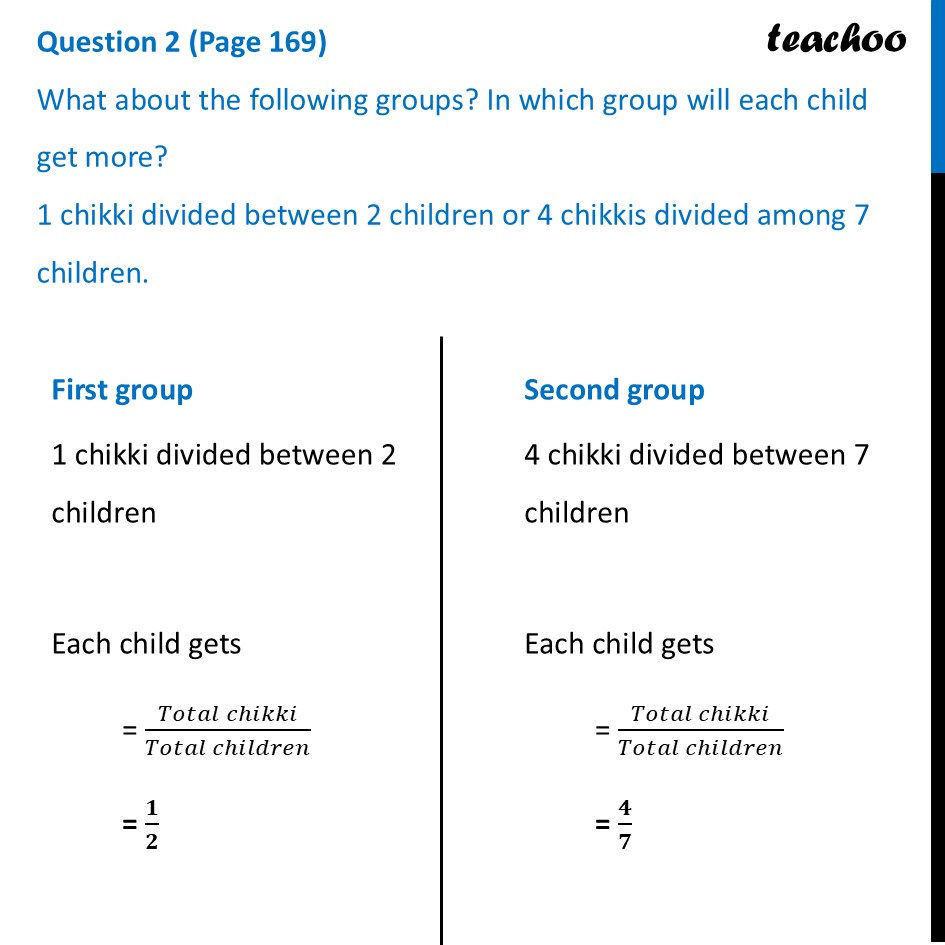
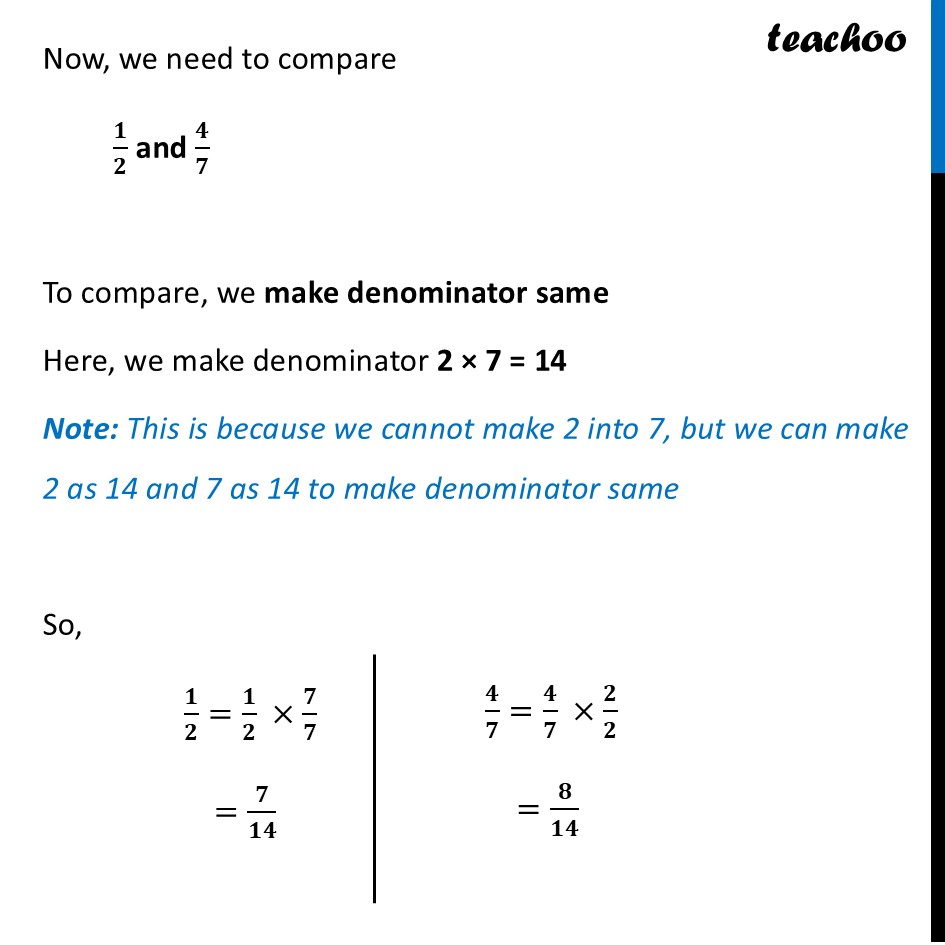
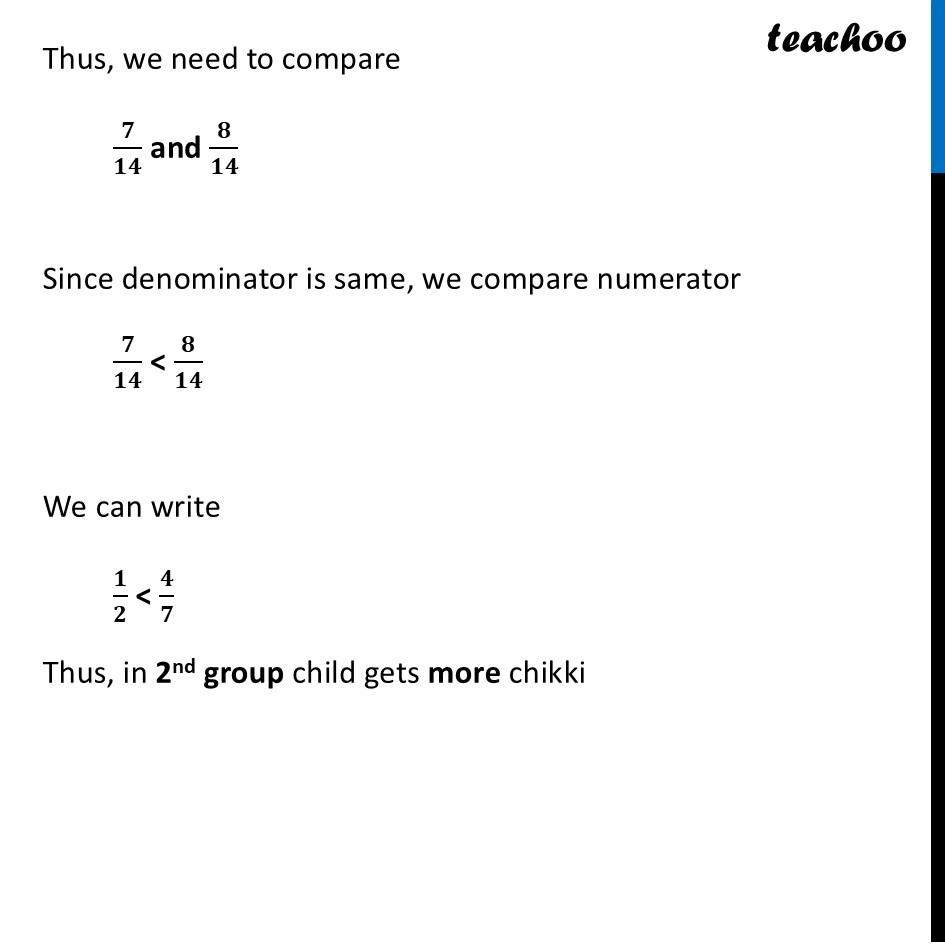
Question 2 (Page 169) What about the following groups? In which group will each child get more? 1 chikki divided between 2 children or 4 chikkis divided among 7 children.First group 1 chikki divided between 2 children Each child gets = (š‘‡š‘œš‘”š‘Žš‘™ š‘ā„Žš‘–š‘˜š‘˜š‘–)/(š‘‡š‘œš‘”š‘Žš‘™ š‘ā„Žš‘–š‘™š‘‘š‘Ÿš‘’š‘›) = šŸ/šŸ Second group 4 chikki divided between 7 children Each child gets = (š‘‡š‘œš‘”š‘Žš‘™ š‘ā„Žš‘–š‘˜š‘˜š‘–)/(š‘‡š‘œš‘”š‘Žš‘™ š‘ā„Žš‘–š‘™š‘‘š‘Ÿš‘’š‘›) = šŸ’/šŸ• Now, we need to compare šŸ/šŸ and šŸ’/šŸ• To compare, we make denominator same Here, we make denominator 2 Ɨ 7 = 14 Note: This is because we cannot make 2 into 7, but we can make 2 as 14 and 7 as 14 to make denominator same So, šŸ/šŸ=šŸ/šŸ Ć—šŸ•/šŸ• =šŸ•/šŸšŸ’ šŸ’/šŸ•=šŸ’/šŸ• Ć—šŸ/šŸ =šŸ–/šŸšŸ’ Thus, we need to compare šŸ•/šŸšŸ’ and šŸ–/šŸšŸ’ Since denominator is same, we compare numerator šŸ•/šŸšŸ’ < šŸ–/šŸšŸ’ We can write šŸ/šŸ < šŸ’/šŸ• Thus, in 2nd group child gets more chikki

Davneet Singh's photo - Co-founder, Teachoo

Made by

Davneet Singh

Davneet Singh is an IIT Kanpur graduate and has been teaching for 16+ years. At Teachoo, he breaks down Maths, Science and Computer Science into simple steps so students understand concepts deeply and score with confidence.

Many students prefer Teachoo Black for a smooth, ad-free learning experience.