You are here


Last updated at August 14, 2026 by Teachoo
Transcript
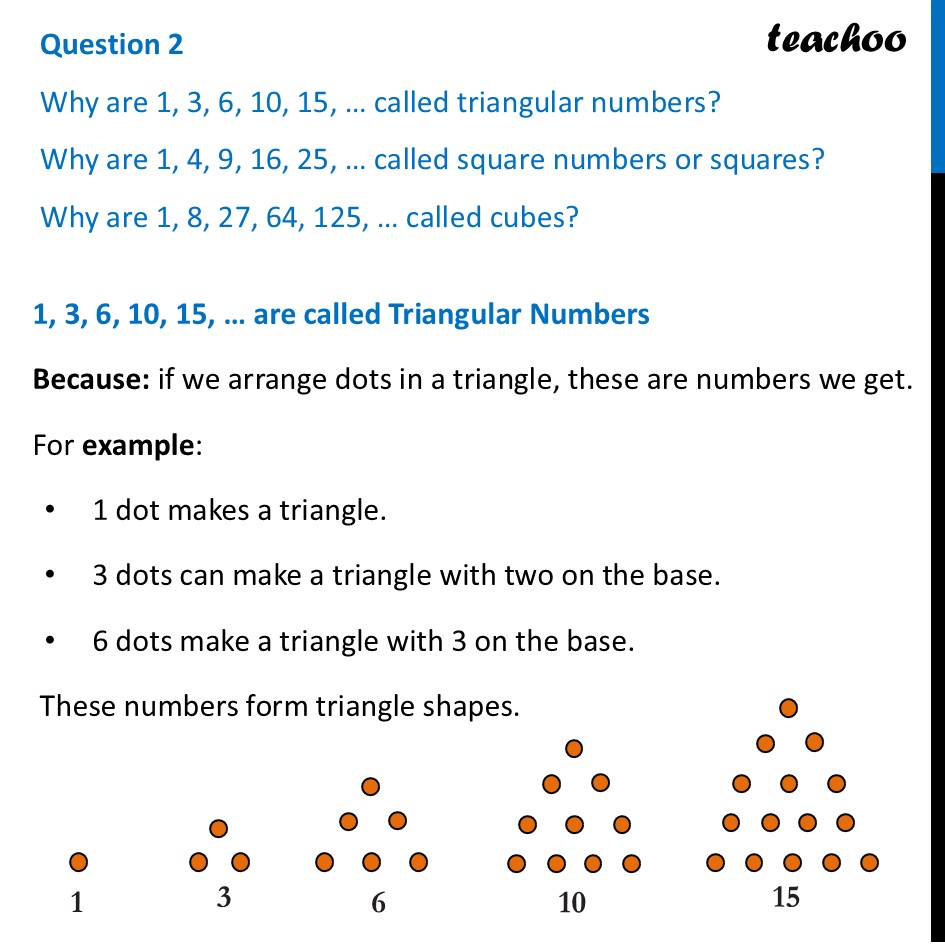
Question 2 Why are 1, 3, 6, 10, 15, … called triangular numbers? Why are 1, 4, 9, 16, 25, … called square numbers or squares? Why are 1, 8, 27, 64, 125, … called cubes?1, 3, 6, 10, 15, … are called Triangular Numbers Because: if we arrange dots in a triangle, these are numbers we get. For example: 1 dot makes a triangle. 3 dots can make a triangle with two on the base. 6 dots make a triangle with 3 on the base. These numbers form triangle shapes. 1, 4, 9, 16, 25, … are called Square Numbers Because: If you arrange dots in a square, these are the totals. For example: 2 × 2 = 4 → 4 dots make a 2 × 2 square. 3 × 3 = 9 → 9 dots make a 3 × 3 square. 5 × 5 = 25 → 25 dots make a 5 × 5 square. These numbers form perfect squares. 1, 8, 27, 64, 125, … are called Cube Numbers Because: These are numbers you get by multiplying a number three times For example: 2 × 2 × 2 = 8 → 8 small cubes making a 2 × 2 × 2 cube. 4 × 4 × 4 = 64 → 64 cubes make a 4 × 4 × 4 cube. These numbers form 3D cube shapes - like dice or boxes!