Given that two of the zeroes of the cubic polynomial ax 3

ย + bx 2 + cx + d are 0, the third zero is

(a) (-b)/aย ย ย ย ย  ย  (b) b/aย  (c) c/a ย  ย (d) -d/a

Two of the zeroes of the cubic polynomial ax^3  + bx^2 + cx + d are 0 - MCQs from NCERT Exemplar

part 2 - Question 2 - MCQs from NCERT Exemplar - Serial order wise - Chapter 2 Class 10 Polynomials

Remove Ads Take short quiz All Quiz and Worksheets
Teachoo ยท Class 10 Explore Class 10

Transcript

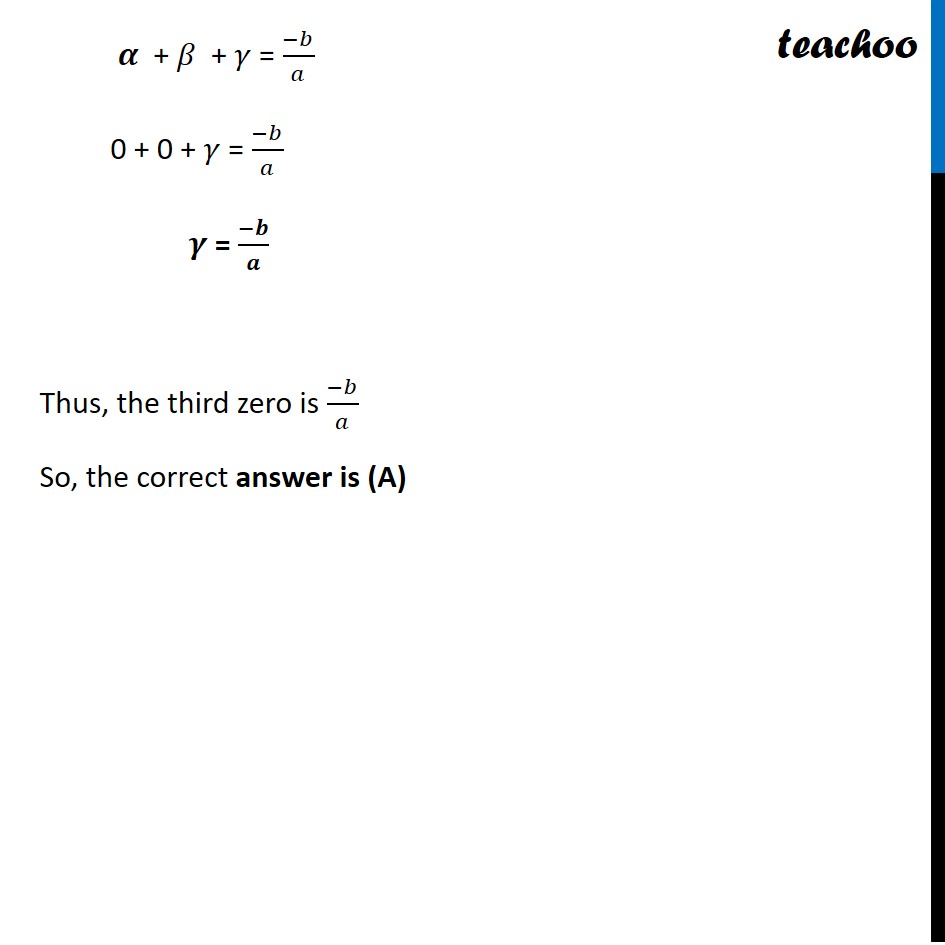
Question 2 Given that two of the zeroes of the cubic polynomial ax3 + bx2 + cx + d are 0, the third zero is (a) (โˆ’๐‘)/๐‘Ž (b) ๐‘/๐‘Ž (c) ๐‘/๐‘Ž (d) โˆ’๐‘‘/๐‘Ž Let p(x) = ax3 + bx2 + cx + d Given that two zeroes are 0 โˆด ๐œถ = 0, ๐œท = 0 and we need to find ๐œธ We know that Sum of zeroes = (โˆ’๐’ƒ)/๐’‚ ๐œถ + ๐œท + ๐œธ = (โˆ’๐‘)/๐‘Ž 0 + 0 + ๐œธ = (โˆ’๐‘)/๐‘Ž ๐œธ = (โˆ’๐‘)/๐‘Ž ๐œถ + ๐›ฝ + ๐›พ = (โˆ’๐‘)/๐‘Ž 0 + 0 + ๐›พ = (โˆ’๐‘)/๐‘Ž ๐œธ = (โˆ’๐’ƒ)/๐’‚ Thus, the third zero is (โˆ’๐‘)/๐‘Ž So, the correct answer is (A)

Davneet Singh's photo - Co-founder, Teachoo

Made by

Davneet Singh

Davneet Singh is an IIT Kanpur graduate and has been teaching for 16+ years. At Teachoo, he breaks down Maths, Science and Computer Science into simple steps so students understand concepts deeply and score with confidence.

Many students prefer Teachoo Black for a smooth, ad-free learning experience.