You are here
Solution of Linear Equation in Two Variables
Solution of Linear Equation in Two Variables
Last updated at November 22, 2026 by Teachoo
Transcript
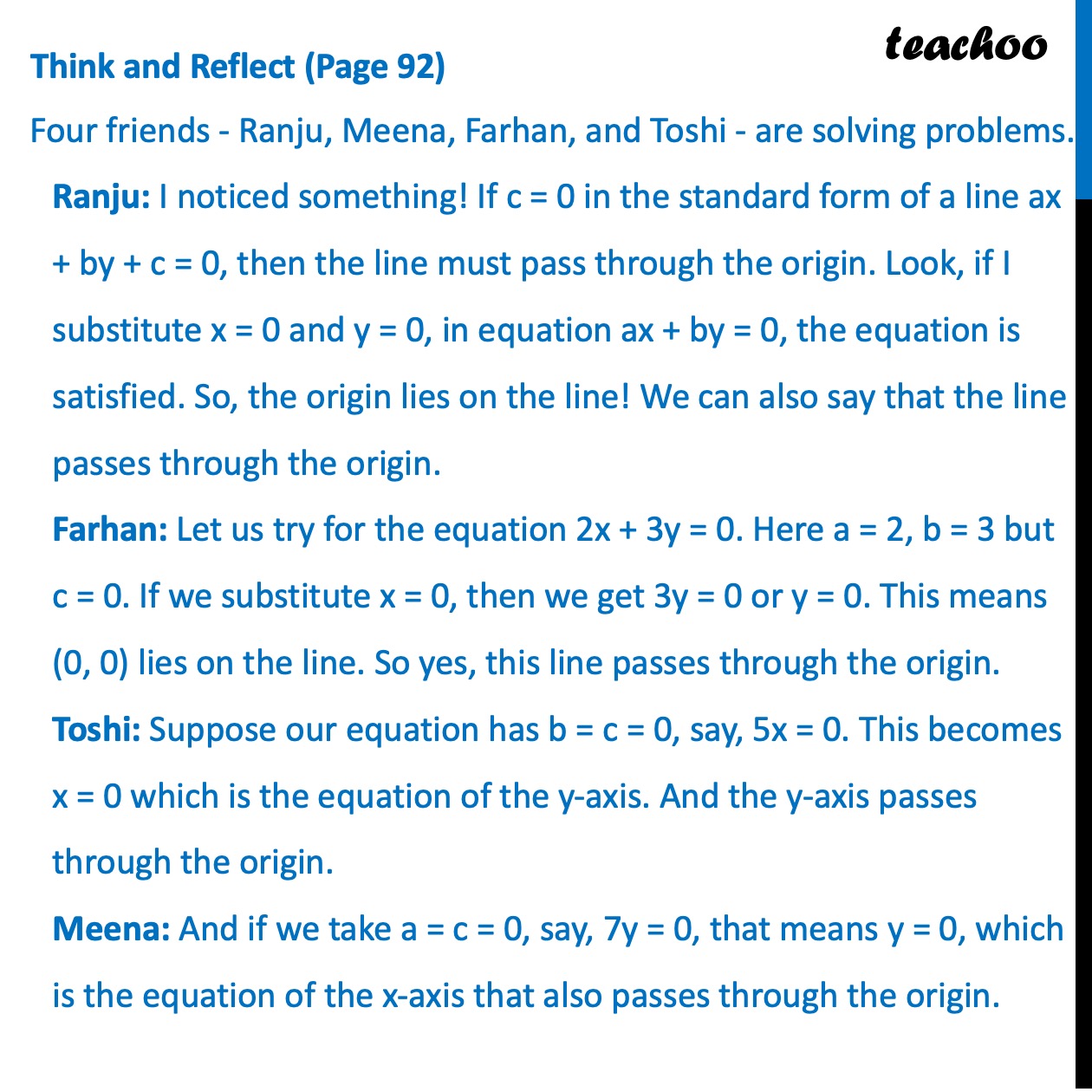
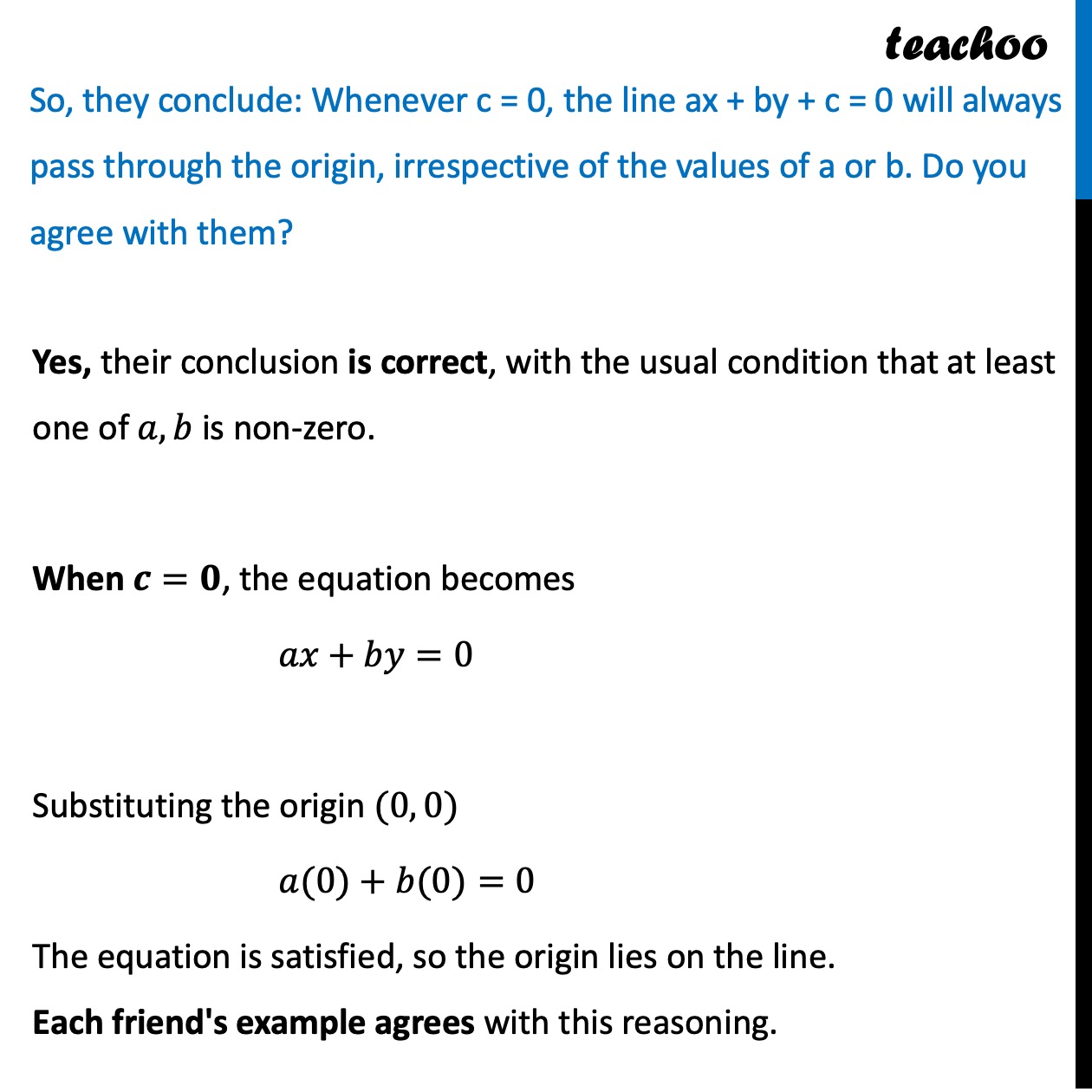
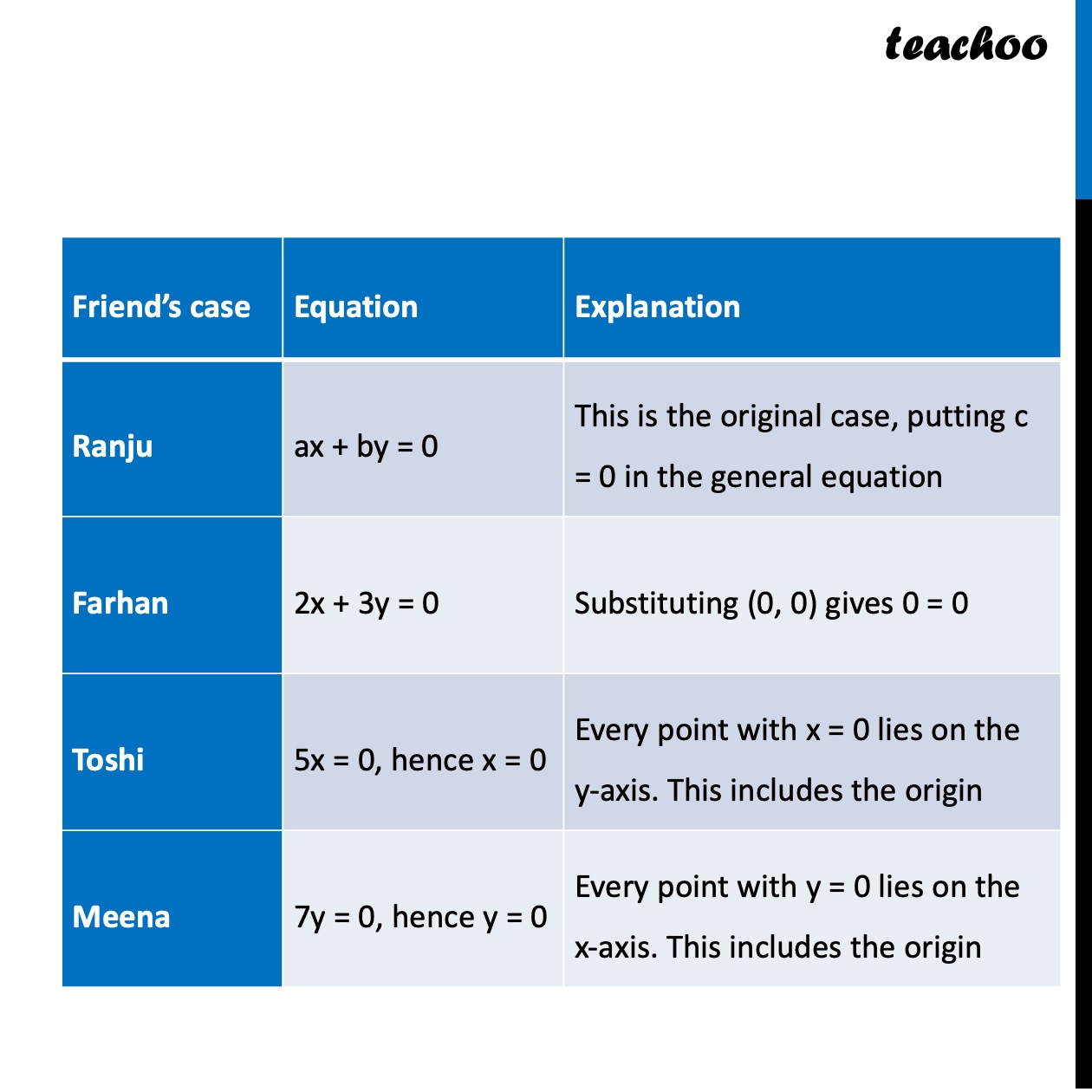
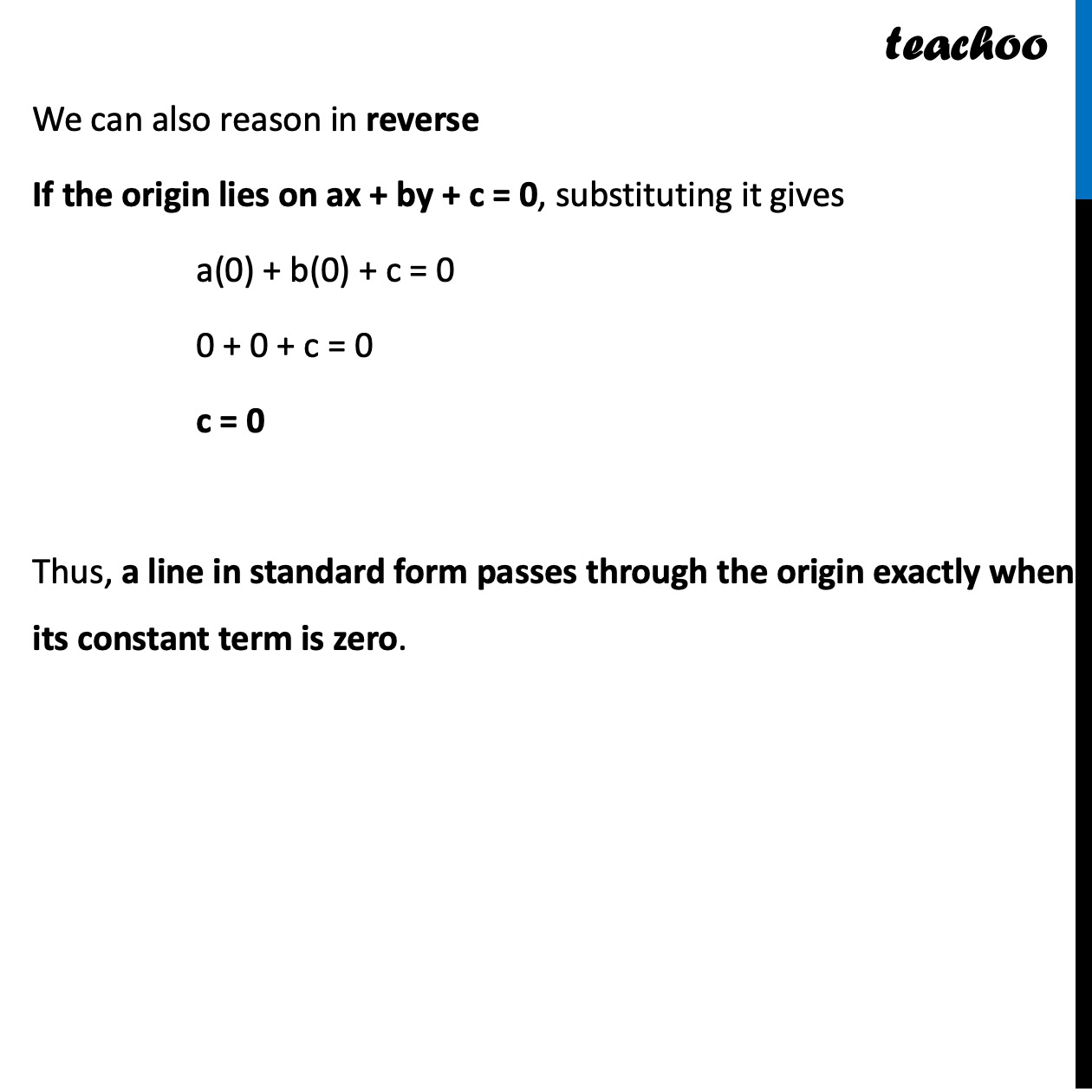
Think and Reflect (Page 92) Four friends - Ranju, Meena, Farhan, and Toshi - are solving problems. Ranju: I noticed something! If c = 0 in the standard form of a line ax + by + c = 0, then the line must pass through the origin. Look, if I substitute x = 0 and y = 0, in equation ax + by = 0, the equation is satisfied. So, the origin lies on the line! We can also say that the line passes through the origin. Farhan: Let us try for the equation 2x + 3y = 0. Here a = 2, b = 3 but c = 0. If we substitute x = 0, then we get 3y = 0 or y = 0. This means (0, 0) lies on the line. So yes, this line passes through the origin. Toshi: Suppose our equation has b = c = 0, say, 5x = 0. This becomes x = 0 which is the equation of the y-axis. And the y-axis passes through the origin. Meena: And if we take a = c = 0, say, 7y = 0, that means y = 0, which is the equation of the x-axis that also passes through the origin. So, they conclude: Whenever c = 0, the line ax + by + c = 0 will always pass through the origin, irrespective of the values of a or b. Do you agree with them? Yes, their conclusion is correct, with the usual condition that at least one of 𝑎,𝑏 is non-zero. When 𝒄=𝟎, the equation becomes 𝑎𝑥+𝑏𝑦=0 Substituting the origin (0, 0) 𝑎(0)+𝑏(0)=0 The equation is satisfied, so the origin lies on the line. Each friend's example agrees with this reasoning. Friend’s case | Equation | Explanation Ranju | ax + by = 0 | This is the original case, putting c = 0 in the general equation Farhan | 2x + 3y = 0 | Substituting (0, 0) gives 0 = 0 Toshi | 5x = 0, hence x = 0 | Every point with x = 0 lies on the y-axis. This includes the origin Meena | 7y = 0, hence y = 0 | Every point with y = 0 lies on the x-axis. This includes the origin We can also reason in reverse If the origin lies on ax + by + c = 0, substituting it gives a(0) + b(0) + c = 0 0 + 0 + c = 0 c = 0 Thus, a line in standard form passes through the origin exactly when its constant term is zero.