
 You are here
Examples
Last updated at October 5, 2026 by Teachoo
Transcript
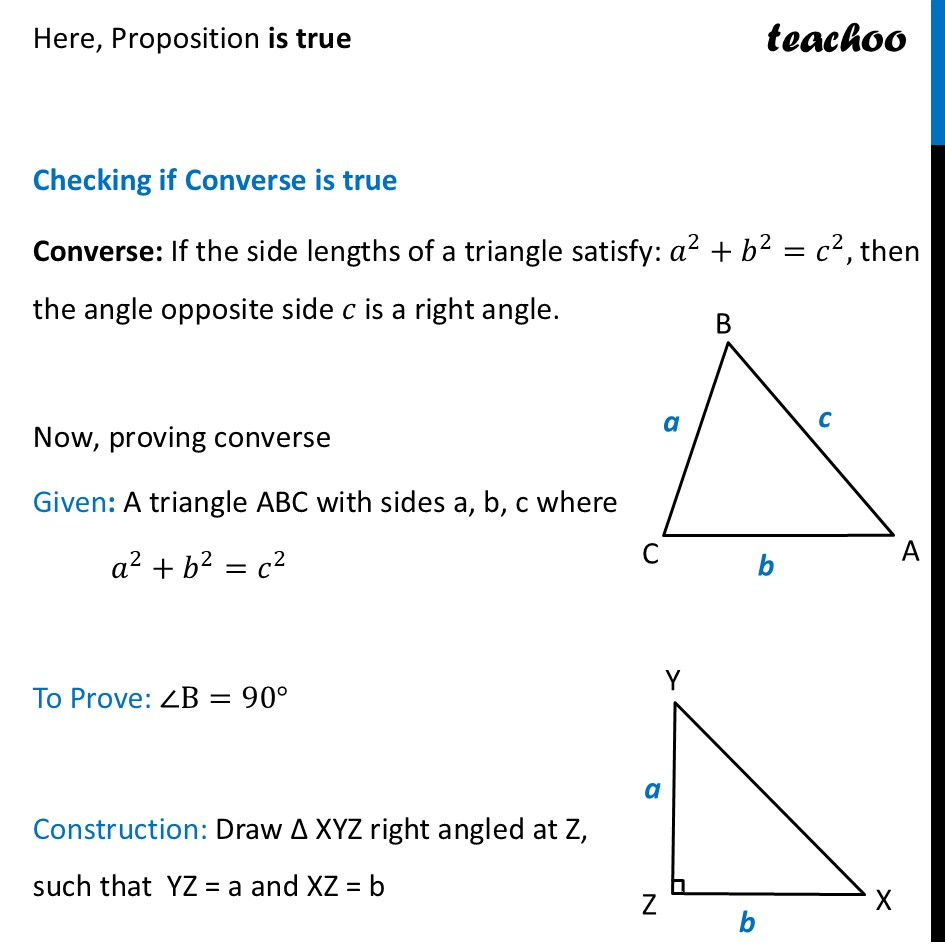
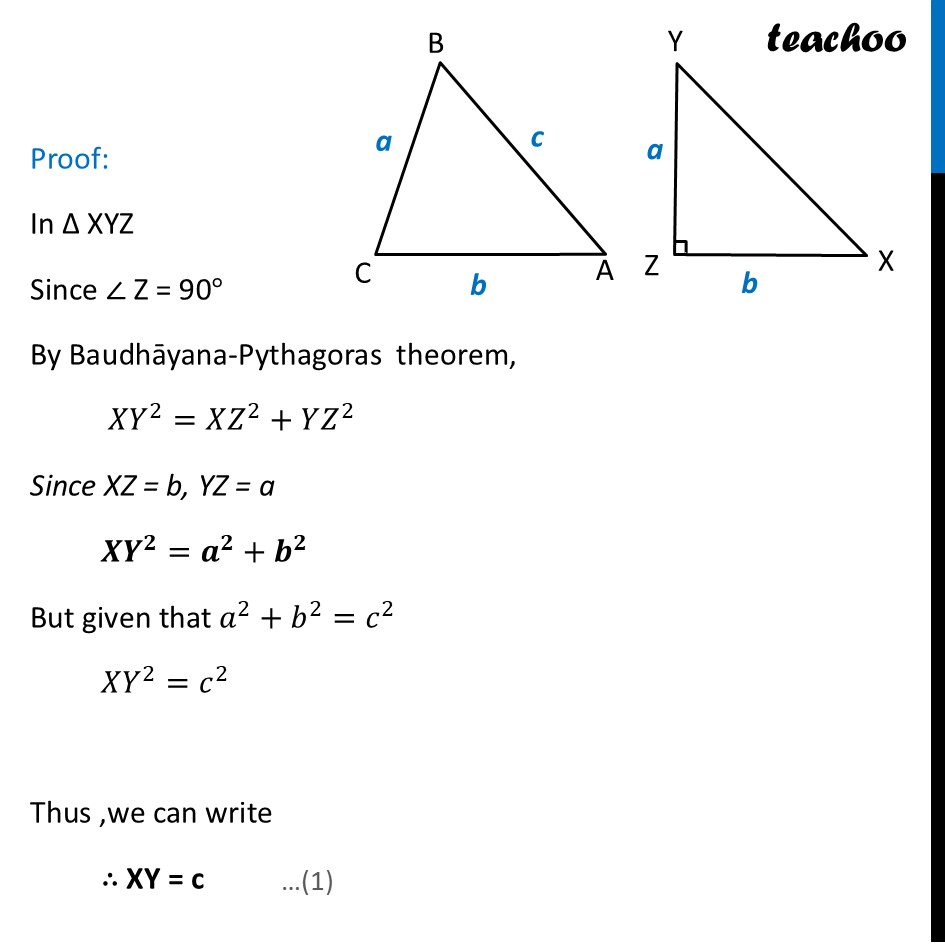
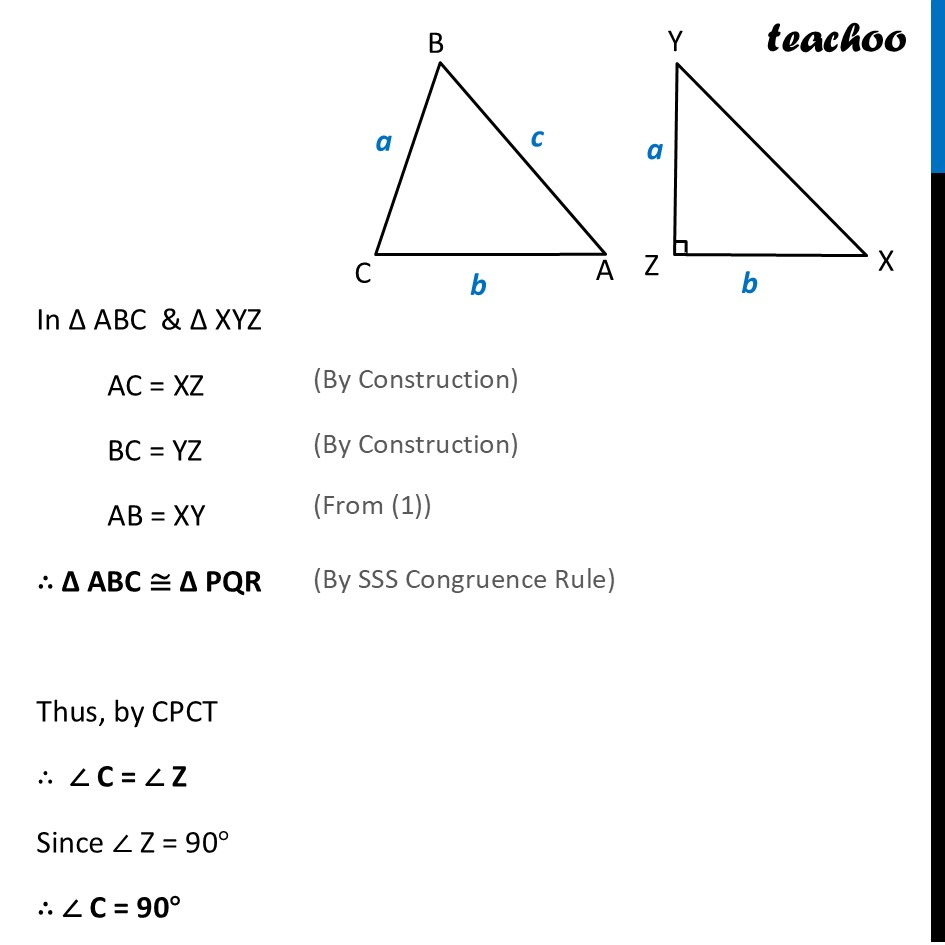
Example 5 Here is a statement of the Baudhāyana-Pythagoras theorem. Let a, b, c be the sidelengths of a triangle. If the triangle is right-angled, then a2 + b2 = c2 . What is its converse? Is the converse true? Let’s write Proposition and Converse first Proposition: If a triangle is right-angled, then: 𝑎^2+𝑏^2=𝑐^2 Where c is side opposite right angle Converse: If the side lengths of a triangle satisfy: 𝑎^2+𝑏^2=𝑐^2, then the angle opposite side 𝑐 is a right angle. Here, Proposition is true Checking if Converse is true Converse: If the side lengths of a triangle satisfy: 𝑎^2+𝑏^2=𝑐^2, then the angle opposite side 𝑐 is a right angle. asdf Here, Proposition is true Checking if Converse is true Converse: If the side lengths of a triangle satisfy: 𝑎^2+𝑏^2=𝑐^2, then the angle opposite side 𝑐 is a right angle. Now, proving converse Given: A triangle ABC with sides a, b, c where 𝑎^2+𝑏^2=𝑐^2 To Prove: ∠B=90° Construction: Draw Δ XYZ right angled at Z, such that YZ = a and XZ = b Proof: In ∆ XYZ Since ∠ Z = 90° By Baudhāyana-Pythagoras theorem, 〖𝑋𝑌〗^2=𝑋𝑍^2+𝑌𝑍^2 Since XZ = b, YZ = a 〖𝑿𝒀〗^𝟐=𝒂^𝟐+𝒃^𝟐 But given that 𝑎^2+𝑏^2=𝑐^2 〖𝑋𝑌〗^2=𝑐^2 Thus ,we can write ∴ XY = c In Δ ABC & Δ XYZ AC = XZ BC = YZ AB = XY ∴ Δ ABC ≅ Δ PQR Thus, by CPCT ∴ ∠ C = ∠ Z Since ∠ Z = 90° ∴ ∠ C = 90° Thus, we proved angle opposite side 𝑐 is a right angle Hence, Converse is true
