
 You are here
-
📋 Revise, Reflect, Refine, Q14 (Page 138)
The potential energy-displacement graph of a 0.5 kg ball moving along a frictionless track is shown. At O, the velocity of the ball is 0 m s⁻¹ and potential energy is 30 J. Calculate the velocity of the ball at P, Q and R. (From the graph — PE at P = 20 J, at Q = 30 J, at R = 40 J.)GIF Watch: why does the pendulum eventually stop in real life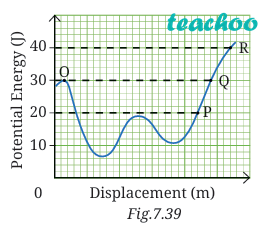
View answer
Answer- At O — velocity = 0, so kinetic energy = 0.
- Total mechanical energy = PE + KE = 30 + 0 = 30 J
- The track is frictionless — mechanical energy stays 30 J everywhere.
Position Potential energy Kinetic energy = 30 − PE Velocity (from ½ × 0.5 × v² = KE) P 20 J 10 J √40 ≈ 6.3 m s⁻¹ Q 30 J 0 J 0 m s⁻¹ R 40 J −10 J — impossible! Ball can never reach R - Kinetic energy can never be negative — so the ball does not have enough mechanical energy to reach R.
Q14 - The potential energy-displacement graph of
Last updated at September 16, 2026 by Teachoo
