
 You are here


Last updated at March 5, 2026 by Teachoo
Transcript
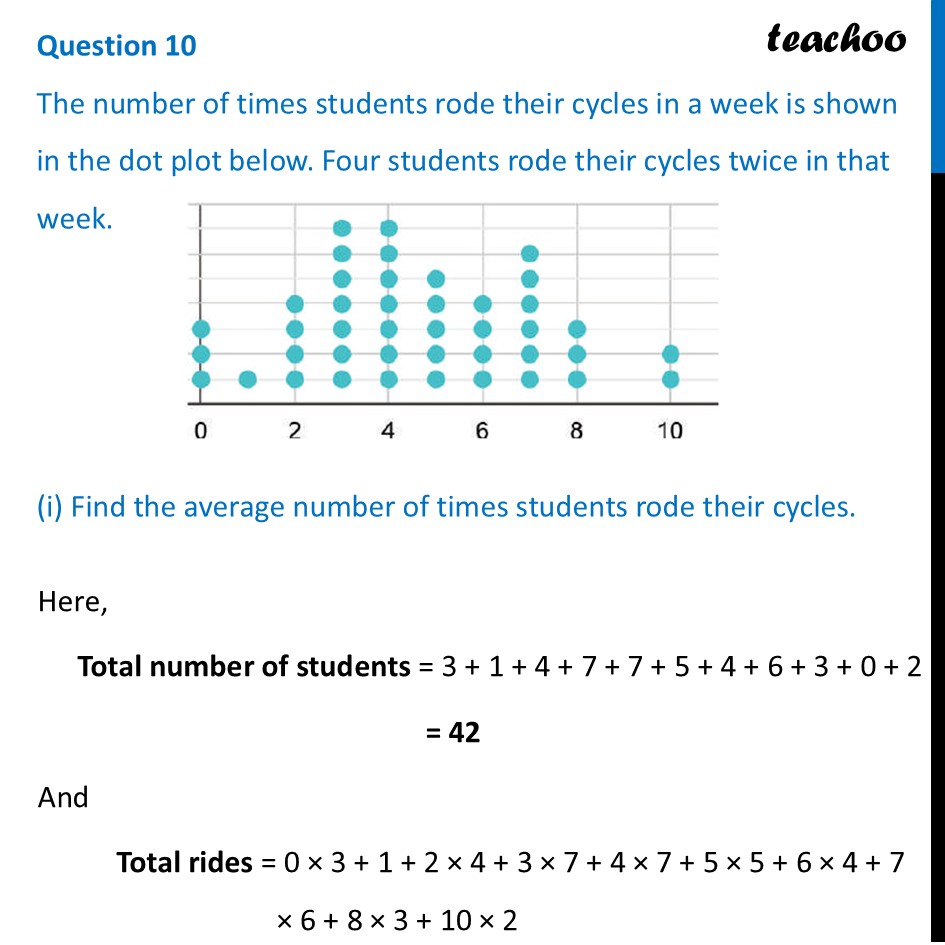
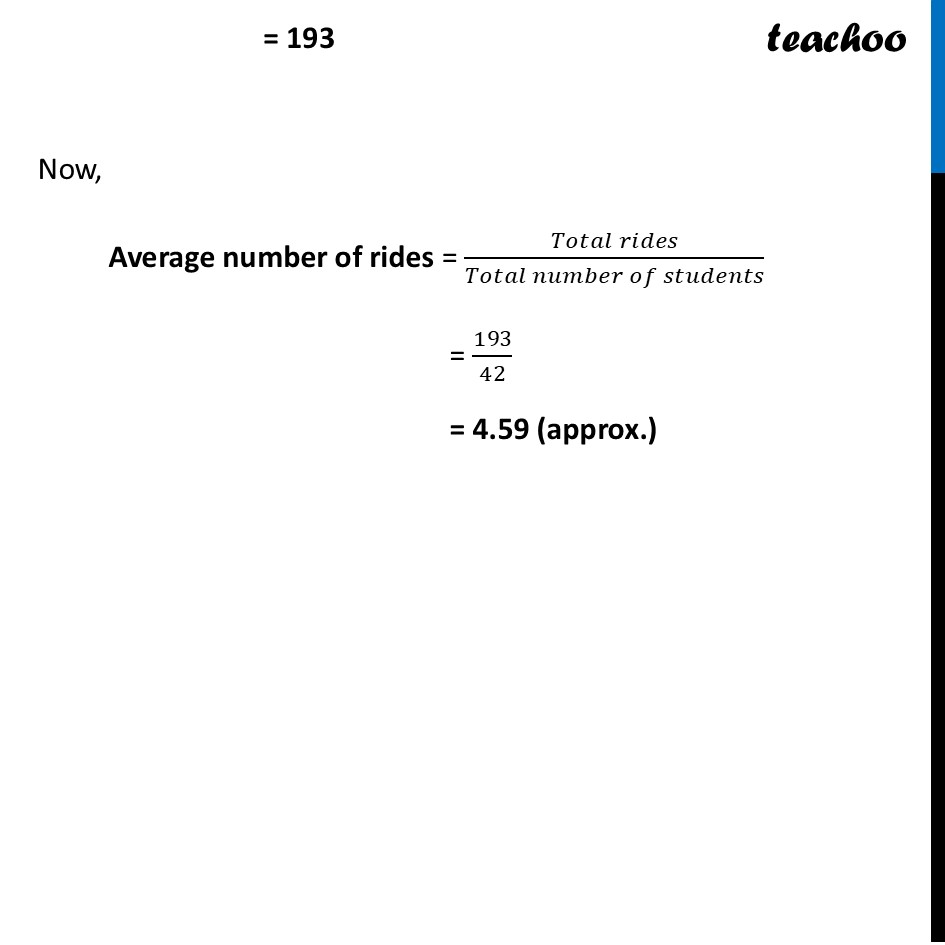
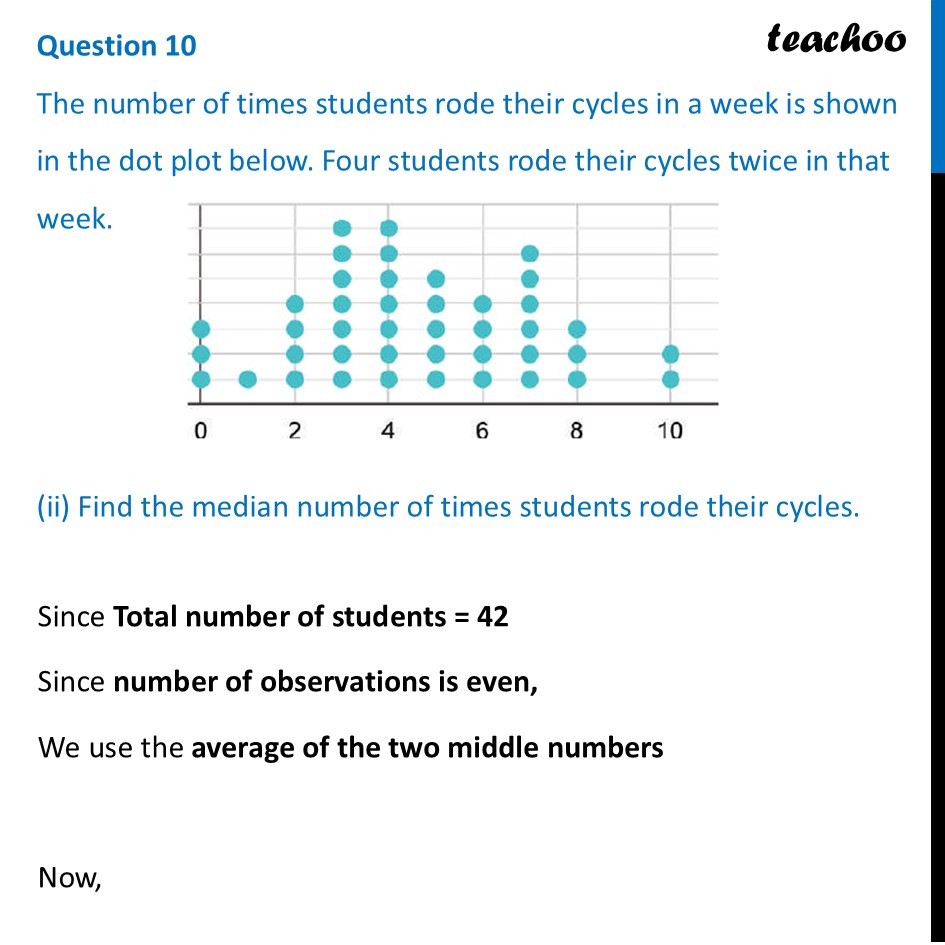
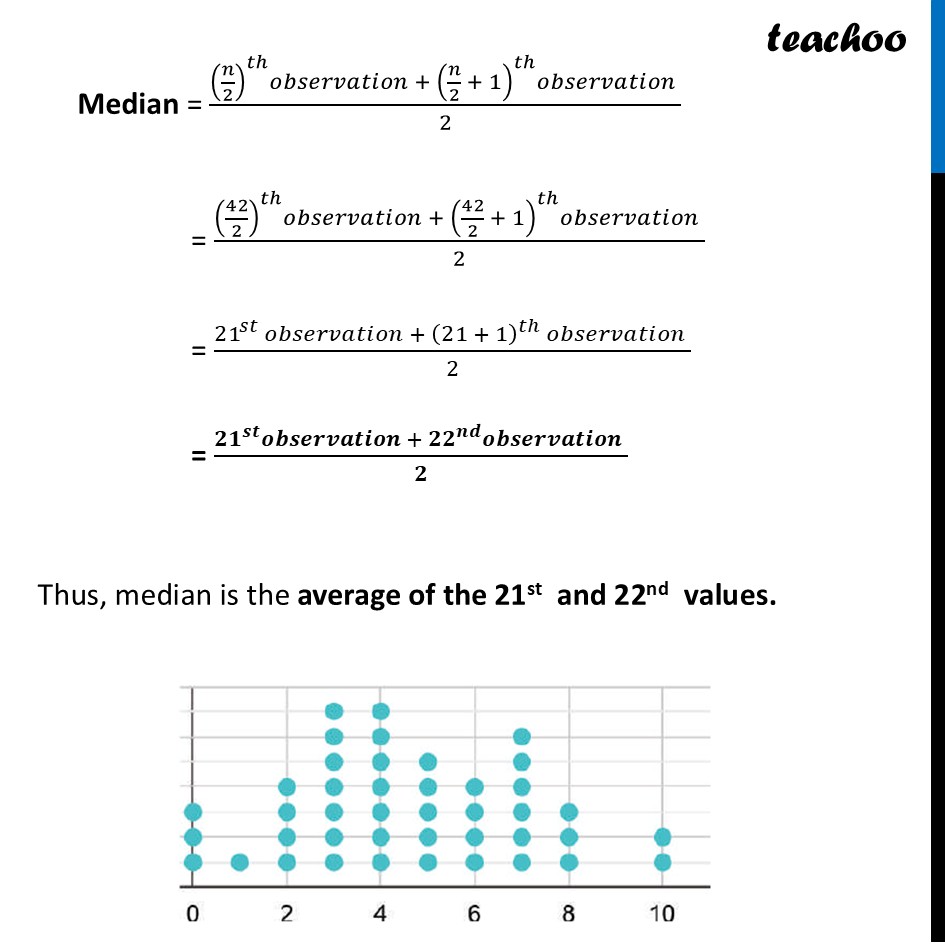
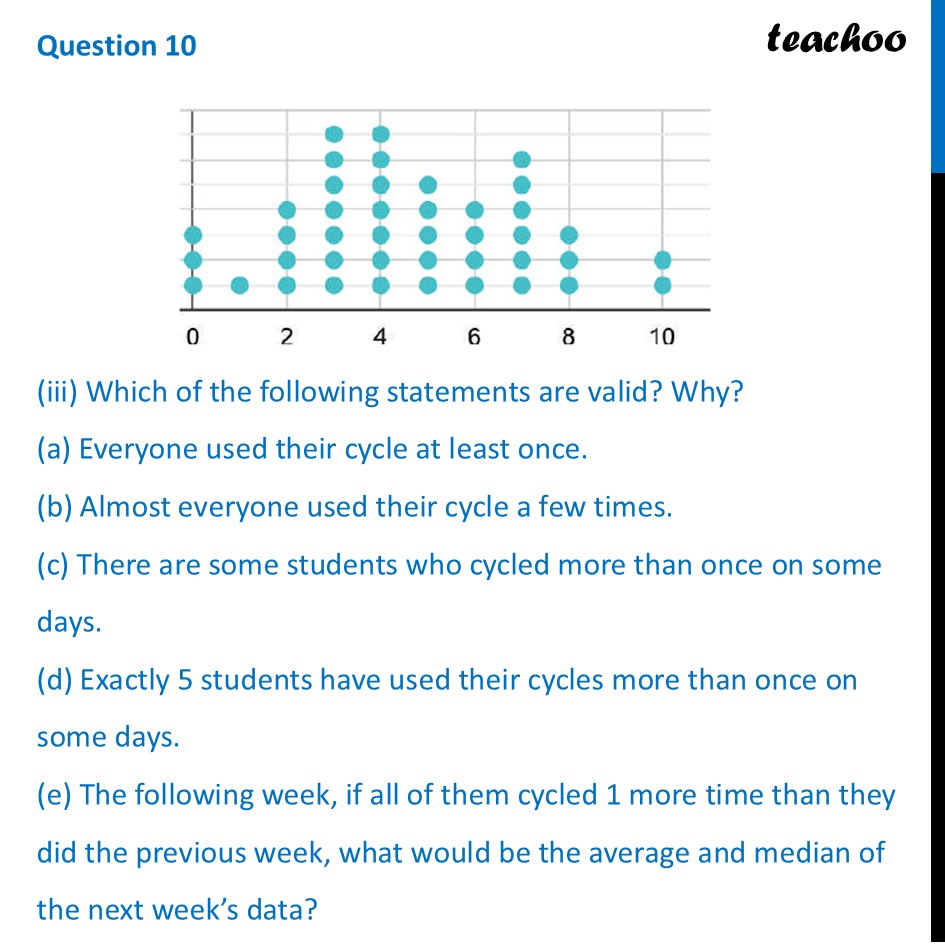
Question 10 The number of times students rode their cycles in a week is shown in the dot plot below. Four students rode their cycles twice in that week. (i) Find the average number of times students rode their cycles.Here, Total number of students = 3 + 1 + 4 + 7 + 7 + 5 + 4 + 6 + 3 + 0 + 2 = 42 And Total rides = 0 × 3 + 1 + 2 × 4 + 3 × 7 + 4 × 7 + 5 × 5 + 6 × 4 + 7 × 6 + 8 × 3 + 10 × 2 = 193 Now, Average number of rides = (𝑇𝑜𝑡𝑎𝑙 𝑟𝑖𝑑𝑒𝑠)/(𝑇𝑜𝑡𝑎𝑙 𝑛𝑢𝑚𝑏𝑒𝑟 𝑜𝑓 𝑠𝑡𝑢𝑑𝑒𝑛𝑡𝑠) = 193/42 = 4.59 (approx.) Question 10 The number of times students rode their cycles in a week is shown in the dot plot below. Four students rode their cycles twice in that week. (ii) Find the median number of times students rode their cycles.Since Total number of students = 42 Since number of observations is even, We use the average of the two middle numbers Now, Median = ((𝑛/2)^𝑡ℎ 𝑜𝑏𝑠𝑒𝑟𝑣𝑎𝑡𝑖𝑜𝑛 + (𝑛/2 + 1)^𝑡ℎ 𝑜𝑏𝑠𝑒𝑟𝑣𝑎𝑡𝑖𝑜𝑛 )/2 = ((42/2)^𝑡ℎ 𝑜𝑏𝑠𝑒𝑟𝑣𝑎𝑡𝑖𝑜𝑛 + (42/2 + 1)^𝑡ℎ 𝑜𝑏𝑠𝑒𝑟𝑣𝑎𝑡𝑖𝑜𝑛 )/2 = (21^𝑠𝑡 𝑜𝑏𝑠𝑒𝑟𝑣𝑎𝑡𝑖𝑜𝑛 + (21 + 1)^𝑡ℎ 𝑜𝑏𝑠𝑒𝑟𝑣𝑎𝑡𝑖𝑜𝑛 )/2 = (𝟐𝟏^𝒔𝒕 𝒐𝒃𝒔𝒆𝒓𝒗𝒂𝒕𝒊𝒐𝒏 + 𝟐𝟐^𝒏𝒅 𝒐𝒃𝒔𝒆𝒓𝒗𝒂𝒕𝒊𝒐𝒏 )/𝟐 Thus, median is the average of the 21st and 22nd values. Counting the dots from left to right, both the 21st and 22nd dots fall in the "4" column. The median is 4. Question 10 (iii) Which of the following statements are valid? Why? (a) Everyone used their cycle at least once. (b) Almost everyone used their cycle a few times. (c) There are some students who cycled more than once on some days. (d) Exactly 5 students have used their cycles more than once on some days. (e) The following week, if all of them cycled 1 more time than they did the previous week, what would be the average and median of the next week’s data?(a) Invalid. Three students rode 0 times. (b) Valid. The heavy clustering in the middle shows almost everyone rode a few times. (c) Valid. There are only 7 days in a week. Some students recorded 8 and 10 rides, meaning they had to ride multiple times in a single day to reach that number. (d) Valid. Exactly 5 students fall into the category mentioned above (three rode 8 times, two rode 10 times). (e) If everyone cycles 1 more time next week, the entire data set simply shifts up by 1. Thus, New average = Old average + 1 = 4.59 + 1 = 5.59 (approx.) And, New median = Old median + 1 = 4 + 1 = 5
