 You are here

![Fractals in Art - Explanation + Examples [Ganita Prakash II Class 8] - Fractals in Art](https://cdn.teachoo.com/5cdb3bc7-0847-418a-885b-24d5121a7102/slide48.jpg)
Fractals in Art
Last updated at February 26, 2026 by Teachoo
Transcript
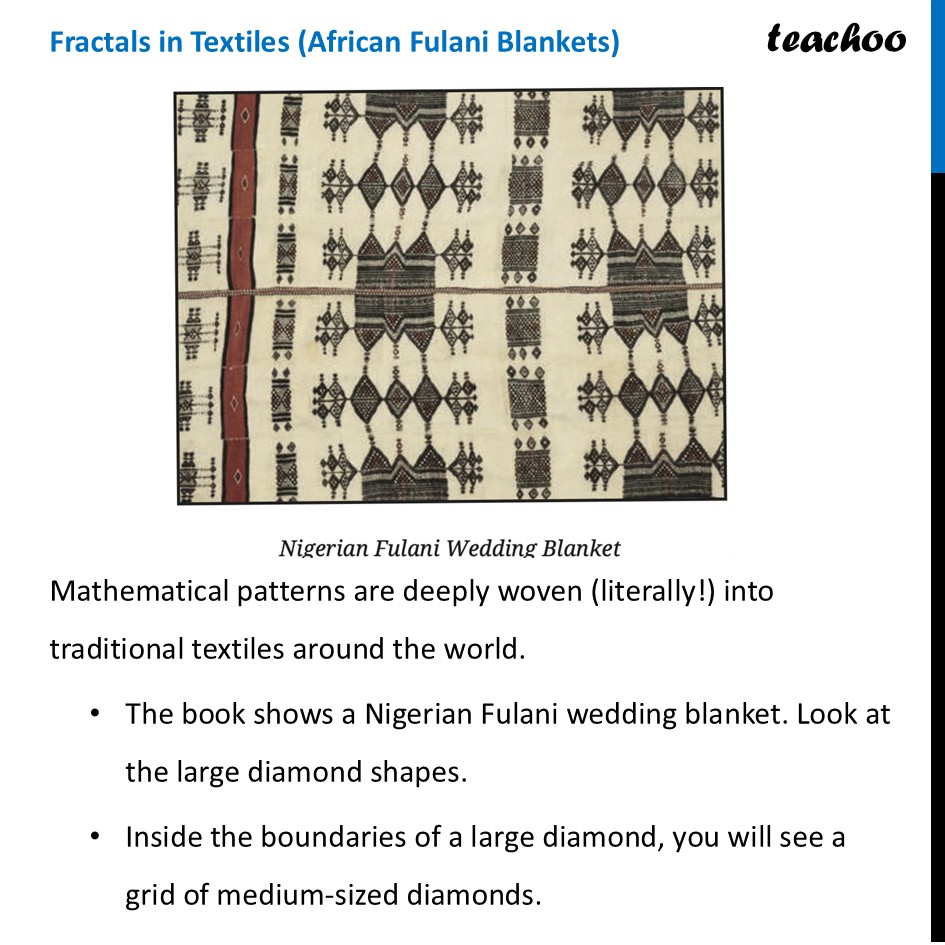
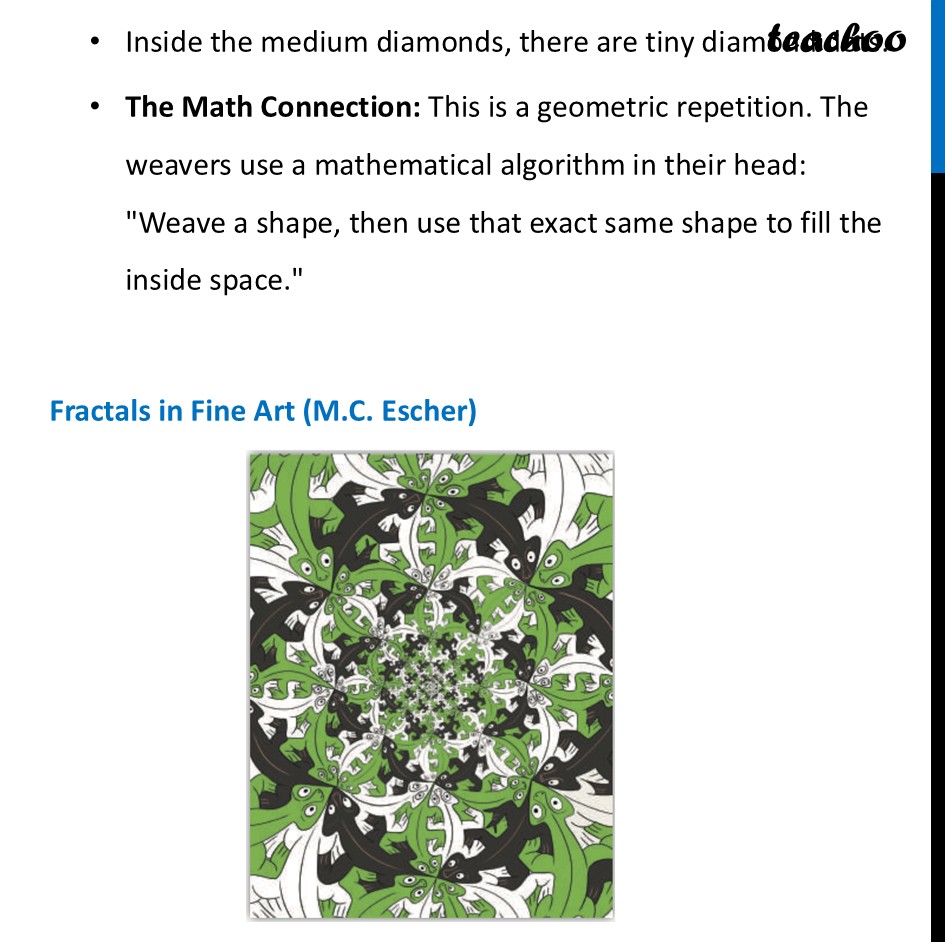
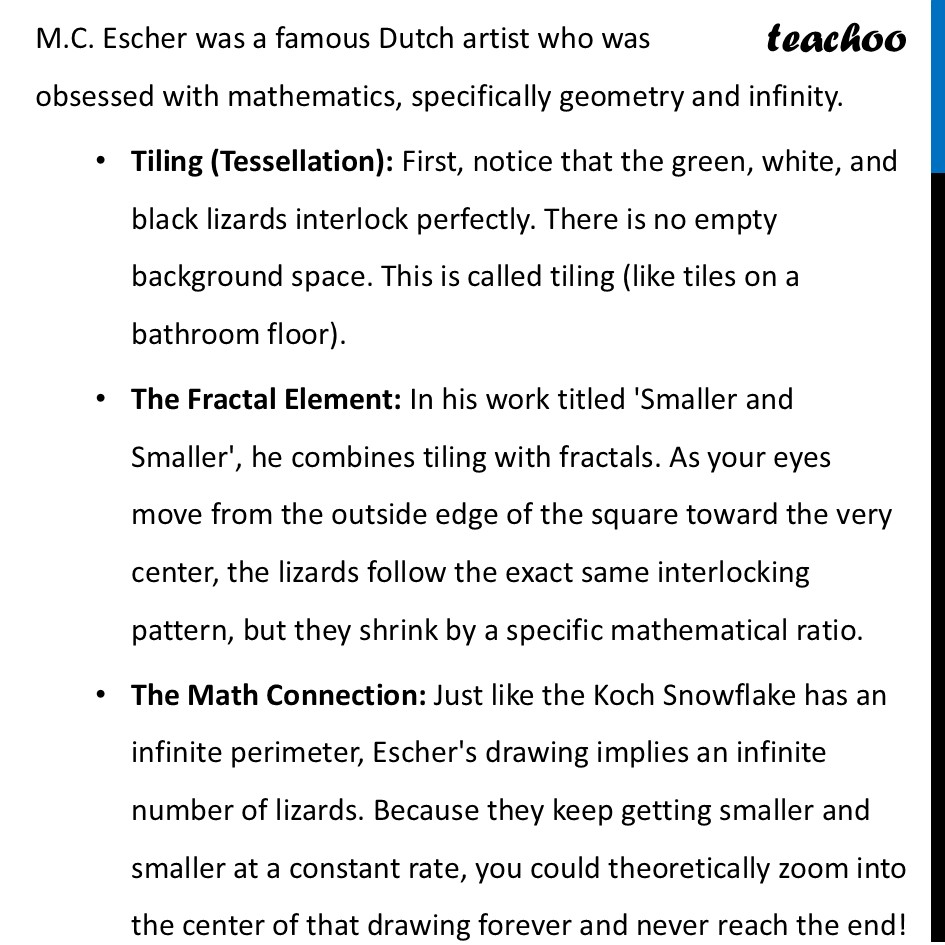
Fractals in ArtLet’s look at 3 examples given in the book Fractals in Architecture (Kandariya Mahadev Temple) If you look closely at the photo of the Hindu temple, you aren't just looking at one big tower. The main central tower (called a shikhara in temple architecture) is surrounded by a cluster of smaller, identical towers. If you zoom in on those smaller towers, you will see they are made up of even smaller carved towers! The Math Connection: This is exactly like the Sierpinski Triangle. Instead of drawing a shape inside a shape, the architects built physical 3D models of the temple, attached them to the outside, and then attached smaller models to those. This creates a texture that looks like a rugged mountain peak, which looks the same whether you are standing a mile away or right up close. Fractals in Textiles (African Fulani Blankets) Mathematical patterns are deeply woven (literally!) into traditional textiles around the world. The book shows a Nigerian Fulani wedding blanket. Look at the large diamond shapes. Inside the boundaries of a large diamond, you will see a grid of medium-sized diamonds. Inside the medium diamonds, there are tiny diamond dots. The Math Connection: This is a geometric repetition. The weavers use a mathematical algorithm in their head: "Weave a shape, then use that exact same shape to fill the inside space." Fractals in Fine Art (M.C. Escher) M.C. Escher was a famous Dutch artist who was obsessed with mathematics, specifically geometry and infinity. Tiling (Tessellation): First, notice that the green, white, and black lizards interlock perfectly. There is no empty background space. This is called tiling (like tiles on a bathroom floor). The Fractal Element: In his work titled 'Smaller and Smaller', he combines tiling with fractals. As your eyes move from the outside edge of the square toward the very center, the lizards follow the exact same interlocking pattern, but they shrink by a specific mathematical ratio. The Math Connection: Just like the Koch Snowflake has an infinite perimeter, Escher's drawing implies an infinite number of lizards. Because they keep getting smaller and smaller at a constant rate, you could theoretically zoom into the center of that drawing forever and never reach the end!
