
 You are here
![[Maths] Consider the numbers 72 and 144. Suppose they are factorised - Figure it out - Page 54](https://cdn.teachoo.com/15fa3dac-741b-4fee-a51b-e0968668046c/slide78.jpg)
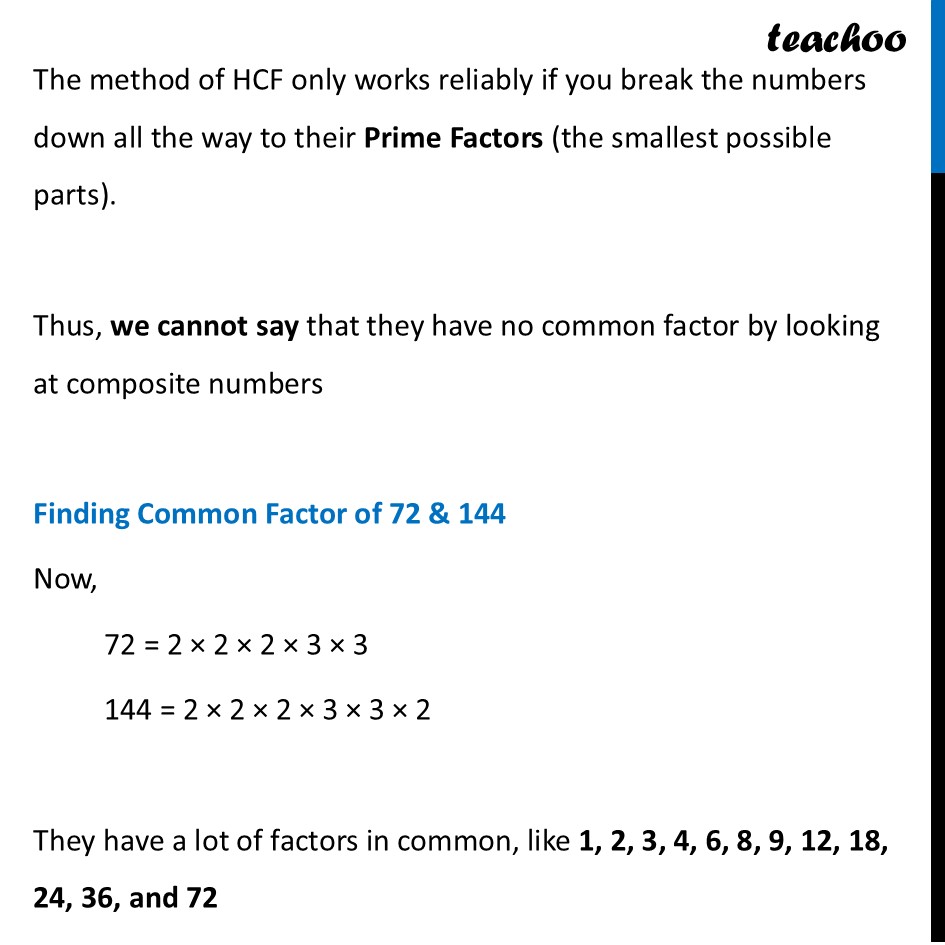
Figure it out - Page 54
Last updated at August 14, 2026 by Teachoo
Transcript
Question 2 Consider the numbers 72 and 144. Suppose they are factorised into composite numbers as: 72 = 6 × 12 and 144 = 8 × 18. Seeing this, can one say that these two numbers have no common factor other than 1? Why not?The numbers 6, 12, 8, and 18 are Composite Numbers, not Prime Numbers. This means they are like boxes that still have smaller numbers inside them. Look at the number 6 in the first list. It is made of 2 × 3. Look at the number 8 in the second list. It is made of 2 × 2 × 2. Even though "6" and "8" look different, they both have a hidden 2 inside them. The method of HCF only works reliably if you break the numbers down all the way to their Prime Factors (the smallest possible parts). Thus, we cannot say that they have no common factor by looking at composite numbers Finding Common Factor of 72 & 144 Now, 72 = 2 × 2 × 2 × 3 × 3 144 = 2 × 2 × 2 × 3 × 3 × 2 They have a lot of factors in common, like 1, 2, 3, 4, 6, 8, 9, 12, 18, 24, 36, and 72
