
 You are here

Last updated at August 14, 2026 by Teachoo
Transcript
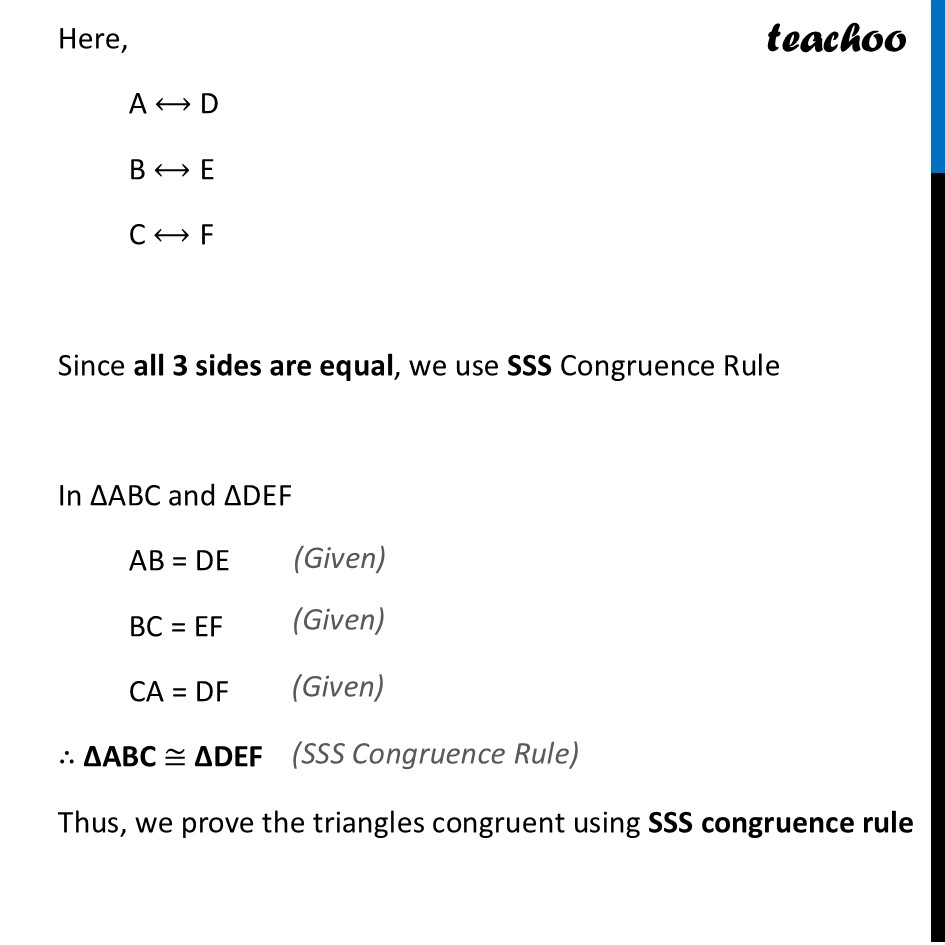
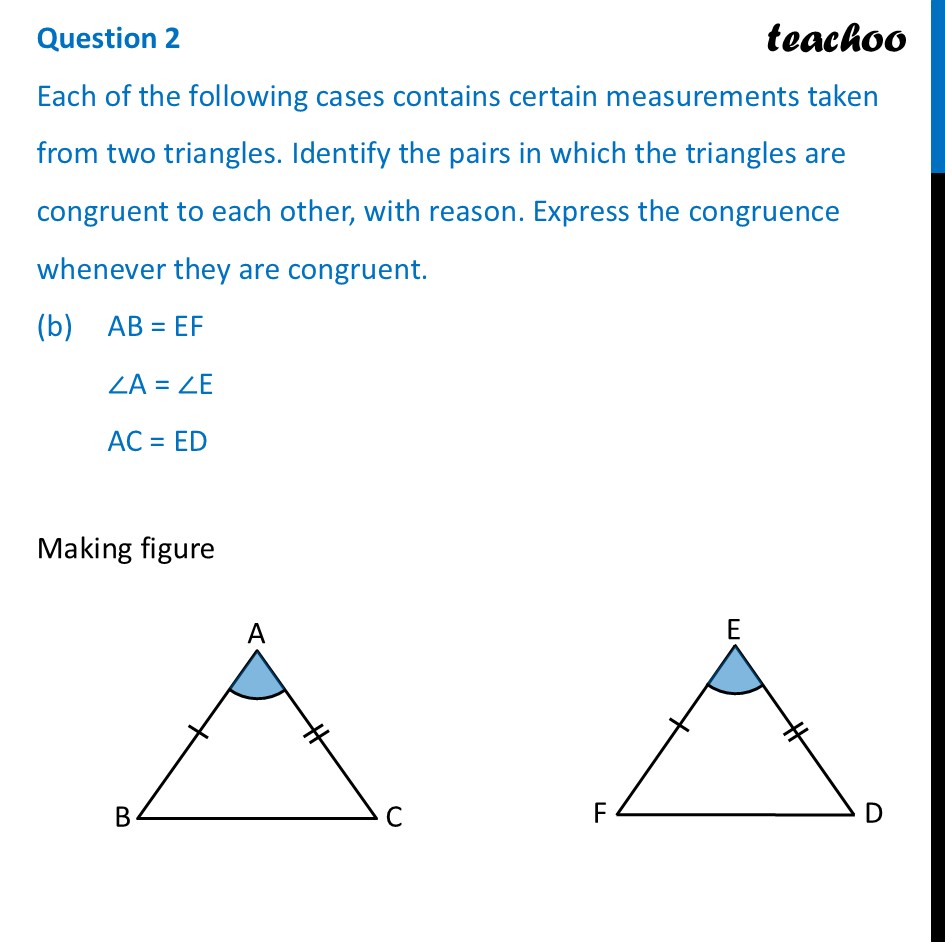
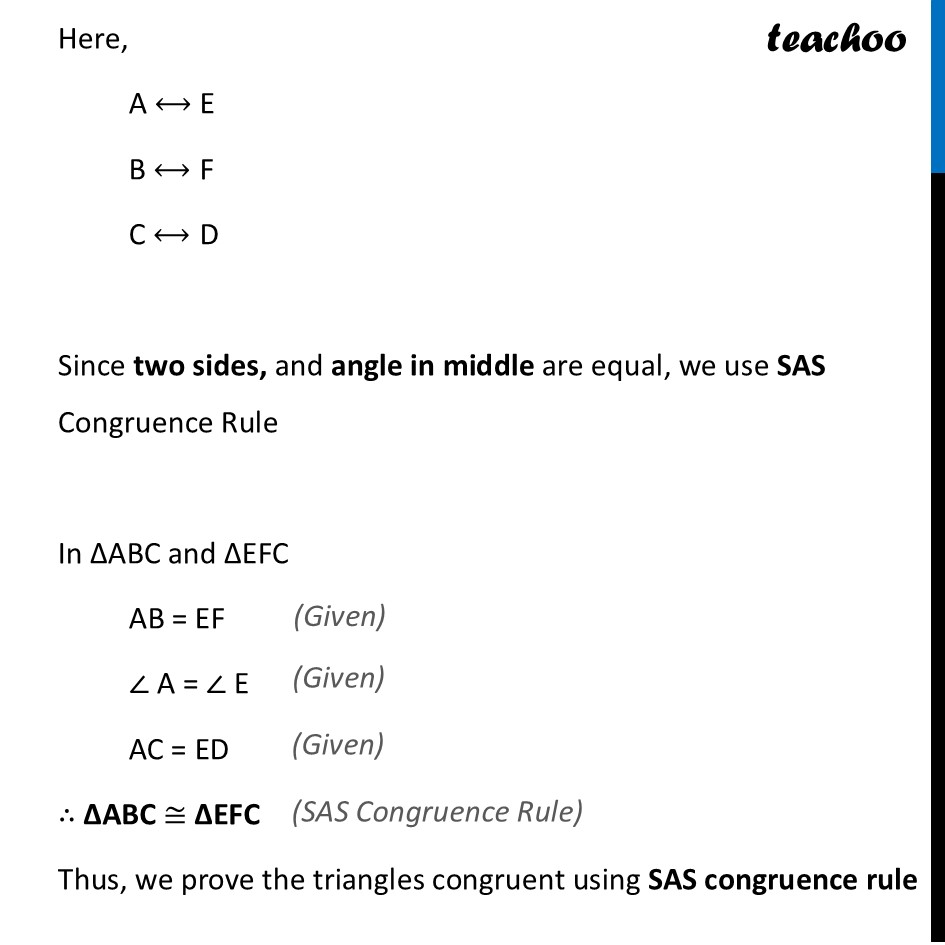
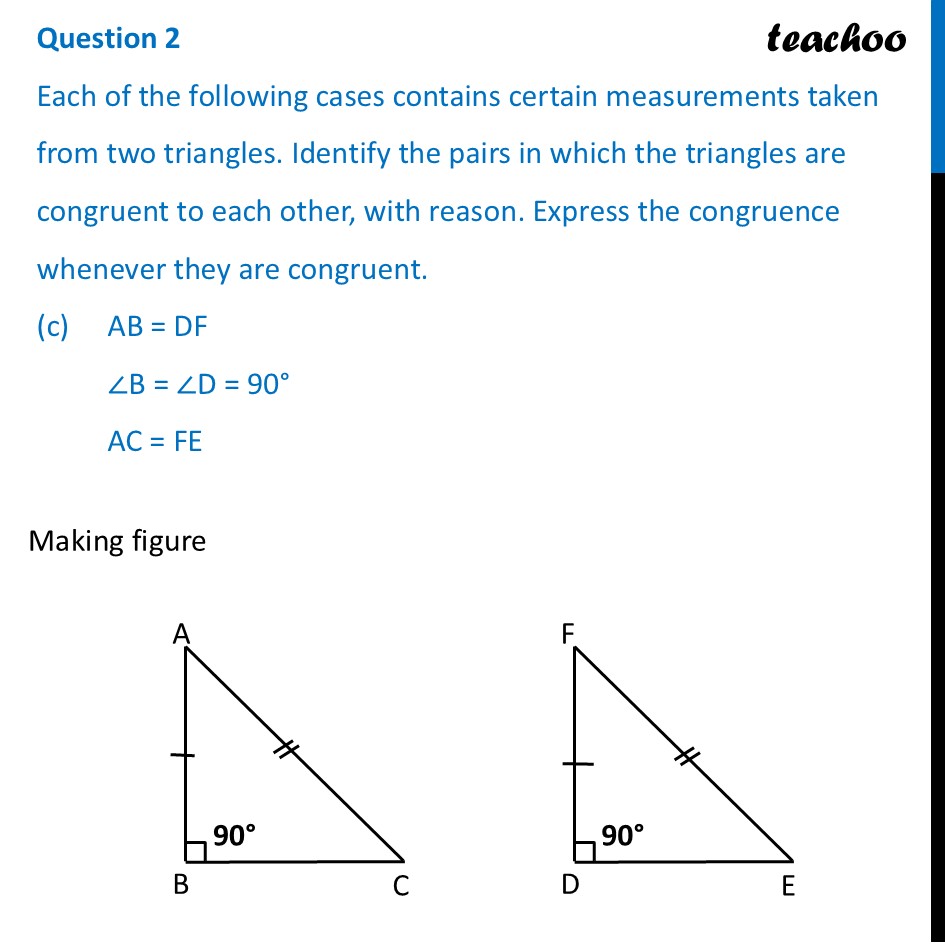
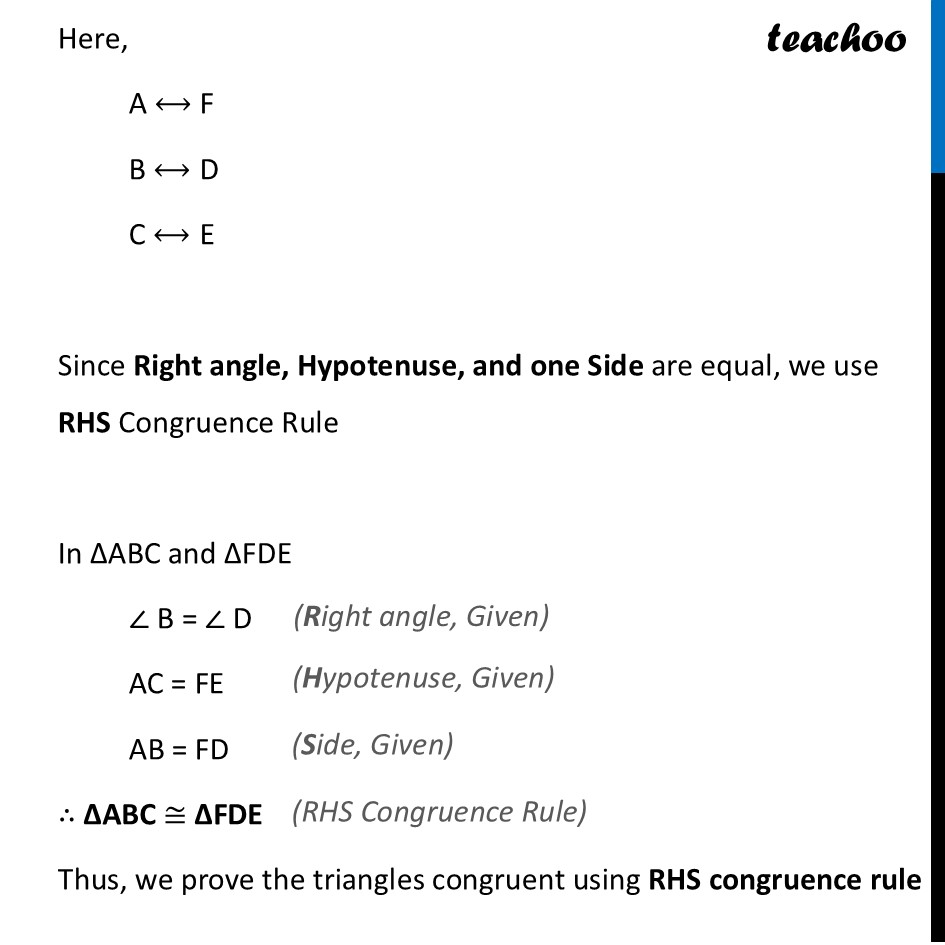
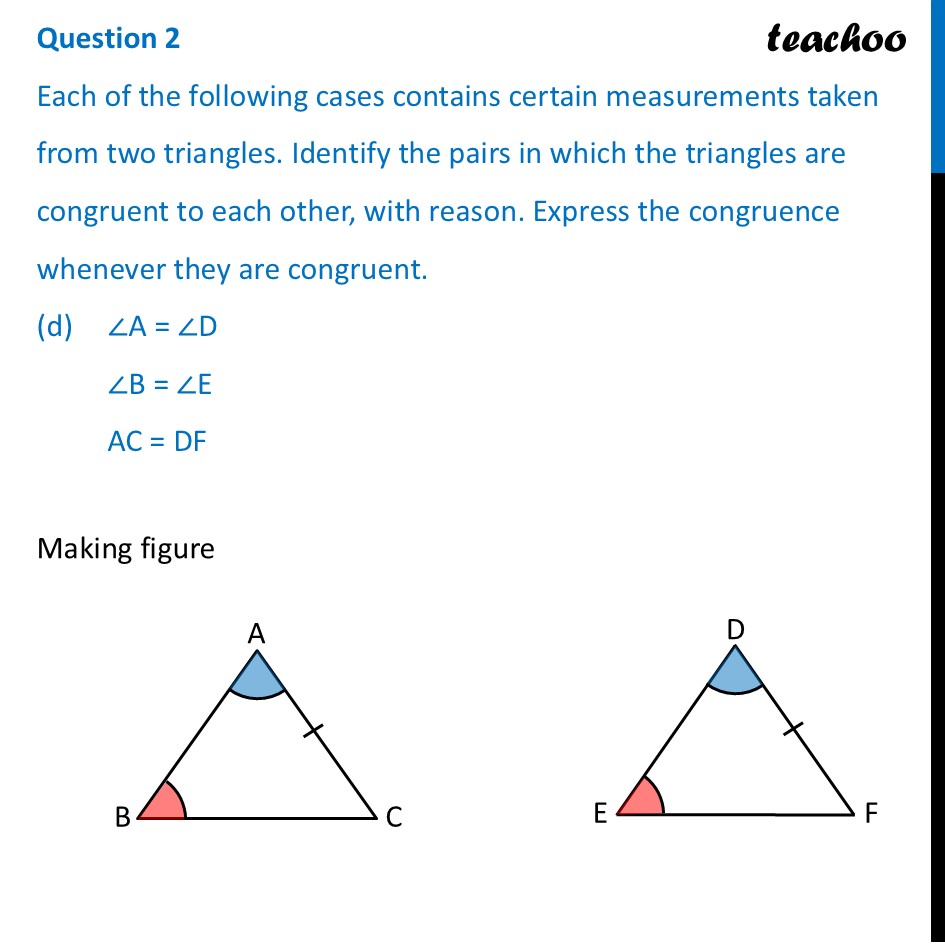
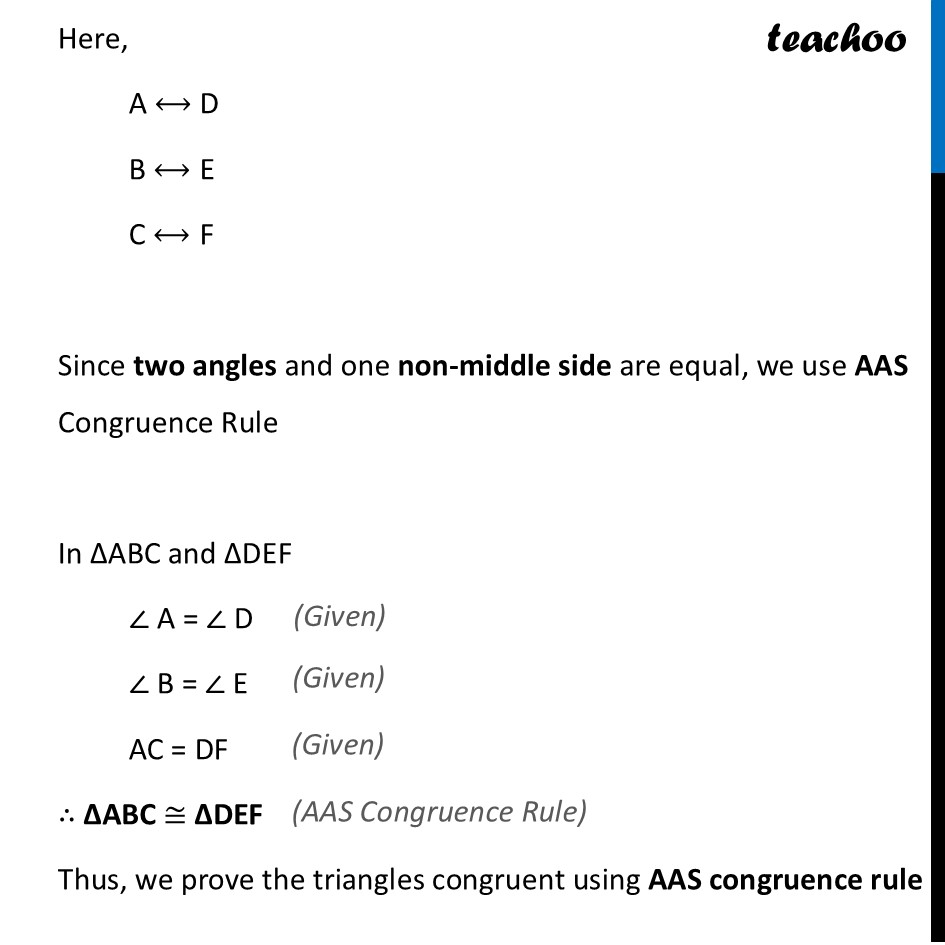
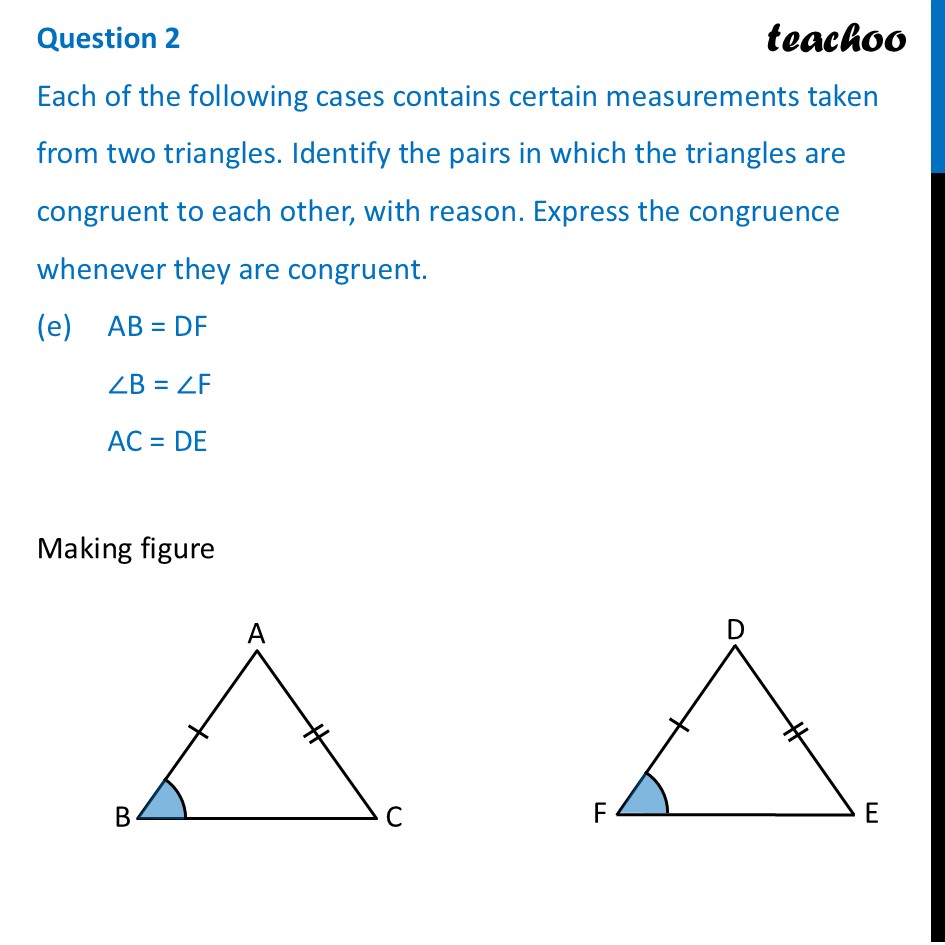
Question 2 Each of the following cases contains certain measurements taken from two triangles. Identify the pairs in which the triangles are congruent to each other, with reason. Express the congruence whenever they are congruent. (a) AB = DE BC = EF CA = DFMaking figure Here, A ⟷ D B ⟷ E C ⟷ F Since all 3 sides are equal, we use SSS Congruence Rule In ∆ABC and ∆DEF AB = DE BC = EF CA = DF ∴ ∆ABC ≅ ∆DEF Thus, we prove the triangles congruent using SSS congruence rule Question 2 Each of the following cases contains certain measurements taken from two triangles. Identify the pairs in which the triangles are congruent to each other, with reason. Express the congruence whenever they are congruent. (b) AB = EF ∠A = ∠E AC = EDMaking figure Here, A ⟷ E B ⟷ F C ⟷ D Since two sides, and angle in middle are equal, we use SAS Congruence Rule In ∆ABC and ∆EFC AB = EF ∠ A = ∠ E AC = ED ∴ ∆ABC ≅ ∆EFC Thus, we prove the triangles congruent using SAS congruence rule Question 2 Each of the following cases contains certain measurements taken from two triangles. Identify the pairs in which the triangles are congruent to each other, with reason. Express the congruence whenever they are congruent. (c) AB = DF ∠B = ∠D = 90° AC = FEMaking figure Here, A ⟷ D B ⟷ E C ⟷ F Since two angles and one non-middle side are equal, we use AAS Congruence Rule In ∆ABC and ∆DEF ∠ A = ∠ D ∠ B = ∠ E AC = DF ∴ ∆ABC ≅ ∆DEF Thus, we prove the triangles congruent using AAS congruence rule Question 2 Each of the following cases contains certain measurements taken from two triangles. Identify the pairs in which the triangles are congruent to each other, with reason. Express the congruence whenever they are congruent. (e) AB = DF ∠B = ∠F AC = DEMaking figure Here, A ⟷ D B ⟷ F C ⟷ E Here, two sides and one non-middle angle are equal, This becomes SSA – and this is not a congruence rule Thus, the two triangles are not congruent
