 You are here

![[Class 8] Find the remaining angles in the following quadrilaterals. - Figure it out - Page 102](https://cdn.teachoo.com/e9511f62-4b10-49c0-ba3a-f7de632b6ce0/slide47.jpg)
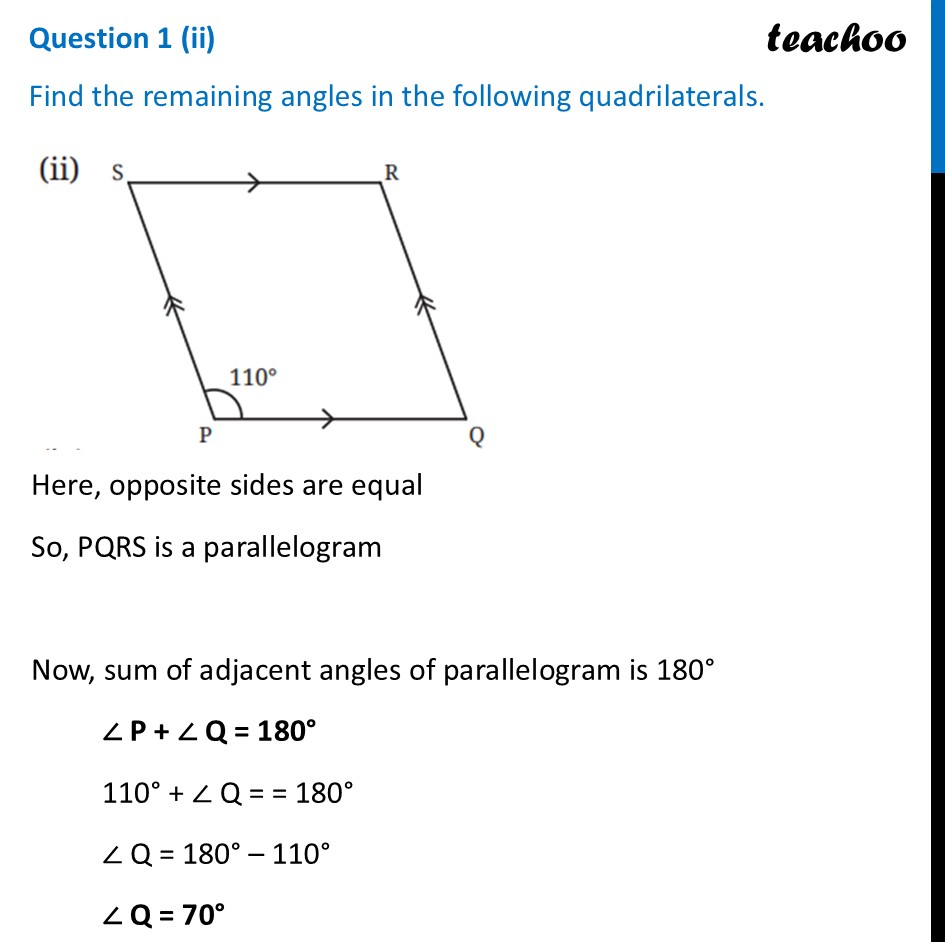
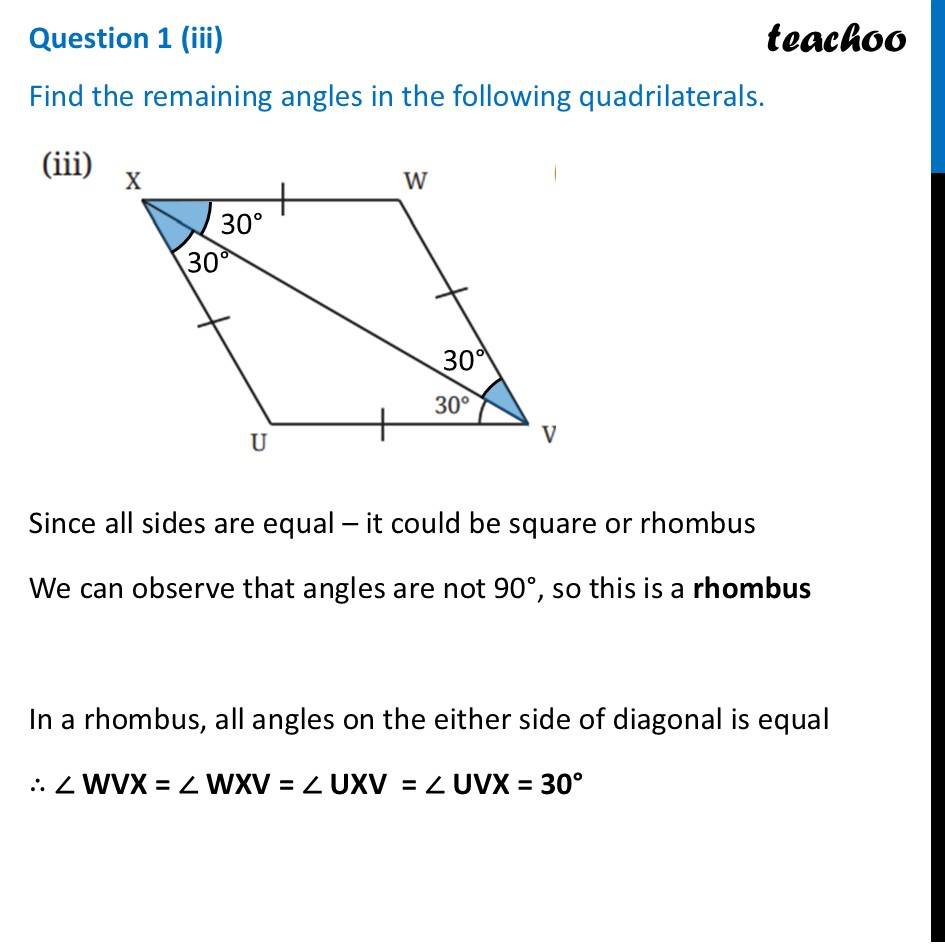
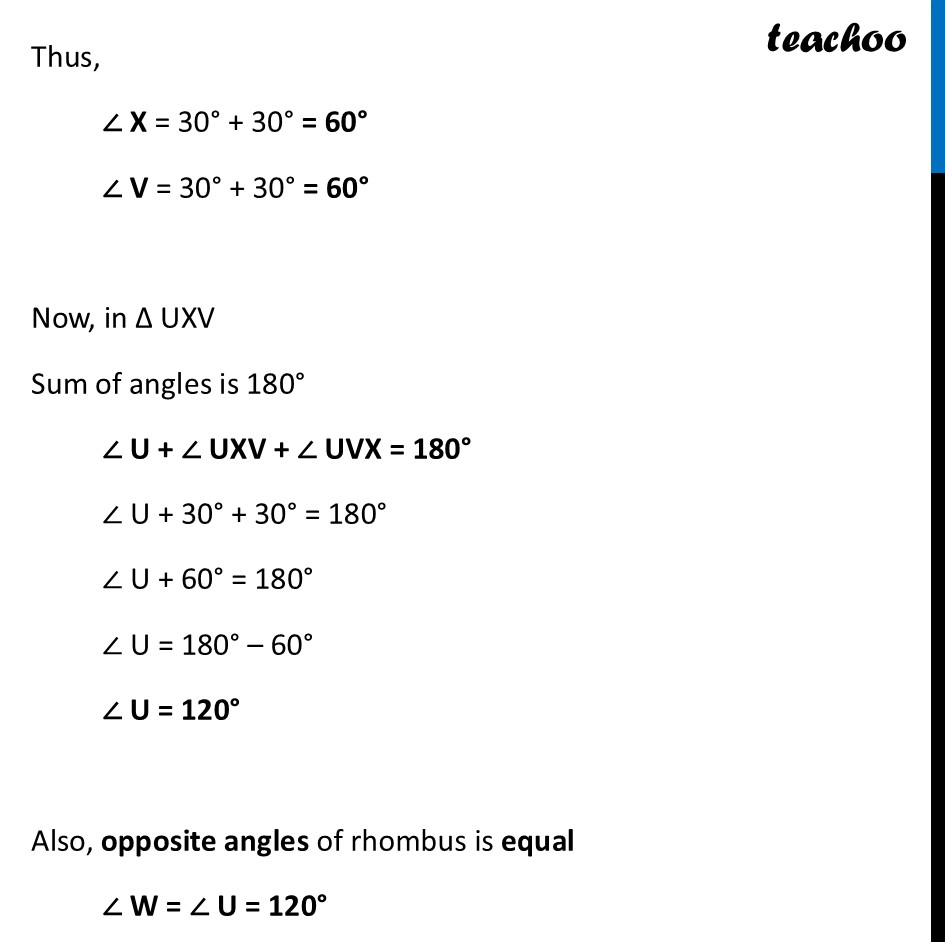
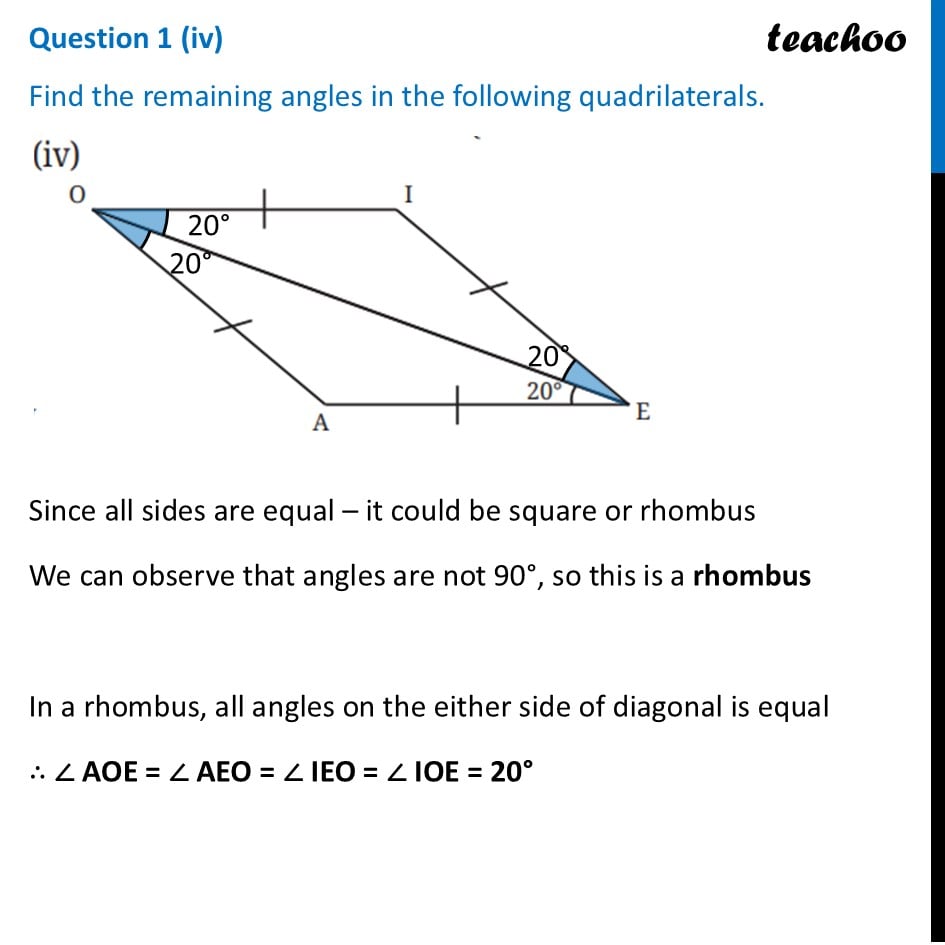
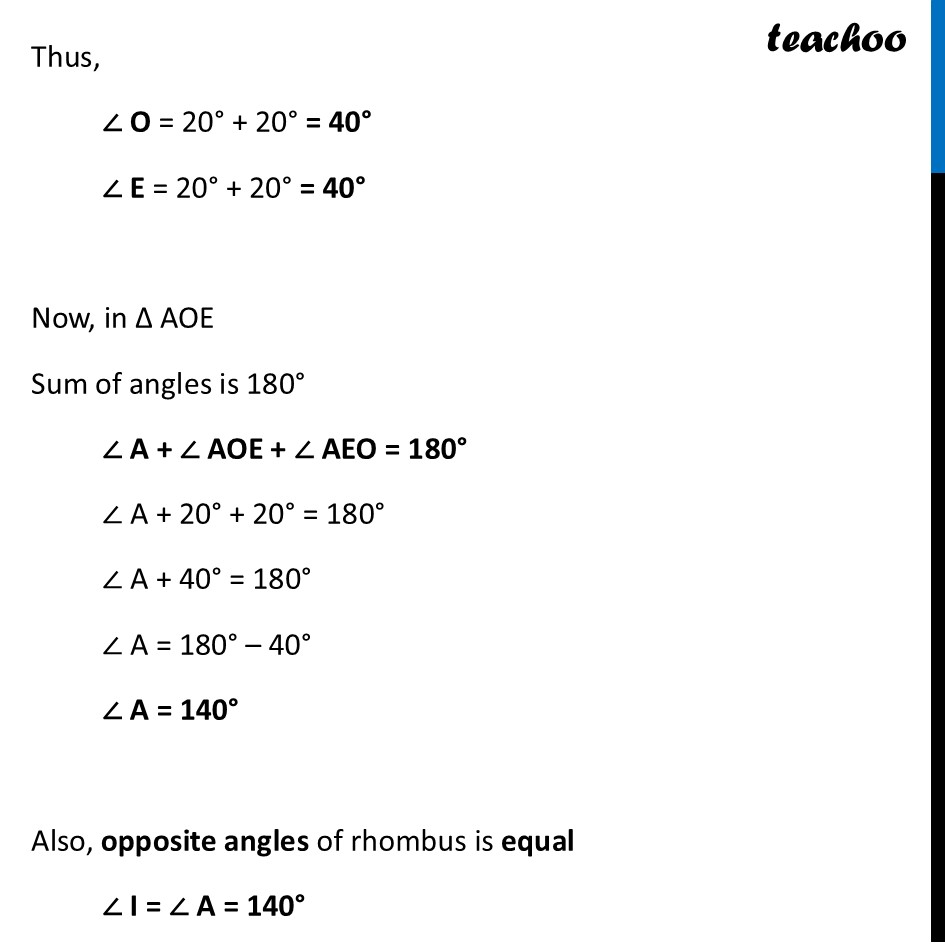
Figure it out - Page 102
Last updated at December 10, 2025 by Teachoo
Transcript
Question 1 (i) Find the remaining angles in the following quadrilaterals.Here, opposite sides are equal So, PEAR is a parallelogram Now, sum of adjacent angles of parallelogram is 180° ∠ E + ∠ P = 180° ∠ E + 40° = 180° ∠ E = 180° – 40° ∠ E = 140° Also, opposite angles of parallelogram are equal ∠ A = ∠ P = 40° ∠ R = ∠ E = 140° Question 1 (ii) Find the remaining angles in the following quadrilaterals.Here, opposite sides are equal So, PQRS is a parallelogram Now, sum of adjacent angles of parallelogram is 180° ∠ P + ∠ Q = 180° 110° + ∠ Q = = 180° ∠ Q = 180° – 110° ∠ Q = 70° Also, opposite angles of parallelogram are equal ∠ R = ∠ P = 110° ∠ S = ∠ Q = 70° Question 1 (iii) Find the remaining angles in the following quadrilaterals.Since all sides are equal – it could be square or rhombus We can observe that angles are not 90°, so this is a rhombus In a rhombus, all angles on the either side of diagonal is equal ∴ ∠ WVX = ∠ WXV = ∠ UXV = ∠ UVX = 30° Thus, ∠ X = 30° + 30° = 60° ∠ V = 30° + 30° = 60° Now, in ∆ UXV Sum of angles is 180° ∠ U + ∠ UXV + ∠ UVX = 180° ∠ U + 30° + 30° = 180° ∠ U + 60° = 180° ∠ U = 180° – 60° ∠ U = 120° Also, opposite angles of rhombus is equal ∠ W = ∠ U = 120° Question 1 (iv) Find the remaining angles in the following quadrilaterals.Since all sides are equal – it could be square or rhombus We can observe that angles are not 90°, so this is a rhombus In a rhombus, all angles on the either side of diagonal is equal ∴ ∠ AOE = ∠ AEO = ∠ IEO = ∠ IOE = 20° Thus, ∠ O = 20° + 20° = 40° ∠ E = 20° + 20° = 40° Now, in ∆ AOE Sum of angles is 180° ∠ A + ∠ AOE + ∠ AEO = 180° ∠ A + 20° + 20° = 180° ∠ A + 40° = 180° ∠ A = 180° – 40° ∠ A = 140° Also, opposite angles of rhombus is equal ∠ I = ∠ A = 140°
