You are here

Polar representation
Last updated at August 17, 2026 by Teachoo
Transcript
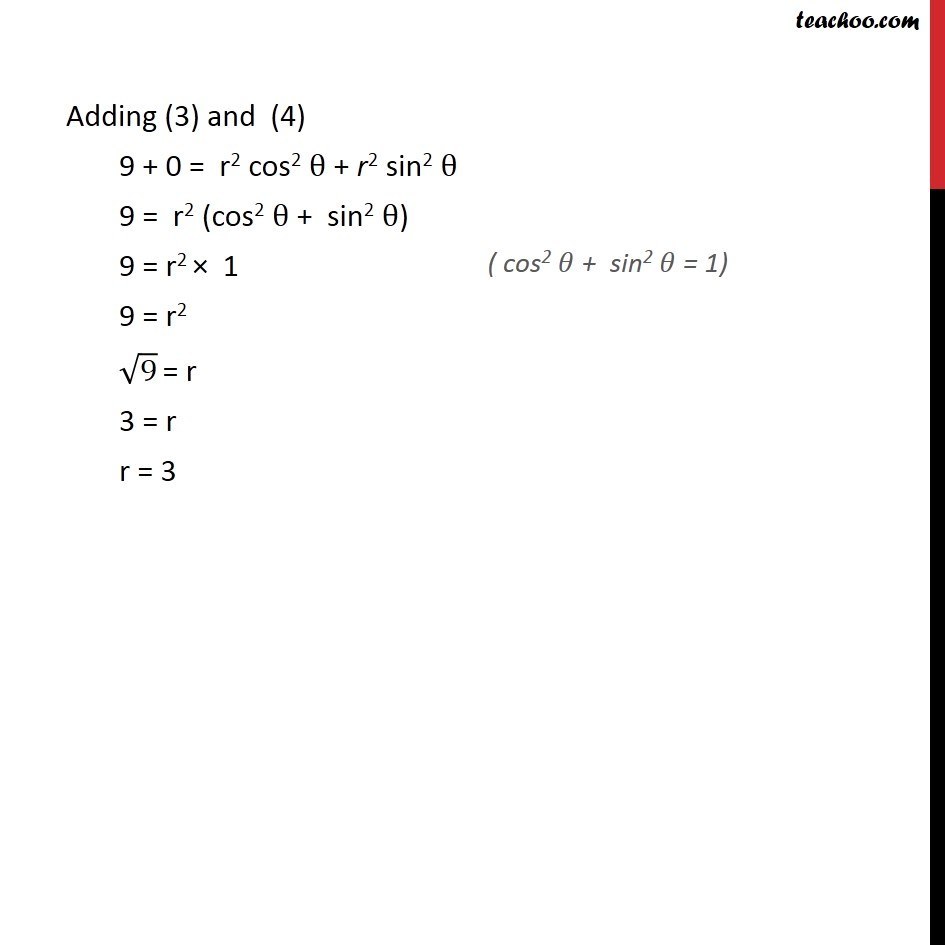
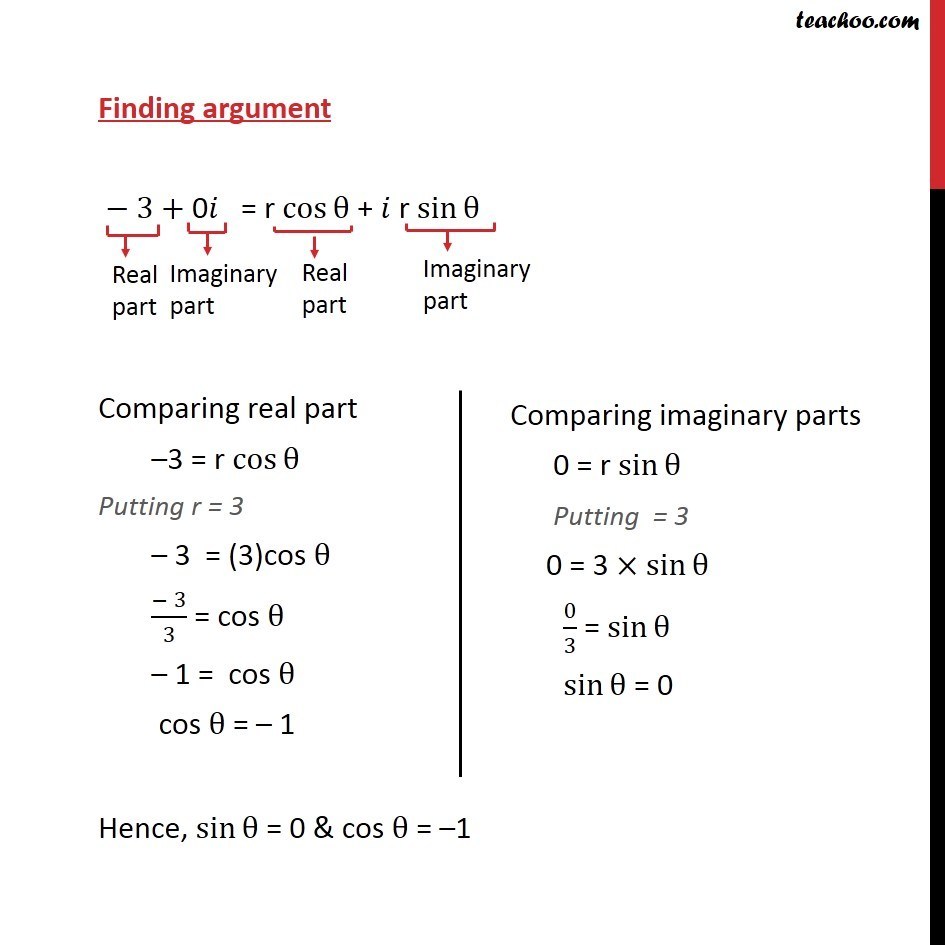
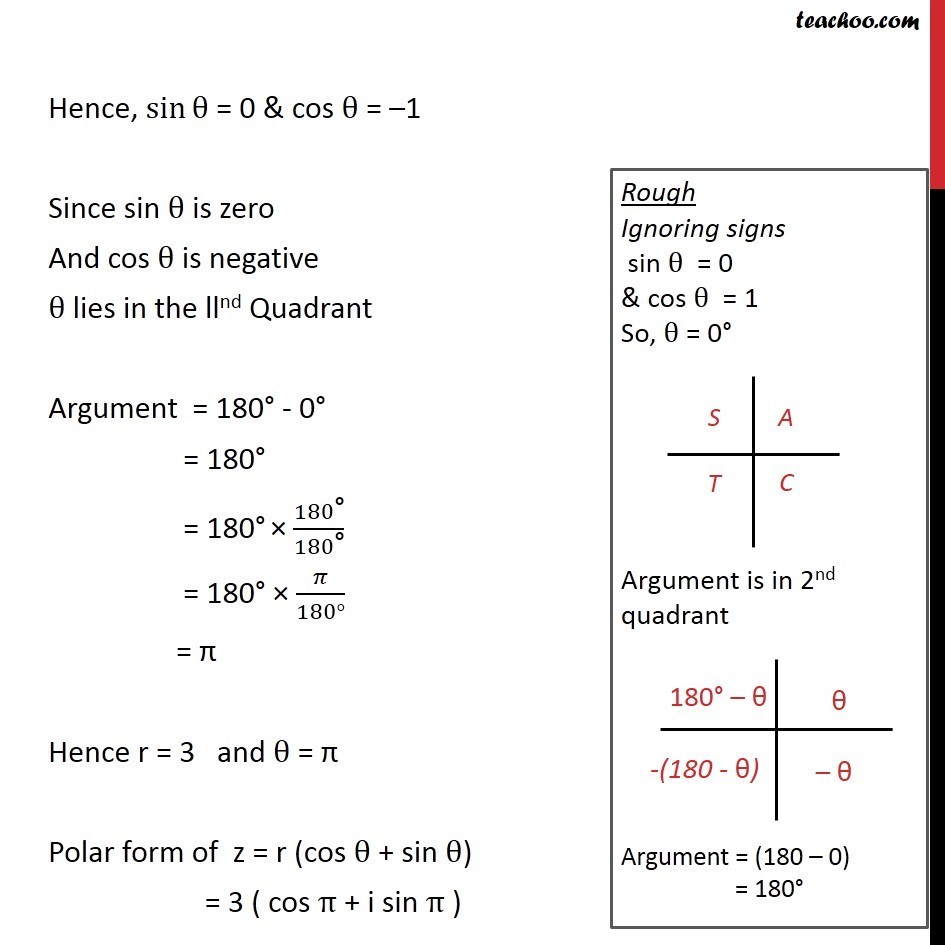
Question 6 Convert the given complex number in polar form: –3 Given z = – 3 z = – 3 + 0i Let polar form be z = r (cosθ + i sinθ) From (1) & (2) − 3+ 0i = r ( cosθ + i sinθ) − 3+ 0𝑖 = r〖 cos〗θ + 𝑖 r sinθ Adding (3) and (4) 9 + 0 = r2 cos2 θ + r2 sin2 θ 9 = r2 (cos2 θ + sin2 θ) 9 = r2 × 1 9 = r2 √9 = r 3 = r r = 3 Finding argument − 3+ 0𝑖 = r〖 cos〗θ + 𝑖 r sinθ Comparing real part –3 = r cosθ Putting r = 3 – 3 = (3)cos θ (− 3)/3 = cos θ – 1 = cos θ cos θ = – 1 Hence, sinθ = 0 & cos θ = –1 Hence, sinθ = 0 & cos θ = –1 Since sin θ is zero And cos θ is negative θ lies in the llnd Quadrant Argument = 180° - 0° = 180° = 180° × 180"°" /180"°" = 180° × 𝜋/(180°) = π Hence r = 3 and θ = π Polar form of z = r (cos θ + sin θ) = 3 ( cos π + i sin π )