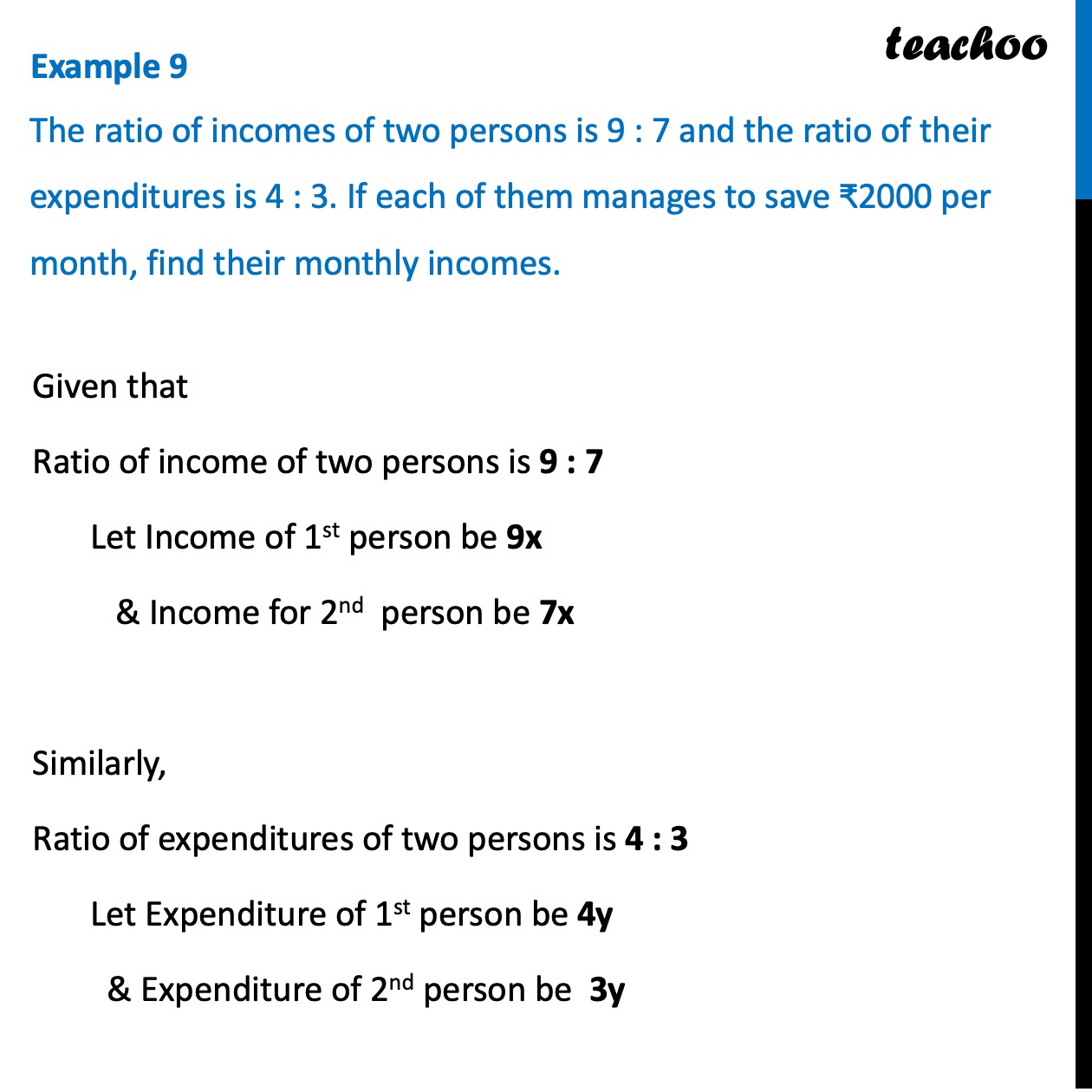
Example 9: The ratio of incomes of two persons is 9 : 7 and the ratio of their expenditures is 4 : 3. If each of them manages to save ₹2000 per month, find their monthly incomes. Given that Ratio of income of two persons is 9 : 7 Let…

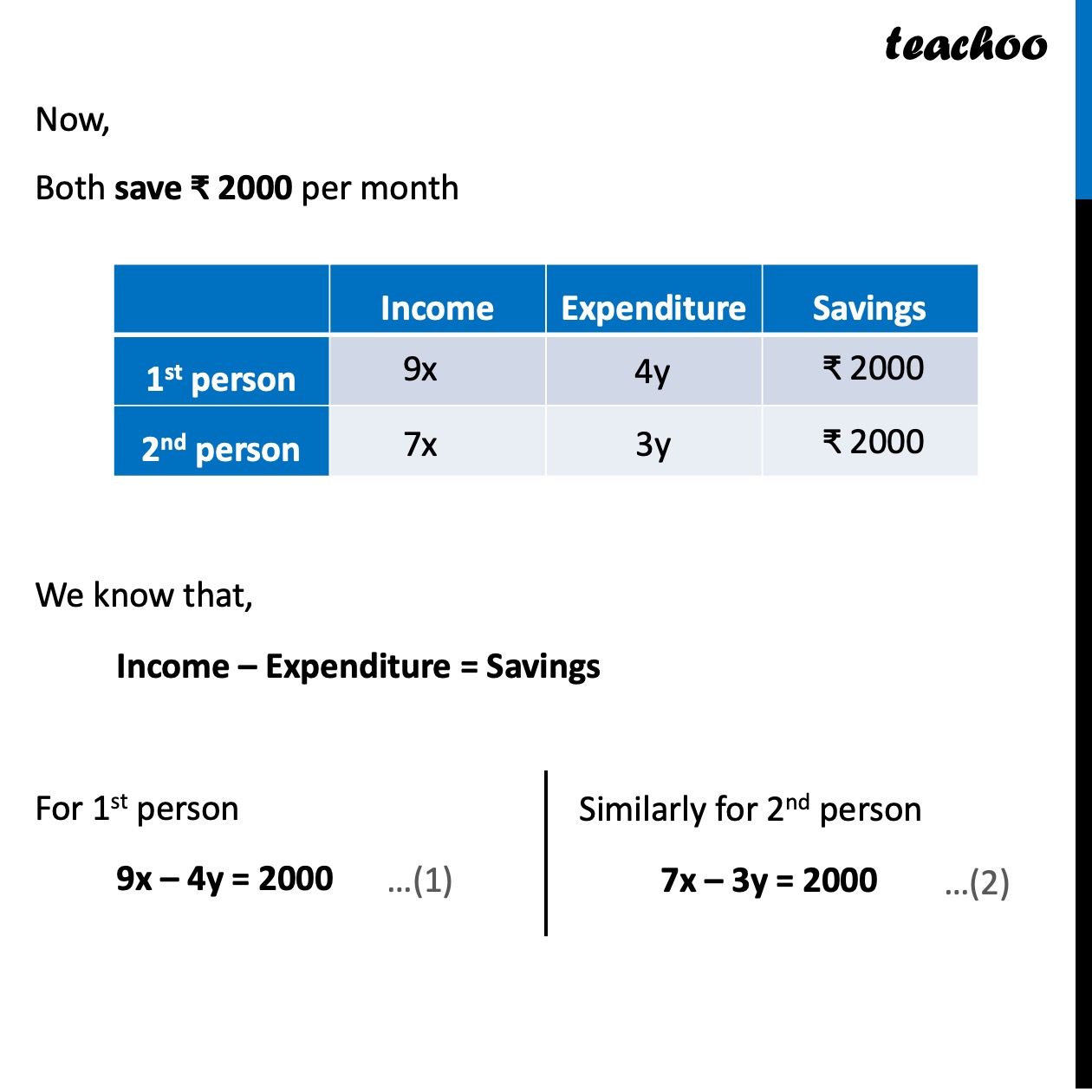
Example 9: Now, Both save ₹ 2000 per month We know that, Income – Expenditure = Savings For 1^(st) person 9x – 4y = 2000 | Income | Expenditure | Savings 1^(st) person | | | 2^(nd) person | | | 9x 7x 4y 3y ₹ 2000 …(2) …(1) Similarly for…

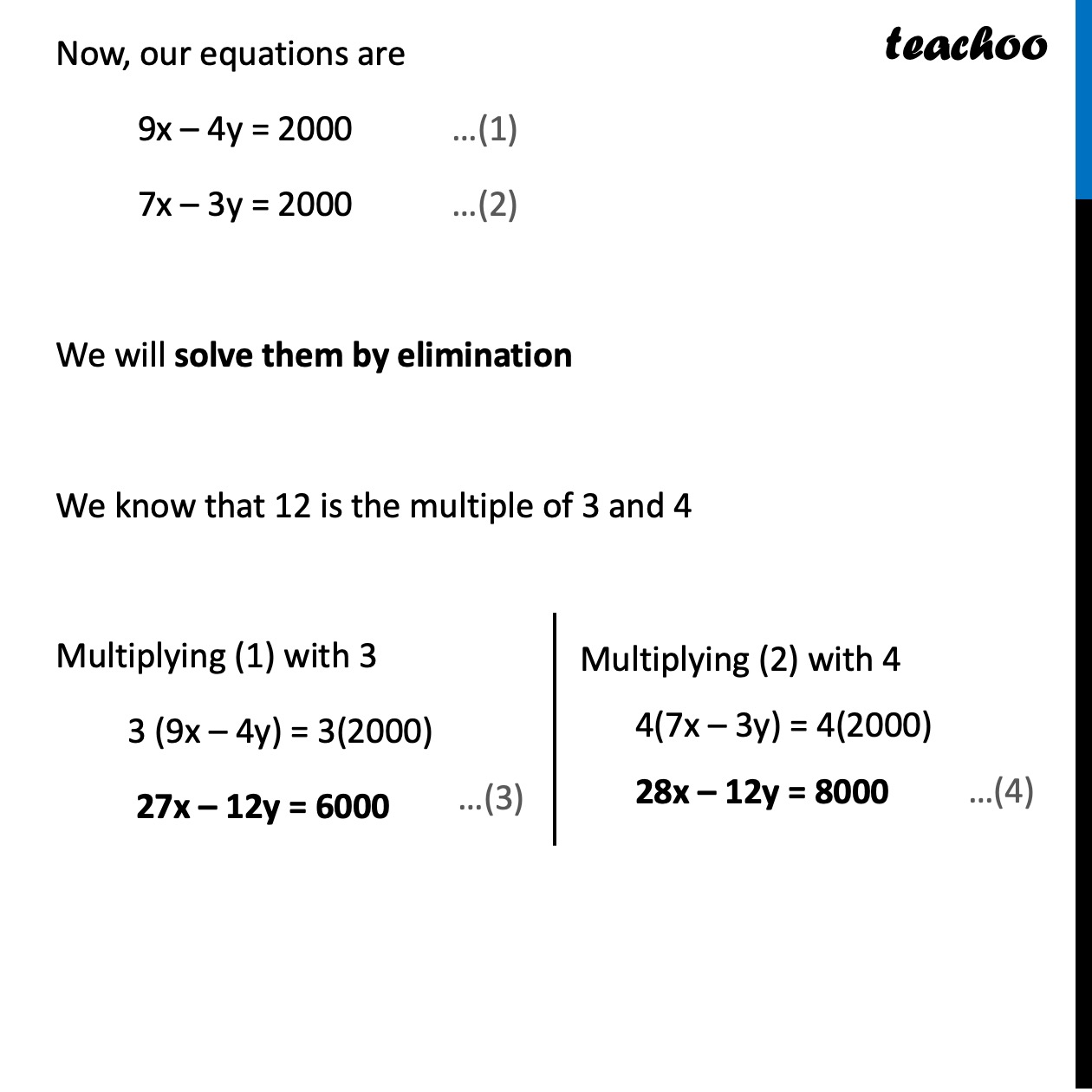
Example 9: Now, our equations are 9x – 4y = 2000 …(1) 7x – 3y = 2000 …(2) We will solve them by elimination We know that 12 is the multiple of 3 and 4 …(3) Multiplying (1) with 3 3 (9x – 4y) = 3(2000) 27x – 12y = 6000 Multiplying (2)…

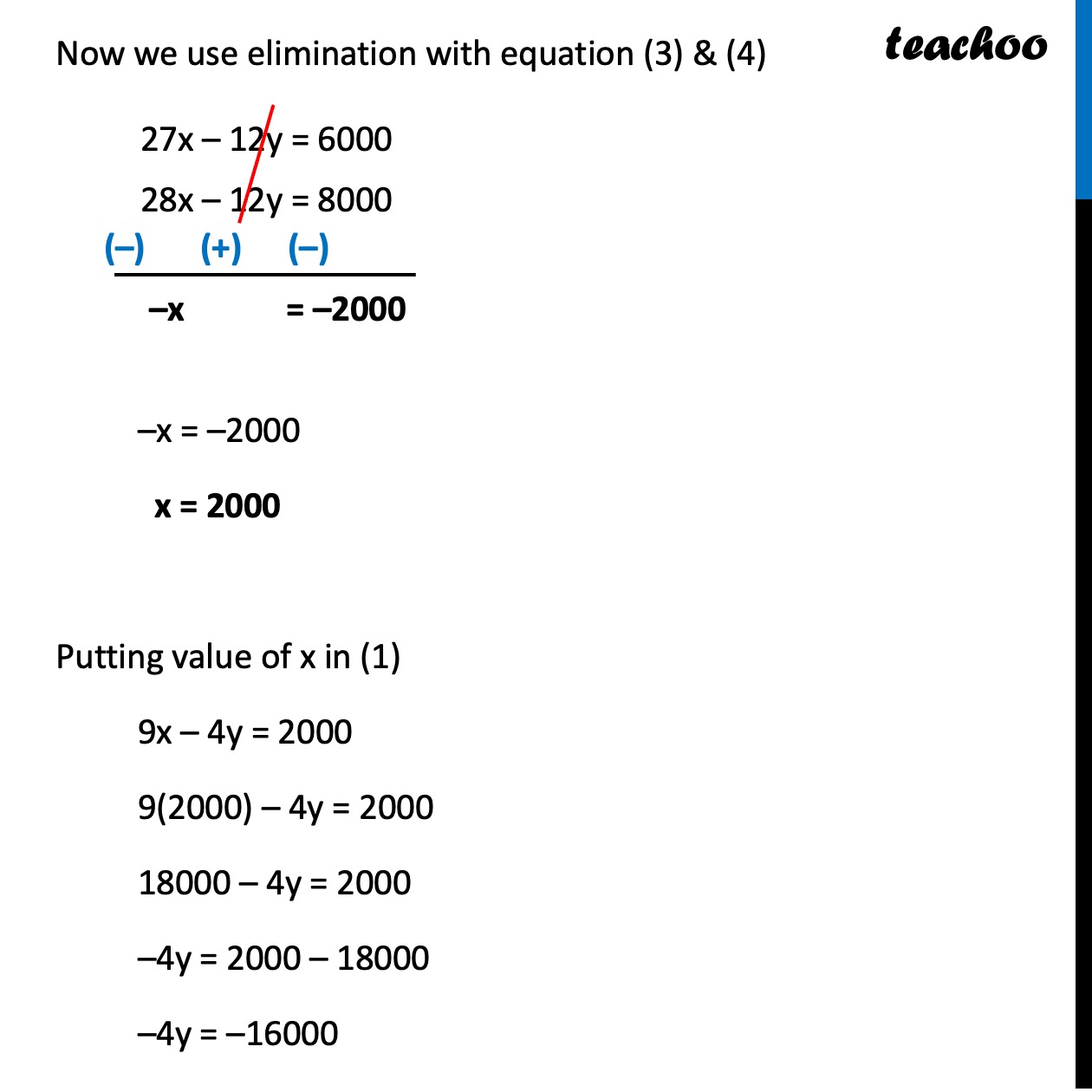
Example 9: Now we use elimination with equation (3) & (4) –x = –2000 x = 2000 Putting value of x in (1) 9x – 4y = 2000 9(2000) – 4y = 2000 18000 – 4y = 2000 –4y = 2000 – 18000 –4y = –16000 27x – 12y = 6000 28x – 12y = 8000 (–) (+) –x =…

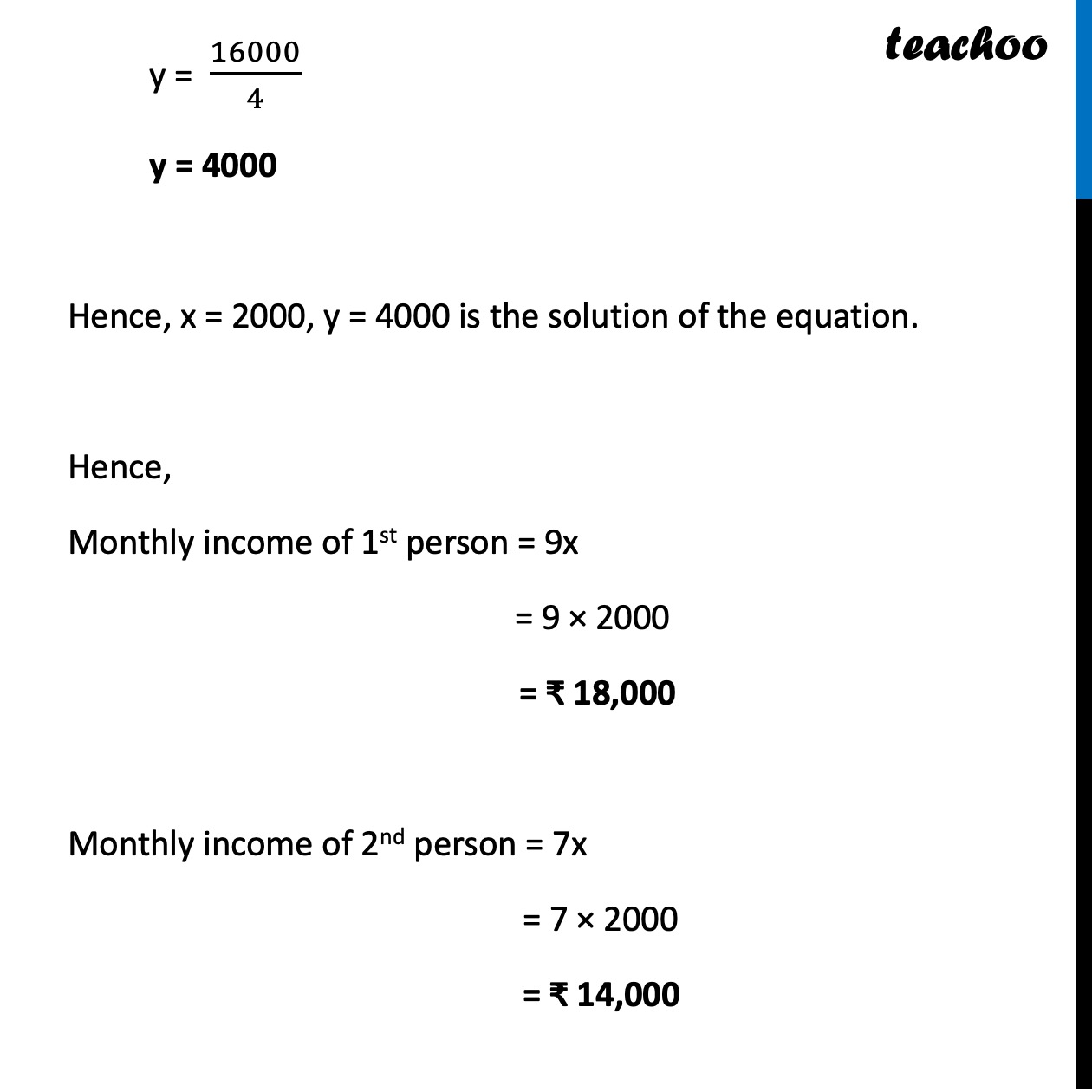
Example 9: y = (16000)/(4) y = 4000 Hence, x = 2000, y = 4000 is the solution of the equation. Hence, Monthly income of 1^(st) person = 9x = 9 × 2000 = ₹ 18,000 Monthly income of 2^(nd) person = 7x = 7 × 2000 = ₹ 14,000

Remove Ads
Teachoo · Class 9 Explore Class 9

Transcript

Example 9 The ratio of incomes of two persons is 9 : 7 and the ratio of their expenditures is 4 : 3. If each of them manages to save ₹2000 per month, find their monthly incomes. Given that Ratio of income of two persons is 9 : 7 Let Income of 1^(st) person be 9x & Income for 2^(nd) person be 7x Similarly, Ratio of expenditures of two persons is 4 : 3 Let Expenditure of 1^(st) person be 4y & Expenditure of 2^(nd) person be 3y Now, Both save ₹ 2000 per month We know that, Income – Expenditure = Savings For 1^(st) person 9x – 4y = 2000 | Income | Expenditure | Savings 1^(st) person | | | 2^(nd) person | | | 9x 7x 4y 3y ₹ 2000 ₹ 2000 …(2) …(1) Similarly for 2^(nd) person 7x – 3y = 2000 Now, our equations are 9x – 4y = 2000 …(1) 7x – 3y = 2000 …(2) We will solve them by elimination We know that 12 is the multiple of 3 and 4 …(3) Multiplying (1) with 3 3 (9x – 4y) = 3(2000) 27x – 12y = 6000 Multiplying (2) with 4 4(7x – 3y) = 4(2000) 28x – 12y = 8000 …(4) Now we use elimination with equation (3) & (4) –x = –2000 x = 2000 Putting value of x in (1) 9x – 4y = 2000 9(2000) – 4y = 2000 18000 – 4y = 2000 –4y = 2000 – 18000 –4y = –16000 27x – 12y = 6000 28x – 12y = 8000 (–) (+) (–) –x = –2000 y = (16000)/(4) y = 4000 Hence, x = 2000, y = 4000 is the solution of the equation. Hence, Monthly income of 1^(st) person = 9x = 9 × 2000 = ₹ 18,000 Monthly income of 2^(nd) person = 7x = 7 × 2000 = ₹ 14,000

CA Maninder Singh's photo - Co-founder, Teachoo

Made by

CA Maninder Singh

CA Maninder Singh is a Chartered Accountant qualified since 2010 and an educator teaching since 2006. At Teachoo, he draws on his accounting and tax experience to explain Accounts, Income Tax and GST through step-by-step lessons and practical examples.

For an uninterrupted learning experience, students can use Teachoo Black to remove ads and focus better.