You are here
Exercise Set 13.2
Last updated at November 22, 2026 by Teachoo
Transcript
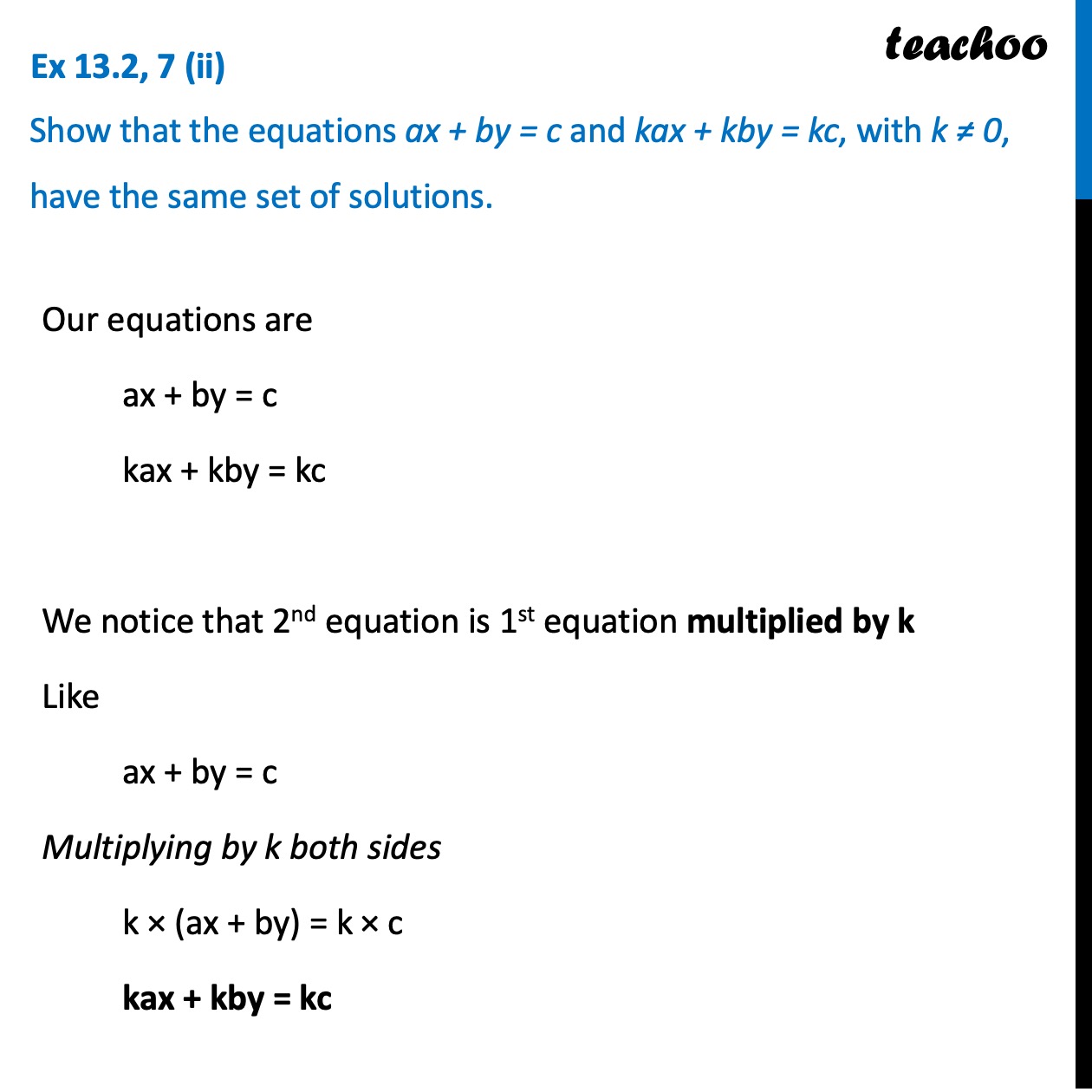
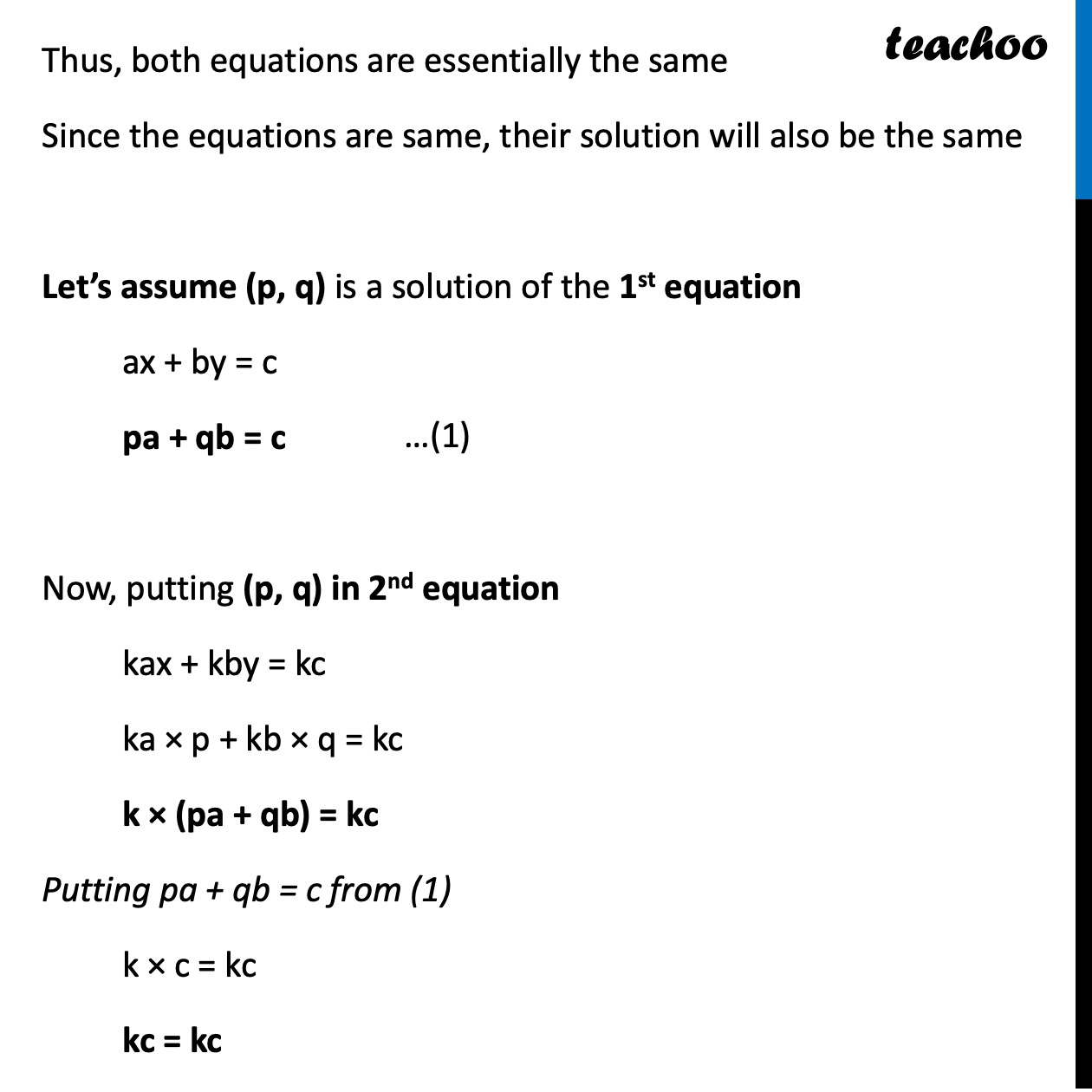
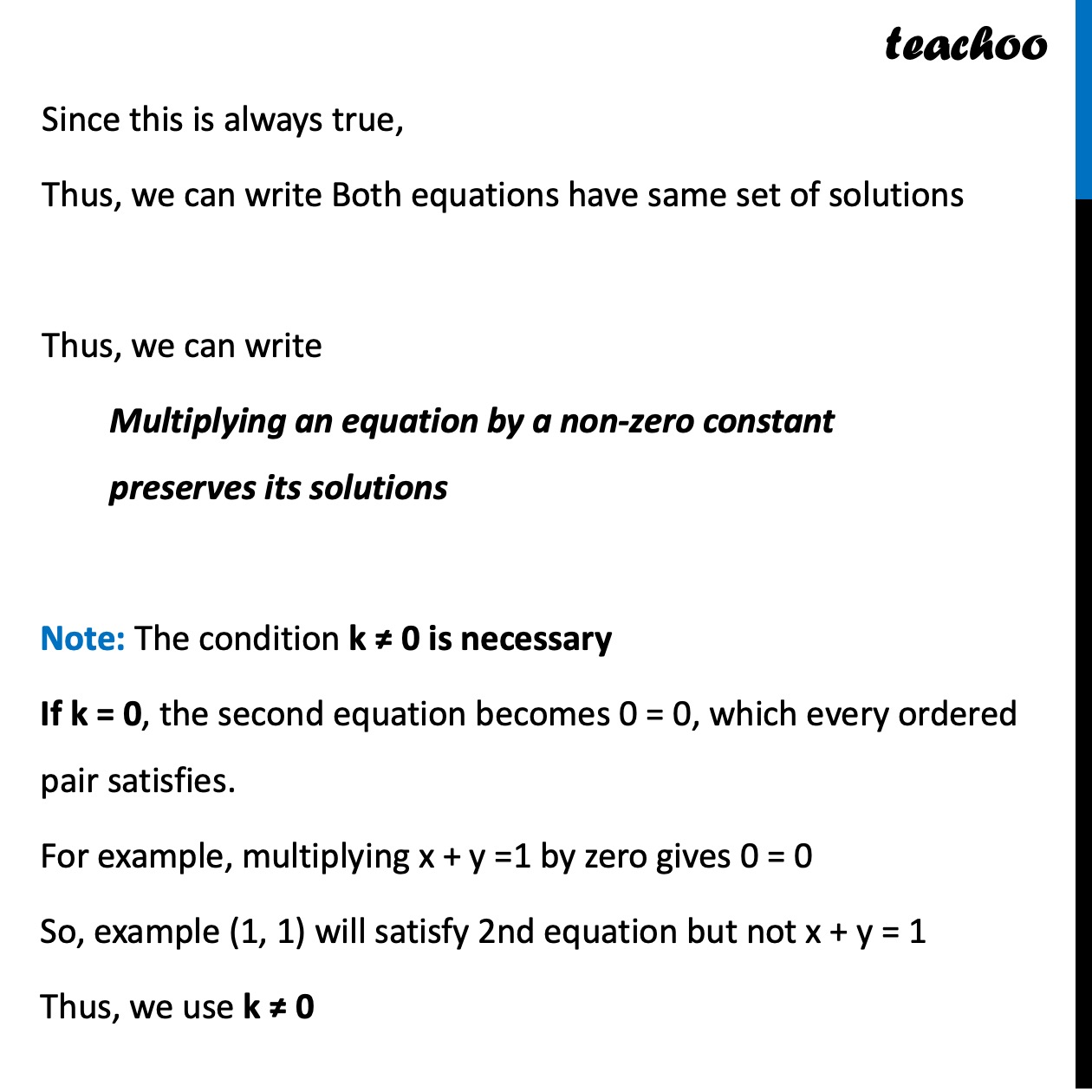
Ex 13.2, 7 (ii) Show that the equations ax + by = c and kax + kby = kc, with k ≠ 0, have the same set of solutions. Our equations are ax + by = c kax + kby = kc We notice that 2^(nd) equation is 1^(st) equation multiplied by k Like ax + by = c Multiplying by k both sides k × (ax + by) = k × c kax + kby = kc Thus, both equations are essentially the same Since the equations are same, their solution will also be the same Let’s assume (a, b) is a solution of the 1^(st) equation 3x + 4y = 7 3a + 4b = 7 Now, putting (a, b) in 2^(nd) equation 6x + 8y = 14 6a + 8b = 14 2 × (3a + 4b) = 14 Putting 3a + 4b = 7 from (1) 2 × 7 = 14 14 = 14 Since this is always true, Thus, we can write Both equations have same set of solutions Thus, both equations are essentially the same Since the equations are same, their solution will also be the same Let’s assume (p, q) is a solution of the 1^(st) equation ax + by = c pa + qb = c Now, putting (p, q) in 2^(nd) equation kax + kby = kc ka × p + kb × q = kc k × (pa + qb) = kc Putting pa + qb = c from (1) k × c = kc kc = kc …(1) Since this is always true, Thus, we can write Both equations have same set of solutions Thus, we can write Multiplying an equation by a non-zero constant preserves its solutions Note: The condition k ≠ 0 is necessary If k = 0, the second equation becomes 0 = 0, which every ordered pair satisfies. For example, multiplying x + y =1 by zero gives 0 = 0 So, example (1, 1) will satisfy 2nd equation but not x + y = 1 Thus, we use k ≠ 0