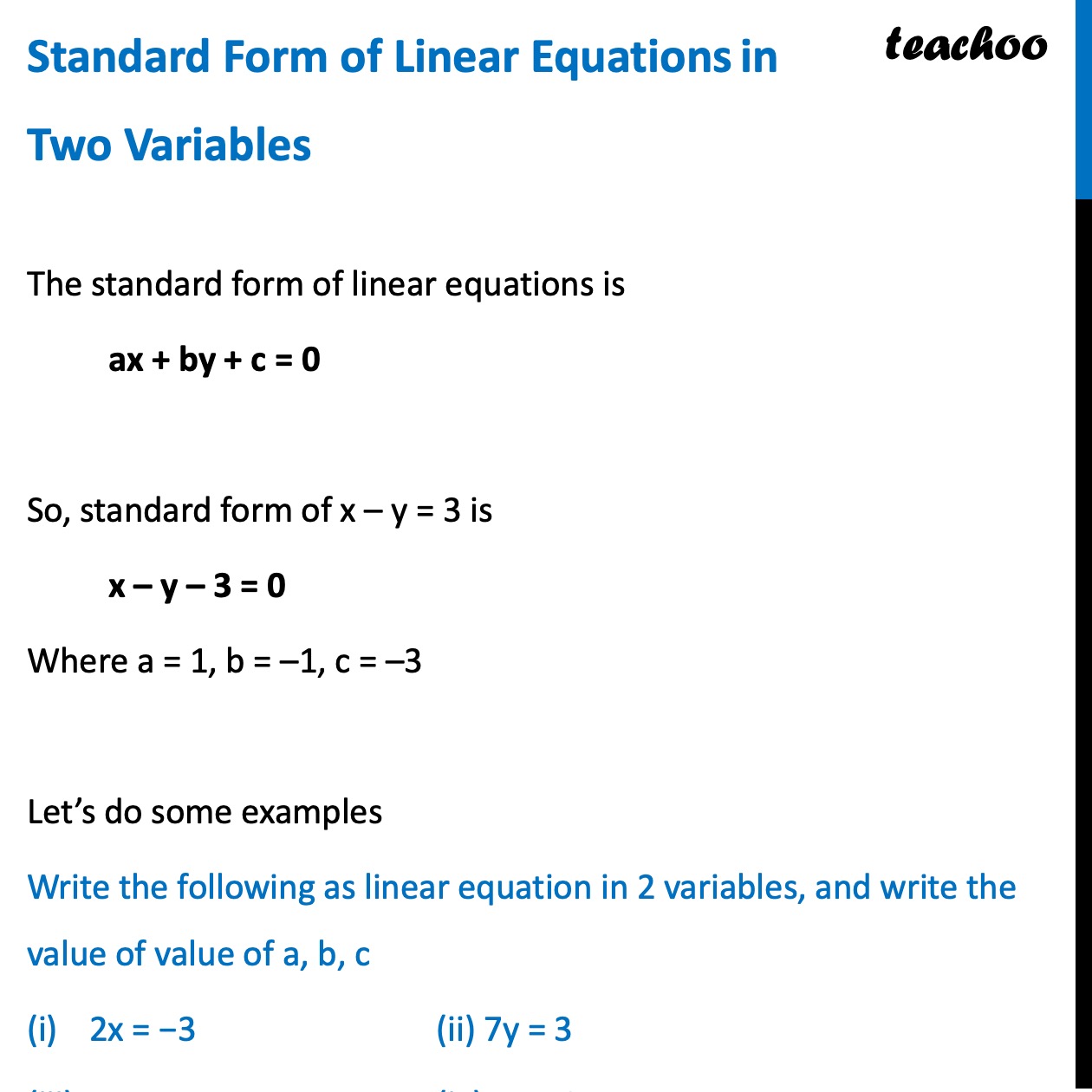
Standard Form of Linear Equations in Two Variables: Standard Form of Linear Equations in Two Variables The standard form of linear equations is ax + by + c = 0 So, standard form of x – y = 3 is x – y – 3 = 0 Where a = 1, b = –1, c = –3…

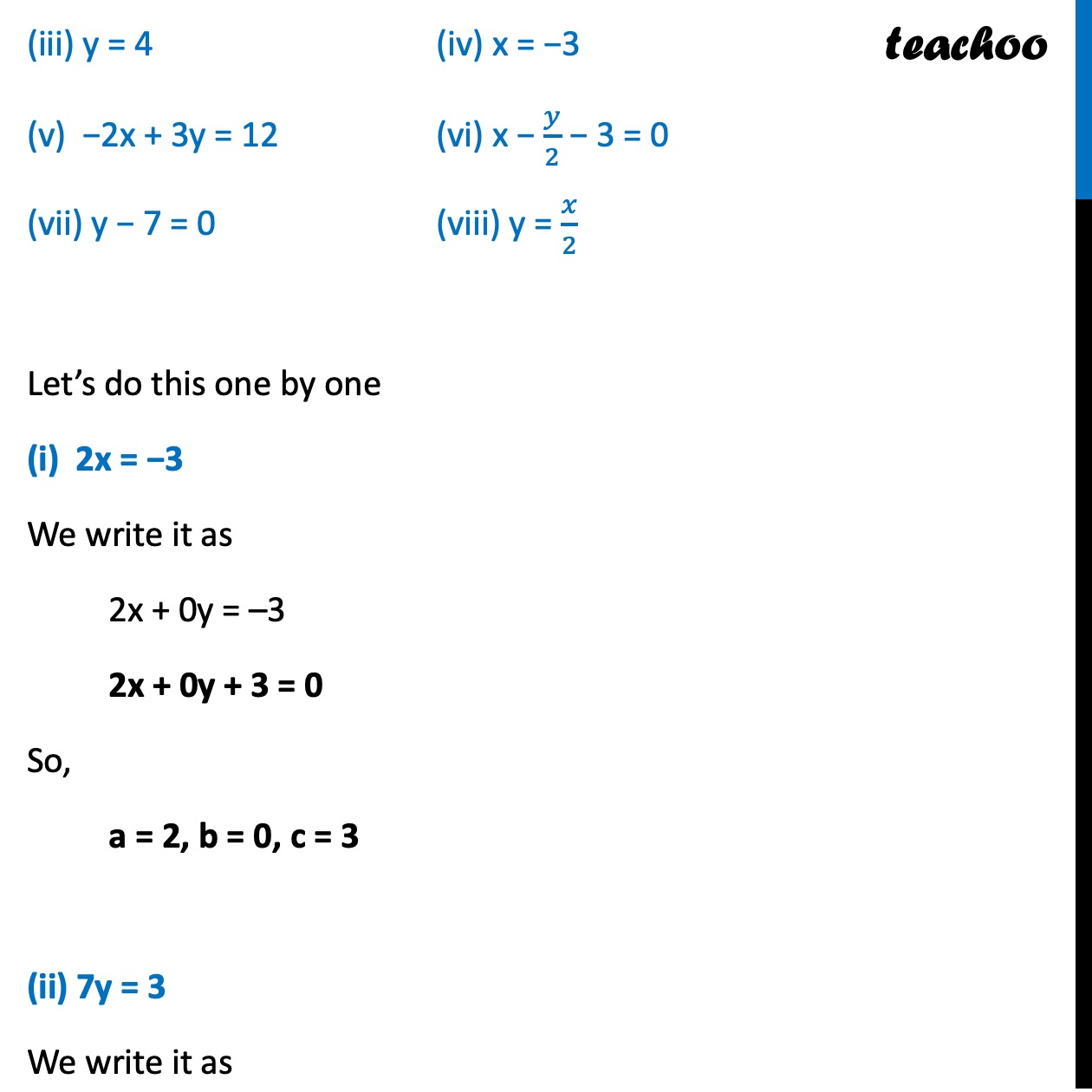
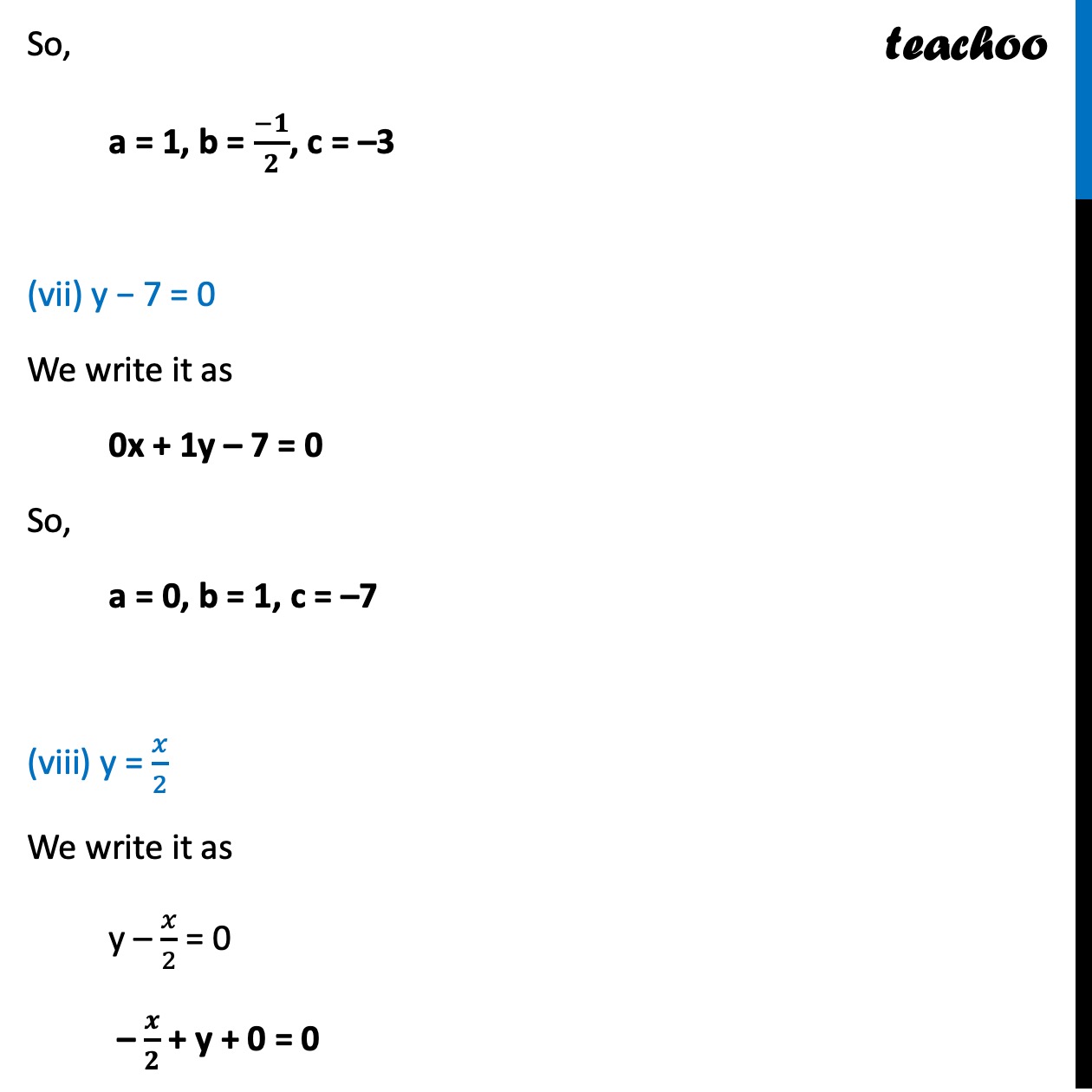
Standard Form of Linear Equations in Two Variables: (iii) y = 4 (iv) x = −3 (v) −2x + 3y = 12 (vi) x − (𝑦)/(2) − 3 = 0 (vii) y − 7 = 0 (viii) y = (𝑥)/(2) Let’s do this one by one (i) 2x = −3 We write it as 2x + 0y = –3 2x + 0y + 3 = 0…

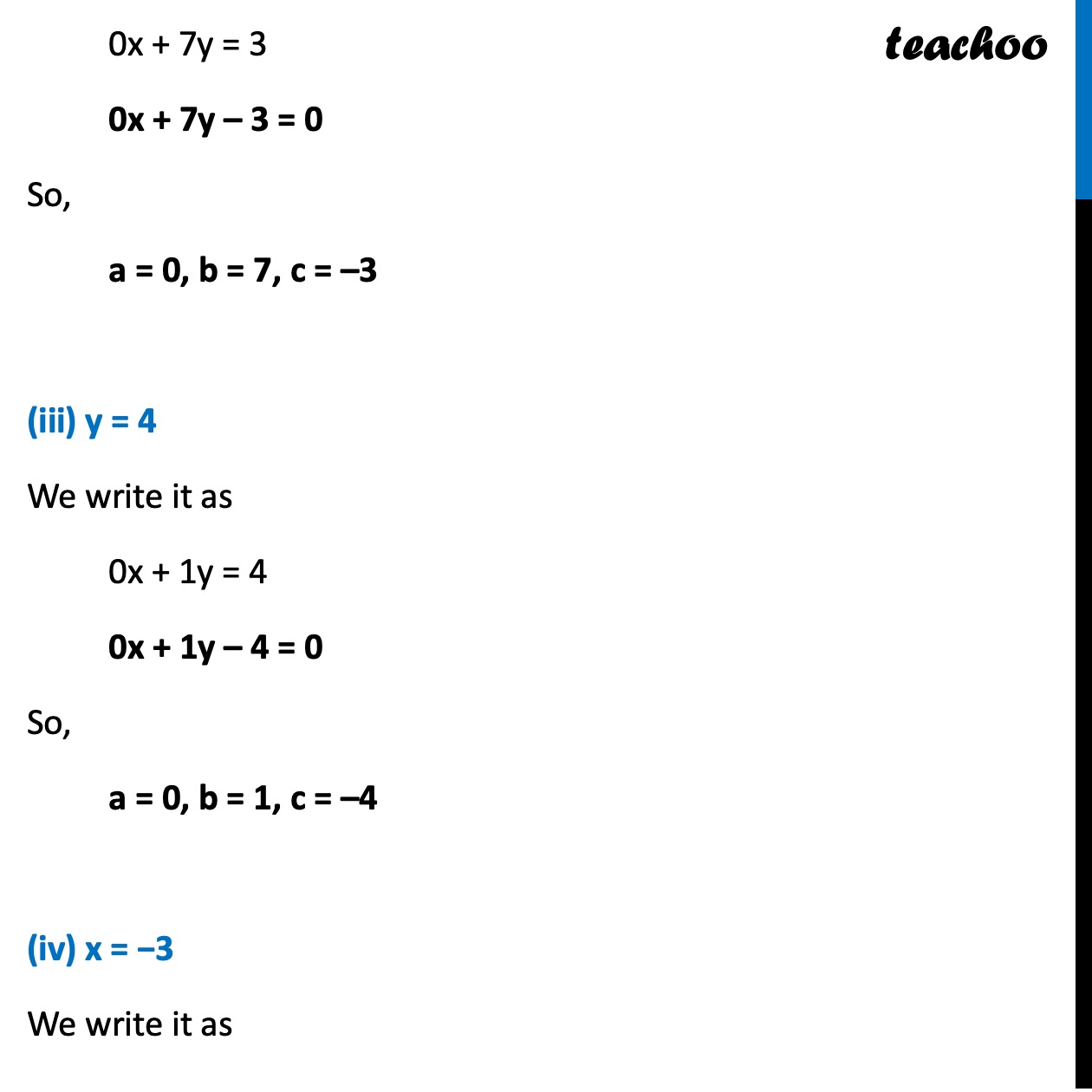
Standard Form of Linear Equations in Two Variables: 0x + 7y = 3 0x + 7y – 3 = 0 So, a = 0, b = 7, c = –3 (iii) y = 4 We write it as 0x + 1y = 4 0x + 1y – 4 = 0 a = 0, b = 1, c = –4 (iv) x = −3

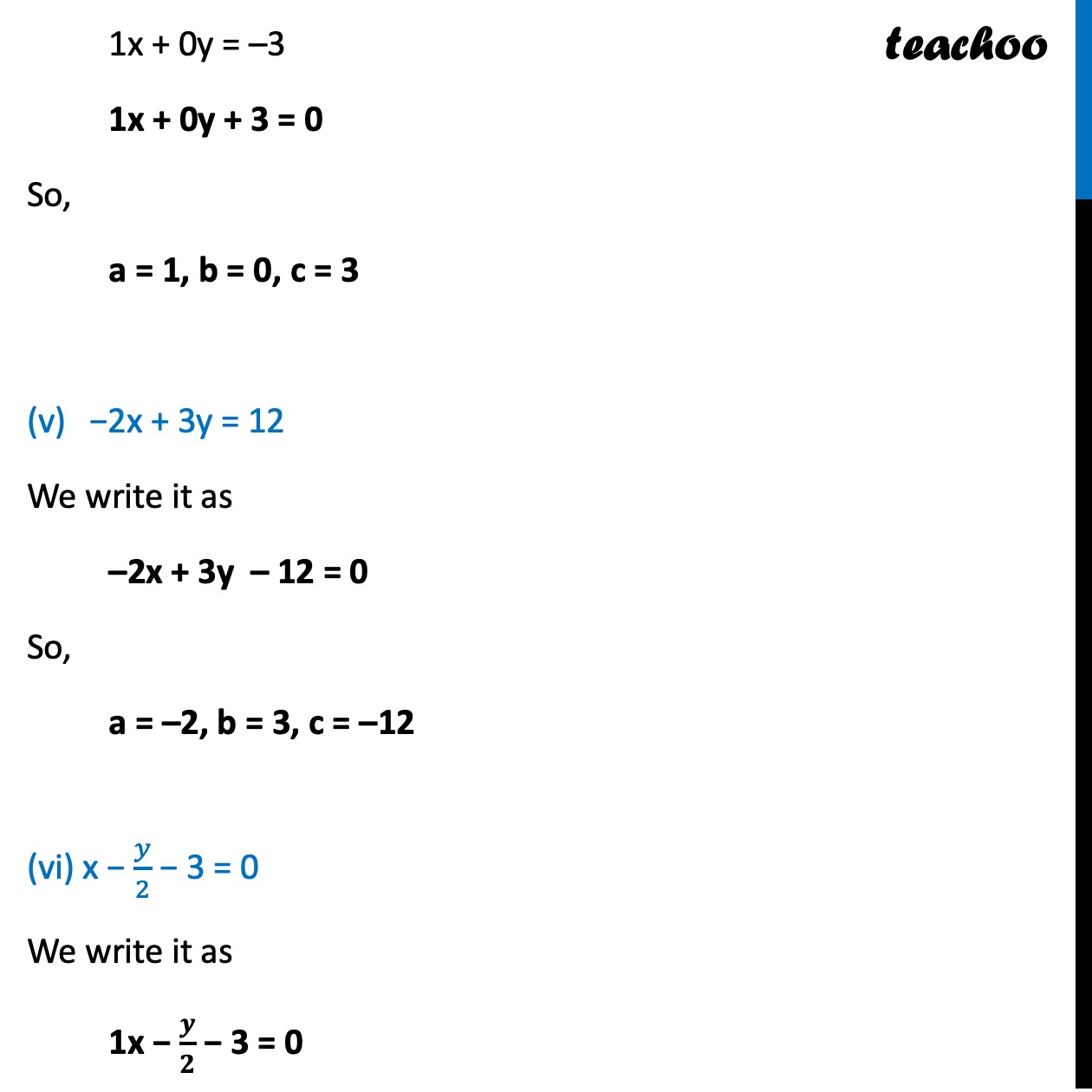
Standard Form of Linear Equations in Two Variables: 1x + 0y = –3 1x + 0y + 3 = 0 So, a = 1, b = 0, c = 3 −2x + 3y = 12 We write it as –2x + 3y – 12 = 0 a = –2, b = 3, c = –12 (vi) x − (𝑦)/(2) − 3 = 0 1x − (𝒚)/(𝟐) − 3 = 0

Standard Form of Linear Equations in Two Variables: So, a = 1, b = (−𝟏)/(𝟐), c = –3 (vii) y − 7 = 0 We write it as 0x + 1y – 7 = 0 a = 0, b = 1, c = –7 (viii) y = (𝑥)/(2) y – (𝑥)/(2) = 0 – (𝒙)/(𝟐) + y + 0 = 0

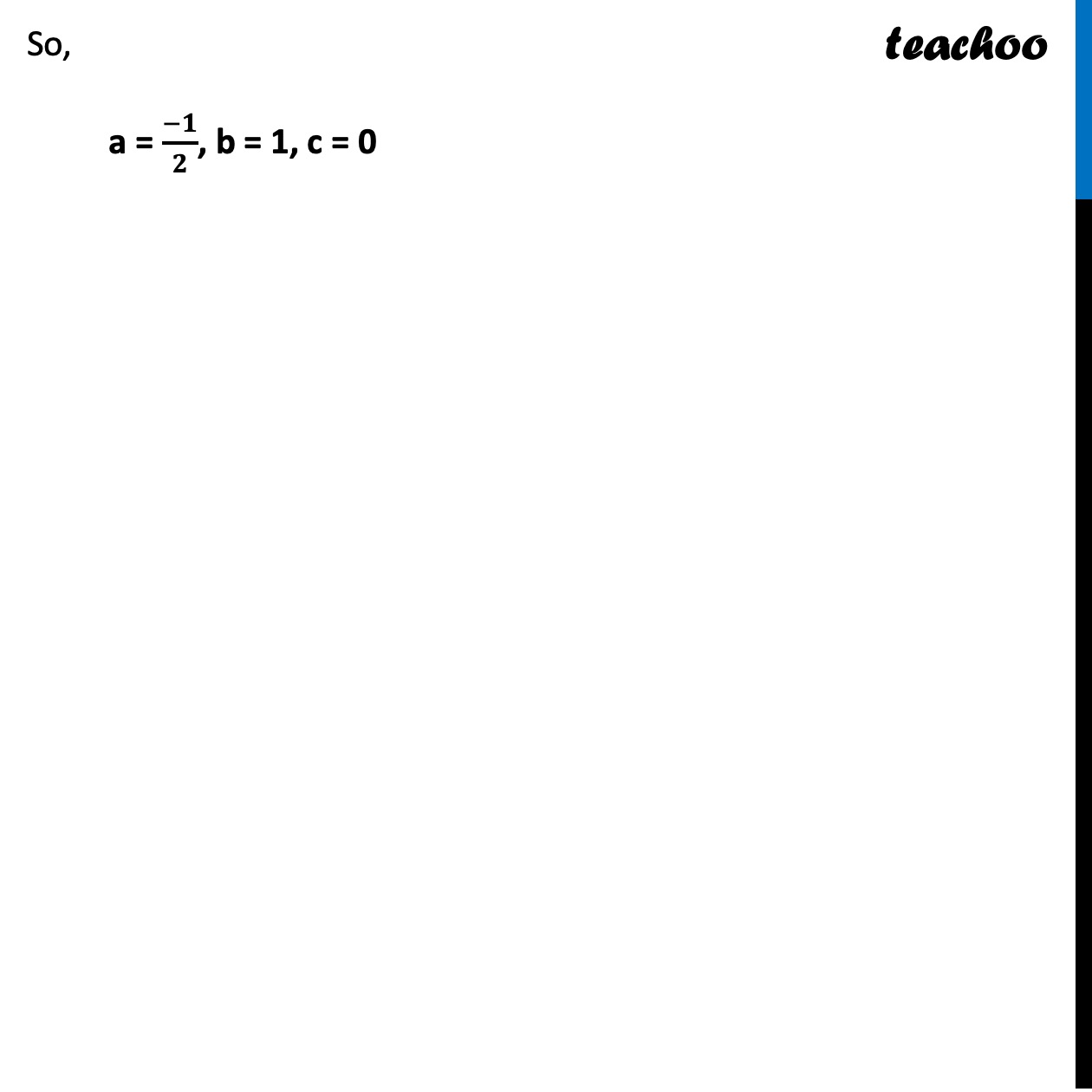
Standard Form of Linear Equations in Two Variables: So, a = (−𝟏)/(𝟐), b = 1, c = 0

Remove Ads
Teachoo · Class 9 Explore Class 9

Transcript

Standard Form of Linear Equations in Two Variables The standard form of linear equations is ax + by + c = 0 So, standard form of x – y = 3 is x – y – 3 = 0 Where a = 1, b = –1, c = –3 Let’s do some examples Write the following as linear equation in 2 variables, and write the value of value of a, b, c 2x = −3 (ii) 7y = 3 (iii) y = 4 (iv) x = −3 (v) −2x + 3y = 12 (vi) x − (𝑦)/(2) − 3 = 0 (vii) y − 7 = 0 (viii) y = (𝑥)/(2) (iii) y = 4 (iv) x = −3 (v) −2x + 3y = 12 (vi) x − (𝑦)/(2) − 3 = 0 (vii) y − 7 = 0 (viii) y = (𝑥)/(2) Let’s do this one by one (i) 2x = −3 We write it as 2x + 0y = –3 2x + 0y + 3 = 0 So, a = 2, b = 0, c = 3 (ii) 7y = 3 We write it as 0x + 7y = 3 0x + 7y – 3 = 0 So, a = 0, b = 7, c = –3 (iii) y = 4 We write it as 0x + 1y = 4 0x + 1y – 4 = 0 So, a = 0, b = 1, c = –4 (iv) x = −3 We write it as 1x + 0y = –3 1x + 0y + 3 = 0 So, a = 1, b = 0, c = 3 −2x + 3y = 12 We write it as –2x + 3y – 12 = 0 So, a = –2, b = 3, c = –12 (vi) x − (𝑦)/(2) − 3 = 0 We write it as 1x − (𝒚)/(𝟐) − 3 = 0 So, a = 1, b = (−𝟏)/(𝟐), c = –3 (vii) y − 7 = 0 We write it as 0x + 1y – 7 = 0 So, a = 0, b = 1, c = –7 (viii) y = (𝑥)/(2) We write it as y – (𝑥)/(2) = 0 – (𝒙)/(𝟐) + y + 0 = 0 So, a = (−𝟏)/(𝟐), b = 1, c = 0

CA Maninder Singh's photo - Co-founder, Teachoo

Made by

CA Maninder Singh

CA Maninder Singh is a Chartered Accountant qualified since 2010 and an educator teaching since 2006. At Teachoo, he draws on his accounting and tax experience to explain Accounts, Income Tax and GST through step-by-step lessons and practical examples.

For an uninterrupted learning experience, students can use Teachoo Black to remove ads and focus better.