
 You are here
-
📝 Revise, Reflect, Refine Q12
In the lower Himalayan region of northern India, apples are an important cash crop that contribute significantly to farmer’s livelihoods. The fruit yield in apple cultivation is declining continuously, associated with climate change and a significant decline in the population of natural pollinators. A researcher-farmer group set up two experimental apple orchards at two distinct locations: Places A and B. In apple orchards at Place A, they allowed natural pollinators to pollinate the flowers of the apple. In apple orchards at Place B, they applied mixed farming techniques of beekeeping. Along with honey, the farmer yielded apples. The yield of apples is depicted in Figure below, in terms of fruit setting (number of fruits/the total number of corresponding fruit-bearing branches) and fruit drop (premature falling of developing fruits) in the two types of experimental places of apple orchards.
(i) What are the hypotheses the researcher-farmer group has thought of for this investigation?(ii) What are the different parameters in the experiment?(iii) Compare and analyse the data of the two orchards in terms of high yields of apple fruits.(iv) Based on your analysis, what do you infer from the data?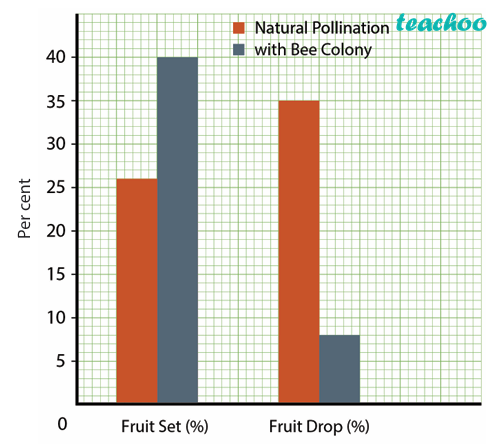
View answer
Answer(i) What are the hypotheses the researcher-farmer group has thought of for this investigation?- Adding bee colonies (more pollinators) will increase fruit set in apple trees.
- More pollination will reduce fruit drop .
- So, beekeeping can increase apple yield where natural pollinators have declined .
(ii) What are the different parameters in the experiment?- What is changed: the type of pollination (natural pollinators only, or with bee colonies).
- What is measured: fruit set and fruit drop .
- What should be kept the same: the apple variety , age of the trees , soil , water , fertiliser and weather in both places.
(iii) Compare and analyse the data of the two orchards in terms of high yields of apple fruits.Place A: Natural pollination Place B: With bee colony Fruit set (fruits formed per fruit-bearing branch) About 26% About 40% Fruit drop (young fruits falling early) About 35% About 8% - Fruit set is higher at Place B ( about 40% ) than at Place A ( about 26% ).
- Fruit drop is much lower at Place B ( about 8% ) than at Place A ( about 35% ).
- So, more fruits form and fewer fall at Place B. Place B gives a much higher yield of apples.
(iv) Based on your analysis, what do you infer from the data?- Bees improve pollination of apple flowers.
- Better pollination gives more fruits and less fruit drop .
- So, beekeeping is a good way to increase apple yield when natural pollinators are declining . The farmer also gets honey .
Q12: In the lower Himalayan region, apple yield
Last updated at November 6, 2026 by Teachoo
